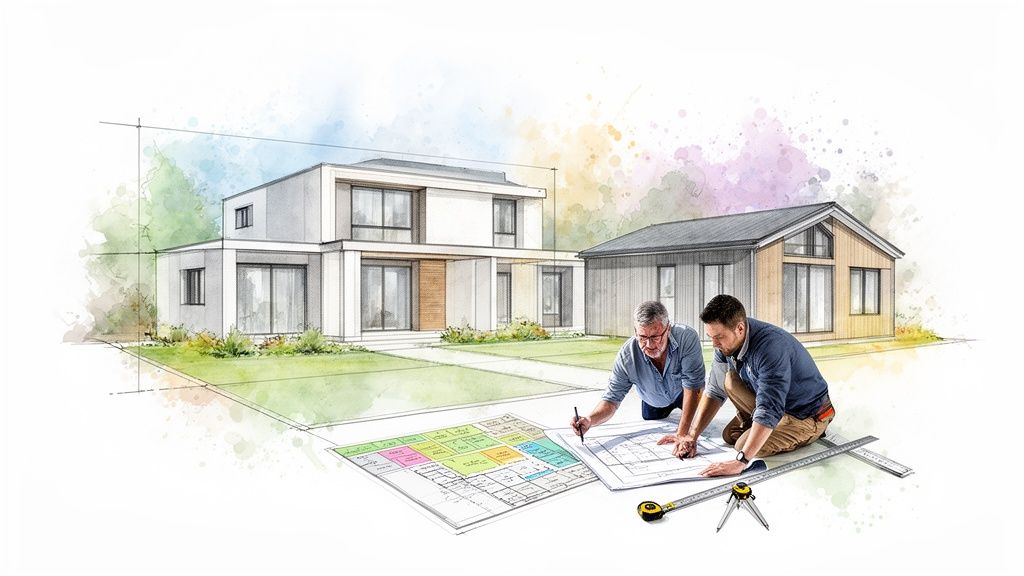

Let's cut right to the chase: yes, you absolutely need permits to build an ADU in Monterey County. It doesn’t matter if it’s a brand-new detached cottage, a simple garage conversion, or a small prefab unit. The entire process requires official oversight to ensure your ADU is safe, legal, and compliant.
Many homeowners hear that California has "streamlined" ADU laws and assume that means they can skip the permit office. That’s a common and very expensive mistake.
Why Permits Are Non-Negotiable For ADUs

While state laws made the approval process faster, they never eliminated the fundamental need for permits. Think of permits as the quality control system verifying your project meets critical safety standards for fire, structural integrity, and electrical wiring.
Building without permits is a huge gamble. It can lead to stop-work orders, hefty fines, and, in the worst-case scenario, being forced to tear the whole structure down.
Multiple Layers of Approval
An ADU project isn't just one permit; it’s a bundle of them. Each one serves a specific purpose, and the exact mix you'll need depends on your property's location and what you plan to build.
For instance, if your property is in the Coastal Zone, you'll need a Coastal Administrative Permit on top of your standard building permit. Forgetting one piece of the puzzle can bring the whole project to a halt.
Monterey County ADU Permit Requirements at a Glance
To make this clearer, let's break down the most common permits you'll encounter. Knowing what they are and why they're needed helps demystify the process.
Here's a quick summary of what's involved in most ADU projects in our area.
| Permit Type | Primary Purpose | When It's Typically Required |
|---|---|---|
| Building Permit | Ensures structural safety, fire resistance, and compliance with electrical and plumbing codes. | Required for all ADU construction, including new builds, conversions, and JADUs. |
| Planning/Zoning Permit | Verifies the project meets local land-use rules for setbacks, height, and lot coverage. | Often required, especially for new detached ADUs or properties in special zoning areas. |
| Utility Permits | Governs new connections or upgrades for water, sewer, septic, and electrical services. | Needed when an ADU requires new utility connections or a septic system capacity check. |
| Coastal Development Permit | Protects coastal resources, public access, and scenic views in designated coastal zones. | Mandatory for any ADU project located within the Monterey County Coastal Zone. |
A contractor familiar with local jurisdictions can help you navigate this. If you want to dig deeper into what’s possible on your property, check out our Monterey County guide to what you can build.
Why 'Streamlined' ADU Laws Still Mean Local Permits
You’ve probably heard that California made it “easier” to build an ADU. This messaging often leaves Monterey County homeowners confused when they still face a complex permit process.
The state’s goal was to stop cities and counties from using unreasonable local rules to kill ADU projects. It wasn't about eliminating permits altogether.
The Highway Analogy for ADU Permitting
Think of it like this: the state built a direct, predictable highway for ADU approvals. But Monterey County still manages the on-ramps and performs safety inspections for every car getting on that highway.
The path is clearer, but it’s not a free-for-all to build without oversight.
And it worked. After the new laws passed, ADU permits in California shot up from 5,911 in 2018 to 15,571 in 2019. That's a nearly 164 percent jump in one year, proving that removing arbitrary roadblocks encourages new housing. You can dig into the data in a report from the Terner Center for Housing Innovation at UC Berkeley.
What 'Streamlined' Actually Means for Homeowners
For a homeowner in Monterey County, "streamlined" means a clearer set of rules and a predictable timeline.
Here’s what that actually looks like:
- Ministerial Approval: If your ADU plans meet objective local standards, they are supposed to be approved administratively. No more subjective public hearings where a neighbor’s opinion could derail your project.
- The 60-Day Shot Clock: Once you submit a complete permit application, your local jurisdiction has 60 days to approve or deny it. This stops your plans from sitting on a desk for months on end.
- Fewer Roadblocks: State law now blocks local agencies from imposing certain restrictions, like minimum lot sizes or replacement parking for garage conversions.
Key Takeaway: The streamlined process makes ADU approval predictable and timely. It forces places like Monterey County to play by a clear rulebook, but it doesn’t remove their job of reviewing your plans for safety and code compliance.
Ultimately, these changes mean your ADU is far more likely to get approved if you do your homework. The biggest mistake is thinking "streamlined" means "permit-free." Professional planning is still the key.
Understanding the Different Types of ADU Permits
When a homeowner asks, "Do I need a permit for an ADU in Monterey County?" they’re usually thinking of one single piece of paper. The reality is more involved.
Getting an ADU project off the ground means coordinating these different permits. This is a series of checks and balances to make sure your new unit is safe and compliant.
Building Permits: The Foundation of Safety
First up is the big one: the building permit. This is all about the structure itself. It's the county's way of verifying that your plans meet the California Building Code.
A solid building permit application usually includes:
- Structural Plans: Blueprints showing how the ADU will be built to handle weight and seismic activity.
- Electrical Plans: A map of all wiring, outlets, and lights to prevent fire hazards.
- Plumbing and Mechanical Plans: The layout for water lines, drains, and ventilation.
The county's plan checkers review these documents to ensure every detail meets safety standards before construction begins.
This flowchart shows how state laws have helped clear a path for ADUs, but the local permit review is still the critical checkpoint.
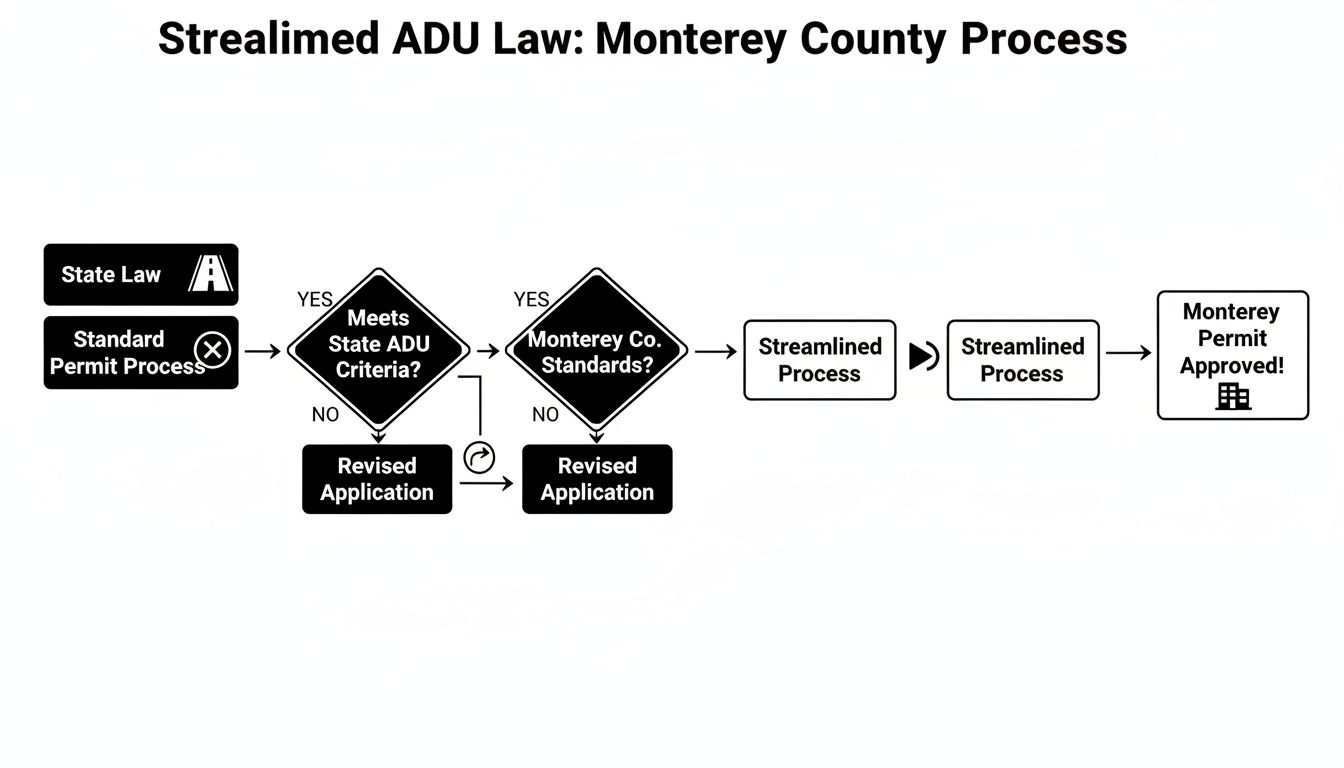
The takeaway is simple: even with state laws making it easier, the final green light comes from a Monterey County permit.
Planning and Zoning Permits: Making Sure It Fits
While the building permit cares about how the ADU is built, the planning and zoning permit cares about where it’s built. This permit confirms your project plays by local land use rules.
Planners will check your project against regulations for things like:
- Setbacks: How far your ADU must be from your property lines.
- Height Limits: The maximum height allowed in your neighborhood.
- Lot Coverage: The total percentage of your lot that can be covered by structures.
This is where having a contractor who knows the local Monterey County playbook pays off. They can help you design an ADU that checks all the boxes from day one.
A Quick Note on JADUs and Conversions: Yes, even Junior Accessory Dwelling Units (JADUs) and garage conversions need permits. The rules might differ, but the goal is the same: to legally and safely create a proper home.
Special Case Permits: Coastal and Environmental Approvals
Monterey County's coastline adds another potential layer to the permitting process. The most common is the Coastal Development Permit (CDP). If your property is inside the designated Coastal Zone, you'll need a CDP.
This review focuses on protecting our coastline, public beach access, and ocean views. It can add time and specific design requirements to your project. Other special permits might pop up, like a grading permit for properties on a steep hill. To learn more about our process, visit our page on home additions and ADUs.
Common ADU Project Permit Checklist for Monterey County
Here’s a quick look at which permits are typically needed for common ADU projects. This isn't an exhaustive list, but it covers the main items.
| Permit / Requirement | New Detached ADU | Garage Conversion ADU | JADU (within existing home) |
|---|---|---|---|
| Building Permit | ✅ Yes | ✅ Yes | ✅ Yes |
| Electrical Permit | ✅ Yes | ✅ Yes | ✅ Yes |
| Plumbing Permit | ✅ Yes | ✅ Yes | ✅ Yes (if adding fixtures) |
| Planning/Zoning Permit | ✅ Yes | ✅ Yes | ✅ Yes (owner-occupancy deed restriction) |
| Grading Permit | Maybe | Unlikely | No |
| Coastal Development Permit (CDP) | If in Coastal Zone | If in Coastal Zone | If in Coastal Zone |
| Water/Sewer Connection Permit | ✅ Yes | Maybe (if no new fixtures) | Unlikely |
| Health Dept. (Septic) Review | If on septic | If on septic | If on septic |
The key is to identify all necessary permits upfront to build a realistic timeline and budget.
Local Factors That Complicate ADU Permits in Monterey County
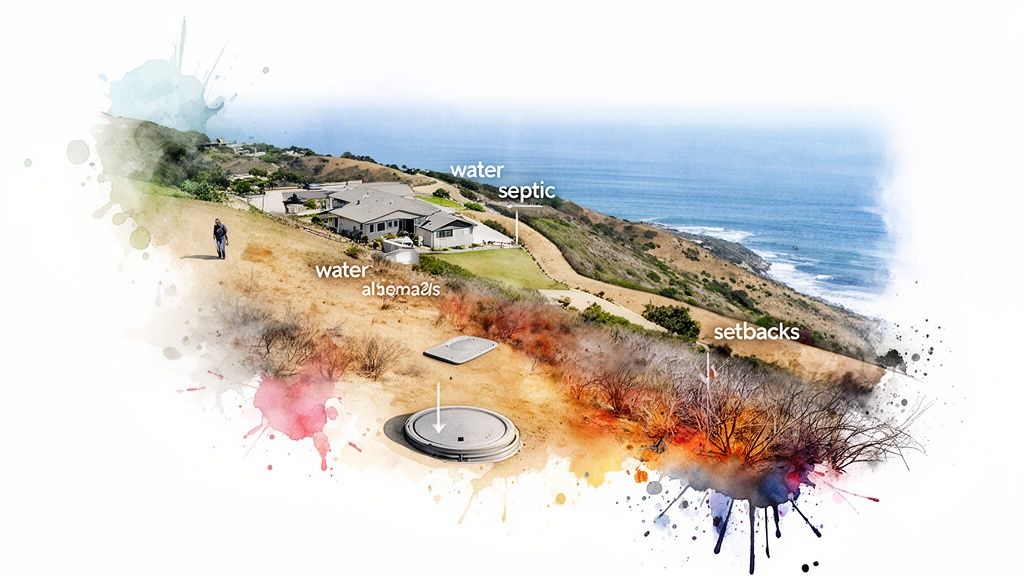
Getting the basic building and planning permits is just the start. Here in Monterey County, our unique mix of coastal geography and overlapping jurisdictions adds extra layers of review that can catch homeowners off guard.
A common misstep is thinking that simplified state ADU laws wipe away all local rules. They don’t.
Unincorporated County vs. Incorporated Cities
First, who has jurisdiction over your property? If you're in an unincorporated area, you’ll work directly with Monterey County.
If your home is inside an incorporated city—like Carmel-by-the-Sea, Pacific Grove, Monterey, or Salinas—you'll deal with that city’s specific planning department. Each has its own ordinances and review processes.
Water Availability and Septic System Capacity
In our region, water is a major consideration. For many properties, securing a "water credit" or proving you have an adequate supply is a hurdle that must be cleared early.
If your property relies on a septic system, you'll need approval from the Monterey County Health Department. They require an evaluation to prove your existing system can handle the extra load from an ADU.
High Fire Hazard Zones and Coastal Overlays
Many areas in Monterey County are designated as Very High Fire Hazard Severity Zones (VHFHSZ). Building an ADU here means you must follow strict fire-hardening building codes for materials like roofing, siding, and vents.
If your property is within the Coastal Zone, you’ll need a Coastal Development Permit (CDP). This triggers another level of review focused on protecting coastal resources and viewsheds.
Regional data shows that ADUs represent 19% to 22% of new housing permits in major coastal metro areas, highlighting how crucial it is to navigate local specifics like those in Monterey County. Discover more insights about California's ADU reforms.
Other Common Local Roadblocks
A few other site-specific issues can pop up, requiring more reports and permits:
- Hillside Properties: Lots with steep slopes almost always require a grading permit and a detailed geotechnical (soils) report.
- Erosion Control: If you're near the coast or a waterway, you'll likely need a specific erosion control plan.
- Historic Districts: Building in a historic district means your ADU will face a tough design review to fit the neighborhood's character.
Catching these potential snags early is the key to a smooth project. For more guidance on navigating these projects, you can explore our resources on ADUs and home additions.
Your First Step: A Professional Feasibility Review
Before spending a dollar on design, your first move should be a professional feasibility review. This upfront investigation replaces assumptions with facts, preventing expensive, project-killing surprises down the road.
The goal is to answer one question: "What is actually possible on my property?"
Many homeowners assume a prefab ADU avoids local regulations, only to discover delays, redesigns, or stop-work orders later. A feasibility review provides a clear, realistic roadmap based on facts.
What a Feasibility Review Actually Covers
A proper feasibility review is a deep dive into your property's specific conditions and limitations.
Here’s what that methodical check looks like:
- Zoning and Land Use Check: We confirm an ADU is allowed and identify special restrictions, like a historic district or high fire hazard area.
- Site and Setback Analysis: We verify your actual buildable area by checking setbacks from property lines and other structures.
- Utility and Water Assessment: We assess your existing water, sewer or septic, and electrical systems to confirm they can handle another dwelling. This is where we catch the need for water credits or a septic upgrade.
- Special Local Requirements: We check for Monterey County-specific rules, such as Coastal Zone requirements or the need for a grading permit.
The Goal of a Feasibility Review: To create a clear roadmap for your ADU. This ensures your design, budget, and timeline are all based on the real-world conditions of your property.
By front-loading this critical research, you can move into the design phase with confidence. An experienced contractor can guide you through this essential stage. To see how this fits into a larger project, you can learn more about our construction process.
How an Experienced Contractor Navigates the Permitting Maze
For a homeowner, the ADU permitting process can feel overwhelming. An experienced general contractor acts as your guide, turning what seems like chaos into a predictable series of steps.
This isn't about finding shortcuts. It's about knowing the system, speaking the language of plan checkers, and managing the project with professional precision.

A contractor who works in Monterey County knows what local jurisdictions expect. They can assemble a complete permit application package that’s right the first time, preventing the back-and-forth that kills timelines.
Managing the Review and Approval Process
Once the application is submitted, your contractor becomes the single point of contact for the city or county. They field technical questions, provide clarifications, and coordinate revisions.
An organized contractor handles the entire workflow:
- Coordinating with Professionals: They work with your architect, surveyor, and structural engineer to ensure all documents are correct and cohesive.
- Tracking Submissions: They keep a close eye on the application's status, following up with officials.
- Resolving Comments: When plan checkers send back corrections, the contractor manages revisions and resubmits the updated plans quickly.
This hands-on oversight is a huge reason why hiring a licensed general contractor is so important—it creates an orderly path forward.
From Permit Issuance to Final Inspection
Getting the building permit is a major milestone, but the process isn't over. Throughout construction, a good contractor manages every required inspection.
They know when to call for foundation, framing, and every other check-in all the way to the final walkthrough.
Key Takeaway: A contractor’s job is to ensure each phase of construction is officially signed off by a county inspector. This creates a permanent legal record that your ADU was built to code, protecting your investment.
Palacios Construction guides homeowners through ADU planning and construction, coordinating permits and inspections so there are fewer surprises mid-project.
Frequently Asked Questions About Monterey County ADU Permits
Here are straightforward answers to the most common questions we hear from homeowners.
How long does it take to get an ADU permit in Monterey County?
While state law requires a 60-day review period for complete applications, the total timeline is often longer. The complexity of your project and the completeness of your initial submission are the biggest factors. A clean, professional application is the best way to avoid delays.
Can I use a pre-approved ADU plan to skip permits?
No, but it can speed things up. Pre-approved plans streamline the design review, but you must still submit a site-specific application. Your property's setbacks, utilities, and local zoning rules still require a full permit review.
Do I need a permit to convert my garage into an ADU?
Yes, absolutely. A garage conversion requires a building permit because you are changing its use from a non-habitable space into a legal dwelling. The permit process ensures the new living space meets safety codes for insulation, fire separation, egress, and utilities.
What happens if I build an ADU without a permit?
Building an unpermitted ADU is a costly gamble. The county can issue a stop-work order, impose significant fines, and may even require you to demolish the structure. An unpermitted unit also creates major problems when you try to sell or insure your home.
Are permits required for a Junior ADU (JADU)?
Yes. Even though a JADU is created within your home's existing footprint, it is still a new, legal dwelling unit. The permit ensures the JADU has a proper efficiency kitchen, meets safety codes, and is officially recognized as a legal living space.
Understanding local permitting early can save months of delays. At Palacios Construction, we provide professional home remodeling and construction expertise to manage this process, ensuring your Monterey County ADU is planned correctly and built to last. Contact us to discuss your project.