
When planning a home remodel in Monterey County, understanding what a licensed general contractor is responsible for is one of your most important first steps. In short, they are the single, legally accountable party for your entire project, managing everything from permits and subcontractors to quality control and final inspections.
Homeowners often assume any contractor can manage a remodel or that the term “licensed” is just a formality. This confusion grows when multiple trades are involved and no one clearly explains who is legally responsible for permits, inspections, and coordinating the work.
However, recent insights show that trust and communication are top homeowner concerns, with many expressing frustration about unclear expectations. In addition, California enforcement actions against unlicensed contractors highlight ongoing risks in the marketplace.
A licensed general contractor (GC) is the central hub of your project—the single point of accountability responsible for turning plans into a finished, safe, and compliant home.
The Project's Single Point of Legal Accountability
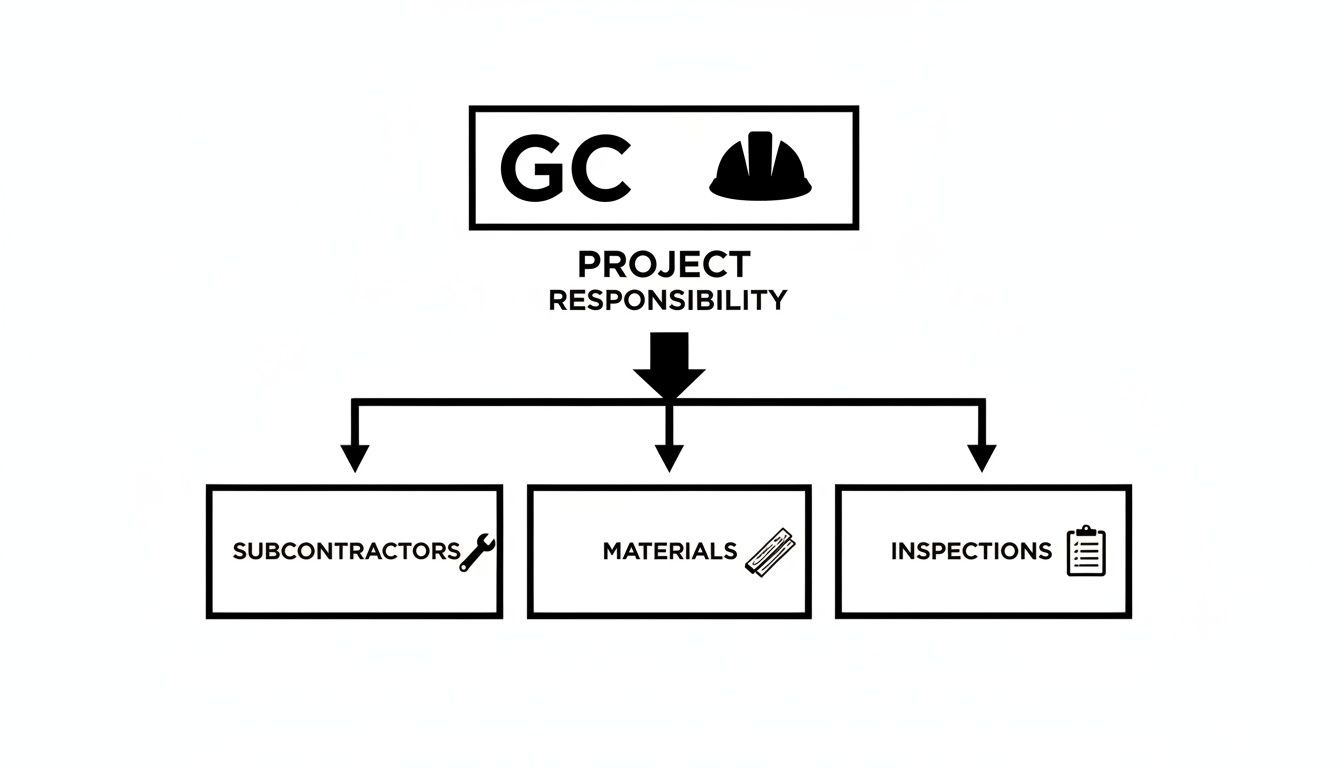
A licensed general contractor is the party legally accountable for the project. They are authorized to pull permits, schedule inspections, ensure code compliance, carry required insurance, and manage specialty subcontractors.
This central role reduces your legal exposure and financial risk. Their license from the California Contractors State License Board (CSLB) isn’t just a piece of paper; it’s legal authority to manage a project involving multiple trades like plumbing, electrical, and framing.
This chart shows how a general contractor sits at the center of the project, managing all the critical pieces.
When you hire a licensed GC, you shift the project’s risk from your shoulders to a qualified professional who is legally and financially equipped to handle it. For a deeper look at this, see our guide on why hiring a licensed general contractor actually matters for your protection.
Building a Foundation of Planning and Legal Clarity
A successful home remodel begins with a solid plan, not a sledgehammer. A key responsibility for a licensed general contractor is pre-construction planning, which happens long before any work starts.
A professional GC works with architects and designers to analyze project plans for feasibility, buildability, and code compliance. This upfront review catches potential issues before they become expensive problems, especially when navigating Monterey County’s unique building conditions or renovating older homes.
Translating Design into a Definitive Plan
Once the design is confirmed as buildable, the next step is to create a detailed project plan. This includes three essential documents that guide the entire process.
- A Detailed Scope of Work: This document lists every task, from demolition to final paint, leaving no room for assumptions.
- A Realistic Budget: Based on the scope, the GC develops a comprehensive budget covering all labor, materials, permits, and subcontractor costs.
- A Dependable Project Schedule: This timeline maps out every activity in a logical sequence, ensuring trades and materials arrive when needed to prevent delays.
This detailed preparation separates a smooth project from a stressful one. Learn more about this critical first stage in our guide to design and pre-construction planning in Monterey.
The Construction Contract: Your Legal Protection
All of this planning is formalized in a construction contract. This is a legally binding document designed to protect you as the homeowner.
The contract legally binds the GC to deliver the project as promised, giving you a clear and enforceable agreement that details responsibilities, timelines, and costs.
It defines payment schedules, material selections, and the warranty on all workmanship. A thorough, compliant contract is a clear sign you are working with a professional who takes their legal and financial responsibilities seriously.
Navigating Permits, Inspections, and Building Codes
The maze of permits, inspections, and building codes is a core part of what a licensed general contractor is responsible for. They manage the regulatory process to ensure your project is safe, lawful, and built to last.
In California, only a licensed contractor is legally authorized to pull permits for most residential remodels involving multiple trades. The GC submits the approved plans to the local building department, officially starting the construction process.

From Permit Application to Final Sign-Off
Once a permit is issued, the contractor’s responsibility shifts to managing mandatory inspections. A city or county inspector must visit the site at critical milestones to verify the work meets California’s building codes.
The GC is responsible for scheduling every inspection. Key milestones include:
- Foundation: Before concrete is poured to verify footings and rebar are correct.
- Framing: After the home's structure is up but before it is covered by drywall.
- Rough-in MEP: For all mechanical, electrical, and plumbing systems before they are concealed.
- Final Inspection: A complete review of the finished project before it can be legally occupied.
By managing this process, your general contractor assumes full legal liability for meeting code. If an inspector finds an issue, it is the GC's responsibility to correct it.
Ensuring Code Compliance in Monterey County
The GC must ensure every aspect of the job meets current building codes. You can explore the full fifty-state survey on contractor licensing for more detail on state-specific rules.
This responsibility protects you from stop-work orders, costly fines, and the inability to get a Certificate of Occupancy. That certificate is critical—without it, you can't legally use your new space or sell your property later.
This also includes knowing local Monterey County rules, such as seismic requirements, coastal material durability, or fire-resistant construction standards. For more on this, see our guide on who handles remodel permits in Monterey and why it matters.
Managing Subcontractors and Ensuring Quality Control
A general contractor’s job includes hiring, managing, and coordinating a team of skilled subcontractors—the electricians, plumbers, painters, and other specialists who complete the work.
This is a careful vetting process. A professional GC relies on a network of trusted, licensed, and properly insured trade partners known for quality work.
The contractor is also directly responsible for the quality of everything these subcontractors do. They manage the schedule so the electrician shows up after framing is done but before drywall goes up, preventing expensive re-work and delays.
Your On-Site Expert for Quality and Risk
Beyond scheduling, the GC acts as your on-site quality control expert. They are responsible for supervising the work of every subcontractor to ensure materials are installed correctly and the final product meets professional standards.
This oversight protects your investment. If a subcontractor's work is deficient, it’s the contractor’s responsibility to have it corrected—not yours.
By hiring insured subcontractors, the general contractor protects you from liability if a worker gets injured on your property. This is a critical risk management function that shields homeowners from potential lawsuits and financial disaster.
When you hire a general contractor, you are hiring one point of accountability for all work. They are legally and professionally responsible for ensuring every trade partner performs to a high standard.
Overseeing the Project Schedule and Budget
A licensed general contractor is the day-to-day operational commander of your project, responsible for keeping your remodel on schedule and on budget.

A key part of this is material procurement and logistics. The GC ensures that everything from lumber and windows to tile and fixtures arrives on time, preventing delays that can disrupt a project.
Maintaining the Schedule and Budget
During construction, the contractor actively manages the project timeline. They coordinate trades, provide progress updates, and solve problems before they cause major delays.
Financial stewardship is the other side of this coin. This responsibility includes:
- Managing the overall budget and tracking all costs against the plan.
- Processing payments to subcontractors and suppliers on time.
- Collecting lien waivers from every party that gets paid.
A lien waiver is a legal document proving a subcontractor or supplier has been paid. By collecting these, your GC protects your property from a mechanic's lien—a legal claim that can cause significant financial and legal problems.
This financial oversight is fundamental to a predictable and successful remodel. To see how these pieces fit together, check out our advanced guide to planning a whole-house remodel.
Finalizing the Project and Protecting Your Investment
A project isn’t finished until every detail is complete and your investment is protected. This final closeout phase is a critical responsibility of a professional contractor.
The first step is the punch list walk-through. We walk the site together, and you identify any final items that need adjustment, such as a paint scuff or a cabinet door alignment. The GC is responsible for creating this list and ensuring every item is completed.
The Formal Handover and Warranty
Once the project passes the final inspection and receives a Certificate of Occupancy, the formal handover occurs. This is a structured walk-through to ensure you are comfortable with your new space.
This handover includes:
- All project paperwork, including manuals and documentation for new appliances and systems.
- A review of key maintenance items, like how to care for new surfaces.
- Your workmanship warranty, which provides long-term protection.
In California, a licensed contractor is required to provide a warranty for their work. The specifics are in your contract, but state law generally provides a one-year warranty for most work and a longer four-year statute of limitations for patent (obvious) defects.
This warranty is the contractor's promise to stand behind the quality of their work. It’s a non-negotiable part of what a licensed contractor is responsible for.
Understanding these final steps helps clarify the entire process. This same detailed approach is how you can avoid surprise costs in a bathroom remodel.
FAQs: General Contractor Responsibilities
Here are straightforward answers to common questions homeowners in Monterey County have about a general contractor's role.
Can I act as my own general contractor to save money?
While California law allows for an owner-builder permit, you assume massive legal and financial liability. You become responsible for permits, code compliance, worker safety, and insurance. A single mistake can erase any potential savings, making it a risky choice without significant construction experience.
How do I verify a contractor's license in California?
Before signing a contract, verify the contractor’s license through the California Contractors State License Board, confirm their classification (such as B General Building), and ask directly who will be pulling permits and supervising inspections. The CSLB website lets you check if a license is active and if they carry the required bond and insurance.
What happens if a subcontractor does poor work?
If you hire a professional general contractor, it is their responsibility to solve the problem. They are accountable for the quality of all work and must manage the subcontractor to fix the issue or hire another professional to correct it at no additional cost to you.
Is the general contractor responsible for site safety and cleanliness?
Yes. A professional GC is legally responsible for maintaining a safe and reasonably clean job site. This includes complying with OSHA safety standards, managing dust, containing debris, and minimizing disruption, especially if you live in the home during the remodel.
What is the difference between a general contractor and a designer?
A designer or architect creates the vision—the "what" of your project—by drawing the plans. A general contractor is responsible for the execution—the "how"—by managing the schedule, budget, trades, and inspections needed to build the project safely and to code. For a deeper look at team roles, check out our Remodeling Contractor guide.
If you are planning a renovation and want clarity about licensing, permits, or project oversight, speaking with a licensed general contractor can help you move forward with confidence and clear expectations. Contact Palacios Construction for expert guidance on Professional Home Remodeling and Construction in Monterey County.