
When homeowners in California start researching an Accessory Dwelling Unit (ADU), their first question is almost always about the cost. But a realistic answer isn't a single number. The final price can range from under $150,000 for a straightforward garage conversion to well over $450,000 for a custom detached unit, especially in a high-cost area.
Understanding why that range is so wide is the first step toward creating a realistic budget. Many homeowners try to use a simple cost-per-square-foot estimate, but this is often misleading because it ignores the key variables that drive the total project cost. Building an ADU is not just about the structure; it's about creating a complete, small home from the ground up, with its own site work, utilities, and permits.
What Drives the Real Cost of an ADU?
A realistic budget for an ADU in California accounts for several distinct phases, each with its own costs. Nearly half of homeowners report their renovation costs more than expected, a trend that applies directly to ADUs. Focusing only on square footage costs is a common misstep.
The full scope includes design, engineering, permitting, utility tie-ins, foundation work, and finish selections. Even a "simple" garage conversion requires full permit-ready plans and code-compliant construction.
The Full Scope: More Than Just the Structure
Before any construction begins, significant planning and site work must occur. Your total investment is a mix of hard costs (labor and materials) and soft costs (planning and fees).
- Pre-Construction: This planning phase includes architectural design, structural engineering, energy compliance reports (Title 24), and creating the permit-ready blueprints required by your local building department.
- Site Work: Your property may need grading, excavation for the foundation, and trenching to run new utility lines. This is especially true on sloped lots or properties with difficult access.
- Foundation: The foundation is a major cost. A concrete slab is often the most cost-effective, but a raised foundation may be necessary depending on site conditions, which impacts the budget.
- Utility Connections: Tying into the main house’s water, sewer, and electrical systems can be a significant expense. The farther the ADU is from existing hookups, the more it will cost to connect.
- Permitting and Fees: Every city and county in California has its own schedule of fees for plan checks, inspections, and issuing final permits. These are unavoidable project costs.
- Construction & Finishes: This is the phase most people visualize—the labor and materials for the structure, roof, windows, insulation, plumbing, electrical, and all interior and exterior finishes.
ADU Cost Categories at a Glance
This table breaks down the major components of a total ADU budget. While percentages will shift based on your project, this provides a clearer financial picture than a simple square-foot number.
| Cost Category | Description | Typical Percentage of Total Budget |
|---|---|---|
| Soft Costs | Architectural design, engineering, surveys, and all city/county permit fees. | 10% – 20% |
| Site Prep & Foundation | Grading, excavation, trenching, and constructing the concrete foundation. | 10% – 15% |
| Utility Connections | The labor and materials to connect water, sewer/septic, electrical, and gas lines. | 5% – 15% |
| Framing & Exterior | Lumber, labor, sheathing, roofing, windows, doors, and exterior siding. | 20% – 25% |
| Interior Systems (MEP) | All mechanical, electrical, and plumbing rough-in work inside the walls. | 10% – 15% |
| Interior Finishes | Drywall, paint, flooring, cabinets, countertops, tile, fixtures, and appliances. | 15% – 25% |
| Contingency | A crucial buffer set aside for unexpected issues. | 10% – 15% |
As you can see, the physical structure is only one piece of the puzzle. Forgetting to budget for site work, utilities, and fees is where homeowners often run into trouble.
One of the biggest misconceptions is that a garage conversion or a small backyard unit is a "simple build." The truth is, even the smallest ADU needs professional, permit-ready plans, full utility systems, and must meet all current California building codes—just like a full-sized house.
Understanding these cost drivers is far more valuable than searching for a generic statewide average. To learn more about local factors, read our guide on how much an ADU costs in Monterey County in our dedicated guide. By breaking down the project into these components, you can work with your contractor to build an accurate budget and avoid costly surprises.
The 7 Key Drivers of ADU Construction Cost
When a homeowner asks why ADU cost estimates vary so much, the answer is a combination of seven specific factors. Understanding these drivers is the first step to setting a realistic budget.
The ADU structure is just one piece of the puzzle. The property it sits on and the process to get it approved are just as important in determining the final cost.
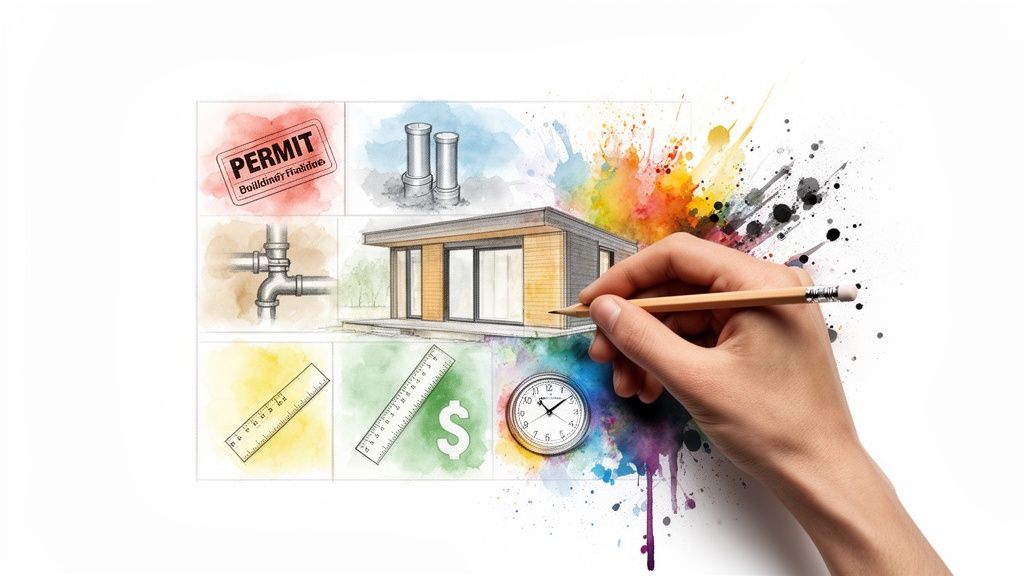
This diagram shows how a total budget is typically split between site work, fees, and the actual structure.

As you can see, site work and "soft costs" like permits are major cost centers that must be part of the initial plan.
1. Site Conditions and Prep Work
Your property's specific characteristics are the starting point for your budget. A flat, easy-to-access lot in Salinas is completely different from a sloped, tree-filled property in Carmel with a narrow driveway.
Site work often includes:
- Grading and Leveling: A flat pad is required for the foundation.
- Excavation: Digging is needed for the foundation and utility lines.
- Soil Quality: Poor soil may require more complex (and costly) foundation engineering.
- Site Access: If heavy equipment cannot easily reach the build site, labor costs increase.
2. Foundation and Structure
The type of ADU you choose has a major impact. A garage conversion uses an existing structure, but many older garages need significant slab and framing upgrades to meet modern building codes, which can reduce initial savings.
A new detached ADU requires a new foundation. A slab-on-grade foundation is the most cost-effective, but a sloped lot or poor soil may necessitate a raised foundation, which adds cost and complexity.
3. Utility Connections
This factor often catches homeowners by surprise. Connecting water, sewer, and electricity is a major expense, and the primary factor is distance. The farther your ADU is from the main house's utility lines, the more it costs to trench and run new connections.
Contractor Tip: A common surprise is discovering the main house's electrical panel cannot handle the ADU's additional load. Upgrading the main panel can add thousands to the budget before ADU construction even begins.
4. Design and Size
Bigger isn't always proportionally more expensive. While a larger ADU uses more materials, the cost per square foot often decreases. This is because both a 400-square-foot unit and an 800-square-foot unit typically require one kitchen and one bathroom—the most expensive rooms to build.
A fully custom design will also cost more in architecture and engineering fees than a pre-approved plan, offering complete control at a premium.
5. Level of Finishes
This is where you have the most direct control over the final cost. Your choices for flooring, cabinets, countertops, fixtures, tile, and appliances can make the budget swing dramatically.
- Builder-Grade Finishes: Basic, durable, and cost-effective.
- Mid-Range Finishes: A balance of quality, style, and cost popular with most homeowners.
- Luxury Finishes: High-end appliances, custom cabinetry, and premium materials.
Opting for luxury finishes can easily add 20-30% or more to the total construction cost compared to standard choices.
6. Labor and Material Markets
Construction costs vary significantly across California. Labor rates in the Bay Area are much higher than in Monterey County due to intense demand. Material costs also fluctuate based on supply chains, fuel prices, and local availability. These market forces are beyond anyone's control but absolutely affect your final budget.
7. Local Permits and Fees
Although state laws have streamlined ADU approvals, each city and county has its own fee schedule. An experienced local contractor familiar with your city's requirements can help you budget for these "soft costs" accurately. To get a sense of where these units are headed, it's worth reading about the top 5 ADU trends Central Coast homeowners should know.
How Your Location Shapes the Final Price Tag
Geography is a powerful and often overlooked factor driving ADU construction costs in California. A budget that is realistic for one county can be completely off in another. National averages are practically useless; what matters are the economic conditions in your specific city and county.

The cost of living isn't the same everywhere in the state, and neither is the cost of building. This is a major reason why more homeowners in Monterey are remodeling instead of moving—it is often more predictable to upgrade an existing home.
Urban Centers vs. Regional Markets
The most dramatic cost differences appear when comparing dense urban centers to other regions. Major metro areas like the San Francisco Bay Area and Los Angeles operate under immense economic pressure that increases project budgets.
- Intense Labor Demand: In cities with booming economies, skilled construction trades are in high demand, driving up wages.
- Higher Contractor Overhead: General contractors in expensive urban areas face higher operational costs for office space, insurance, and vehicle maintenance, which are factored into their pricing.
- Complex Logistics: Transporting materials and vehicles through dense cities is more difficult and time-consuming, leading to higher delivery fees and labor hours.
The Bay Area vs. The Central Coast: A Cost Snapshot
A 2020 survey of ADU owners by the Terner Center for Housing Innovation at UC Berkeley revealed a huge difference in project costs across California. The median statewide construction cost was $150,000, or about $250 per square foot.
But that number jumped to a median of $177,500—or $329 per square foot—in the high-cost San Francisco Bay Area. That’s a direct result of its expensive labor market and tougher local regulations.
In contrast, the Central Coast region, which includes Monterey County, had a median cost of $140,000, or $223 per square foot. This significant difference demonstrates how much location dictates the budget.
This data confirms a fundamental truth of construction: local market forces are one of the biggest drivers of your final price.
Why This Matters for Monterey County Homeowners
For homeowners in Monterey County, this context is crucial. While our region is not the cheapest in California, our costs are not subject to the same extreme pressures as the Bay Area. This creates a more predictable and stable environment for planning an ADU.
Understanding that location is a key variable allows you to set realistic expectations. It also highlights the importance of working with a local contractor who has a firm grasp of regional labor rates, material suppliers, and the economic landscape of building in Monterey County.
Navigating Local Permits, Regulations, and Fees
A significant and often underestimated portion of an ADU budget is dedicated to "soft costs." These are the fees for design, approvals, and inspections that must be paid before construction begins. While state laws have made it easier to get an ADU approved, navigating local rules is a primary reason why costs vary so much.
Every jurisdiction, from Monterey County down to the city of Salinas, has its own fee schedule and review process. These charges can easily add tens of thousands of dollars to your total cost.
The Different Types of Fees You'll Encounter
Your total permit cost is a collection of different fees paid at various stages. Having a clear plan is the only way to forecast these expenses, which we detail in our guide on what permits are needed to build an ADU in Monterey County.
Key fees include:
- Plan Check Fees: Paid to the city or county to review your architectural and engineering plans for code compliance.
- Building Permit Fees: Paid to receive the actual permit that allows construction to start.
- Inspection Fees: Paid for each site visit from a building inspector at key project milestones.
- School Impact Fees: In many areas, new housing units must contribute to local school districts.
- Utility Connection Fees: Charged by utility companies to connect your ADU to the electrical grid and water/sewer systems.
Recent state laws waived most impact fees for ADUs under 750 square feet, but all other fees remain and can vary significantly by location.
How Local Rules Drive Big Cost Differences
The exact amount you pay in fees depends on your property's location. For example, a 2020 analysis by the Terner Center showed some Bay Area ADUs costing over $800 per square foot, pushing a 500-square-foot unit to $400,000. A major factor was the added cost of meeting rigorous local seismic standards and environmental reviews.
The True Cost of Delays: A slow permit process doesn't just push back your start date—it can quietly drive up your total project cost. Delays disrupt contractor schedules, expose you to material price increases, and complicate financing.
This is where working with a licensed general contractor who knows your local jurisdiction pays off. A good contractor can prepare a complete permit package, anticipate the review timeline, and budget for these regulatory costs with greater precision from the start.
Local Cost Factors for a Monterey County ADU
While state laws provide a framework, the final cost of an ADU in Monterey County comes down to on-the-ground realities. Online cost calculators often miss these local factors.
- Coastal Conditions: In coastal areas like Monterey and Pacific Grove, the salty air and fog are highly corrosive. Building a durable ADU requires weather-resistant materials like stainless steel fasteners and high-performance windows, which cost more than standard products.
- Sloped Lots: Properties in Carmel Valley or on the Monterey Peninsula are often not flat. Building on a slope requires more grading, excavation, and potentially engineered retaining walls, increasing site preparation costs.
- Older Housing Stock: Many homes in Monterey County were built decades ago. Connecting a new ADU often reveals the need for expensive but necessary upgrades to the main house's electrical panel or plumbing systems to meet current safety codes.
- Local Ordinances and Water Use: In addition to state laws, each city has its own rules. In Monterey County, this can include specific regulations regarding new water connections or fixture types to manage regional water resources.
A general contractor who builds exclusively in Monterey County will incorporate these local realities into your plan from the beginning, leading to a more accurate budget and a smoother project.
How Professional Planning Prevents Costly Surprises
A structured, professional planning process is the single best way to control your ADU budget and prevent expensive surprises. Rushing through planning to get to construction is a costly mistake. Investing in thorough pre-construction work is not an extra cost—it's a critical investment in a predictable outcome.
This upfront clarity helps define exactly what is included and dramatically reduces the risk of expensive changes once construction is underway. Palacios Construction approaches ADU projects with this type of structured planning.

The Foundation of a Predictable Budget
A reliable ADU budget is built on clear documentation, not guesswork. The pre-construction phase is where every key decision is made, documented, and priced.
Key planning steps include:
- Detailed Site Analysis: On-site measurements and a professional assessment of property conditions, including topography, utility access, and potential challenges.
- Layout and Design Development: Finalizing the floor plan and overall design. Using 3D modeling helps you visualize the space and make adjustments before they become expensive on-site change orders.
- Permit-Ready Blueprints: These are not just floor plans. They are comprehensive documents covering all structural, electrical, plumbing, and mechanical systems required by your building department.
- Material and Finish Selections: Choosing flooring, cabinets, fixtures, and tile upfront allows for accurate budget numbers from the start.
Turning Plans Into Action
Once this detailed plan is complete, a professional contractor can develop a precise cost estimate broken down by phase. This gives you a transparent view of where every dollar is going.
The goal of pre-construction is to answer every possible question on paper so you don’t have to solve problems with expensive labor and materials on-site. Making changes during design is simple; making them after the foundation is poured is a budget disaster.
This process-driven approach is fundamental to a successful project. With a detailed scope of work and a full set of plans, the construction phase becomes an exercise in execution, not exploration. It’s also why hiring a licensed general contractor matters—they manage this entire process.
By embracing structured planning, you take control of your project’s financial outcome, ensuring your ADU is built on a solid foundation of clear expectations, accurate budgeting, and professional execution.
Frequently Asked Questions About ADU Costs
Is a garage conversion always cheaper than a new detached ADU?
Not necessarily. While you start with an existing structure, many older garages require significant upgrades to meet modern building, energy, and seismic codes. This can include a new foundation slab, full insulation, and all-new electrical and plumbing systems. A detached ADU provides complete design freedom, which can be a valuable trade-off.
How much do plans and permits add to the total cost?
A good rule of thumb is to budget 10% to 20% of your total construction cost for these "soft costs," which include architectural design, engineering, and all city or county permit fees. For a $300,000 ADU project, that means setting aside $30,000 to $60,000 for the pre-construction planning and approval phase.
Will a prefab or modular ADU save me money?
Sometimes, but it is critical to compare the total project cost, not just the advertised price of the unit. The final cost must include site-specific work like a permanent foundation, utility connections, transportation, and crane rental. When all costs are included, the final price is often comparable to a traditional, site-built ADU.
Why can't a contractor give me a price per square foot over the phone?
Because a simple price-per-square-foot number is misleading. It ignores the real-world variables that determine the final cost, such as site conditions, utility access, and finish levels. A professional contractor needs to see your property and understand your goals to develop a detailed scope of work. Anything less is just a guess.
What is the best first step for creating a realistic ADU budget?
Start with defined goals and talk to a licensed, local general contractor. An experienced builder can perform an initial site visit, identify potential challenges like poor access or older utility lines, and explain the entire process. This conversation is the fastest way to move from online averages to a real-world budget based on a plan for your specific property.
Ready to build your ADU with clarity and confidence? The team at Palacios Construction specializes in professional home remodeling and construction in Monterey County, using a process-driven approach to deliver well-planned projects. Contact us today to discuss your project.