
Quick Answer
A quick online number is usually the wrong starting point for an ADU budget.
In Monterey County, cost estimates swing because the actual price is shaped early by conditions the calculator cannot see. Slope, access for crews and equipment, distance to sewer or utilities, fire and drainage requirements, permit path, and the level of design work all affect the number before construction even starts. If you have not yet confirmed whether your property can support an ADU under local site and zoning constraints, any estimate is still preliminary.
That explains why ADU cost estimates vary more than most homeowners expect.
Homeowners often assume the big variables are square footage and finish level. In practice, I see pre-construction costs and site-specific conditions create the first major spread between one estimate and another. A flat lot with nearby utilities and a straightforward permit review budgets very differently than a property with grading, long trench runs, tree constraints, coastal review, or utility upgrades tied back to the main house.
The short version is simple. The reliable ADU budget is the one built from your lot, your jurisdiction, and your scope, not from a statewide average.
The Myth of the Average ADU Cost Per Square Foot
The square-foot price is the number homeowners ask for first, and it is usually the least useful number in early ADU planning.
I see the problem all the time in Monterey County. Two properties can both pencil out as a 600-square-foot ADU on a website calculator, then land in very different budget ranges once we look at the lot, the utility path, the jurisdiction, and the approval work needed before construction starts. The calculator only sees size. It does not see the project.
Square footage is only one input
An ADU is a full dwelling, not a spare bedroom with a roof over it. It still needs a kitchen, a bathroom, ventilation, electrical service, plumbing, waterproofing, title coordination, design work, and permit review. Those costs stay with the project whether the unit is compact or larger.
That is why smaller ADUs often carry a higher cost per square foot than homeowners expect.
A 500-square-foot unit may still need nearly the same categories of work as a 750-square-foot unit. The foundation may be smaller, but the kitchen is still a kitchen. The bathroom is still a bathroom. The permit set still has to be prepared, submitted, corrected if comments come back, and approved.
Practical rule: If an estimate is built mainly from square footage, treat it as a rough placeholder. A usable budget has to come from the property, the jurisdiction, and the actual scope.
Why the "average" number breaks down in Monterey County
The average price per square foot hides the exact costs that make Monterey County ADU budgets move.
Local projects are shaped early by conditions that do not show up in broad statewide averages. Coastal Commission considerations in some areas, stricter fire access concerns on certain lots, drainage and grading issues, older utility infrastructure, and longer runs back to existing services can all change the number before concrete is poured. In older neighborhoods, the main house can also trigger related upgrade work that the online estimate never asks about.
That is the part many homeowners miss. The budget spread often starts before framing, not after finish selections.
A detached ADU behind a flat home in a straightforward jurisdiction is one pricing scenario. A detached ADU on a sloped lot with limited access, utility trenching across the property, and extra review requirements is another. Both may be the same size on paper.
What online calculators usually miss
Most online tools leave out the variables that decide whether the early budget is realistic:
- Project type: Detached new construction, attached ADUs, and garage conversions follow different construction paths and carry different risks.
- Pre-construction work: Surveying, soils input, structural coordination, Title 24 documentation, and plan revisions can add cost before the build starts.
- Local review path: City, county, coastal, and special district requirements do not move at the same speed or ask for the same documentation.
- Existing property conditions: Access, drainage, tree placement, retaining needs, and distance to utilities can change labor and equipment costs fast.
- House-related upgrades: Panels, sewer lines, water service, or other existing conditions at the main home can expand the scope.
This is why one contractor can sound "high" and another can sound "low" in the first conversation. Sometimes one is carrying more real project conditions into the estimate. Sometimes one is pricing a cleaner version of the job than the property will allow.
For a local benchmark, this guide on how much an ADU costs in Monterey, CA is more useful than a national average because it starts with the cost drivers that show up on actual Monterey County properties.
Three questions that matter more than price per square foot
Before a homeowner puts much weight on a number, these questions need real answers:
| Early planning question | Why it affects cost |
|---|---|
| Detached, attached, or conversion | Each option changes structural work, construction sequencing, and utility needs |
| What has to be extended, relocated, or upgraded | Power, water, sewer, gas, and HVAC scope can shift the budget quickly |
| How much design customization is planned | Layout changes, rooflines, window packages, and finish selections can move pricing well beyond a simple size-based estimate |
If those answers are still loose, the estimate will be loose too.
Site Conditions That Drive Up Your ADU Budget
Homeowners often expect the building itself to set the price. On Monterey County ADU projects, the site regularly does it first.
A backyard can look straightforward and still be expensive to build on. Grade changes, drainage paths, coastal soil behavior, narrow access, older hardscape, and prior site work all affect how the project gets engineered, staged, and constructed. Online calculators rarely account for that, which is why they miss early cost pressure on local properties.
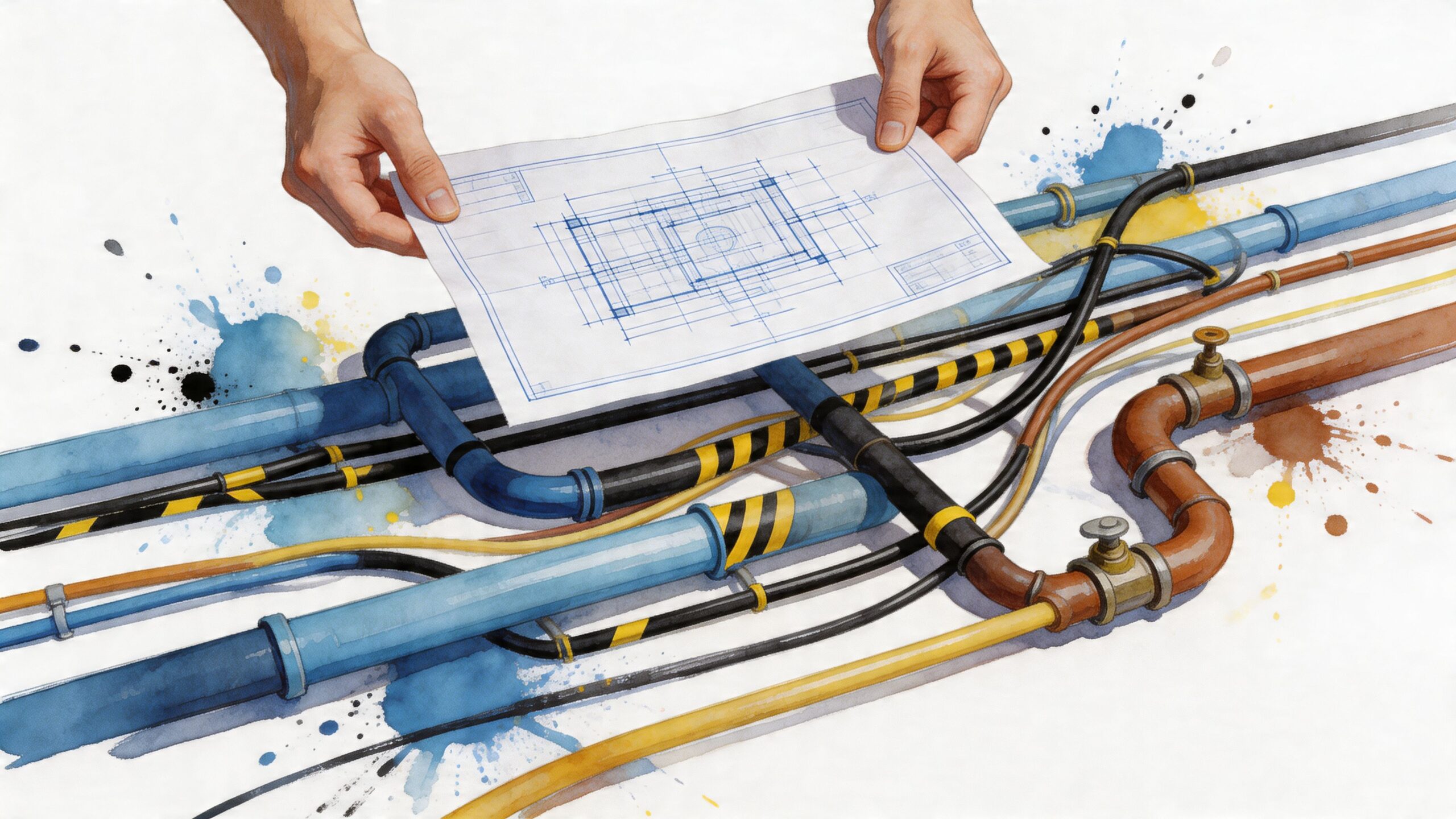
Slope, drainage, and access can change the budget before construction starts
On a flat lot with good access, site prep may stay fairly routine. On a sloped lot or a parcel with drainage issues, the job can shift quickly into added excavation, retaining, drainage improvements, and more engineering review.
Common cost drivers at this stage include:
- Elevation changes: Steep yards may require stepped footings, retaining walls, or heavier excavation.
- Drainage control: Runoff has to be directed correctly so the new unit does not create water problems at the ADU or the main house.
- Equipment access: Tight side yards and limited staging space slow production and can require more hand work.
- Existing obstacles: Trees, sheds, patios, buried lines, and old concrete often add demolition or redesign costs.
Those are pre-construction issues, not finish upgrades. They affect the job long before anyone picks cabinets or flooring.
Soil and foundation assumptions are where early estimates often drift
Foundation pricing stays reasonable when the soil conditions support a standard approach. It changes fast when the engineer calls for a different system because of fill, expansive soil, settlement risk, or coastal conditions.
That explains why a homeowner may hear one preliminary number early and a different one after site review and engineering. The floor plan did not change. The foundation strategy did.
On Monterey County lots near the coast or in hillside areas, that difference is not unusual. A standard slab assumption can turn into piers, deeper footings, drainage improvements, or more reinforcing once the site is evaluated.
On ADUs, "same size" doesn't mean "same build." A level inland lot and a sloped coastal lot may share a floor plan and still require very different construction methods.
Existing property conditions create soft costs that homeowners do not see at first
Some of the budget increase happens in dirt work and foundation work. Some of it happens earlier, in the investigation required to price the job responsibly.
If the parcel has slope, drainage concerns, tree impacts, or questionable soil history, the project may need more surveying, civil input, geotechnical review, or structural coordination before the construction budget tightens up. Those are real pre-construction costs. They do not produce visible progress on site, but they reduce surprises later.
Air quality planning can also come up sooner than owners expect, especially on tighter sites or when the ADU design has limited natural ventilation. In some cases, indoor environment decisions get discussed alongside mechanical layout and enclosure strategy, including options such as air purification systems.
For homeowners still evaluating feasibility, this local guide on what determines whether you can build an ADU on your property is a good starting point before relying on any budget range.
What a serious site review should answer
A useful early estimate needs site-specific answers, not just square footage and a unit type.
The pre-construction review should address:
- Buildable placement: Where the ADU can sit once setbacks, easements, and site limitations are considered
- Foundation assumptions: Whether standard footings are realistic or the engineer may require a different system
- Drainage and grading scope: What has to be corrected, redirected, or built to protect the structure
- Access and staging logistics: How crews, materials, and equipment reach the backyard without turning a simple build into a slow one
Ignoring those conditions does not remove the cost. It usually means the number was incomplete.
Utility Connections and Hidden Home Upgrades
Utility work often complicates ADU budgets faster than homeowners expect. The building may be small, but the systems serving it are not. A detached ADU still needs safe, code-compliant power, water, sewer, ventilation, and often its own heating and cooling strategy.

Detached ADUs need infrastructure, not just construction
Detached units usually cost more because they require more than a slab, walls, and a roof. They need new utility runs, trenching, tie-ins, inspections, and coordination with the existing house systems. Industry discussion of detached versus attached ADUs regularly points to separate plumbing, electrical, and mechanical work as a major cost driver (detached vs. attached ADU cost discussion).
In the field, that difference shows up quickly. A conversion or attached ADU may be able to use part of the existing structure and shorten utility routes. A detached unit in the back of the lot often means a longer sewer connection, a longer water run, more trenching, and more labor just to get the new unit functioning properly.
The house may need upgrades before the ADU can work
A lot of ADU budgets miss the fact that the main house can become part of the job. I see this on older Monterey County properties all the time. The backyard has enough room, the concept looks feasible, and then the pre-construction review shows the electrical service is maxed out, the sewer line is undersized or poorly located, or the water connection plan is more complicated than the owner expected.
Common examples include:
- Electrical capacity problems: The existing panel may need replacement or service changes before the ADU load can be added.
- Sewer connection issues: Line depth, condition, slope, and routing can change the scope fast.
- Water service limitations: Fixture counts, line sizing, and connection path all affect cost.
- Mechanical system decisions: Extending the main house system is often less practical than installing a dedicated system for the ADU.
Those upgrades are easy to miss in online calculators because they are property-specific. They also tend to show up before framing is complete, which is why they disrupt budgets more than finish upgrades do.
Monterey County utility review has local cost consequences
Monterey County adds another layer that generic cost tools ignore. Utility planning is tied to local permitting, agency review, and existing site conditions, especially on older homes and peninsula properties. Water availability, service capacity, trench routes, and the condition of prior work all matter before a contractor can price the job with confidence.
That is one reason homeowners should understand the local permit path early, not after drawings are finished. This guide on ADU permit requirements in Monterey County gives the regulatory side that often intersects with utility planning.
On some properties, the question isn't whether the ADU can connect. Instead, the question is how much work it takes to connect it legally and whether the existing house systems can support the added demand.
A detached ADU has to be integrated into the property's existing utility systems. If those systems are outdated, undersized, or poorly located, the project scope grows before the new unit is even dried in.
Where estimates usually break down
Utility numbers get shaky when the estimate is built on assumptions such as "connect to existing services" without verifying what those services can handle. That language sounds complete, but it often hides unanswered pre-construction questions.
A more reliable estimate identifies issues like these:
| Utility issue | Why it matters |
|---|---|
| Distance from main service points | Longer runs increase trenching, material, patchback, and labor |
| Existing panel condition | Capacity and code issues can trigger panel or service upgrades |
| Sewer routing | Depth, slope, and existing line condition affect feasibility and cost |
| Mechanical approach | System choice affects electrical load, equipment, and installation scope |
The money is usually not lost in one dramatic surprise. It gets added through several decisions that were never priced clearly at the start.
How Design Scope and Finishes Impact the Final Price
Design decisions change ADU pricing faster than many homeowners expect. In Monterey County, the jump usually has less to do with square footage than with how much customization the plan demands, how the rooms are arranged, and how many finish choices push the build out of the standard lane.
Two units can be nearly the same size and end up with very different budgets. A simple rectangular detached ADU with standard windows, a basic roof, and stock finishes is one job. A unit with vaulted ceilings, large glass openings, a custom shower layout, higher-end cabinetry, and detailed exterior trim is a different job entirely.
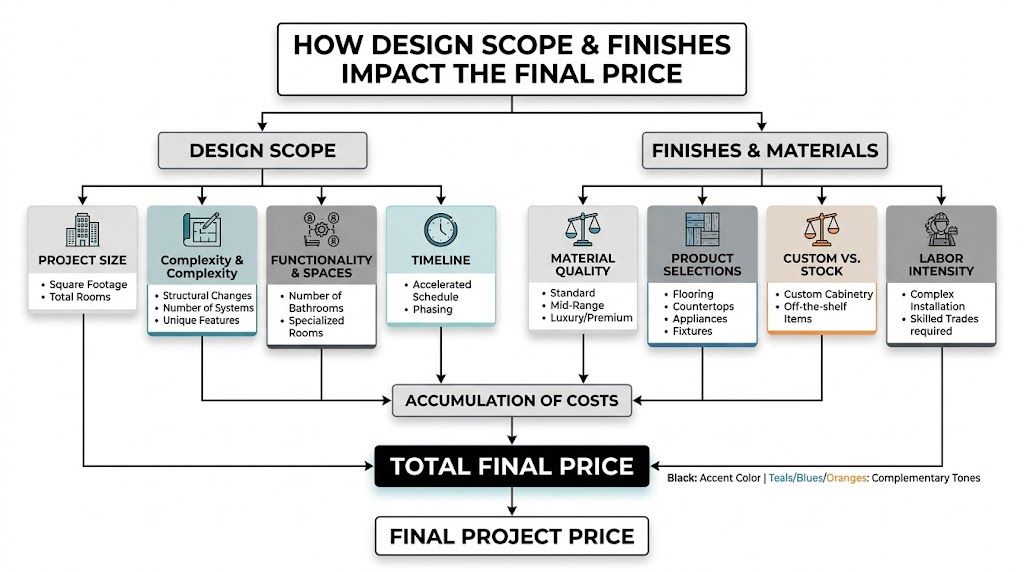
The format of the ADU changes the cost structure
Detached construction, garage conversions, and attached additions each carry different cost pressure points.
A detached ADU usually gives the cleanest end result for privacy and long-term use, but it also means building a full structure from the ground up. An attached ADU can reduce some exterior work, yet tying new construction into an existing house often creates added framing, waterproofing, and finish matching work. A garage conversion may look cheaper on paper, but older garages in Monterey County often need slab correction, wall upgrades, insulation, new openings, and substantial interior rebuilding before they function like legal living space.
The lowest starting number is not always the lowest final cost. The better question is which approach fits the property with the least amount of reconstruction and compromise.
Complexity drives labor
Industry pricing summaries note that detached stick-built ADUs often cost more as layouts and finish packages become more custom, and that kitchens and bathrooms carry a large share of the budget because they concentrate cabinetry, plumbing, electrical, tile, and fixture work in a small footprint (ADU cost guide and pricing).
That lines up with what happens in the field. Cost rises quickly when the plan includes corners, offsets, beam details, premium window packages, relocated plumbing walls, custom millwork, or finish transitions that require tighter coordination between trades.
Small units are especially sensitive to these decisions. In a compact floor plan, one upgraded kitchen or one highly detailed bath can move the total budget more than homeowners expect, because those rooms still need the same core systems and skilled labor as larger homes.
Finish choices create ripple effects
Finishes are not just an allowance sheet. They affect installation time, substrate prep, lead times, and sometimes the design itself.
For example, standard cabinetry and off-the-shelf plumbing fixtures usually keep purchasing and installation more predictable. Custom cabinets, large-format tile, recessed shower niches, specialty lighting, and multi-panel doors often add labor as much as material cost. In coastal parts of Monterey County, material selection can also intersect with durability. Some products hold up better than others in damp or marine-influenced conditions, so the cheapest option upfront is not always the smartest one to install.
Mechanical planning belongs in this conversation too. Homeowners who care about comfort in a tight footprint sometimes ask about filtration and indoor air quality upgrades such as air purification systems. That choice should be discussed early, because equipment location, duct routing, power needs, and wall space can all affect the plan.
The design choices that usually keep budgets steadier
The most reliable budgets come from clear priorities set before drawings are far along. That means deciding what matters most, then keeping the rest straightforward.
Choices that usually help control cost include:
- Simple rooflines: Fewer framing complications and fewer waterproofing transitions
- Tighter plumbing layout: Keeping kitchens, baths, and laundry closer together reduces routing and labor
- Standard window and door sizes: Custom dimensions can increase ordering cost and slow scheduling
- Selective upgrades: Put money into the finishes used every day instead of upgrading every surface
- Cleaner structural spans: Large open rooms and oversized glass often require more engineering and more expensive framing solutions
Homeowners get better results when design and budgeting happen together instead of in separate steps. Early design and pre-construction planning in Monterey for permit-ready projects helps sort out those trade-offs before the drawings lock in expensive decisions.
Navigating Permits, Fees, and Local Regulations
Permits are where a lot of ADU budgets start drifting off course.
Homeowners usually focus on framing, finishes, and labor. In Monterey County, pre-construction costs can change the job before excavation even begins. The permit path affects what gets drawn, what has to be engineered, which consultants get involved, and how long the project sits in review.
Permits are usually several costs grouped together
An ADU permit budget is rarely one fee. It often includes building plan review, planning review, school or district-related fees where applicable, utility sign-off, and sometimes grading or drainage review depending on the site. If the property is in the Coastal Zone, on a slope, or tied to older records that do not match current conditions, the review process can widen quickly.
That is why online calculators regularly miss the mark. They tend to assume a clean lot, straightforward approvals, and no redraws.
A more realistic early budget should leave room for soft costs tied to approvals, including:
- Architectural or drafting plans
- Structural engineering
- Title 24 energy documentation
- Surveying or site verification when conditions are unclear
- Plan check responses and drawing revisions
- Permit issuance fees and inspection coordination
Those are real project costs, not optional extras.
Local rules in Monterey County change the price before building starts
State ADU law has made approvals more predictable, but local conditions still shape cost in a very practical way. Monterey County properties often come with coastal constraints, septic questions, access limitations, fire severity requirements, or older utility layouts that need to be verified before the plans are ready.
I see this on rural parcels and older in-town lots alike. A homeowner may start with a simple detached ADU idea, then learn the site needs updated drainage information, a utility trench plan, or added documentation to satisfy plan check comments. None of that is dramatic. All of it costs money.
Homeowners who want a clearer picture of the approval path should review the local permit requirements for an ADU permit process in Monterey County before locking in assumptions about timeline or budget.
Revisions are where permit costs start multiplying
The first submittal does not always get approved as-is. Plans come back with comments. Setbacks may need clarification. Structural details may need adjustment. Site information may turn out to be incomplete. Each round of revisions adds consultant time, and consultant time is part of the budget.
Working with a licensed general contractor is valuable because permit issues are cheaper to address before the drawings are too far along. Good pre-construction planning catches obvious conflicts early, especially on Monterey County sites where zoning, slope, access, and utility conditions can all affect the final buildable scope.
What actually helps control this part of the budget
The owners who keep these costs steadier usually do a few things early:
| Good practice | Why it helps |
|---|---|
| Early zoning and parcel review | Catches use, setback, and access issues before design time is wasted |
| Site verification up front | Reduces bad assumptions about grade, utilities, and existing conditions |
| Coordinated design team communication | Keeps architect, engineer, and builder pricing the same scope |
| Complete submittal package | Lowers the chance of avoidable correction cycles |
Some homeowners also look into broader strategies to reduce construction costs, but permit savings usually come from better planning, not from cutting corners. In this part of the process, clarity is what saves money.
Why ADU Cost Estimates From Contractors Can Still Vary
Even when the project is the same on paper, contractor estimates can still come in far apart. That doesn't always mean someone is overcharging or someone else found a magic savings. Often, the bids are based on different assumptions.
The hard part for homeowners is that those assumptions don't always show up clearly on page one.
Allowances can make a bid look lower than it is
One proposal may use placeholders for cabinets, tile, appliances, fixtures, or site work. Another may price those items more fully. The first number looks better, but it may not reflect what the homeowner plans to build.
Allowances aren't automatically a problem. They become a problem when the allowance is too low, too vague, or attached to too many major categories.
Scope detail matters more than the total at first glance
The cheapest bid is often the shortest bid. If one contractor includes demolition protection, trench restoration, permit coordination, finish-level assumptions, and cleanup while another leaves those items broad or silent, the totals won't compare cleanly.
A reliable estimate should make it easier to answer questions like:
- What exactly is included in site work
- Which finishes are assumed
- Who is handling permit coordination
- What exclusions could become change orders
- How utility unknowns are being treated
Business structure affects price too
Contractors also price work through the lens of their overhead, insurance, supervision, scheduling, and trade relationships. A licensed contractor carrying proper coverage, managing subcontractors directly, and building a realistic schedule will often price differently than someone working from a thinner structure.
That doesn't mean the higher number is always better. It does mean homeowners should understand what supports the number.
A low bid can be accurate, or it can be incomplete. The only way to tell is to read the scope, not just the bottom line.
For that reason, homeowners comparing ADU proposals should also understand what a licensed general contractor is responsible for. If one proposal assumes much more coordination, compliance, and risk management than another, the price difference may be justified.
How to Get a More Reliable ADU Cost Estimate
A good ADU estimate isn't the one that sounds comfortable. It's the one that reflects the actual project. Homeowners can improve estimate accuracy a lot by doing some specific work up front.
That starts with replacing rough assumptions with verified information.
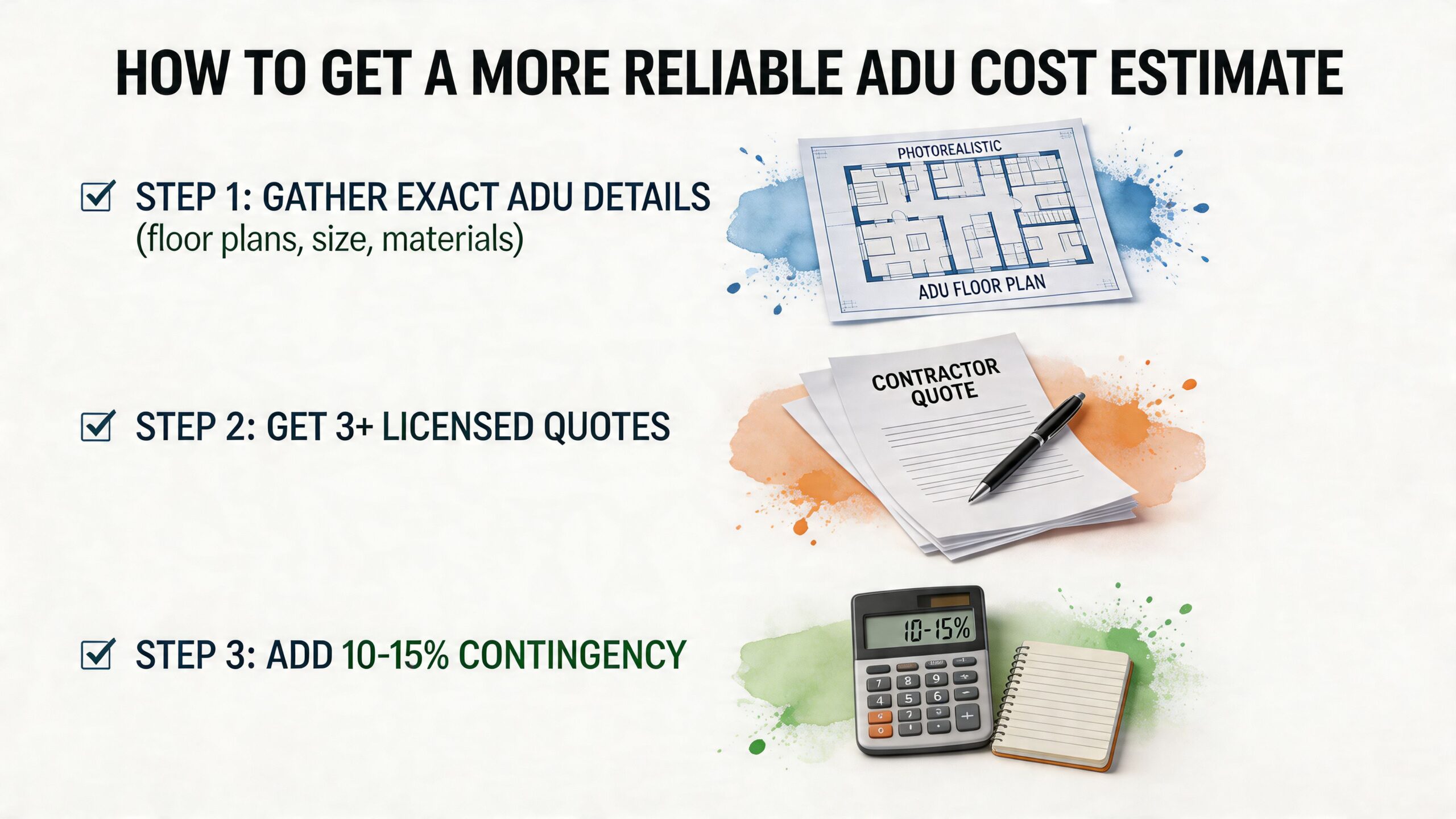 ADU construction cost estimate for homeowners.” />
Start with feasibility, not finishes
Before choosing tile, flooring, or cabinet colors, sort out the fundamentals. The best early money is usually spent on understanding the lot, utility path, likely permit issues, and the right ADU type for the property.
That early review should answer:
- Where can the ADU go
- What utility route is realistic
- Whether the project should be detached, attached, or a conversion
- Which constraints are likely to affect engineering or permitting
Ask contractors the questions that expose risk
Good estimate conversations are direct. Homeowners should ask where the unknowns are and which items are still provisional.
Useful questions include:
| Question | What it reveals |
|---|---|
| What site assumptions are built into this number | Whether grading, access, or foundation conditions are still guesses |
| What utility work is included or excluded | Whether trenching or service upgrades may still move later |
| Which finish categories are allowances | How much selection risk remains in the budget |
| What usually leads to change orders on projects like this | Whether the contractor is being realistic about uncertainty |
Carry a contingency on purpose
Verified ADU guidance recommends a 10 to 15 percent contingency for surprises like grading, tree removal, utility trenching, or other unforeseen issues (verified contingency guidance). That isn't a sign the planning failed. It's standard protection in construction where existing conditions and jurisdictional review can still change the scope.
A homeowner who refuses to budget contingency doesn't eliminate risk. They just remove the cushion for handling it.
Keep the design decisions aligned with the budget
Late changes are expensive because they affect labor, materials, and coordination all at once. If you're looking for broader reading on strategies to reduce construction costs, the most useful ideas are the ones that support early decision-making, simpler scope, and fewer revisions after pricing starts.
The practical version is straightforward:
- Choose a clear layout early
- Limit custom details unless they matter
- Confirm utility assumptions before pricing hard
- Compare estimates by scope, not by headline number
That approach doesn't remove every unknown. It usually removes the avoidable ones.
Frequently Asked Questions About ADU Costs
Why isn't a simple floor plan enough for a firm ADU quote
A floor plan shows size and layout, but it doesn't confirm the site conditions, utility path, permit requirements, or finish level. A contractor can give a rough range from a plan, but a dependable estimate needs more project-specific information.
Is a detached ADU always more expensive than a garage conversion
Not always, but detached units usually carry more new construction scope. Garage conversions can save on part of the structure, yet they can still require major upgrades if the slab, framing, insulation, ceiling height, or utilities don't meet current requirements.
How should I budget for the costs that aren't construction labor and materials
Treat design, engineering, permitting, utility review, and pre-construction investigation as part of the project budget from the start. When those items are left out of the first estimate, homeowners usually experience the difference later as an overrun.
Do ADU projects usually go over budget
They can if the early estimate was based on assumptions instead of verified conditions. The risk is much lower when the lot, utility needs, design scope, and permit path are reviewed before construction pricing is treated as final.
Can I manage my own ADU project to save money
Some owners try, but ADUs involve coordination between design, engineering, trades, inspections, and local rules. If the project runs into scope gaps or sequencing mistakes, the money saved on paper can disappear quickly in delays, corrections, or change orders.
Are modular or prefab ADUs always cheaper
Not automatically. They may simplify parts of the build, but site work, foundation requirements, transport logistics, utility connections, and local review still control a large part of the budget.
Planning Your Monterey County ADU with Confidence
If you're exploring the possibility of building an ADU, taking time to understand cost drivers can prevent major surprises later. Reviewing local regulations, property constraints, and design goals early often makes the budgeting process much clearer before construction begins.
That is the practical answer to why adu cost estimates vary more than most homeowners expect. The estimate gets more reliable when it's based on your actual property, your utility conditions, and a defined scope, not a generic average.
If you want to talk through an ADU, JADU, or home addition in Monterey County, start with the site and the process. That's where the clearest budgeting decisions get made.
If you're considering an ADU and want a grounded conversation about scope, site conditions, and budgeting, Palacios Construction is available to help. You can reach out through the website or visit at 222 Ramona Ave Unit 5, Monterey, CA to discuss your project and request an estimate.
Sources
YouTube. "ADU construction costs exhibit extreme variability primarily due to fixed expenses like design fees, kitchens, and bathrooms." n.d. https://www.youtube.com/watch?v=yRdT7A84O74
Fast Build. "ADU Construction Cost." n.d. https://fast-build.com/adu-construction-cost/
EHD Builders. "Debunking Common Misconceptions About ADU Costs Per Square Foot." n.d. https://ehdbuilders.com/debunking-common-misconceptions-about-adu-costs-per-square-foot/
HouseIdea. "ADU Cost Guide and Pricing." n.d. https://www.houseidea.com/blog/adu-cost-guide-and-pricing/
Full Perspective. "ADU Cost Design Factors." n.d. https://fullperspective.com/blog/adu-design/adu-cost-design-factors/