
Direct Answer: An ADU makes financial sense when the rental income or property value gain clearly exceeds the total build cost — including permits, construction, and carrying costs — within a realistic timeframe for your specific property.
A lot of Monterey County homeowners are looking at their backyards and asking the same question: would an ADU actually pay off? It’s a fair question — and the honest answer is that it depends on factors most general articles never bother to spell out.
In a county where median home values in Carmel-by-the-Sea and Pebble Beach regularly exceed $1.5 million, adding a well-built ADU can meaningfully increase property value. But the construction cost, your lot’s specific constraints, local permit requirements, and your intended use all shape whether the math actually works in your favor.
This article breaks down the three things that matter most when evaluating an ADU financially: what it will cost to build, what it will realistically generate in rental income, and how it affects your property’s long-term value. Skip the sections that don’t apply to your situation — but read the ones that do carefully.
What ADUs Actually Cost to Build in Monterey County
Cost is the starting point for any honest financial analysis. And in Monterey County, ADU construction costs sit at the higher end of the California range — for reasons that are specific to this market.
Labor costs here reflect a coastal premium. Material delivery to the Peninsula adds expense. And the permitting process in cities like Pacific Grove and Carmel-by-the-Sea involves additional layers — including Monterey Peninsula Water Management District (MPWMD) fixture unit allocations for any project that adds plumbing. That water permit piece alone can add cost and time that homeowners in the Central Valley simply don’t face.
As a general range, Monterey County homeowners should budget:
- Detached ADU (new construction, 400–800 sq ft): $250,000–$400,000+
- Garage conversion ADU: $80,000–$150,000 depending on structural condition and finish level
- JADU (Junior ADU, interior conversion): $40,000–$90,000 for most projects
- Permit and utility connection fees: $10,000–$30,000 depending on jurisdiction and scope
These numbers shift based on your specific lot, existing utility connections, and finish selections. Why ADU cost estimates vary more than most homeowners expect covers this in more detail — but the short version is that two nearly identical lots can produce very different bids.
One thing worth watching: some contractors use low estimates to win the job, then charge for everything else later. Clear budgeting practices from day one — with every line item and allowance explained up front — are what protect homeowners from that pattern.
Rental Income: What You Can Realistically Expect on the Monterey Peninsula
Rental income is usually the primary financial argument for building an ADU. And Monterey County has a genuinely strong rental market — but the numbers vary more than most people assume.
A well-finished 1-bedroom ADU in Monterey or Pacific Grove will typically rent for $2,000–$2,800 per month in the current market. Carmel-by-the-Sea and Pebble Beach can push higher, though deed restrictions and HOA rules in those areas sometimes complicate short-term or long-term rentals. A studio ADU or smaller JADU in Seaside or Marina might land closer to $1,400–$1,800.
Before you run the math on rental income, there are a few things to account for:
- Vacancy months — even a well-managed rental will likely sit empty one to two months per year
- Property management fees — typically 8–12% of monthly rent if you use a manager
- Ongoing maintenance — budget at least $1,500–$3,000 per year for a new ADU
- Insurance and tax implications — rental income is taxable, and your homeowner’s policy may need adjustment
Can you really rent out an ADU in Monterey County? walks through the local rental rules in more depth — including owner-occupancy requirements that some jurisdictions still enforce.
With those reductions factored in, a $2,200/month ADU might net closer to $18,000–$20,000 per year in actual take-home income. That’s real money, but it changes the payback timeline significantly when your construction cost was $300,000.
ADU Payback Timeline: Three Scenarios for Monterey County
This table compares how different ADU types and rental rates affect the rough breakeven point — assuming no mortgage on the construction cost and realistic net income after vacancy and expenses.
| ADU Type | Estimated Build Cost | Est. Net Annual Income | Rough Payback Period |
|---|---|---|---|
| JADU (interior conversion) | $60,000 | $16,000 | ~4 years |
| Garage Conversion ADU | $120,000 | $20,000 | ~6 years |
| Detached ADU (new build) | $300,000 | $22,000 | ~14 years |
| Detached ADU (new build, financed) | $300,000 + interest | $22,000 minus debt service | 20+ years or negative |
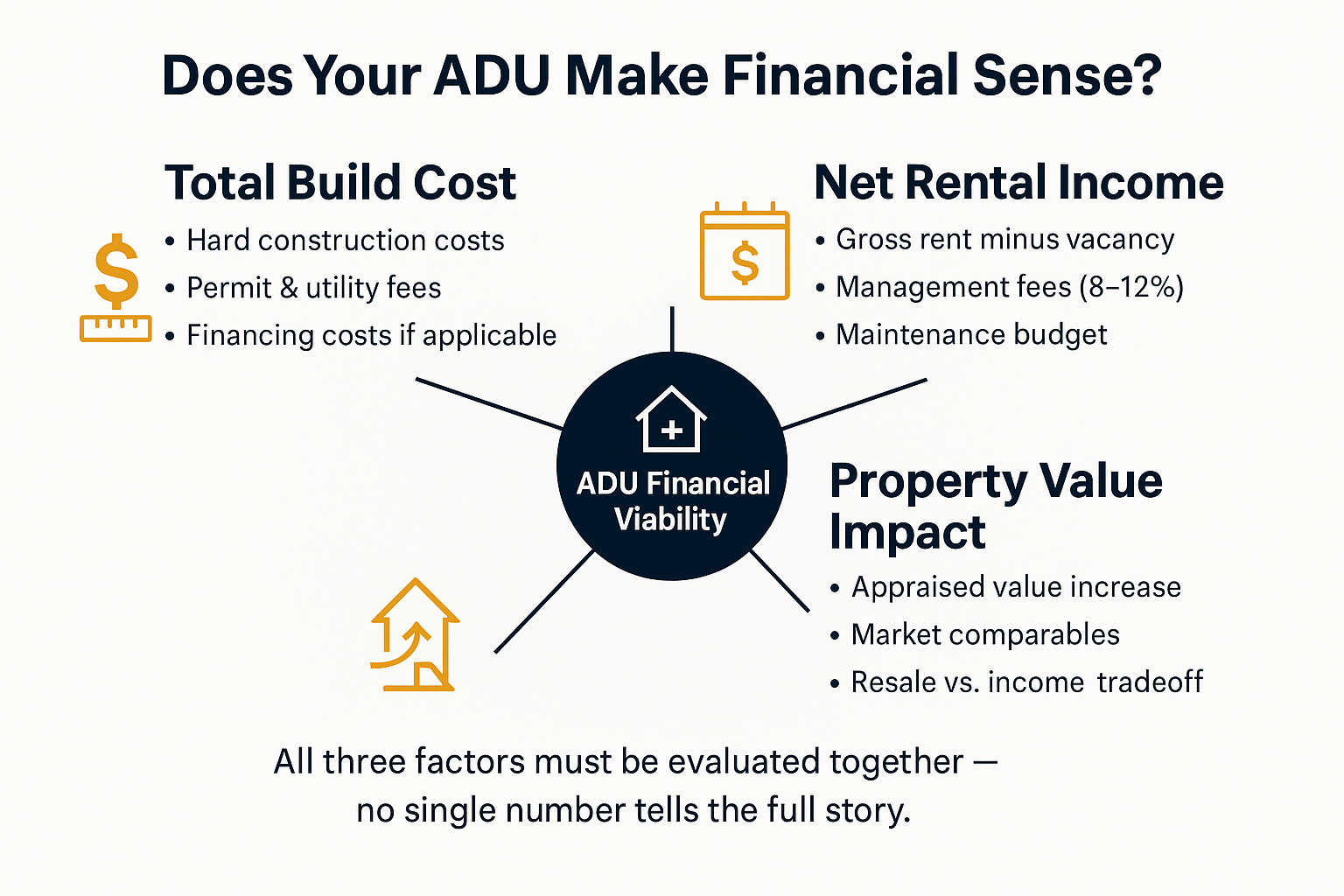
The Three Factors That Determine ADU Financial Viability
These are the three questions every Monterey County homeowner should answer before committing to an ADU project.
Property Value: How ADUs Affect What Your Home Is Worth
Rental income isn’t the only financial return an ADU delivers. For many homeowners on the Monterey Peninsula, the more compelling argument is what the ADU does to their property’s appraised value when they eventually sell.
ADUs generally add value — but appraisers don’t always capture the full construction cost in the appraised value, especially for detached new-build units. A $300,000 ADU might increase your home’s appraised value by $150,000–$220,000, depending on market comparables in your specific neighborhood. In Carmel Valley, where lot sizes support detached structures and buyer demand for multi-use properties is strong, the value bump tends to be more favorable than in denser urban pockets of Seaside.
There’s also the question of who your future buyer is. A buyer who wants the ADU for rental income will value it differently than a buyer who wants it for a parent or adult child. Why Monterey homeowners are turning to ADUs for multigenerational living explains how that segment of the market is growing — and it matters for resale.
One honest caveat: if your primary goal is resale value, not rental income, a well-executed kitchen remodel or primary suite addition might generate a stronger per-dollar return than a detached ADU. The right answer depends on your timeline, your equity position, and how long you plan to stay in the home.
The Site Constraints That Can Kill the Math Before You Start
Even when the numbers look good on paper, your specific lot may introduce costs or limitations that change the calculation entirely. This is where a lot of homeowners get surprised.
Some of the most common site constraints that affect ADU financial viability in Monterey County:
- Setback requirements — most cities require the ADU to sit at least 4 feet from rear and side property lines, which limits placement on smaller lots
- Lot coverage limits — adding an ADU footprint may push your total coverage over what your zoning allows
- Septic systems — properties in Carmel Valley and Prunedale on septic may need a system upgrade or expansion to accommodate an additional unit, adding $15,000–$40,000 or more
- Utility laterals — if your water or sewer lateral is undersized, a new ADU connection may require a full lateral replacement
- Slope and grading — hillside lots common in Pacific Grove and Pebble Beach can require engineered foundations and significant grading work
These aren’t reasons not to build. But they are reasons to get a thorough pre-construction evaluation before you commit. Why many ADU projects run into problems before construction even starts goes deeper on the planning phase issues that catch homeowners off guard.
A contractor who does hands-on project management should be flagging these constraints at the estimate stage — not after the permits are pulled.
Frequently Asked Questions About ADU Financial Returns
How long does it take for an ADU to pay for itself in Monterey County?
For a garage conversion or JADU, you’re typically looking at 4–8 years to break even on the construction cost through rental income. For a detached new-build ADU in the $280,000–$350,000 range, that payback period stretches to 12–18 years — longer if you financed the construction. Whether that timeline is acceptable depends entirely on your goals. If you’re planning to stay in the home long-term or pass it on, the math often still works. If you’re thinking about selling in five years, the rental income alone probably won’t recoup the investment.
Does building an ADU increase property taxes?
Yes. In California, adding an ADU triggers a partial reassessment — but only on the value of the newly constructed ADU, not your entire property. Your existing home’s assessed value stays the same. The tax increase is typically proportional to the ADU’s added value, so a $150,000 value increase would add roughly $1,500–$1,800 per year in property taxes at current rates.
Is a JADU or garage conversion a better financial decision than a detached ADU?
For most homeowners, yes — when the primary goal is rental income. The lower construction cost means a shorter payback period, even if the rent is somewhat lower than a detached unit. How to convert a garage to living space covers what that process looks like in practice. The tradeoff is that a smaller or attached unit may generate less property value appreciation than a well-built detached ADU.
What if I want the ADU for family use, not rental income — does it still make financial sense?
It can, but the analysis shifts. Instead of calculating rental income payback, you’re looking at whether the ADU is more cost-effective than other housing alternatives for your family member — like renting a separate apartment in Monterey, where 1-bedroom rents average $2,200–$2,600/month. Over 5–7 years, avoiding that rent can justify a significant construction cost. The property value benefit is still there regardless of how you use it.
Do I need a separate water meter for an ADU in Monterey County?
Not always, but the Monterey Peninsula Water Management District regulates fixture unit allocations for any project adding plumbing — and this applies to ADUs. Whether you need a separate meter depends on your jurisdiction and the ADU type. This is one of the local cost variables that makes Monterey County ADU budgeting different from most other California markets. Your contractor and the relevant building department can clarify what applies to your specific parcel.
Should I get multiple bids before committing to an ADU?
Yes — and pay attention to how each contractor handles the estimate. A bid that’s significantly lower than others usually means something isn’t included. What homeowners should ask before signing with any contractor has a solid list of questions that help you evaluate whether a proposal is realistic or just competitive-looking on the surface.
Thinking Through an ADU for Your Monterey County Property?
The financial picture for an ADU depends on details that are specific to your lot, your city’s permit requirements, and your goals — not on general rules of thumb. Palacios Construction works with homeowners across the Monterey Peninsula through the planning and pre-construction phase to help them understand realistic costs before any commitments are made. If you’re at the evaluation stage and want a straightforward conversation about what your project would actually involve, reach out at (831) 220-3334 or visit palaciosconstructionca.com.