
Quick Answer
The cost of a master suite addition depends less on a generic online average and more on the specific conditions of your home and site. In Monterey County, the biggest cost drivers are usually the size of the addition, how the new structure ties into the existing house, whether the project includes a full bathroom and walk-in closet, the level of interior finishes, and local factors like Coastal Zone permits, seismic requirements, and hillside or drainage-related foundation work. For most homeowners, the right way to budget is to start with a realistic scope, expect permitting and engineering to be part of the process, and work from a detailed estimate rather than a rough price-per-square-foot guess.
If you're considering the cost of master suite addition work in Monterey County, you're probably trying to answer one question first. What is this really going to cost once permits, engineering, site work, and finish selections are all included?
That question matters because a master suite is not a simple room add-on. It combines structure, roofing, plumbing, electrical, HVAC, waterproofing, and finish work in one project, and local conditions from Salinas to Carmel can change the budget fast. Homeowners who are staying put are asking this more often, especially as the stay and renovate trend continues shaping homeowner decisions.
Introduction
A lot of homeowners start with an online calculator and get a number that feels workable. As the project takes shape, they discover factors like lot slope, older framing, permit path, or bathroom layout change the budget more than the room size itself.
In Monterey County, that gap between a rough estimate and a real estimate is usually where the frustration starts. Coastal review, hillside drainage, older homes, and stricter structural requirements all affect the final scope. A practical budget has to account for those conditions from the beginning, not after drawings are done.
A master suite addition also sits in a different category than a basic bedroom. Nationally, labor accounts for 40-60% of an addition's total cost, and a master suite is among the most expensive additions because it combines a bedroom with a full bathroom and the plumbing, electrical, and HVAC that go with it (getasiteplan.com). That difference is why simple room-addition averages don't tell the full story.
Practical rule: If the new space includes a bathroom, don't budget it like a bedroom addition. You're building a small system inside the house, not just four walls and a roof.
Ballpark Budgets for a Monterey County Master Suite
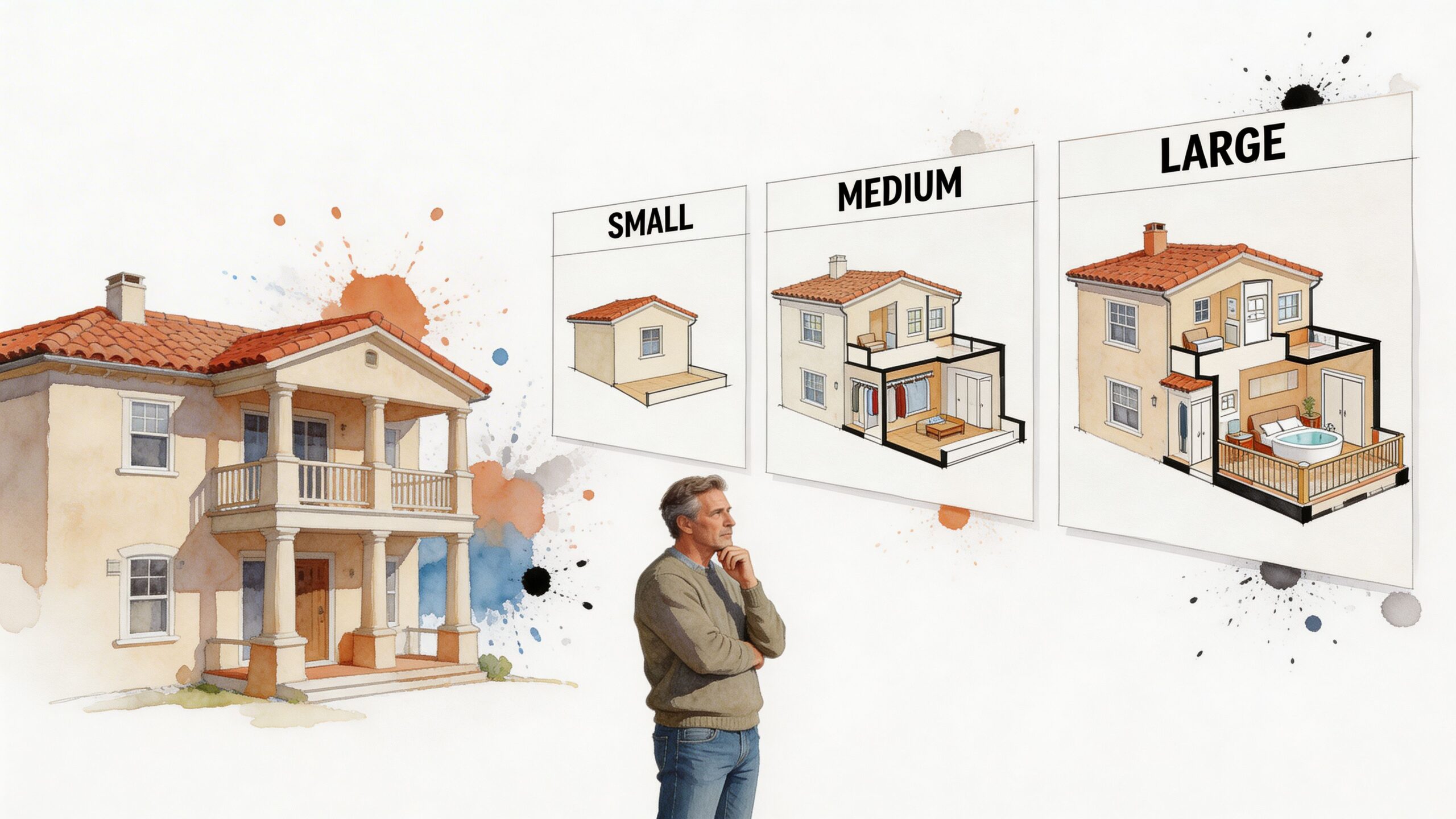
A useful way to think about budget is by scope tier, not by chasing one statewide average. The room size matters, but the structural tie-in, bath layout, and finish level usually matter just as much.
In Salinas, which is a useful local baseline, a standard-grade master suite addition costs $125.97 to $200.10 per square foot for basic construction, with an average of $163.04 per square foot. That baseline includes standard materials, permits, labor, and waste removal, but it does not include design work, premium finishes, or more complex foundation conditions that are common in coastal and hillside locations (ProMatcher, 2026).
Small bump-out suite
A smaller suite is usually the most controlled version of this project. Think of a compact bedroom, a straightforward bath, standard windows, and a simple roof extension that doesn't require major reworking of the existing house.
This kind of addition works best on a flat lot with direct access and a clean tie-in to the existing plumbing and framing. If you're comparing this to an ADU, the trade-offs are different, and it's worth reviewing how local homeowners think through ADU cost in Monterey, CA because the utility and permitting paths are not the same.
Mid-range primary suite
Many Monterey County projects fall into this category. The room is larger, the bathroom gets more comfortable, the closet becomes part of the layout, and the roof and exterior integration usually become more involved.
A mid-range addition often includes more than square footage. It may require new headers, reworked roof geometry, better exterior matching, and more careful planning around how the addition meets the existing house so it doesn't look tacked on.
Large or custom suite
A large suite changes the house more substantially. The bath may include a larger shower, separate fixture zones, or more custom tile work. Window packages, doors, trim details, and exterior materials also tend to move away from standard selections.
These projects also carry more structural risk. Once the addition gets larger, the contractor may need to address load paths, deeper engineering review, more extensive roof revisions, and longer utility runs.
| Scope tier | Typical project character | What usually drives the jump |
|---|---|---|
| Small | Ground-floor bump-out, standard bath, basic roof tie-in | Plumbing tie-in and finish choices |
| Mid-range | Full suite with closet, stronger exterior integration | Structural tie-ins, roof work, bath complexity |
| Large or custom | Major rework, custom bath, more architectural detailing | Engineering, premium materials, broader disruption to the home |
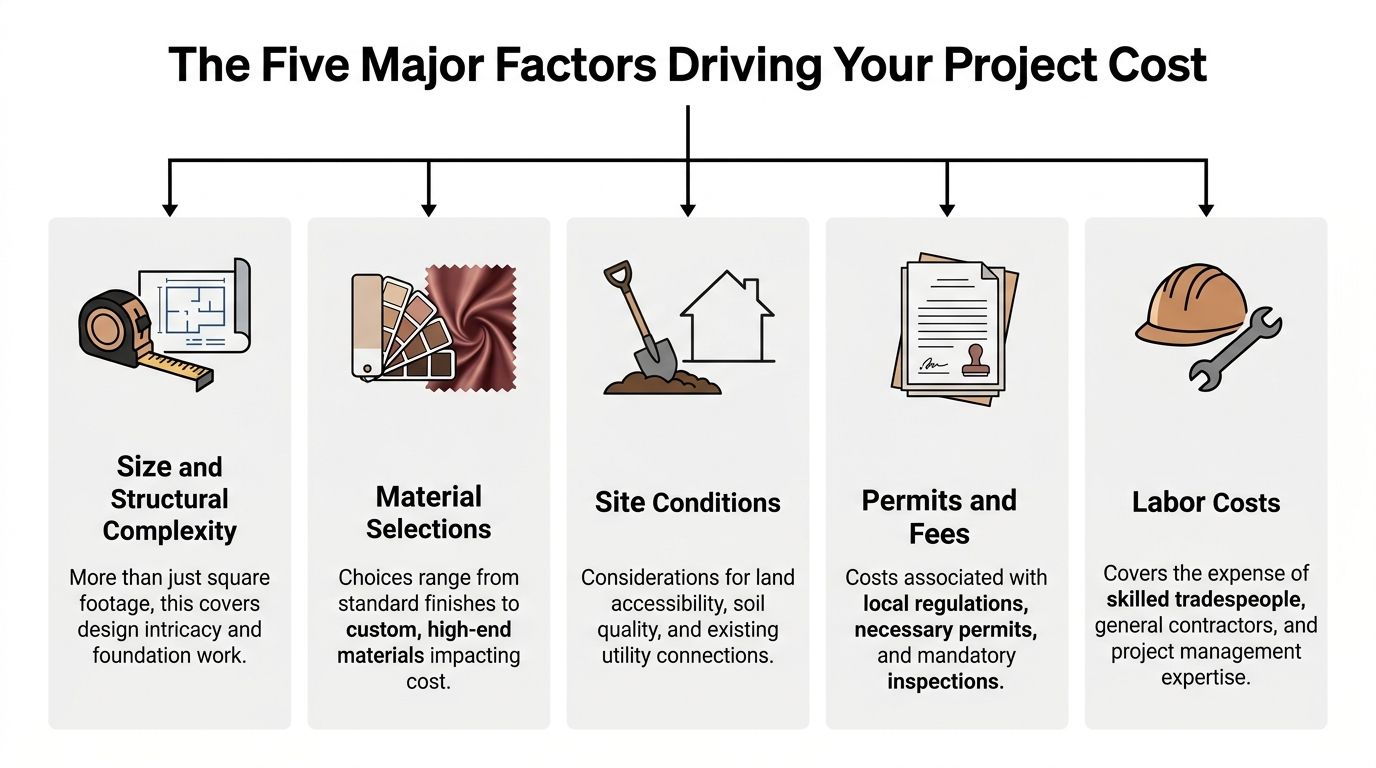
The Five Major Factors Driving Your Project Cost
A master suite addition in Monterey County can look straightforward on paper and still shift hard in price once the house, lot, and permit path are examined. The same 400 square feet costs one number on a flat inland lot and a very different number in Carmel Highlands, Pacific Grove, or on a sloped parcel in Monterey with limited access.
Size and structural complexity
Square footage is only the starting point. What matters more is how the new suite ties into the existing house.
A simple bump-out with a clean roof connection, clear foundation access, and straightforward framing is usually more predictable. Costs rise when the addition cuts into an older roof structure, removes bearing walls, requires large headers, or forces engineers to rework load paths. That comes up often in older Monterey and Pacific Grove homes, where previous remodels, undersized framing, or deferred repairs show up after demolition.
Second-story work increases that structural risk. So does any design that opens the existing house significantly to create a larger primary suite feel instead of just adding a room.
Foundation and site work
Site conditions move budgets fast. On a flat lot with room for excavation and material staging, crews can work efficiently and inspections tend to stay straightforward. On a hillside site, a narrow coastal parcel, or a backyard with poor equipment access, labor hours increase before the first wall is framed.
In Monterey County, foundation cost is often tied to the site as much as the suite itself. Sloped grades can require stepped footings, retaining work, drainage improvements, or more involved engineering. Sandy soils near the coast, expansive soils in some inland areas, high groundwater, and erosion concerns all change how the foundation is designed and built.
This is one of the places where early planning saves real money. A permit set that reflects actual site conditions avoids expensive revisions later. That is why permit-ready pre-construction planning in Monterey County matters before the project is priced too aggressively.
Build for the actual lot conditions. If drainage, access, or soil issues are ignored at bidding, the correction usually shows up later as a change order.
Utilities and bathroom systems
The bathroom drives a large share of the budget because it concentrates trades in one area. Water lines, drains, venting, waterproofing, electrical circuits, exhaust, lighting, heating, and finish coordination all have to work together.
The hard cost depends on where those connections are. If the new suite backs up to existing plumbing and the electrical panel has open capacity, the work is more direct. If the addition is on the far side of the house, over a crawlspace with poor access, or above an older first floor that was never framed for new plumbing runs, labor goes up quickly.
In older Monterey County homes, utility upgrades are common. I often see panels that need replacement, undersized drain lines, and HVAC systems that were already at capacity before the addition was considered.
Finish level
Finish selections can change the final cost as much as layout decisions. A standard vanity, acrylic shower base, basic lighting, and stock plumbing fixtures keep the budget under better control. Custom cabinetry, large-format tile, curbless shower detailing, premium windows, and specialty hardware push both material and labor costs higher.
Bathrooms are where homeowners usually feel this jump first. Tile layout, waterproofing details, glass enclosures, niche work, heated floors, and upgraded plumbing trim all add time. None of those items are wrong. They just need to be priced accurately from the start.
Late selections also create avoidable cost. If finishes are still undecided after plans are approved, allowances tend to be too low or too vague to hold the number.
Ground floor versus second story
For many properties, this choice determines the budget more than any single finish upgrade. Ground-floor additions are usually simpler to build because crews can work from the exterior, foundations are direct to inspect, and the house often stays more livable during construction.
Second-story additions preserve yard space, which matters on smaller lots in Seaside, Marina, and parts of Monterey. They also bring more structural work, more disruption to the existing house, and more coordination around stairs, roof removal, fire separation, and mechanical routing. On older homes, engineers may require substantial reinforcement below before the new suite can be added above.
What usually works best
- Flat lot with usable side or rear yard: Ground-floor construction is often the cleaner and more cost-stable option.
- Tight lot where open space is limited: A second-story addition may make sense, but only after the existing structure is checked carefully.
- Older house with uncertain framing or foundation capacity: Start with structural evaluation before assuming building up will save money.
- Coastal or hillside property: Expect site constraints, access limits, and engineering requirements to shape the design early.
Navigating Permits and Site-Specific Costs in Monterey County
A master suite addition in Monterey County can look straightforward on paper and still get expensive fast once the property itself enters the conversation. I see that on coastal lots, older homes near downtown Monterey and Pacific Grove, and hillside parcels in Carmel Valley and above Highway 68. The square footage is only part of the price. Permit path, site conditions, and structural requirements often decide whether the original budget holds.
Projects near the coast often face more review than homeowners expect. Exterior changes may trigger design comments. Older homes may need closer structural review when new loads tie into original framing. Some properties also fall under coastal rules that add another layer of approval before work can start. For that reason, design and pre-construction planning for permit-ready projects in Monterey matters because incomplete drawings usually lead to plan check corrections, redesign, and extra holding costs.
Site work is another place where generic cost guides miss the exact cost. A flat lot in Marina is one thing. A sloped backyard in Monterey with tight access, retaining needs, and drainage work is another. On hillside sites, crews may need smaller equipment, more hand work, more engineering, and a foundation design that responds to soil movement and runoff instead of assuming standard trench footings will work.
Coastal exposure changes material decisions too.
Fog, wind, and salt air are hard on exterior assemblies. Fasteners, flashing, trim details, siding, and window packages need to be selected for that environment, especially in Pacific Grove, Pebble Beach, and other exposed locations. Cheaper materials can reduce the bid number at the start and raise repair costs later.
Seismic work is also a real cost driver in this county. Many additions need more than a simple tie-in to the existing house. Engineers may call for new shear walls, hold-downs, collector framing, foundation reinforcement, or diaphragm work so the old house and new suite perform as one structure during seismic movement. In older homes, that connection work can cost more than homeowners expect because the existing framing rarely matches current assumptions.
Permit costs by themselves do not usually sink a project. The bigger problem is going into plan check with missing engineering, unresolved site issues, or drawings that do not reflect how the house is built. That is where budgets start slipping.
A Realistic Timeline for Your Master Suite Addition
A homeowner in Carmel approves plans in spring and hopes to sleep in the new suite by summer. On paper, that sounds reasonable. In Monterey County, the typical schedule usually runs longer because design, plan check, site conditions, inspections, and finish selections all affect the calendar before the room is ready to use.
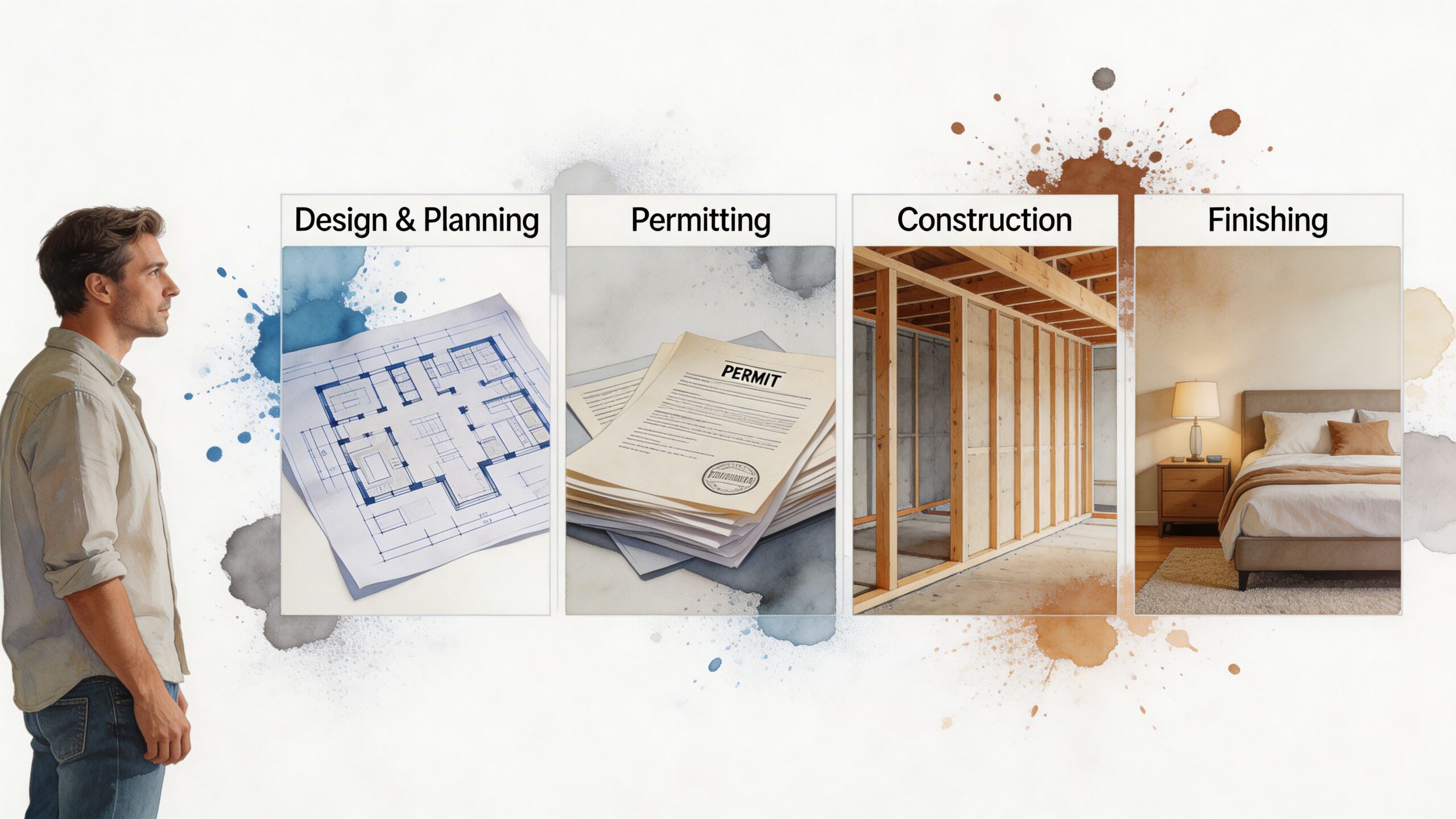
Phase one with planning and scope lock
The first phase is deciding exactly what is being built. Room size, bathroom layout, window placement, structural direction, and finish level need to be settled enough for drawings and engineering to stay aligned.
Rushed decisions cost time later.
I see this often with additions that start from a rough sketch and then change after pricing, after engineering, or after plan check comments come back. Every revision affects someone downstream. The designer updates plans, the engineer revises details, the estimator rechecks numbers, and the permit set may need another round. Homeowners who have already lived through a major renovation usually understand this, which is why it helps to set expectations early by looking at how long a whole house remodel usually takes.
Phase two with permitting
Permitting is usually the hardest part to predict. Review times vary by jurisdiction, and Monterey County projects can slow down quickly when the property has coastal constraints, hillside conditions, drainage questions, or older records that do not match the house as built.
A straightforward addition in a less constrained area can move through review with relatively minor corrections. A project in Monterey, Pacific Grove, or an unincorporated coastal area may need more back-and-forth, especially if planning, structural, and site comments overlap. The permit itself is only part of the schedule. Revisions, resubmittals, and waiting for clear direction from multiple departments often take longer than homeowners expect.
Phase three with construction
Once permits are issued, the field schedule follows a sequence that still has some built-in uncertainty. Crews typically move from site prep and layout to foundation work, framing, dry-in, rough mechanicals, insulation, drywall, tile, cabinetry, paint, finish carpentry, and fixture installation.
Some parts move fast. Others do not.
Concrete inspections, framing corrections, special-order windows, custom shower glass, and finish materials can all affect the handoff from one trade to the next. On occupied homes, production also slows down because crews need to protect the existing house, maintain safe access, and keep utilities working while the addition is tied in.
Phase four with inspections and closeout
The last phase includes final inspections, punch-list work, paperwork, and cleanup. That period is easy to underestimate because the room may look finished before every item is complete.
Final sign-off often depends on smaller details. Hardware may still need to be installed, paint touch-ups may be pending, or an inspector may call for one correction before approval. Closing out a project properly takes coordination, especially when the suite includes a bathroom, HVAC tie-in, and new electrical work.
What slows projects down most often
- Plan changes after drawings are underway: Late layout or finish decisions create revisions that push both permit review and construction.
- Permit comments from multiple departments: Planning, building, public works, or fire comments can stack on the same project.
- Lead times on selected materials: Windows, plumbing fixtures, specialty tile, and custom glass often control the finish schedule.
- Existing house conditions discovered during work: Rot, undersized framing, old wiring, or hidden plumbing changes can interrupt the planned sequence.
- Limited access and occupied-home logistics: Tight side yards, steep lots, and daily family use all reduce how quickly crews can work.
Sample Scope of Work and Budgeting Considerations
A 400 square foot master suite addition on a 1970s Monterey house can start as a simple sketch and end up touching nearly every part of the property. The bedroom, bathroom, and closet are only the visible pieces. The full budget comes from what has to happen underneath, behind the walls, and at the connection point to the existing house.
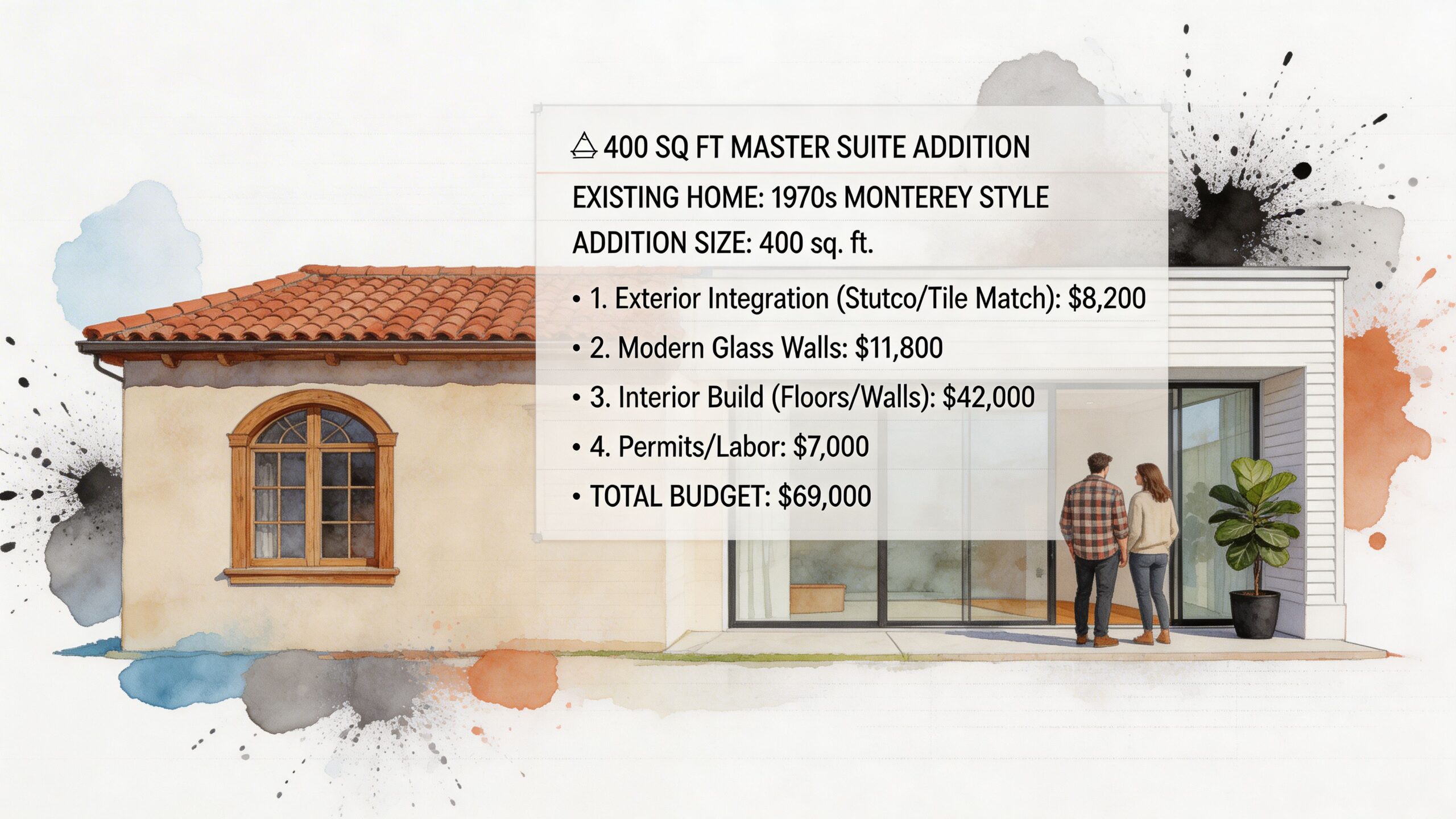 home renovation featuring a 400 square foot master suite addition project cost.” />
What the estimate usually includes
A usable estimate starts with pre-construction work, not lumber and drywall. That means measured plans, drafting, structural engineering, Title 24 coordination where required, permit submittals, plan check responses, and revisions if Monterey, Pacific Grove, Carmel, or the County asks for changes. On coastal lots or homes with slope issues, that front-end work gets larger fast.
Then come the site and shell costs. These usually include demolition, protection of the occupied home, excavation, grading, spoils haul-off, temporary access, foundation work, framing, roof tie-in, sheathing, weather barrier, windows, roofing, siding, and exterior trim. If the lot has tight side-yard access or the addition sits on a hillside, labor goes up because crews and materials cannot move efficiently.
The bathroom is usually the cost center. Plumbing rough-in, drain and vent work, hot water routing, dedicated electrical circuits, lighting, exhaust, GFCI protection, HVAC extension, and possible panel upgrades add real money before any finish materials go in. On older Monterey County homes, the connection to the existing structure can also trigger structural corrections such as new shear transfer, hold-downs, foundation reinforcement, or framing changes where the new roof and walls tie into the old house.
Those items are easy to miss on a sketch plan. They are not optional in the field.
Interior scope that changes budgets quickly
Interior selections create the biggest spread between a controlled budget and a drifting one. The difference is not just luxury versus basic finishes. It is also labor.
- Bathroom assembly: Shower pan and waterproofing system, wall tile layout, floor tile, niche details, glass enclosure, vanity, countertop, mirrors, plumbing trim, and accessories
- Bedroom finish work: Flooring, paint, interior doors, baseboards, casing, closet shelving, lighting, and hardware
- Exterior integration: Matching the existing roof profile, siding pattern, trim depth, window style, and paint so the addition does not look patched on
- Final completion: Fixture installation, startup and testing, punch-list corrections, final cleaning, and closeout documentation
In Monterey County, exterior matching can cost more than homeowners expect. A straightforward stucco patch is one thing. Matching older siding exposure, custom trim profiles, aging roof lines, or coastal-grade window and flashing details is another. If the house sits in a high-wind or high-exposure area, the waterproofing and exterior detailing need to be better than average, especially around large windows and roof intersections.
A good budget also carries a contingency for hidden conditions. Once work opens up a 1970s wall or crawlspace, crews sometimes find undersized framing, outdated wiring, old galvanized plumbing, moisture damage, or foundation issues near the tie-in area. That does not mean every house has a problem. It means the budget should reflect the age of the structure and the chance of corrections once the work starts.
Homeowners should ask for an estimate detailed enough to show quantities, allowances, exclusions, and who is responsible for each part of the job. That level of detail usually comes from working with a licensed general contractor who manages scope, sequencing, and code compliance.
A reliable estimate lets you see how the suite will actually be built, from drawings and excavation through finish work and final inspection. If the scope is thin, the budget usually is too.
Financing Your Addition and Protecting Your Investment
Most homeowners pay for a master suite addition through some mix of savings, a HELOC, a cash-out refinance, or a construction loan. The right option depends on your broader financial picture, so this is a good place to talk with your lender early instead of waiting until plans are nearly complete.
The bigger point is that financing and value are connected. A master suite can improve daily use of the home, support long-term living, and make the property more functional for changing family needs. But the value holds better when the work is built correctly and documented through a proper permit process.
Cutting corners to reduce the initial cost of master suite addition work is where homeowners often lose money later. Poor waterproofing, weak structural tie-ins, bad ventilation, or mismatched exterior detailing usually don't stay small problems.
If you're putting significant money into an addition, it's worth understanding why hiring a licensed general contractor matters. The job isn't just to build. It's to coordinate the sequence, manage risk, and keep the project aligned with code, scope, and long-term durability.
Frequently Asked Questions About Master Suite Additions
Q: Can I save money by acting as my own general contractor?
A: Sometimes on paper, yes. In practice, most homeowners underestimate how much coordination is involved with scheduling trades, inspections, materials, and problem-solving when existing conditions change. On a master suite addition, one sequencing mistake can delay several trades behind it.
Q: Does a master suite addition always increase my property taxes?
A: A permitted addition generally leads to reassessment of the value added by the improvement. That means homeowners should plan for some increase in property taxes after completion. The exact amount depends on how the county assessor values the new work.
Q: Is it cheaper to build a detached ADU than an attached master suite?
A: Not automatically. An ADU can involve separate utility requirements and different zoning issues, while an attached suite has to integrate structurally and visually with the existing house. The better option depends on whether you need private independent living space or more room in the main home.
Q: How much does finish selection affect the final cost?
A: A lot. Tile, windows, shower construction, cabinetry, hardware, and lighting can move the budget quickly even when the room size stays the same. Making those decisions early helps keep the estimate more accurate.
Q: Should I build up or build out?
A: If you have the lot space, building out is often simpler and less disruptive. Building up can preserve yard area, but it usually brings more structural review, more disruption inside the house, and more complexity overall.
Q: Can we live in the house during construction?
A: In many cases, yes, especially for a ground-floor addition with a controlled work area. It depends on access, how much of the existing house must be opened up, and how the contractor manages dust, safety, and utility interruptions.
Q: Why do online calculators feel so far off?
A: Most calculators don't know your site's slope, permit path, structural condition, or how far the bathroom is from existing utilities. They also don't account well for older Monterey County homes where tie-ins can be more involved than expected.
Palacios Construction approaches additions the way they should be approached in Monterey County. With careful planning, realistic scopes of work, and hands-on management from start to finish. That matters on projects where permitting, structural tie-ins, and occupied-home logistics all need to be handled correctly the first time.
The company stays focused on residential work and limits project load so communication and quality control don't get stretched thin. For homeowners planning a master suite addition, that kind of direct oversight usually makes the process more predictable and the finished work more durable.
If you're weighing the cost of master suite addition work and want a clear conversation about scope, site conditions, and what your home can realistically support, Palacios Construction is available to talk through the project, provide an estimate, and help you plan the next step. You can also visit the office at 222 Ramona Ave Unit 5, Monterey, CA, or reach out through palaciosconstructionca.com.
Sources
ProMatcher. "Salinas, California Home Addition Cost." 2026. https://additions.promatcher.com/cost/salinas-ca-additions-costs-prices.aspx
Get A Site Plan. "Room Addition Cost." 2025. https://getasiteplan.com/room-addition-cost/
HomeAdvisor. "Bedroom Addition Cost." 2025. https://www.homeadvisor.com/cost/bedrooms/
GreatBuildz. "Room Addition Costs in the Bay Area." 2025. https://www.greatbuildz.com/blog/room-addition-costs-bay-area/
A2Z Construction Management. "Master Suite Addition Cost." 2024. https://a2zconstructionmgmt.com/home-renovation-blog/master-suite-addition-cost