
Direct Answer: The right contractor for your project has a current CA license, experience with your specific project type, clear answers about permits, and a proposal that explains every cost line by line.
Most homeowners in Monterey County don’t struggle to find a contractor. They struggle to figure out which one to actually trust with a $60,000 kitchen remodel or a $200,000 home addition. There are licensed contractors, unlicensed ones, general contractors, specialty subs, and everything in between — and they all sound pretty similar on the phone.
The questions that matter most aren’t the obvious ones. License status is a starting point, not an answer. What actually tells you whether a contractor is right for your specific project is how they handle the details: how they build a proposal, who manages day-to-day work, and whether they understand the permit environment in your city.
This guide covers the three areas where fit becomes clear: verifying credentials properly, reading a proposal for red flags, and understanding how project management actually works on a well-run job. These aren’t soft signals — they’re the things that predict whether your project goes smoothly or sideways.
What to Actually Check When Verifying a Contractor’s License
California requires general contractors to hold a valid B license through the Contractors State License Board. But a license number on a business card doesn’t tell you much by itself. You need to look it up.
Go to the CSLB license lookup tool at cslb.ca.gov and search by name or license number. What you’re looking for:
- License status — should say “Active,” not expired or suspended
- Bond and workers’ compensation status — both should be current
- Disciplinary actions — any complaints, citations, or prior suspensions on record
- License classification — a B general contractor license covers most residential remodeling; specialty-only licenses (like C-8 concrete or C-36 plumbing) do not
For a project in Carmel-by-the-Sea or Pacific Grove, this matters even more. Both cities have their own design review processes, and a contractor who hasn’t pulled permits in those jurisdictions before may underestimate what’s involved. That can cost you weeks of delay and unexpected fees before a single wall comes down.
One more thing: ask directly whether the contractor carries general liability insurance with your project listed as an additional insured. A license and a bond are not the same as liability coverage. If they hesitate on this question, that tells you something.
How to Read a Contractor Proposal Without Getting Misled
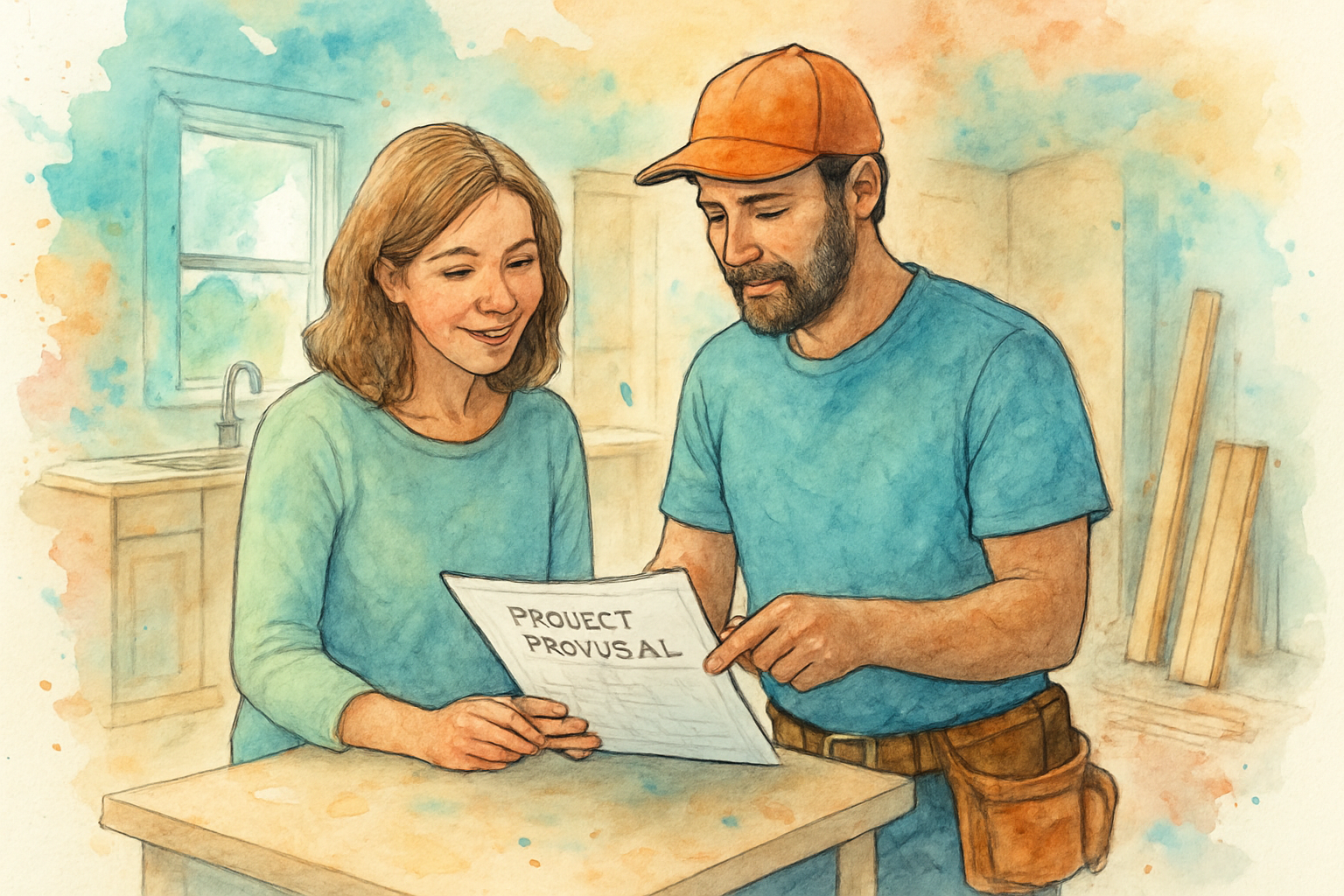
A proposal is where most homeowners get tripped up. A low number looks appealing. But a low number with vague line items almost always means one thing: change orders later.
A well-built proposal should break out costs by category. You should be able to see labor, materials, subcontractor work, and finish allowances listed separately. If the proposal says “kitchen remodel — $58,000″ with no further detail, that’s not a real proposal. It’s a starting point that gives the contractor room to charge more as the project moves forward.
Pay specific attention to finish allowances — the dollar amounts assigned to items like tile, fixtures, cabinetry, and countertops. These should reflect what things actually cost. A $500 allowance for a kitchen faucet in a Pebble Beach home isn’t realistic. If you swap it for something in the $900 range (which is standard for mid-grade fixtures in this market), that $400 difference comes back to you as a change order. Multiply that across ten finish categories and you understand how hidden expenses catch Monterey homeowners off guard.
When comparing two proposals, make sure you’re comparing the same scope. Ask both contractors:
- Are permit fees included, or billed separately?
- What is the allowance for each finish category, and what product does that represent?
- Are subcontractors already priced in, or estimated?
- What’s the process if the actual cost of a line item is higher than the estimate?
A contractor who can answer those questions specifically — without hesitation — is a better sign than a polished pitch and a low number.
Proposal Red Flags vs. Signs of a Solid Bid
When you’re reviewing two or three bids side by side, these markers can help you separate a well-planned proposal from one that’s likely to grow after you sign.
| What You See in the Proposal | Red Flag | Good Sign |
|---|---|---|
| Line item detail | Lump sum with no breakdown | Labor, materials, and allowances listed separately |
| Finish allowances | Vague or missing | Specific dollar amounts with product examples |
| Permit fees | Not mentioned | Included or itemized as a separate line |
| Subcontractor work | “Included” with no detail | Named trades priced individually |
| Change order policy | Not addressed | Written process explained upfront |
| Payment schedule | Large deposit, vague milestones | Tied to specific project milestones |
The Four Questions That Reveal Contractor Fit
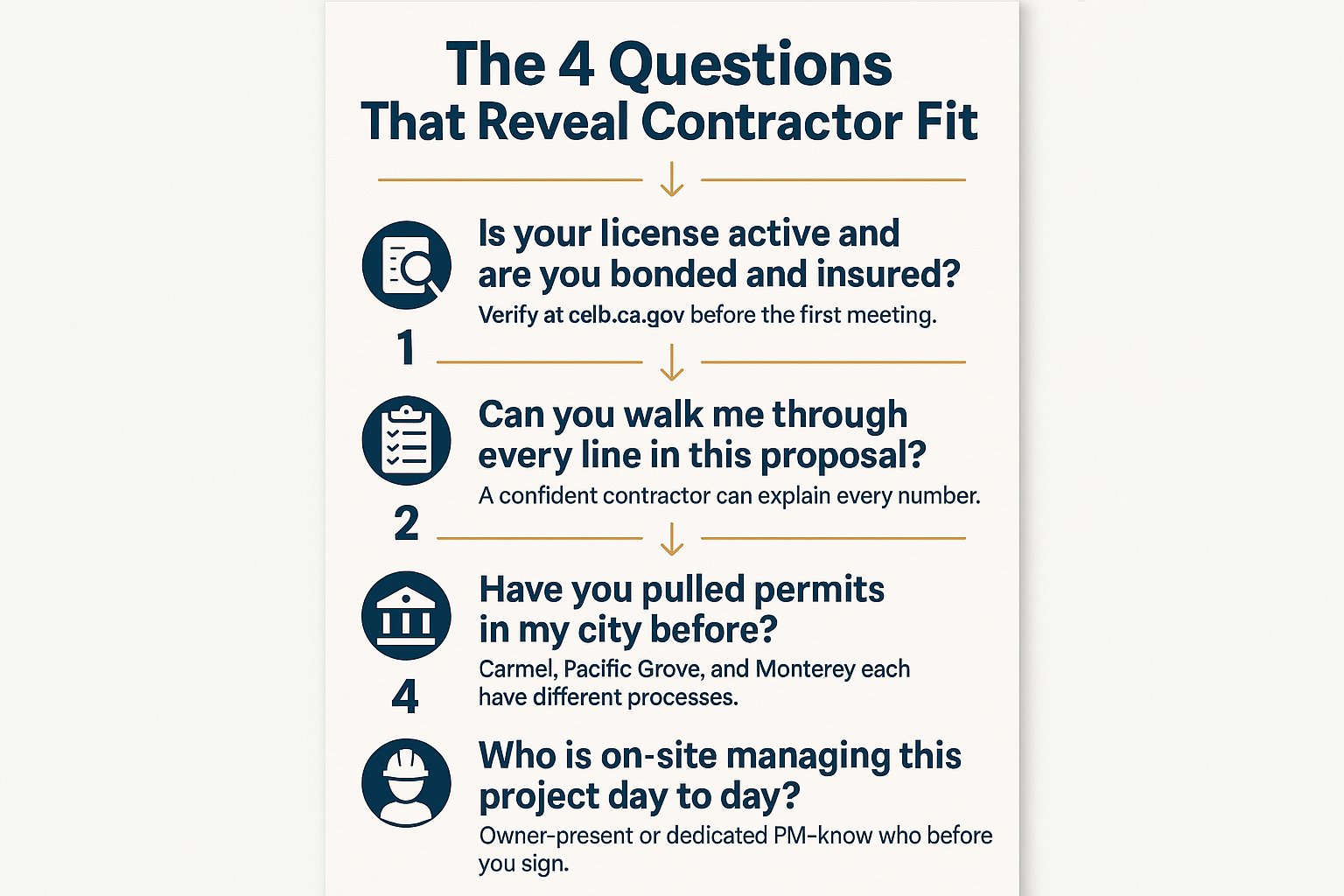
Before you sign with any contractor, these four questions cut through the noise and show you what you’re actually working with.
Who Is Actually Managing Your Project — and Why It Matters
This is the question most homeowners don’t think to ask until they’re three weeks into a remodel and can’t get a straight answer about why the tile hasn’t shown up.
General contractors operate differently. Some have a dedicated project manager on every job. Some rely on the lead carpenter to manage subcontractors. Some — especially smaller operations — are owner-led, meaning the person who sold you the job is also on-site managing the work. None of those models is automatically better, but you need to know which one applies to your project before anything starts.
For a bathroom remodel or kitchen remodel in Monterey, this matters because the job involves multiple trades — demo, framing, plumbing, electrical, tile — and someone has to coordinate the sequence. If a plumber runs two days late, does anyone know to push back the tile installer? If they don’t, you pay for a subcontractor to show up and stand around. That cost comes back to you as a change order or simply as time lost.
Good questions to ask:
- Who will I contact when I have a question during construction?
- How often will I get a project update, and in what format?
- If a subcontractor is behind, who owns that conversation?
Hands-on project management throughout every phase of the work — not just at kickoff — is what separates a project that finishes on time from one that drags six weeks past the original schedule. Ask for references specifically from homeowners whose projects were similar in scope to yours, and ask them directly whether communication was consistent throughout the job.
Local Knowledge Is a Real Differentiator in Monterey County
A contractor who has done most of their work in Salinas may not be the right fit for a project in Pacific Grove or Carmel-by-the-Sea — not because they’re less skilled, but because those cities have specific requirements that take experience to manage well.
Carmel-by-the-Sea has a design review process for exterior changes that goes through the City’s Planning Department. Pacific Grove has its own historic preservation considerations in certain neighborhoods. And both cities — along with Monterey — fall under the Monterey Peninsula Water Management District, which means any project that adds or modifies plumbing fixtures requires a water permit in addition to a standard building permit. That’s an extra step that catches out-of-area contractors off guard, and it can stall a project by several weeks if it isn’t handled early.
For larger projects — additions, ADUs, or second story work — local plan check experience matters even more. A contractor who has already navigated the permit process for home remodeling in Monterey knows which details trigger extra scrutiny and how to prepare drawings that move through plan check without multiple revision cycles. That knowledge alone can shave four to six weeks off a project timeline.
When you’re interviewing contractors, ask specifically: Have you pulled permits with the City of [your city] in the last two years? And: Are you familiar with MPWMD water permit requirements? If they look uncertain, that’s useful information.
Scope Experience: Does This Contractor Actually Do This Type of Work?
A general contractor‘s B license covers a wide range of residential work, but experience within that range varies significantly. A contractor who primarily does decks and patios may not be the right fit for a home addition that involves structural engineering, foundation work, and a multi-phase permit process.
Ask about completed projects in the same category as yours, not just projects of similar dollar value. A $150,000 kitchen-and-bath renovation is a very different undertaking than a $150,000 detached ADU. The permit process is different, the trades involved are different, and the risk profile is different.
Request photos and ask if you can speak with a past client whose project matches yours in type and scale. A contractor who does well-planned, professionally managed projects regularly will have references ready. One who hesitates or offers only general references from years ago may not have the depth of experience your project needs.
For context: an ADU project in Monterey County typically involves site plan review, utility coordination, structural drawings, and a permit process that runs three to six months before construction starts. A contractor who hasn’t done this before is learning on your project — and you’re paying for that learning curve.
Frequently Asked Questions About Hiring a Contractor in Monterey County
How do I verify a contractor’s license in California?
Go to cslb.ca.gov and use the license lookup tool. Search by name or license number. Check that the license is active, the bond is current, and workers’ comp coverage is listed. Look for any disciplinary history while you’re there — it’s all public record.
Is a lower bid always a red flag?
Not automatically, but it deserves a closer look. The question is why the number is lower. If the scope is the same and the allowances are realistic, maybe they’re just more efficient. But if the lower bid has vague line items, missing permit fees, or suspiciously low finish allowances, you’re likely looking at a number that will grow once work starts. Ask both contractors to walk you through their line items side by side and see where the difference actually comes from.
Do I need separate permits for plumbing work in Pacific Grove or Monterey?
Yes — on top of standard building permits, any project that adds or modifies plumbing fixtures in cities served by the Monterey Peninsula Water Management District requires a water permit. This includes Monterey, Pacific Grove, Carmel-by-the-Sea, and several surrounding areas. Requirements vary by jurisdiction, so verify with your city’s building department and MPWMD before the project starts.
What should I ask a contractor’s references?
Ask specifically: Did the project finish close to the original timeline? Were there change orders, and were they explained clearly before you agreed to them? Who was your main contact during construction? Would you hire them again for a larger project? Those questions surface more useful information than a general ‘how did it go?’
Can a specialty contractor like a plumber or tile installer manage my whole remodel?
Technically, no — managing a multi-trade remodel requires a general contractor license. A specialty contractor can only supervise work within their licensed trade. If someone without a B license is coordinating your whole project, that’s a legal issue and a liability risk for you as the homeowner.
How early in the process should I be asking these questions?
Before you share your full project scope with anyone. The first conversation — even a free estimate call — tells you a lot about how a contractor operates. If they can’t answer basic questions about permits, insurance, or how they structure a proposal in that first call, the answers won’t get better after you sign.
Have Questions Before You Hire?
Palacios Construction works with homeowners across Monterey County — from Carmel-by-the-Sea to Salinas — on residential remodeling, additions, and ADU projects. If you’re in the early stages of evaluating contractors and want to understand what a well-planned, professionally managed project actually looks like from proposal to completion, reach out at palaciosconstructionca.com or call (831) 220-3334.