Direct Answer: In Monterey Peninsula cities, any bathroom remodel that adds or changes plumbing fixtures requires a Monterey Peninsula Water Management District water permit before a building permit can be issued.
Every week I talk to homeowners on the Monterey Peninsula who are ready to move on a bathroom remodel. They’ve picked their tile, they know what fixtures they want, and they’re ready to get started. What almost none of them know is that there’s a required step that has to happen before the City will issue a building permit, and skipping it, even accidentally, can put a project on hold for weeks.
That step is the Monterey Peninsula Water Management District (MPWMD) water permit. If your project involves adding, relocating, or changing plumbing fixtures, and most bathroom remodels do, you need this permit first. I’ve seen homeowners submit plans, receive a permit application number, and then sit waiting without understanding why nothing is moving. The water permit is why.
This is specific to the Monterey Peninsula market. If you’re remodeling a bathroom in Sacramento or San Jose, this isn’t a conversation you’d be having. But here in Monterey, Pacific Grove, Carmel-by-the-Sea, and Pebble Beach, it’s one of the first things any contractor who knows the area should be raising with you.
Why Bathroom Remodels Trigger the Water Permit Requirement
The MPWMD exists because the Monterey Peninsula has a long-standing water supply problem. Water is a genuinely limited resource here, and the District controls how much new water use gets allocated to properties within its service area.
When a bathroom remodel involves an intensification of water use, the District requires a water permit before any building permit can be issued. In plain terms, intensification means you’re adding fixtures or changing to a fixture type that uses more water than what’s currently there.
Here’s what typically triggers the requirement in a residential bathroom:
- Converting a tub-shower combo to a separate shower and freestanding tub (two fixtures instead of one)
- Adding a toilet or relocating one into an enclosed compartment that didn’t previously have its own plumbing
- Adding a second sink where only one existed before
- Any fixture addition in a bathroom that’s being expanded in scope
A straight in-kind replacement, swapping an old toilet for a new one of the same type, or replacing a shower with another shower of the same size and type, generally does not trigger the water permit. But the moment you change fixture count or fixture type, the District gets involved.
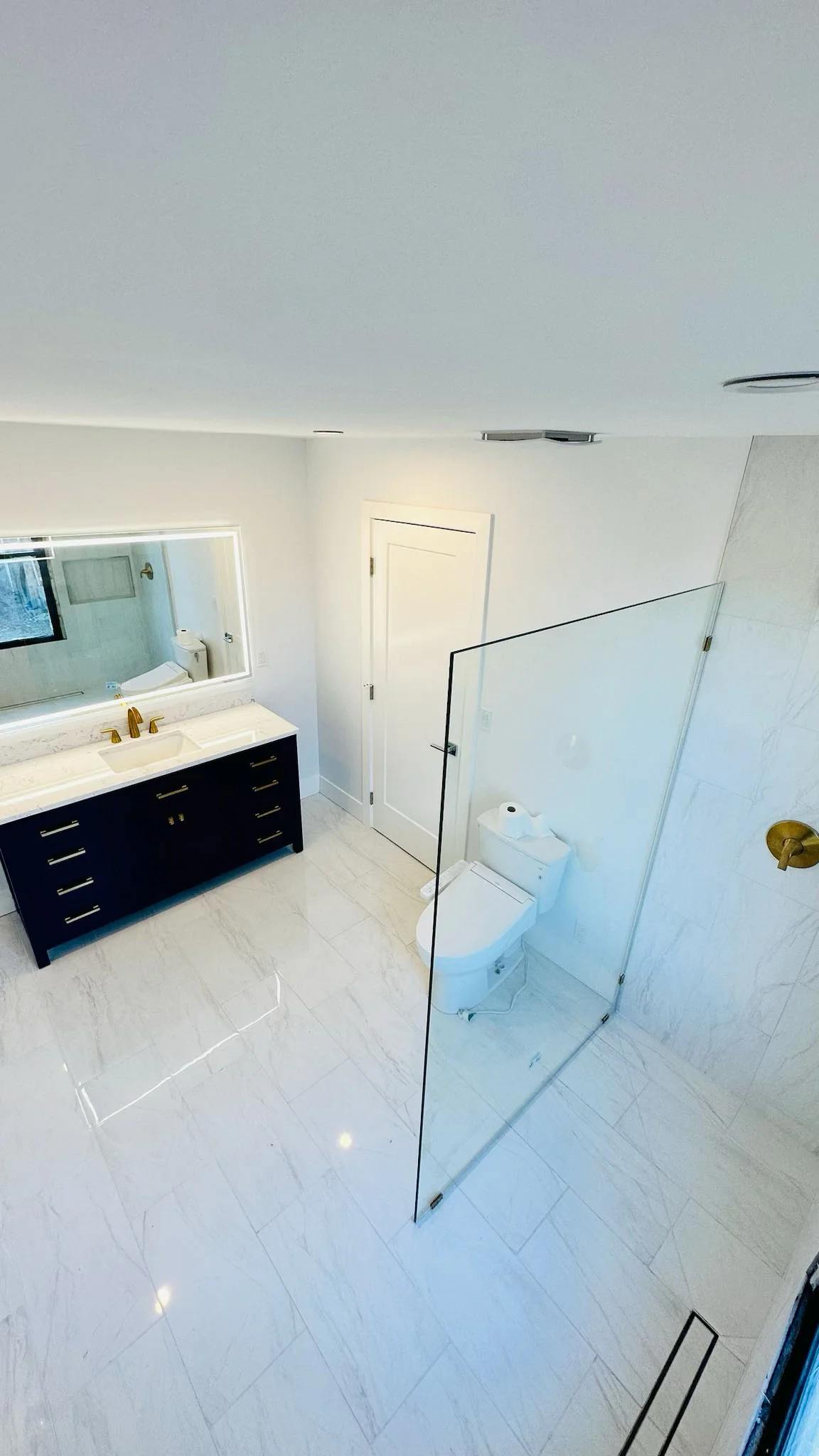
For projects like the ones I see frequently, where a homeowner wants to remove a fiberglass tub-shower combo and install a large walk-in tiled shower, the fixture math matters. One combination unit versus one stand-alone shower might seem equivalent, but the District evaluates this using fixture unit values, which are assigned by fixture type and updated annually each July 1. What actually drives bathroom remodel costs on the Monterey Peninsula often comes down to exactly these kinds of permit and fixture decisions that don’t show up on a materials estimate.
The Sequence That Most Contractors Don’t Explain
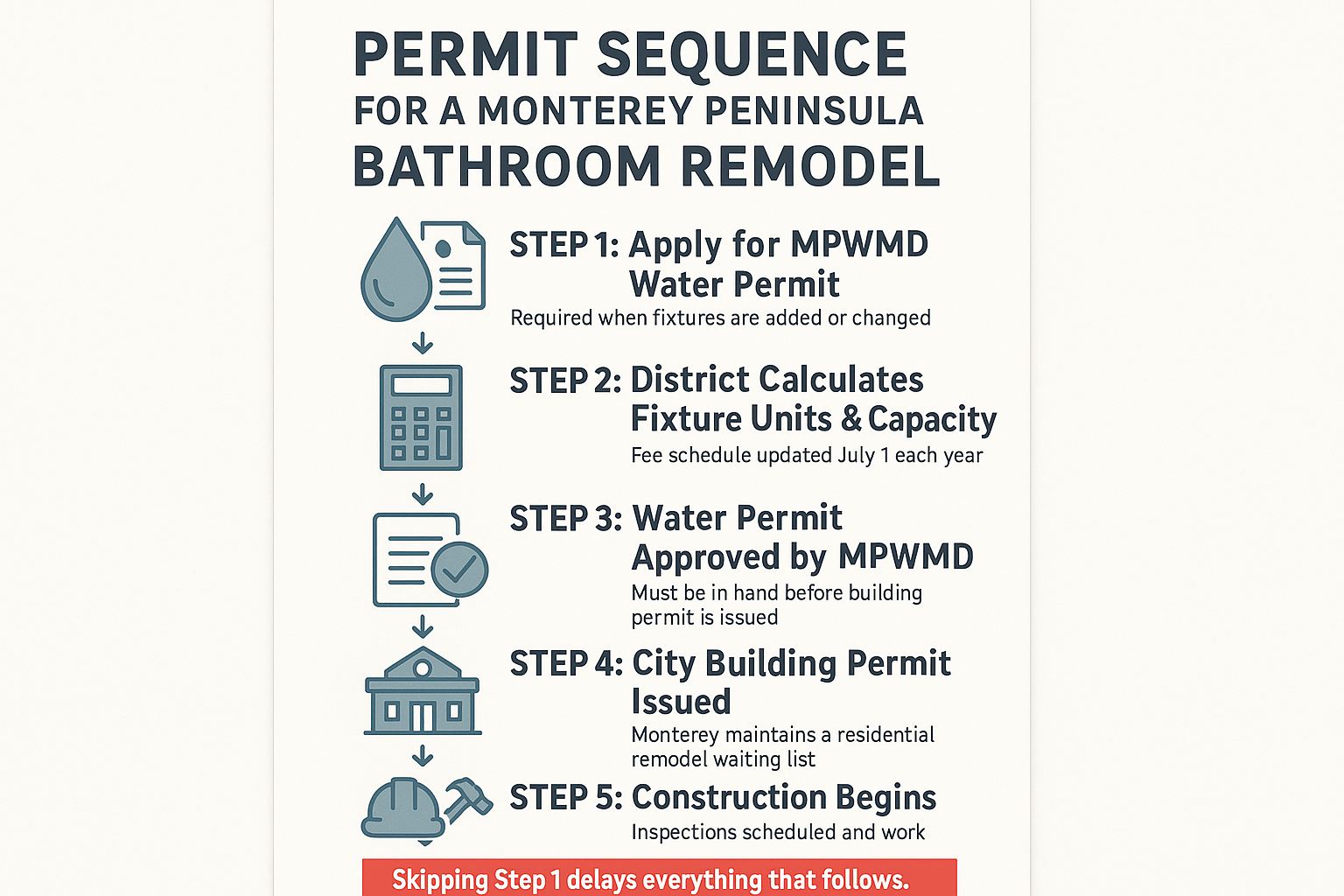
Here’s the order that actually matters for a bathroom remodel in the City of Monterey or other Peninsula cities served by MPWMD:
Step 1: Water permit from MPWMD
Before anything else, the water permit application goes to the District. The District evaluates the fixture units being added and determines the capacity fee owed.
Step 2: Building permit from the City
Only after the water permit is in place can a building permit be issued. The City of Monterey maintains a residential remodel water waiting list separate from new construction, because water credits available for allocation are limited. A homeowner who doesn’t know this can end up stuck at this stage with no clear explanation of why.
Step 3: Construction begins
Once the building permit is issued and inspections are scheduled, work can start.
The capacity fee the MPWMD charges is calculated based on the number of fixture units being added. The District updates its fee schedule every July 1, so I never quote specific numbers, they change, and any figure I gave you today could be wrong by the time your permit is filed. The District publishes current rates, and it’s worth asking specifically about your fixture list before your project scope is finalized.
What a contractor familiar with MPWMD can do during the planning phase is help you understand how your fixture choices affect the fee before you commit to a layout. Choosing a tub-plus-shower combination over a shower-only installation might look like a design decision, but it has a permit cost attached to it. That’s the kind of thing that should come up at the estimate stage, not after plans are drawn.
The Permit Sequence for a Monterey Peninsula Bathroom Remodel
This shows the order of steps required before and during a bathroom remodel in cities served by the Monterey Peninsula Water Management District.
What Changes Depending on Where Your Property Is
The MPWMD serves properties in Monterey, Pacific Grove, Carmel-by-the-Sea, Pebble Beach, and parts of the surrounding area, but not every community on the Peninsula or in Monterey County.
Seaside and parts of unincorporated Monterey County may be served by different water agencies with their own permit processes and their own forms. The rules are not uniform. A homeowner in Seaside who assumes their project follows the same process as one in Monterey might be working from the wrong checklist entirely.
A few things worth knowing by location:
- Pacific Grove and Carmel-by-the-Sea are both within MPWMD’s service area, so the same water permit requirement applies, but each city has its own building department and its own waiting list process
- Pebble Beach, governed by the Del Monte Forest, also falls within MPWMD and has additional design review considerations for exterior work
- Carmel Valley properties vary, some are within MPWMD, others are not, depending on the specific parcel and water service provider
- Salinas is generally outside MPWMD’s service area and operates under different water rules
I always tell homeowners: don’t assume. Verify with the specific agency that serves your property before you plan your fixture layout. This is also why understanding what a general contractor actually does on a remodel in Monterey matters, coordinating these permit sequences is a core part of the job, not an afterthought.
Water Permit Requirements by Monterey Peninsula Area
This gives a general reference for which water agency typically governs residential remodels by location. Always verify with your specific provider before planning fixture changes.
| Location | Primary Water Agency | Water Permit Required for Fixture Changes? |
|---|---|---|
| City of Monterey | MPWMD | Yes, required before building permit |
| Pacific Grove | MPWMD | Yes, required before building permit |
| Carmel-by-the-Sea | MPWMD | Yes, required before building permit |
| Pebble Beach | MPWMD | Yes, plus Del Monte Forest design review |
| Seaside | Varies by parcel | Verify with City of Seaside building dept. |
| Marina | Marina Coast Water District | Verify with MCWD directly |
| Carmel Valley | Varies by parcel | Verify, some parcels within MPWMD |
| Salinas | Salinas Valley Water / City | Generally outside MPWMD, verify locally |
What This Tells You About the Contractor You’re Talking To
One of the most consistent things I hear from homeowners who had bad experiences with prior contractors is some version of the same story: they weren’t told what was required before work started, and then they were surprised by delays or fees mid-project.
In a market where the water permit, building permit, and inspections all run in sequence, a contractor who doesn’t surface these dependencies during the estimate phase is leaving the homeowner to discover them at the worst possible time.
A contractor who raises the MPWMD water permit question during your first conversation about a bathroom remodel is showing you something real. It’s not a bureaucratic detail, it’s a signal that they’ve done this work in Monterey County before, that they understand how the local permit process is sequenced, and that they’re thinking about your project timeline from day one.
A contractor brought in from outside the Peninsula who isn’t familiar with MPWMD may not even know to ask. That gap shows up in your schedule and sometimes in your budget. How a contractor’s bid process reveals more than the price is something worth reading before you sign anything, the permit conversation is one of the clearest tests of whether a contractor knows this market.
For projects that involve more than just the bathroom, a full renovation, an addition, or a home that’s getting multiple rooms done at once, planning the full project without losing control of the budget starts with exactly this kind of permit sequencing conversation.
Frequently Asked Questions About Water Permits and Bathroom Remodels on the Monterey Peninsula
Does replacing my old shower with a new tiled shower require a water permit?
It depends on whether the fixture type or count is changing. A straight in-kind replacement, one shower for one shower, typically does not require a water permit. But if you’re converting a tub-shower combo into a shower-only unit, or adding a second fixture like a body spray system that qualifies as a separate fixture under MPWMD rules, the District may require a permit. The safest move is to have your fixture list reviewed before plans are finalized.
How long does the MPWMD water permit process take?
Processing times vary and can shift based on the District’s current workload and the availability of water credits in your city’s allocation pool. The City of Monterey maintains a separate residential remodel waiting list, which means timing is not always predictable. Plan for this step to take several weeks at minimum, and factor it into your project start date, not after permits are already in motion.
Who files the water permit, me or my contractor?
In most cases, a licensed general contractor handles the water permit application as part of managing the overall permit process. That said, it’s worth confirming this explicitly with whoever you hire. Ask them directly: ‘Will you handle the MPWMD water permit, and when in the process does that happen?’ The answer tells you a lot about their familiarity with Peninsula projects. For more on the permit responsibility question, who is responsible for permits on a remodeling project walks through how this typically works.
What does the MPWMD water permit cost?
The District calculates capacity fees based on fixture units added to the property, and that fee schedule is updated every July 1. I don’t quote specific numbers because they change annually and vary by fixture type. Contact the MPWMD directly with your planned fixture list for a current estimate. Your contractor should be able to walk you through how the fixture unit calculation works for your specific project so there are no surprises.
My property is in Seaside. Do I still need an MPWMD water permit?
Seaside may be served by a different water agency depending on your specific parcel. Don’t assume the MPWMD rules apply, verify with the City of Seaside’s building department and confirm which water agency serves your address. The permit process and fees may differ from what applies in Monterey or Pacific Grove.
Can I start demo while waiting for the water permit?
No. The standard sequence is water permit first, then building permit, then work begins. Starting construction before permits are in place creates legal exposure and can complicate your project significantly. What happens when remodeling work gets done without a permit is worth reading if you’re weighing this question.
Planning a Bathroom Remodel on the Monterey Peninsula?
If you’re thinking about converting a tub-shower combo, adding a toilet enclosure, or reconfiguring your bathroom layout, the permit conversation needs to happen before anything else. Palacios Construction works with homeowners across Monterey County, including Monterey, Pacific Grove, Carmel-by-the-Sea, Seaside, and Marina, and the water permit process is part of every project discussion from day one. You can reach the team at (831) 220-3334 or through palaciosconstructionca.com to talk through your project and get a clear picture of what the permit sequence looks like for your specific address.