
Direct Answer: Permit fees, water compliance costs, and what’s found inside older walls are the most common expenses Monterey homeowners don’t budget for — and they add up fast.
Most homeowners in Monterey County start a remodel with a number in their head. They get a proposal, it looks reasonable, and they say yes. Then the walls open up.
What’s inside older homes on the Peninsula — corroded pipes, outdated wiring, undersized framing — doesn’t show up in any estimate until work is already underway. And that’s not the only place budgets get stretched. Permit fees, water district requirements, and material lead times in this specific market add costs that don’t appear in national remodeling guides.
This article focuses on three categories of costs that consistently catch Monterey homeowners off guard: what happens when old conditions are discovered mid-project, how local permitting and water compliance add real dollars, and why allowance numbers in a proposal matter more than most homeowners realize.
What’s Behind Your Walls Can Change the Whole Budget
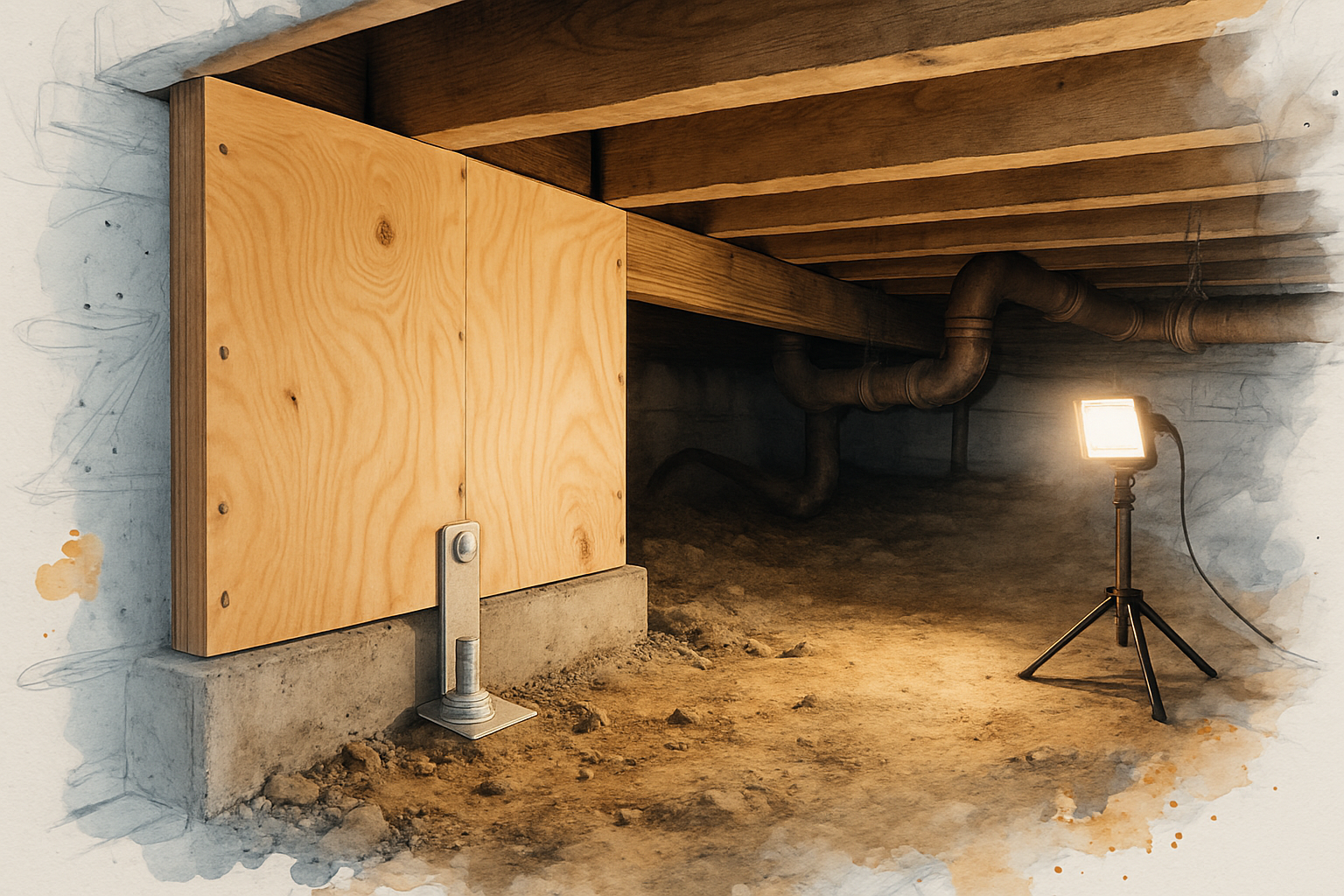
Homes in Pacific Grove, Carmel-by-the-Sea, and older neighborhoods throughout Monterey were mostly built between the 1920s and 1970s. A lot has been patched, added onto, and modified over the decades — not always with permits or professional work.
When a contractor opens a wall or ceiling for a kitchen remodel or bathroom renovation, they sometimes find conditions that have to be addressed before anything else can move forward. These aren’t optional fixes.
The most common discoveries include:
- Galvanized steel plumbing that’s corroded from the inside out and needs full replacement
- Knob-and-tube or aluminum wiring that code requires be brought up to standard
- Water damage or dry rot in framing behind showers, under sinks, or around windows
- Asbestos or lead paint in materials disturbed during demolition, triggering required remediation
- Subfloor damage that wasn’t visible until tile or hardwood was removed
Any one of these can add $1,500 to $8,000 or more to a project depending on severity. A professional contractor will walk you through what was found, show you exactly what needs to happen, and give you a clear number before proceeding. That’s how well-planned, professionally managed projects handle the unexpected — not by guessing, and not by hiding it.
The best thing a homeowner can do before signing a contract is ask how the contractor handles unforeseen conditions. If there’s no clear answer, that’s worth paying attention to.
Permits and Water Compliance Cost More Here Than in Most Markets
Monterey County homeowners sometimes assume permit fees are a small, flat cost. In practice, they’re calculated as a percentage of project valuation — and in cities like Monterey, Pacific Grove, and Carmel-by-the-Sea, the full fee schedule includes plan check fees, school impact fees on some projects, and inspection fees that are billed per visit.
For a mid-range kitchen remodel valued at $80,000, permit costs in the City of Monterey can run $1,200 to $2,500 or more depending on scope. A full bathroom remodel or home addition will run higher. These are real numbers that belong in any honest budget from day one.
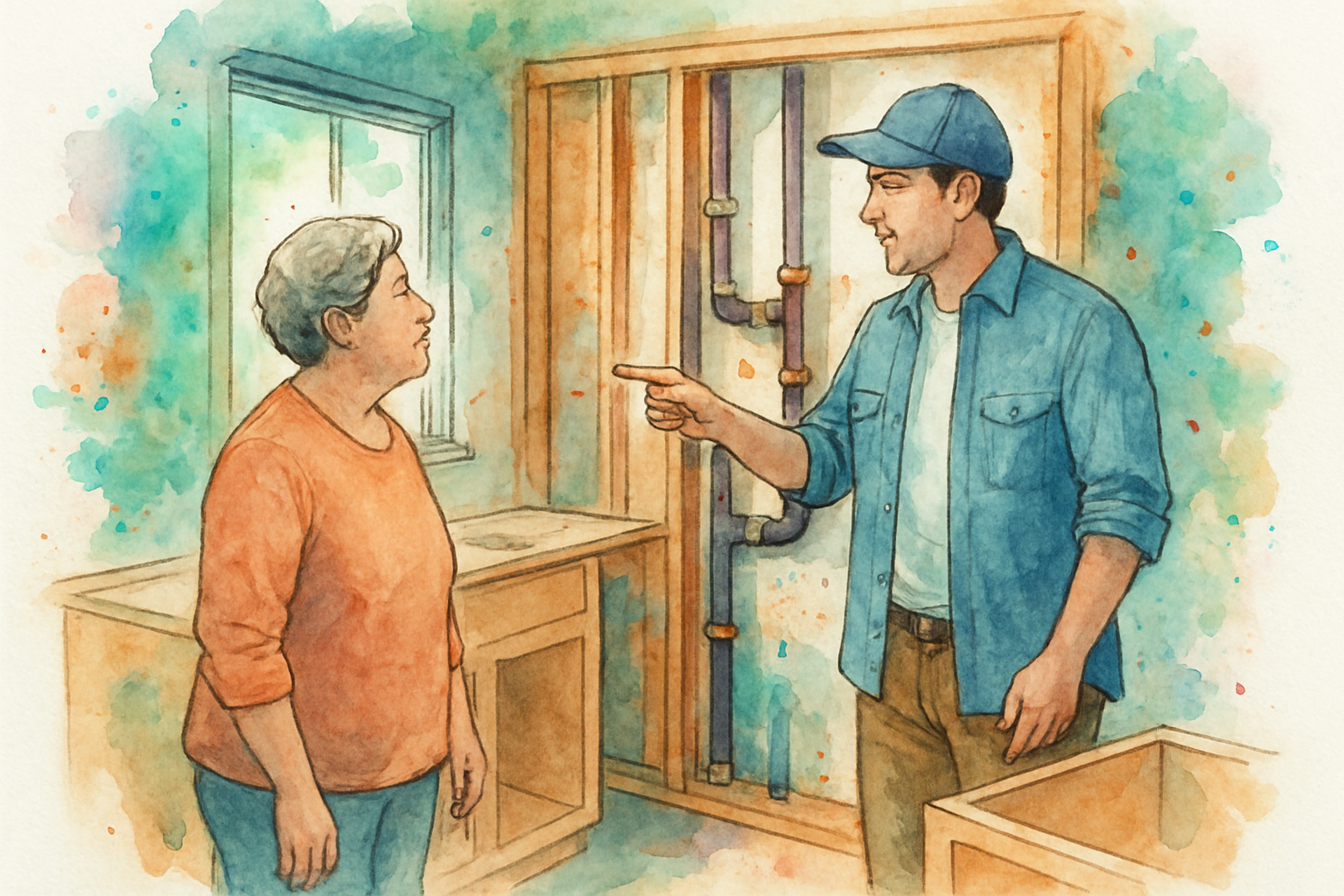
But the cost that surprises homeowners most — especially those doing any plumbing work — is the Monterey Peninsula Water Management District (MPWMD) compliance requirement. If a project adds or relocates fixtures, or if the home is being upgraded as part of a renovation, MPWMD may require a water budget analysis and possibly a fixture replacement offset before a permit will be issued.
This process adds both time and cost that isn’t built into most general estimates. On projects with significant plumbing work, MPWMD compliance alone can add several weeks to the permitting timeline and $500 to $2,000 in administrative and fixture offset costs.
If you’re planning a bathroom renovation or kitchen remodel that touches plumbing, ask your contractor specifically how they handle MPWMD requirements. The home remodeling permits process in this region has layers that don’t exist in most California markets. Understanding them upfront keeps the schedule intact.
Requirements vary by jurisdiction, and homeowners should always verify current requirements directly with their local building department and MPWMD.
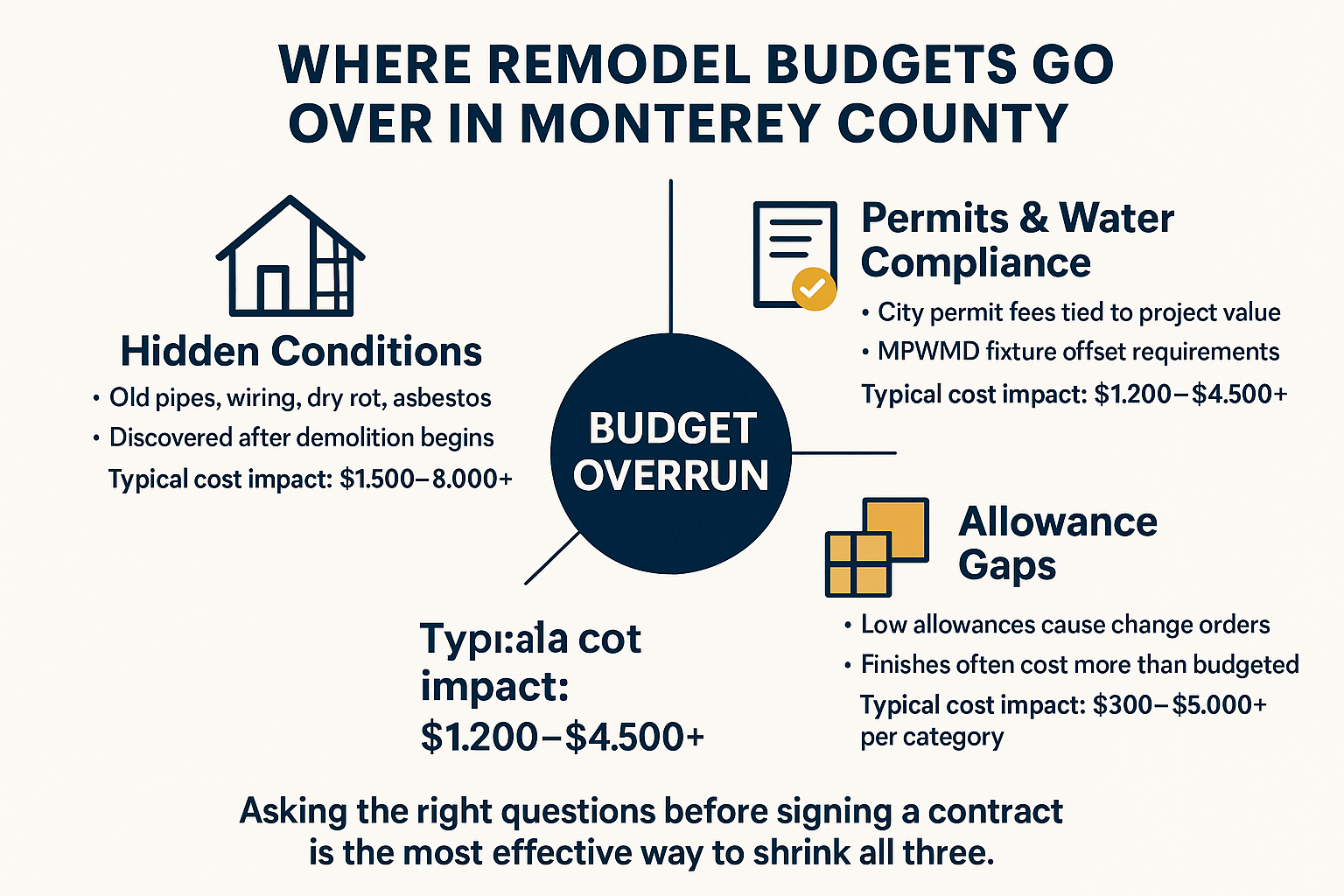
Where Budget Surprises Come From: The Three Categories
Most remodeling overruns fall into one of three buckets. This breakdown shows where the money actually goes when projects run over budget.
Allowances: The Quiet Budget Killer in Most Proposals
An allowance is a placeholder number in a contractor’s proposal. It represents what has been budgeted for a specific finish or product — tile, fixtures, cabinet hardware, light fixtures, countertops — before the homeowner has made a final selection.
Allowances aren’t a problem. They’re a normal part of how proposals are written early in a project. The problem is when they’re set unrealistically low to make the overall number look appealing.
Here’s a simple example. A bathroom remodel proposal includes a $400 tile allowance per the contract. The homeowner picks tile at $8 per square foot for a 60-square-foot shower — that’s $480 in tile alone, before setting materials or labor. The difference becomes a change order. Multiply that across five or six allowance categories and the budget has drifted by $3,000 to $5,000 without a single unexpected structural problem.
This pattern shows up in kitchen projects too. A $2,000 countertop allowance sounds reasonable until you price quartz at a local supplier. Waterfall edge countertops, which have become a popular choice in Monterey Peninsula kitchens, can run $4,500 to $9,000 installed for a moderate-size kitchen — a gap that gets discovered after the contract is signed. You can read more about what drives that specific cost in this contractor’s guide to waterfall edge kitchen islands.
The right approach is proposals that use realistic allowances with every line item clearly explained, so the homeowner knows exactly what the number includes and what will trigger an adjustment. Ask any contractor you’re evaluating to walk you through each allowance in their proposal. That conversation tells you a lot about how they run their projects.
Common Allowance Categories and Realistic Ranges for Monterey County Projects
These ranges reflect typical mid-range selections in the current Monterey County market. Lower-end allowances in proposals often fall well below these numbers.
| Allowance Category | Low Proposal Placeholder | Realistic Mid-Range Cost |
|---|---|---|
| Bathroom tile (per room) | $400–$600 | $900–$2,200+ |
| Plumbing fixtures (bath) | $500–$700 | $1,200–$2,500 |
| Kitchen countertops | $1,500–$2,500 | $3,500–$7,000+ |
| Cabinet hardware | $200–$350 | $500–$1,200 |
| Light fixtures (kitchen) | $300–$500 | $700–$1,800 |
| Interior doors (per unit) | $150–$250 | $350–$650 installed |
One More Category Homeowners Overlook: Temporary Living Costs
A major remodel rarely lets you stay in your home the whole time without some disruption. Kitchen renovations that span 4 to 8 weeks mean eating out or ordering in daily. Bathroom remodels in a single-bathroom home may require a short hotel stay or making arrangements with family.
These aren’t contractor costs — they’re real out-of-pocket expenses that don’t appear anywhere in the project estimate. A homeowner in Pacific Grove or Carmel-Valley doing a full kitchen gut might spend $1,500 to $3,000 on meals and incidentals over the course of construction. That’s money that comes directly out of the same household budget as the remodel.
For larger projects like home additions or full renovations, temporary housing costs can be significantly higher. Building this into your total project budget before you start — not after — gives you an accurate picture of what the project actually costs from start to finish.
The homeowners who feel blindsided by remodeling costs almost always had one thing in common: their contractor gave them a construction number, not a complete project number. Those are different things, and understanding the difference before signing anything is one of the best things you can do.
Frequently Asked Questions About Hidden Remodeling Costs in Monterey County
How do I know if my contractor’s proposal has realistic allowances?
Ask the contractor to walk you through each allowance line by line and explain what product or finish that number is based on. Then do a quick check — look up the tile, fixture, or countertop they referenced and compare the actual price. If their allowance doesn’t match what the product actually costs installed, you’ve found a gap. Contractors who use realistic allowances will be able to point to a specific product or spec for each number without hesitation.
Do all remodels in Monterey County require permits?
Most structural, electrical, plumbing, and mechanical work does. Cosmetic work like painting or flooring typically doesn’t. But the line between what requires a permit and what doesn’t is specific to each city — Carmel-by-the-Sea, Pacific Grove, and the City of Monterey each have their own building departments. Always verify with your local building department before assuming a permit isn’t needed. The home remodeling permits process is more layered here than in most inland California cities.
What is MPWMD and why does it affect my remodel cost?
The Monterey Peninsula Water Management District regulates water use across the Peninsula. If your remodel adds or relocates plumbing fixtures, MPWMD may require a water budget analysis or a fixture offset — meaning you may need to remove older water-using fixtures elsewhere on the property to offset any increase. This adds time and cost that many homeowners don’t expect. Budget roughly $500 to $2,000 for compliance costs on projects with significant plumbing changes, and verify current requirements directly with MPWMD before your permit application is submitted.
What happens if unexpected conditions are found once my walls are open?
Work stops, the contractor shows you what was found, and you receive a written change order with the cost before anything proceeds. That’s how it should work. A good contractor documents the discovery with photos, explains why it has to be addressed, and gives you a clear number. You approve it before the work continues. If a contractor ever just proceeds without showing you what they found, that’s a problem.
Is it common for Monterey remodeling projects to go over budget?
Some cost variance is genuinely hard to avoid in older homes. But large, unexpected overruns are usually a sign of a poorly structured proposal — low allowances, no contingency built in, or a contractor who didn’t ask enough questions upfront. A well-planned project will include a 10 to 15 percent contingency for unforeseen conditions and realistic allowances from the start. That doesn’t mean the project will use all of it — but it means you’re not caught off guard if something does come up.
Should I budget anything extra beyond the contractor’s proposal?
Yes. A 10 to 15 percent personal contingency on top of the contract amount is a reasonable cushion for any remodel in an older Monterey County home. Also account for temporary living costs, meals during kitchen renovations, and any finish upgrades you decide on after the contract is signed. The complete out-of-pocket number is almost always higher than the proposal alone.
Ready to Get a Proposal Built Around Real Numbers?
Palacios Construction works with homeowners throughout Monterey County — from Pacific Grove to Carmel Valley — who want a clear budget before construction starts, not surprises after. If you’re planning a kitchen remodel, bathroom renovation, addition, or other residential project and want to understand exactly what it will cost and why, reach out to the team at palaciosconstructionca.com or call (831) 220-3334 to talk through your project.