Direct Answer: Before signing with any contractor, verify their license, ask exactly who manages the work daily, and make sure the proposal includes itemized costs — not just a lump sum.
Most homeowners in Monterey County don’t realize how much can go wrong before a single board gets cut. The problems usually start earlier — during the hiring process, when a proposal looks reasonable on the surface but leaves out the details that end up costing thousands later.
This is a particularly common experience on the Monterey Peninsula, where older housing stock, coastal permitting requirements, and Monterey Peninsula Water Management District rules add layers that many contractors either don’t know or don’t mention upfront. A remodel that looks straightforward on paper can get complicated fast if the person you hired wasn’t honest about what the job actually involves.
The questions below aren’t meant to trip anyone up. They’re the kind of things a well-informed homeowner asks before committing to a five, six, or seven-figure project — and the answers will tell you a lot about whether the contractor in front of you is worth trusting.
Start With the License and Insurance — Don’t Skip This
California requires general contractors to hold a valid license through the Contractors State License Board (CSLB). For residential work, that’s typically a Class B General Building Contractor license. Before anything else, ask for the license number and verify it yourself at cslb.ca.gov — it takes about 60 seconds.
What you’re checking:
- Is the license active and in good standing?
- Does the name on the license match the person or company you’re hiring?
- Are there any disciplinary actions or complaints on file?
- Does the contractor carry general liability insurance and workers’ compensation?
Workers’ comp is especially important. If a crew member gets hurt on your property and the contractor doesn’t carry it, you could be held liable. Ask for a current certificate of insurance — not a verbal confirmation.
For reference, what a licensed general contractor is responsible for goes deeper on what that license actually covers and what it doesn’t. It’s worth reading before you sit down with anyone.
Ask Who Is Actually Running Your Job Site
This is the question most homeowners forget to ask, and it’s often the one that matters most.
Many contractors sell you the job and then hand it off. The person who walked your property, answered your questions, and made you feel confident? They may not be the one showing up every day. Sometimes it’s a foreman. Sometimes it’s a rotating crew with no single point of contact.
Ask directly:
- Who will be on site daily?
- Will I have a single point of contact for the entire project?
- How often will you personally be on the job?
- What’s the best way to reach you if something comes up mid-project?
Hands-on project management — where the contractor is actively involved throughout every phase, not just at the kickoff — is one of the clearest differentiators between a smooth project and a frustrating one. The answer to this question tells you a lot.
If you’re still evaluating whether a contractor is the right fit overall, how to tell if a Monterey contractor is the right fit for your project covers the full picture.
Read the Proposal Like a Document, Not a Quote
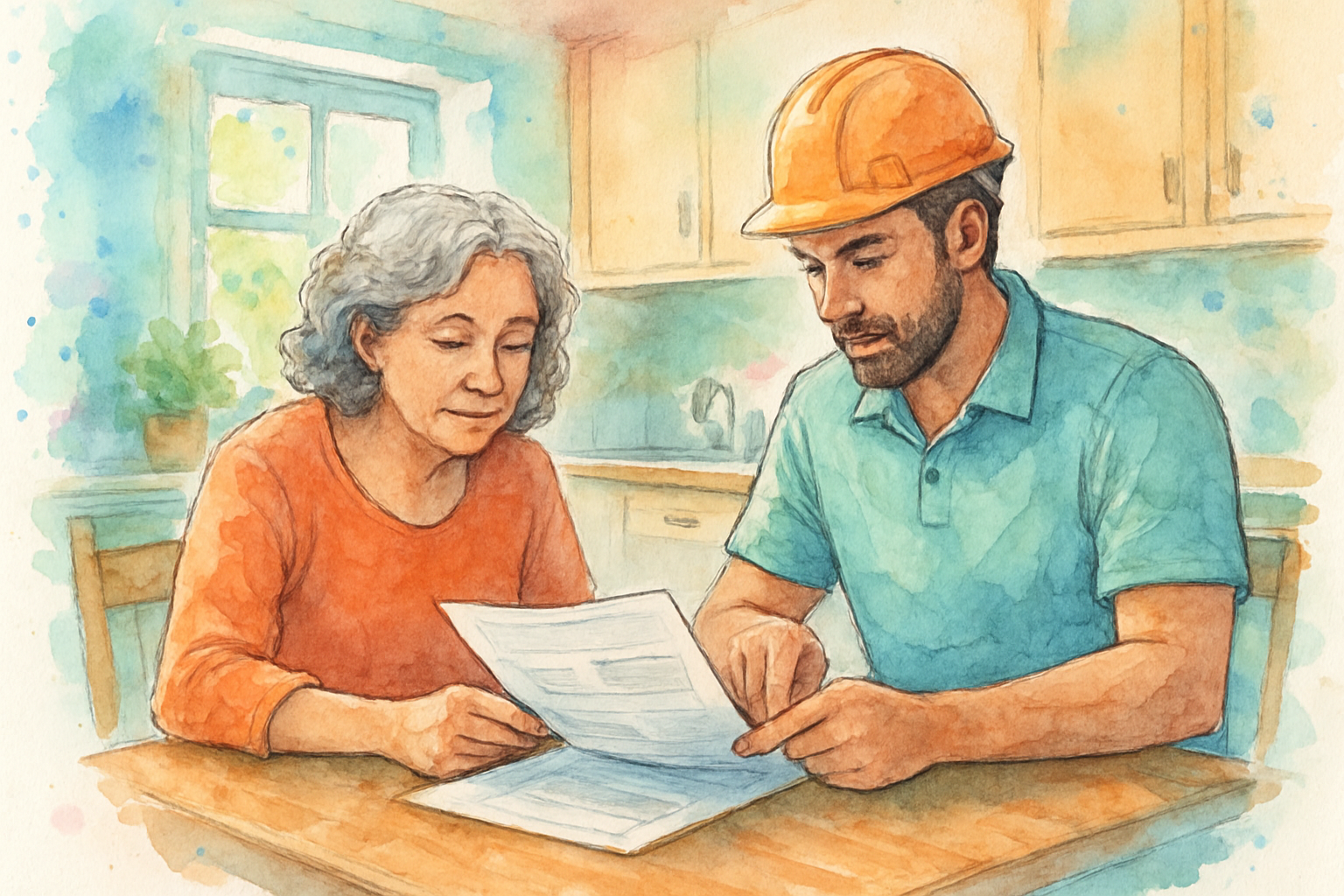
A proposal is not just a number. It’s a preview of how a contractor thinks — and how they’ll behave once the work starts.
A well-written proposal should break down costs by category: labor, materials, subcontractors, permits, and contingency. If a contractor hands you a lump sum with no line items, that’s a problem. You won’t know where your money is going, and you won’t have any basis for comparison if something changes mid-project.
Specific things to look for:
- Are material allowances listed with actual numbers, or just described vaguely?
- Does the proposal include permit fees, or are those added later?
- Is there a contingency line for unforeseen conditions?
- What’s the payment schedule — and does it tie to milestones or just dates?
Low-ball proposals are one of the most common sources of budget shock in Monterey County remodels. A contractor who prices materials at $8,000 when the realistic cost is $14,000 isn’t saving you money — they’re moving the bill to a change order later. Clear budgeting practices, where every allowance reflects what things actually cost in this market, protect you from that.
For more on where the unexpected charges tend to appear, the hidden expenses that catch Monterey homeowners off guard breaks down the most common ones.
What a Strong Proposal Includes vs. What to Be Cautious About
This comparison shows what separates a detailed, honest proposal from one that leaves you exposed to surprises down the road.
| Proposal Element | What to Look For | Red Flag |
|---|---|---|
| Cost breakdown | Line items by category: labor, materials, subs, permits | Single lump-sum number with no detail |
| Material allowances | Specific dollar amounts per item or category | Vague language like ‘allowances TBD’ or ‘per selection’ |
| Permit fees | Listed as a separate line item with estimated cost | Not mentioned or marked ‘owner’s responsibility’ without explanation |
| Payment schedule | Tied to construction milestones | Large upfront deposit (over 10%) or date-based payments only |
| Contingency | A stated percentage or dollar amount for unknowns | No contingency — assumes everything goes perfectly |
| Subcontractors | Named trades listed or described | No mention of who does specialty work like electrical or plumbing |
| Scope of work | Detailed written description of what’s included | Short paragraph or verbal explanation only |
Five Questions Worth Asking Before You Sign Anything
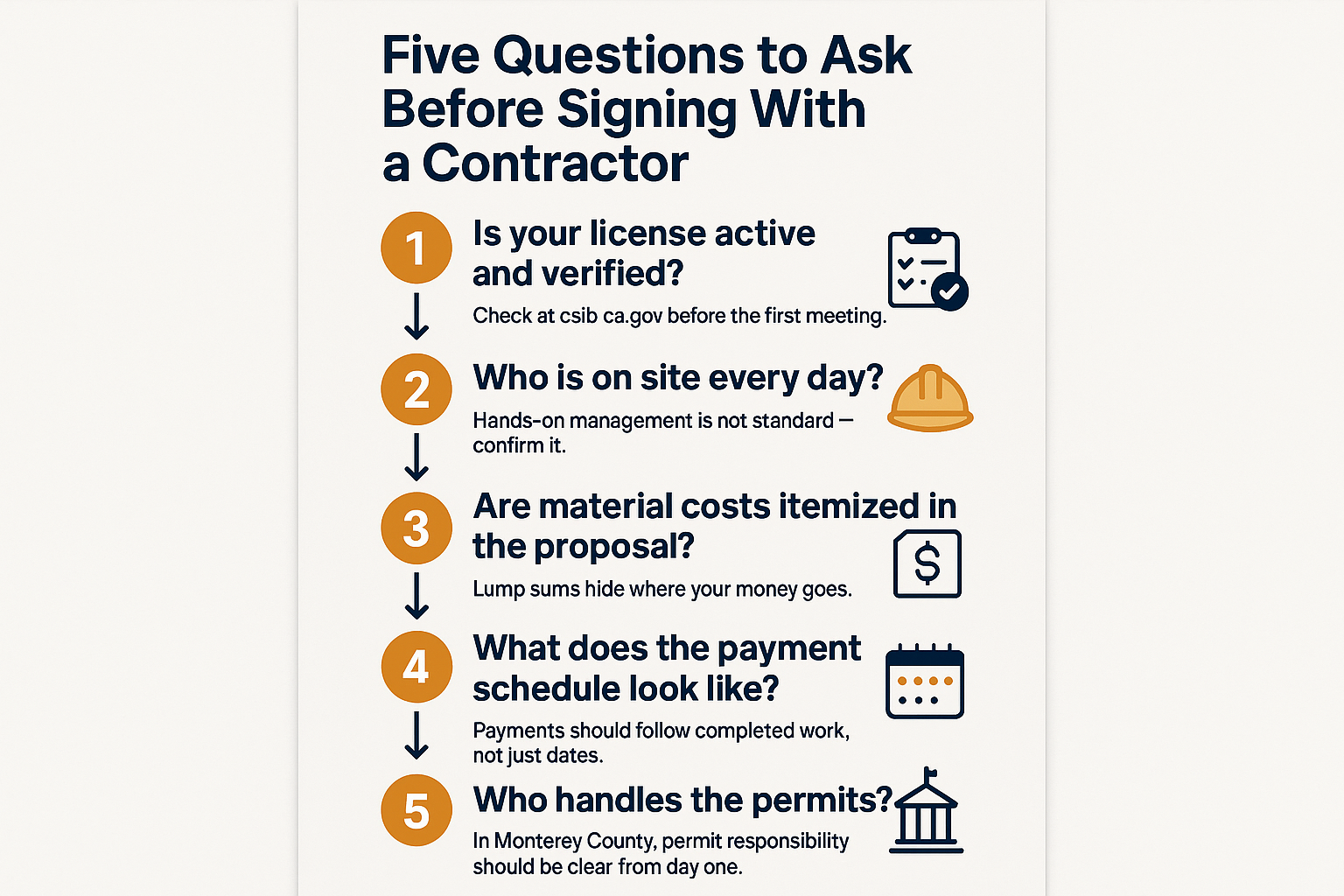
These five questions cut through most of the uncertainty homeowners face when evaluating a contractor in Monterey County.
Clarify Who Pulls the Permits — and What That Means
Permit responsibility is one of the most misunderstood parts of hiring a contractor in Monterey County.
In most residential remodeling projects — kitchen remodels, bathroom renovations, additions, ADUs — permits are required. The contractor should pull them, not the homeowner. When a contractor asks the homeowner to pull permits as an “owner-builder,” it can shift legal liability and expose you to problems when you sell the property.
In cities like Carmel-by-the-Sea, permit timelines run longer than most people expect because of design review requirements. In Pacific Grove and Monterey, projects involving plumbing fixtures need to account for Monterey Peninsula Water Management District water use rules — which affect what fixtures you can install and sometimes require additional review.
Ask:
- Who pulls the permits for this project?
- Are permit fees included in the proposal?
- Are there any city-specific reviews that could affect the timeline?
A contractor who knows the local permitting environment should be able to answer these questions without hesitation. For a broader look at how permits work across Monterey County jurisdictions, home remodeling permits in Monterey covers the basics in plain language.
And if your project involves an ADU, permit complexity goes up significantly — why many ADU projects run into problems before construction even starts explains the most common early-stage mistakes.
Frequently Asked Questions About Hiring a Contractor in Monterey County
How much of a deposit is normal before work starts?
California law limits contractor deposits to 10% of the total contract price or $1,000, whichever is less for most residential projects. Any contractor asking for 30% or 50% upfront should be able to clearly explain why — and if they can’t, that’s worth paying attention to. A reasonable payment schedule ties draws to completed milestones, not arbitrary dates.
What’s the difference between a bid and a proposal?
A bid is usually just a number. A proposal is a document — it includes scope of work, material allowances, payment terms, and timeline. For any project over $20,000, you should expect a written proposal, not just a number on a piece of paper. If a contractor only provides a verbal quote or a one-page bid with no detail, ask for more before you sign.
Can I ask for references from similar projects in Monterey County?
Yes, and you should. Ask specifically for references from projects similar in scope to yours — a bathroom remodel reference isn’t very useful if you’re planning a full home addition. Ask the reference two questions: did the project come in close to the original budget, and was communication consistent throughout? Those two answers tell you most of what you need to know.
What happens if the contractor finds something unexpected once work starts?
Unexpected conditions — old plumbing, moisture damage, substandard framing — are common in older homes throughout Monterey and Pacific Grove. A good contractor will explain the issue, show you what they found, and present a written change order with cost and timeline impact before doing any additional work. You should never hear about a price change after the fact. Ask the contractor directly how they handle change orders before you sign.
Is it a problem if a contractor uses subcontractors?
Most general contractors use licensed subcontractors for specialty trades like electrical, plumbing, and HVAC — that’s normal and expected. What matters is that the general contractor manages those subs, coordinates scheduling, and remains your single point of contact. Problems happen when the GC is hands-off and subs are left to coordinate themselves.
Should I get multiple bids before deciding?
Getting two or three proposals is reasonable. But comparing them only on price is a mistake. A proposal that comes in $15,000 lower than the others usually isn’t saving you money — it’s leaving something out. Compare scope, allowances, and what’s included line by line. The most informative thing you can do is ask each contractor to walk you through their proposal and explain how they priced it.
Have Questions Before Starting a Project in Monterey County?
Palacios Construction works with homeowners across Monterey, Pacific Grove, Carmel-by-the-Sea, and surrounding communities on residential remodeling and construction projects. If you’re in the early stages of planning and want to understand what a well-planned, professionally managed project actually looks like from proposal to completion, the team is available to talk through the specifics. Reach out at palaciosconstructionca.com or call (831) 220-3334.