

Direct Answer: A successful remodel follows a specific sequence: design first, permits second, demolition third, rough work fourth, finishes last. Skipping steps or reordering them is where most projects fall apart.
Most homeowners start thinking about their remodel the same way: they pick finishes, browse countertops, and then call a contractor. That order feels natural. But it’s backward — and it’s one of the main reasons projects stall, go over budget, or have to be partially redone.
In Monterey County, the sequencing problem is worse than most places. Between the Monterey Peninsula Water Management District permit requirements for any plumbing work, city-specific design review in places like Carmel-by-the-Sea, and older housing stock that often hides surprises behind the drywall, a project that starts in the wrong order doesn’t just slow down — it can cost thousands to untangle.
This article walks through the actual sequence that experienced contractors follow — from first decisions through final walkthrough. Not every project hits every step the same way, but the logic of the order holds across kitchens, bathrooms, additions, and ADUs alike.
Why Sequence Matters More Than Most People Realize
Construction is a dependency chain. Each phase sets up the next one. When something happens out of order, you’re not just inconvenienced — you’re often undoing finished work, which means paying for the same square footage twice.
A common example: a homeowner in Pacific Grove picks out their kitchen tile before the rough plumbing is set. The plumber comes in, shifts a drain line two inches to hit the existing stack, and now the tile layout doesn’t center the way the design called for. The tile has already been ordered. That’s a real cost — and a real argument.
The same thing happens with cabinetry ordered before rough-in is inspected, or flooring installed before a subfloor moisture issue gets addressed. These aren’t rare edge cases. They’re what happens when decisions get made in the wrong order.
Understanding the sequence doesn’t require a construction background. It requires knowing which decisions are locked early and which ones can wait — and why the locked ones have to come first.
The Remodel Sequence, Phase by Phase
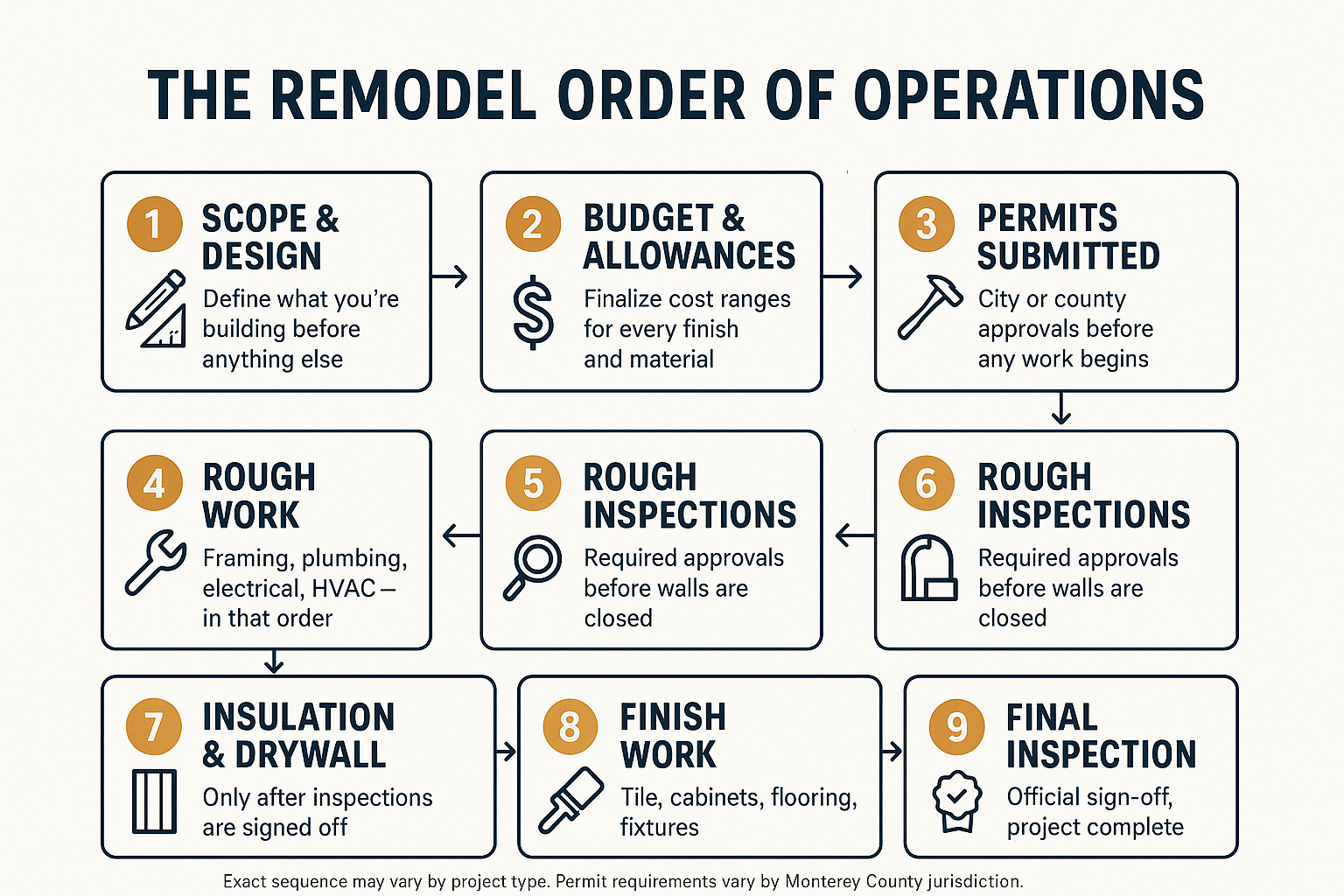
This diagram shows the full order of operations for a residential remodel, from planning through final inspection.
The First Three Steps Are Where Most Projects Win or Lose
Before a single wall comes down, three things need to be settled: what you’re building, what it costs, and whether you have permission to build it. These aren’t just administrative boxes to check — they’re the foundation the rest of the project stands on.
Step 1 is scope. This means a documented set of plans — either full architectural drawings or detailed contractor drawings, depending on the project type. A bathroom remodel in Seaside may only need contractor-level plans. A second-story addition in Monterey city limits will require stamped architectural drawings before the building department will accept the application. Scope has to be fixed before a real budget can be written.
Step 2 is budget — with real allowances. A proposal that lists “tile allowance: $3/sf” for a Carmel homeowner is not a real budget. Realistic allowances reflect actual material costs in this market, which run meaningfully higher than national averages. A contractor who writes low allowances isn’t saving you money — they’re deferring the conversation about money until you’re mid-project and have less negotiating power. Clear budgeting practices from day one are what separate a well-planned project from one that surprises you at every turn. The hidden expenses that catch Monterey homeowners off guard covers this in more detail if you want to go deeper on the budget side.
Step 3 is permits. This step gets skipped or rushed more than any other — and it’s the one with the most downstream consequences. In Monterey County, permit timelines vary significantly by jurisdiction:
- City of Monterey: Over-the-counter permits available for smaller projects; larger projects go through plan check
- Carmel-by-the-Sea: Design review is required for most exterior changes, adding weeks to the timeline
- Pacific Grove: Standard plan check, but any plumbing work triggers MPWMD water permit requirements
- Unincorporated Monterey County: Handled by the County Building Department, separate process from city permits
Pulling permits after demolition starts isn’t just a procedural problem — it can trigger a stop-work order and require opening walls that were just closed. Home remodeling permits in Monterey has a full breakdown of how that process works locally.
Rough Work Has Its Own Sequence — and It’s Not Negotiable
Once permits are approved and demolition is done, the rough work phase begins. This is the part that lives inside the walls — and it has its own internal order that most homeowners don’t see.
The typical sequence for rough work is:
- Framing first — any structural changes, new walls, or openings get built before any mechanical systems run through them
- Plumbing second — drain lines and supply lines get set based on the final fixture locations
- Electrical third — panels, circuits, and rough wiring follow after plumbing is in place
- HVAC last — ductwork and mechanical rough-in fills in around the other systems
This order isn’t arbitrary. Plumbers need to know where walls land before they can set drain slopes. Electricians need to know where plumbing runs so they don’t cross them in ways that fail inspection. HVAC gets the leftover space — which is fine, because ductwork is the most flexible of the four.
After rough work is complete, rough inspections happen before anything gets covered up. This is non-negotiable. A building inspector needs to see every pipe, wire, and duct before drywall goes on. If a contractor closes walls before inspection, the inspector can require the drywall to come down. That’s a real cost and a real delay — paid for by the homeowner.
For anyone curious about how this plays out specifically in a kitchen project, how long a kitchen remodel actually disrupts your home walks through the phase-by-phase timeline in practical terms.
Common Remodel Types and Where the Sequence Is Most Often Broken
Different project types have different failure points in the sequence. This table shows where things most often go wrong — and what it typically costs to fix.
| Project Type | Most Common Sequence Mistake | Typical Cost to Fix |
|---|---|---|
| Kitchen Remodel | Cabinets ordered before rough plumbing is inspected | $800–$2,500 in layout changes or reorders |
| Bathroom Remodel | Tile installed before subfloor moisture is addressed | $1,500–$4,000 to demo and redo |
| Home Addition | Framing started before permit is approved | Stop-work order; $500–$2,000+ in delays |
| ADU Construction | Design finalized without checking setbacks or utility capacity | $3,000–$8,000 in redesign fees and resubmittals |
| Second Story Addition | Structural engineer not engaged before design is finalized | $2,000–$6,000 in redesign to meet load requirements |
Finishes Come Last — and That’s When You Make the Decisions You Thought You Made First
There’s a reason experienced contractors don’t want homeowners finalizing every finish on day one. Some of those decisions depend on what’s already been built.
Floor height changes after a subfloor repair. Cabinet dimensions shift when rough-in moves a half-inch. Trim profiles that looked right in the showroom look wrong once the room is drywalled and painted. Finish decisions made too early often need to be revisited once the rough work is done — and if the materials have already been ordered, you’re either stuck with the wrong choice or eating a restocking fee.
The better approach is a two-phase material selection process:
- Phase 1 (before permits): Finalize anything that affects the permit drawings — fixture locations, structural changes, window/door sizes, overall layout
- Phase 2 (after rough inspections): Finalize tile, cabinet styles, hardware, paint, flooring, and decorative fixtures
This isn’t about delaying decisions. It’s about making decisions at the moment when you have the most accurate information. A contractor who pushes you to finalize everything in week one isn’t being organized — they’re front-loading their process in a way that shifts risk onto you.
For anyone who has already been through one project that didn’t go smoothly, what homeowners should ask before signing with any contractor is worth reading before the next one.
Frequently Asked Questions About the Remodel Order of Operations
Can I start demo before my permits come through to save time?
No — and this is one of the most common mistakes. Starting demolition before a permit is issued is a code violation in every Monterey County jurisdiction. If an inspector finds out, they can issue a stop-work order that freezes the entire project until the permit is approved and any unpermitted work is reviewed. The time you save is almost never worth the risk.
What happens if I order materials early and the dimensions change during rough work?
You’ll either pay a restocking fee — typically 15–25% of the material cost — or you’ll be stuck using something that doesn’t fit right. Tile and cabinetry are the most common culprits. Tile can be ordered in the rough work phase if you’ve confirmed layout. Cabinetry should always wait until the rough-in is inspected and final dimensions are confirmed.
Does this sequence apply to ADU projects too?
Yes, and ADUs have additional front-end requirements that make the early steps even more important. Setback verification, utility capacity checks, and in many cases a site survey all need to happen before design is finalized. Why many ADU projects run into problems before construction even starts covers the specific pre-construction pitfalls in detail.
How long does the permit phase take in Monterey County?
It varies significantly by city. Smaller projects in the City of Monterey can sometimes get over-the-counter approval the same day. A kitchen remodel in Pacific Grove involving plumbing might take 3–6 weeks once you factor in the MPWMD water permit. A project in Carmel-by-the-Sea that requires design review can take 8–12 weeks before a permit is issued. Always ask your contractor to give you a jurisdiction-specific timeline estimate — not a generic one.
What’s the most common mistake homeowners make during rough inspections?
Scheduling finish work before the inspection is approved. Drywall and tile have lead times, so homeowners sometimes try to get things moving while they wait. If the inspection requires a change — a pipe repositioned, a circuit rerouted — anything installed before the fix has to come down. Wait for the signed inspection card before ordering or installing anything that covers rough work.
Ready to Start Your Project the Right Way?
If you’re planning a remodel, addition, or ADU anywhere in Monterey County and want to understand exactly what the sequence looks like for your specific project, Palacios Construction is available to walk through it with you. Call (831) 220-3334 or visit palaciosconstructionca.com to get in touch.