
Direct Answer: In Monterey County, ADUs on properties served by septic often require a wastewater system upgrade before a construction permit can move forward, and that clearance runs through Environmental Health, not the building department.
I talk to a lot of homeowners in Carmel Valley and Prunedale who come in with a clear picture of their ADU project, square footage, layout, finish ideas, even a rough budget. What catches them off guard, almost every time, is learning that the first real obstacle has nothing to do with the building itself. It’s the septic system.
For properties on municipal sewer in Seaside, Marina, or most of Monterey proper, the utility side of an ADU project is relatively straightforward. But a significant portion of Monterey County’s residential properties, especially those on larger lots in unincorporated areas, run on private septic. And Monterey County Environmental Health reviews those systems independently from the building permit process.
What I’ve seen in practice is that homeowners who don’t account for this step early end up with a signed construction contract and a budget in hand, only to discover they’re looking at weeks or longer of permit delay before a shovel touches the ground. This article is about why that happens and what you actually need to know before committing to an ADU timeline.
What the County Actually Requires for ADUs on Septic
The Monterey County ADU development standards checklist spells this out directly. If your ADU includes a kitchen with cooking equipment, which most detached ADUs do, the county requires an additional septic tank to reduce the load on the existing disposal field. That’s not a contractor recommendation. That’s a county requirement.
For properties on lots under 1.25 acres served by septic, the situation can be more involved. County standards may require an Alternative Onsite Wastewater Treatment System (AOWTS) with supplemental treatment, depending on lot size, soil conditions, and the existing system’s capacity. That determination comes from Environmental Health, not from your contractor or the building department.
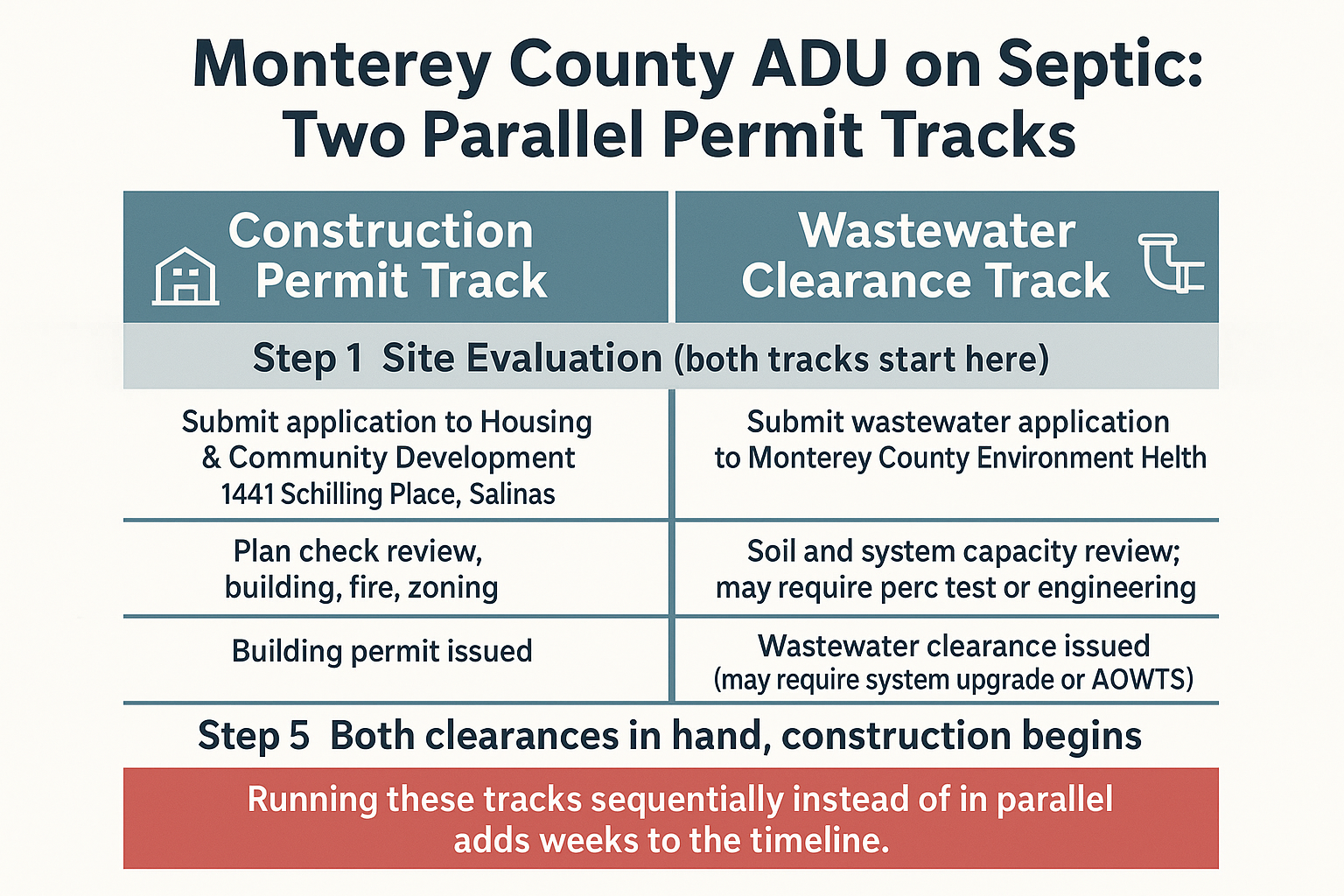
The practical implication is that there are two separate tracks running at the same time on a septic-served ADU project:
- The construction permit application, routed through the Housing and Community Development office at 1441 Schilling Place in Salinas
- The wastewater clearance, which runs through Monterey County Environmental Health and requires its own application, review, and approval
Neither track waits for the other. If you start one without moving the other in parallel, the project stalls. A contractor who doesn’t flag this upfront isn’t giving you an accurate timeline, and that matters when you’re planning around rental income, family housing needs, or a project budget that has carrying costs baked in.
How This Plays Out Differently Across the County
Not every Monterey County homeowner faces this issue. Where you are on the map matters a lot, and this is one reason I always say ADU permitting in Monterey County depends heavily on location.
Homes connected to municipal sewer generally don’t face a wastewater capacity question in the same way. But septic-served properties in Carmel Valley, Prunedale, and unincorporated rural areas of the county face the full Environmental Health review process before construction can start.
There’s also a separate but related issue for properties inside the Monterey Peninsula Water Management District boundary, served by California American Water. County planning won’t accept a permit application for a project that would use additional water without an assured water source. So before an ADU moves forward in those areas, the homeowner needs to understand what water credits or offsets are available.
I’ve written about this before in a related context, the same water supply question affects bathroom remodels on the Peninsula, and the water permit step most homeowners miss is a real factor in project timelines. For ADUs, it’s even more significant because the scope is larger and the water demand is greater.
Here’s a simplified way to think about which situations trigger the most review:
- Detached ADU with kitchen, septic lot, under 1.25 acres, highest likelihood of requiring a system upgrade or AOWTS
- Detached ADU with kitchen, septic lot, over 1.25 acres, still requires Environmental Health review; outcome depends on existing system and soil capacity
- Garage conversion ADU, connected to sewer, wastewater review is typically simpler; garage conversion ADUs in Monterey County follow a different path
- ADU in MPWMD service area, water supply documentation required before planning accepts the application
Two Tracks That Have to Run at the Same Time
This infographic shows how the construction permit and the wastewater clearance run as parallel processes, and where delays happen when homeowners treat them as sequential.
Septic vs. Sewer: How ADU Requirements Differ
This table gives a quick reference for how the utility situation affects what an ADU project needs to resolve before construction starts.
| Property Type | Utility Connection | Key Requirement Before Building Permit |
|---|---|---|
| Detached ADU with kitchen, lot under 1.25 acres | Septic | Environmental Health review; likely additional tank or AOWTS required |
| Detached ADU with kitchen, lot over 1.25 acres | Septic | Environmental Health review; outcome depends on existing system capacity and soil |
| Garage conversion ADU | Sewer | Sewer connection verification; typically simpler wastewater review |
| ADU in MPWMD service area | Cal Am Water | Water availability documentation required before planning accepts application |
| ADU in Seaside, Marina, or Monterey proper | Municipal sewer | Standard permit process; no private wastewater review in most cases |
What This Means for Your Budget and Timeline
The cost of a septic upgrade varies based on what the existing system can handle, the lot conditions, and what Environmental Health requires after their review. A straightforward additional tank is a different expense than a full Alternative Onsite Wastewater Treatment System. I can’t give you a firm number here because the range is genuinely wide, it depends on engineering, soil reports, system type, and installation, and any number I quoted without seeing your site conditions would be misleading.
What I can tell you is that not accounting for it at all is the most expensive version of this problem. A homeowner who budgets for the ADU build but not the wastewater work discovers mid-process that their project costs are higher than the original plan. That’s the outcome clear budgeting practices are meant to prevent.
For properties in Carmel Valley and Prunedale especially, I recommend treating the site conditions conversation, septic, water, soil, lot size, as phase one of the planning process, not something that gets figured out after the construction contract is signed. That’s the approach we take on every ADU project, and it’s why understanding what determines whether an ADU makes financial sense starts with the site, not the square footage.
A few things that affect how quickly the Environmental Health track can move:
- Whether a current soil perc test is on file for the property or one needs to be ordered
- The age and condition of the existing septic system
- Whether the existing system was sized for a single residence or has any existing reserve capacity
- Lot size and available space for expansion of the leach field
- Whether the county requires a licensed engineer to design the upgraded system
One More Thing the County Requires for New Detached ADUs
The septic question gets most of the attention, but the county’s ADU checklist includes a few other requirements that catch homeowners off guard. New detached ADUs must comply with California’s solar mandate, meaning a solar installation is required as part of the build, not optional. The ADU also cannot share an HVAC system with the main residence; it needs its own independent heating and cooling.
These aren’t deal-breakers, but they affect the project scope and budget. They’re the kind of details that a general contractor who actually knows Monterey County will surface during the pre-construction planning phase, not after the permit is submitted.
The Monterey County permit center does offer pre-designed ADU plan sets specifically to help streamline the process for common configurations. But even with a pre-approved plan set, the wastewater and water supply documentation still have to be resolved on their own track. Pre-approved plans don’t bypass Environmental Health.
Frequently Asked Questions About ADUs and Septic in Monterey County
How do I find out if my property is on septic or connected to the sewer?
Your property records will show this, and your county assessor’s office or Environmental Health department can confirm it. If you bought the home with a disclosure package, the transfer disclosure statement typically identifies the wastewater system type. When in doubt, a quick call to Monterey County Environmental Health at their Salinas office can point you in the right direction.
Can I still build an ADU if my septic system needs an upgrade?
Yes, in most cases, but the upgrade becomes part of the project scope. Environmental Health will tell you what the existing system can support and what needs to change to accommodate the additional dwelling. The key is getting that review started early so it doesn’t delay the construction permit.
Does a JADU (Junior ADU) trigger the same septic requirements?
JADUs are carved out of the existing main residence and typically do not include a full kitchen with cooking equipment, which changes the wastewater load calculation. But requirements vary depending on the specific configuration, and Environmental Health still needs to review the project. Never assume a JADU is exempt without confirming with the county.
How long does the Environmental Health review typically take?
It varies. A property with a recent perc test on file and a straightforward existing system can move faster. Properties that need new soil testing, engineering, or a full system design can take several weeks to a few months depending on the county’s current review queue and how quickly your engineer can turn around the required documents. Starting this track at the same time as the building permit application, not after, is what keeps the project on schedule.
What is an Alternative Onsite Wastewater Treatment System (AOWTS)?
It’s an advanced septic treatment system required when a standard septic setup can’t meet current treatment standards for a given lot size or soil condition. They cost more than a conventional septic tank addition and require ongoing maintenance agreements. If your lot is under 1.25 acres, this is one of the scenarios Environmental Health may identify during their review.
Should my contractor be involved in the Environmental Health process?
The engineering and Environmental Health application are typically handled by a licensed civil or geotechnical engineer, not the general contractor. But your general contractor should know this process exists and should be coordinating the timeline so the construction and wastewater tracks move in parallel. If your contractor isn’t raising this question early in the conversation, that’s worth noting.
Planning an ADU in Monterey County?
If your property is in Carmel Valley, Prunedale, or anywhere else in unincorporated Monterey County, the site conditions conversation needs to happen before anything else. Palacios Construction works with homeowners across the county on well-planned, professionally managed ADU projects, and that planning always starts with what the site actually requires, not just what the client wants to build. Reach out at palaciosconstructionca.com or call (831) 220-3334 to start that conversation.