
Direct Answer: Detached ADUs give the most privacy and can reach 1,200 square feet, but cost more for utilities. Attached ADUs share a wall and existing hookups, which usually lowers cost and suits narrow lots.
Most people who call me about an ADU already have a picture in their head. Usually it is a small standalone unit in the back yard with its own door and its own driveway path.
Then we walk the property, pull up the parcel, and the picture changes. Lot depth, setbacks, and where the sewer lateral runs decide more about this project than any floor plan does.
I have had several homeowners in Monterey and Pacific Grove start with a detached guest house question and end up asking about an attached addition instead once we measured the rear yard. This article walks through how I think about that choice, in the order it actually matters: read the lot first, then price the utilities, then get the permit classification straight.
Start With the Lot, Not the Floor Plan
The first thing I do is figure out how much usable rear yard is left after setbacks. A detached ADU needs a clear building footprint plus access for equipment, materials, and people during construction.
On the Peninsula, that is not a given. Older Pacific Grove lots near the Lighthouse Avenue corridor are often narrow and shallow, and a chunk of the back yard is already taken up by a garage or a slope.
Here is what I look at on a first walk:
- Rear yard depth after required setbacks, not the full lot dimension
- Side yard access wide enough to move framing lumber and a small excavator
- Where the existing sewer lateral and main panel sit relative to the proposed unit
- Grade and drainage, since a sloped Carmel Valley lot may need retaining work before anything gets framed
- Trees and root zones, which several Peninsula jurisdictions protect
If the rear yard passes all of that, detached is on the table. Detached units can reach up to 1,200 square feet under current state law, and they give the most separation, which matters if you are housing a parent or renting the unit out.
If the rear yard does not pass, attached is usually the smarter conversation. Attached ADUs share a wall with the house, so they work on narrower lots and preserve outdoor space that a detached unit would eat up.

Utility Connections Are the Cost Line People Forget
Almost nobody budgets for utilities at the start. It is the single most common gap I see between what a homeowner expects and what a real proposal looks like.
A detached unit is a separate building sitting away from the house, so it usually needs its own path for power, water, and waste. That can mean:
- A new electrical sub-panel and a trenched feeder run from the main service
- A sewer lateral extension, sometimes with a cleanout added
- New water and gas lines trenched across the yard
- Restoration of whatever the trenching tore up, including hardscape
An attached unit can often tie into what is already there, because the connections are a few feet away instead of forty. That is a real savings, and it is one of the main reasons attached construction usually costs less per square foot.
There is a local wrinkle too. Much of the Peninsula sits inside the Monterey Peninsula Water Management District, and adding plumbing fixtures generally triggers a separate water permit and a fixture count review before the city will finalize your building permit.
I treat that as a planning variable, not a tiebreaker. On a flat lot where the panel and lateral are already near the back of the house, a detached unit may not cost much more to connect. On a Seaside lot where the main runs out the front, the trenching alone can change the math. Our proposals carry realistic allowances for this work instead of a placeholder number that quietly grows later. If you want the technical version of setbacks, size caps, and hookups, we covered it in ADU requirements in Monterey County.
Attached Addition or Attached ADU? The Answer Changes the Permit
This one trips people up constantly. A homeowner in Monterey recently asked me about adding about 400 square feet of new space, roughly two rooms off the back of the house.
Whether that is an addition or an attached ADU depends entirely on how it is configured. If the new space has its own entrance, kitchen, and bathroom and can function independently, it is generally an ADU. If it connects only to the interior of the house and shares the kitchen, it is an addition.
Why it matters:
- ADUs follow a different review track with state mandated timelines and specific size and setback rules
- Additions follow standard residential plan check and local zoning standards
- Utility, fixture, and water permit requirements differ between the two
- Rental use is treated very differently, which is worth understanding before you design anything
Getting this decided in week one instead of week six is the difference between a clean plan set and a redesign. The state’s ADU guidance from California HCD is a good place to see how the state defines these units, though your city’s interpretation is what governs your permit. Requirements vary by jurisdiction, so verify with the building department for your address.
If independent rental is part of the plan, read whether you can rent out an ADU in Monterey County before the layout is locked in.
Attached vs Detached ADU: How the Tradeoffs Compare
This is the shorthand I use with homeowners on a first visit. Every property is different, so treat it as a starting frame rather than a rule.
| Factor | Attached ADU | Detached ADU |
|---|---|---|
| Best lot type | Narrow or shallow lots, limited rear yard | Lots with usable rear yard depth and side access |
| Privacy and separation | Shares a wall, more sound and proximity | Full separation, own entry and outdoor area |
| Utility work | Often ties into existing panel and lateral | Frequently needs sub-panel, trenching, lateral extension |
| Relative cost | Generally lower, shared foundation and framing | Generally higher, standalone structure and site work |
| Yard impact | Preserves most open space | Consumes rear yard footprint plus access |
| Typical use fit | Family member nearby, home office suite, guest space | Long term rental, multigenerational living with separation |
The Order I Work Through the Decision
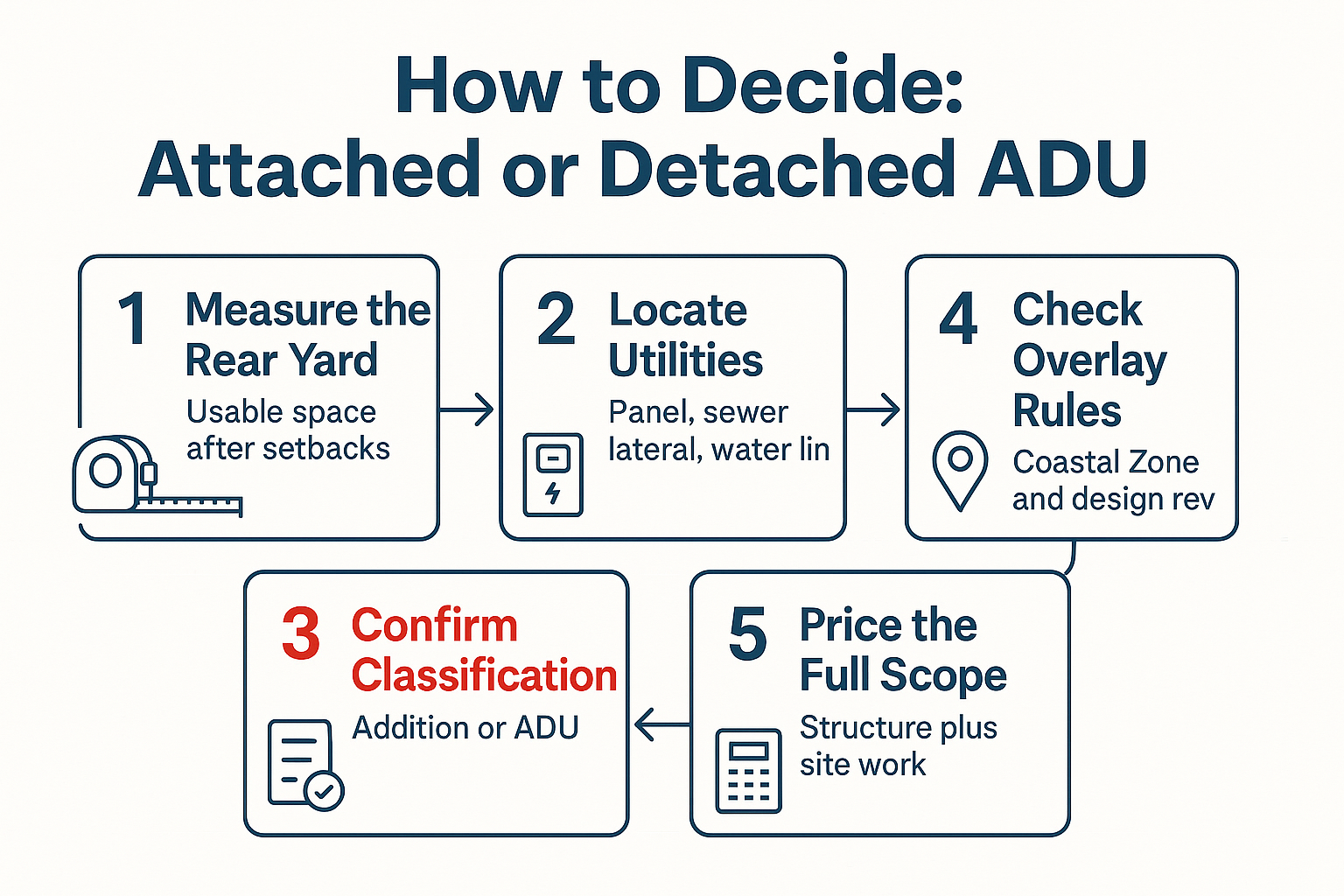
Homeowners often start at step four and work backward. Running it in this order saves redesign time.
Where Garage Conversions and Coastal Lots Fit In
A garage conversion is its own category, and for many lots it is the least expensive path to a legal unit. You are working inside an existing structure that already has a foundation, walls, and a roof.
State law also bars cities from requiring replacement parking when a garage becomes an ADU, which removes a barrier that used to kill these projects. But it is not really part of the attached versus detached question, because you are converting existing square footage rather than building new. The permitting path reflects that difference, and we broke down what to expect in turning a garage into an ADU.
One more local factor. Properties inside the Coastal Zone, which includes much of Carmel-by-the-Sea, Pacific Grove, and the shoreline side of Monterey, may face a Coastal Development Permit review on top of the standard building permit.
That is a real step with a real timeline, and it does not apply to most inland unincorporated county parcels. If your address is coastal, factor it in early rather than after plans are drawn. Recent changes have shortened parts of that process, which I covered in coastal ADU permitting.
And if the goal is a small unit for a family member rather than a full rental, a junior ADU may fit the lot better than either option here.
Frequently Asked Questions About Attached vs Detached ADUs in Monterey County
Is a detached ADU always more expensive than an attached one?
Usually, but not always. The gap comes mostly from foundation, exterior walls, roof, and site work like trenching. On a lot where the panel and sewer lateral already sit near the back, that gap narrows. On a lot where everything runs out the front, it widens. Costs vary widely by site, so the only honest number comes from walking the property.
Can I convert part of my house into an attached ADU instead of building new?
Often yes, if the space can be made independent with its own entrance, kitchen, and bathroom. Interior conversions of existing living space are usually cheaper than new construction, though older Peninsula homes may need electrical and plumbing upgrades to support a second unit.
Does an attached ADU need its own water meter?
Not necessarily. Requirements differ by jurisdiction and by water provider, and within the Monterey Peninsula Water Management District the fixture count review matters more than the meter question for many projects. Verify with your local building department and water district before assuming either way.
How long does the permit process take for each type?
It depends far more on your jurisdiction and whether your parcel sits in the Coastal Zone than on attached versus detached. Carmel-by-the-Sea and Pacific Grove have design review layers that add time. I would rather set expectations after seeing your address than give you a number that turns out wrong.
What is the single most common mistake you see at this stage?
Committing to a design before anyone has confirmed the lot can hold it. That is how a set of plans gets paid for twice. We wrote more about that in our piece on why many ADU projects run into problems before construction starts.
Thinking through an ADU on your Monterey County property?
If you are weighing attached against detached and want a straight read on what your lot can actually support, we handle these projects across the Peninsula and inland Monterey County. You can reach our team at (831) 220-3334 or at palaciosconstructionca.com when the timing is right for you. No rush, and no pressure to decide anything before you have the information.