
Quick Answer
To hire a general contractor, start by defining the work clearly. Then talk to at least three licensed contractors, verify license and insurance, check recent references, compare detailed written bids, and only sign a contract that spells out scope, payment milestones, timeline, and change order rules.
Starting a remodel or addition usually feels simple at first. You know what you want to change, but once you start calling contractors, the process gets confusing fast.
If you're figuring out how to hire a general contractor in Monterey County, the biggest mistake is shopping by price before you've defined the project. Clear scope, careful vetting, and a solid contract do more to protect your budget and timeline than anything else.
Prepare Your Project Before You Make the First Call
A homeowner in Carmel calls three contractors about the same kitchen remodel. One hears "mostly cosmetic." Another hears "open up the wall if possible." The third walks in and finds knob-and-tube wiring, a tight delivery path, and no clear appliance plan. The bids come back miles apart, and none of them are easy to compare.
That problem starts before the first phone call.
In Monterey County, early planning carries more weight than it does in easier markets. Coastal Commission issues, older homes in Pacific Grove and Monterey, hillside access in places like Carmel Valley, and trade availability all affect price, schedule, and whether a contractor even wants to pursue the job. A well-prepared homeowner gets better conversations, better bids, and fewer surprises.

Write down what the project includes
You do not need full construction drawings for every remodel. You do need a clear written scope that another person can read without guessing.
Include the basics:
- Spaces involved such as the kitchen, primary bath, guest bath, addition area, ADU, deck, or patio
- Work you know is required such as removing walls, replacing windows, upgrading plumbing, or rewiring
- Items you want but can cut later if pricing comes in high
- Finish level including cabinet type, countertop material, tile extent, fixture quality, flooring, and appliances
- Site conditions such as narrow side yards, steep lots, limited parking, older electrical, termite damage, or previous unpermitted work
Photos help too. So do rough dimensions, inspiration images, and a short note on how you use the space now versus how you want it to work after the remodel.
If you are still sorting out function and furniture flow, this guide on how to plan a room layout can help you organize the space before you ask anyone to price it.
Set priorities before you ask for numbers
A bid is only useful if the contractor knows what matters most to you.
Some homeowners care most about keeping the home livable during construction. Others care about finish quality, speed, or holding the budget line. Those goals can pull in different directions. Custom work raises cost and usually adds time. Fast scheduling may depend on material choices that are easier to source. Work in an occupied home often takes more labor because crews need to isolate dust, protect finishes, and phase the job carefully.
I tell neighbors to sort their priorities into three buckets: must have, would like, and can wait. That alone clears up a lot of confusion.
Set a realistic budget range too, with room for hidden conditions. In Monterey County, older homes often reveal dry rot, outdated wiring, plumbing problems, or foundation issues once walls are opened.
Give every bidder the same information
If one contractor sees a sketch, another gets a wish list, and a third gets detailed notes, you are not comparing bids. You are comparing assumptions.
Send each contractor the same packet:
- Your written scope
- Photos of the existing space
- Any plans or sketches
- Product selections you have already made
- Known property constraints
- Your target timing
- Any HOA or neighborhood access restrictions
Site walkthroughs should also be consistent. If one bidder visits during a quiet weekday and another shows up when street parking is blocked and the side yard is full of stored materials, they are pricing different jobs.
If permits may be involved, settle that question early. Local review can affect design, sequencing, and budget long before demolition starts. This guide explains who handles remodel permits in Monterey and why it matters.
A clear scope will not solve every problem. It will prevent the most common one, which is hiring based on numbers that were never describing the same job in the first place.
Finding and Vetting Qualified Contractors in Monterey County
A polished website doesn't tell you much. What matters is whether the contractor is properly licensed, insured, experienced with your type of job, and familiar with local conditions.
Monterey County adds another layer. Coastal exposure, older homes, hillside lots, and local review standards can change how a project is priced and managed.
Start with a short list, not a giant search
A good list usually comes from a mix of referrals, local supplier recommendations, and your own screening. Keep it tight. Three to five contractors is enough if they're qualified for the work.
When you talk to them, ask what kinds of residential jobs they handle most often. A contractor who mainly chases one kind of work may not be the right fit for a full home renovation, addition, ADU, or a remodel that involves multiple trades.
Verify the basics before discussing price
Before you spend time on meetings and bid reviews, confirm these items:
- License status through the California Contractors State License Board
- General liability insurance with current proof
- Workers' compensation coverage if they have employees
- Residential project history similar to your own job
- Recent references you can call
If you want a plain-language overview of the GC role itself, this article on what a licensed general contractor is responsible for gives a useful baseline for what should and shouldn't fall on the homeowner.
Ask for documents, not promises. Legitimate contractors expect that question and should be ready for it.
Ask local questions that generic hiring guides miss
In Monterey County, permit experience isn't a side issue. It affects schedule, planning, and whether your drawings and scope are realistic in the first place.
BuildLabs notes that, especially for ADUs and similar residential work, homeowners in California coastal counties have sometimes faced permit review times of 6-12 months, which makes local permitting knowledge a real advantage (BuildLabs, 2026). Ask direct questions:
- Have you worked with Monterey County Planning and Building Services or the relevant city department recently?
- What types of delays show up on coastal or hillside projects?
- How do you handle corrections from plan review?
- Who prepares and tracks submittals?
- What happened on the last project where existing conditions differed from the plans?
Use references the right way
Most homeowners ask, "Were you happy?" That's too broad. Ask what changed during the job, how the contractor handled it, whether communication stayed consistent, and whether the final cost tracked reasonably with the original scope.
Look for patterns, not perfection. A strong reference usually sounds specific, balanced, and calm. A weak one sounds vague, defensive, or overly rehearsed.
How to Compare Bids and Interview Candidates
Three bids land in your inbox on the same day. One is two pages, one is a polished packet, and one is a single number in an email. Homeowners get into trouble here because they compare price before they compare what each contractor is pricing.
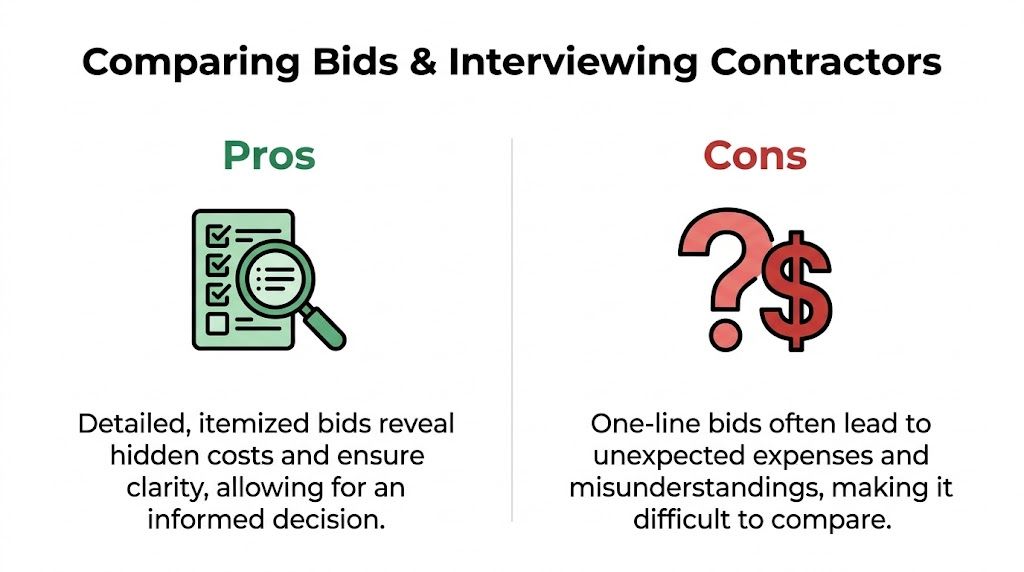
Look for detail, not just a total
A useful bid shows how the contractor read your plans, your existing house, and the likely trouble spots. In Monterey County, that matters more than it does in a flat, inland subdivision. Coastal exposure, hillside access, older homes in Carmel or Pacific Grove, and permit timing can all change labor, sequencing, and allowances.
If one proposal says "kitchen remodel, $95,000" and another breaks out demolition, cabinet install, electrical upgrades, tile scope, permit coordination, and cleanup, the second one gives you something you can test. The first one gives you room for surprises.
A side by side comparison sheet helps keep this objective. If you want a more formal framework, these Request for Proposal (RFP) evaluation criteria can help you build a clean comparison before you start interviewing finalists.
Check each bid for the same core items:
- Demolition and debris hauling
- Permit coordination and plan revision responsibility
- Allowances for fixtures, tile, flooring, and finish hardware
- Trade scope for plumbing, electrical, HVAC, drywall, and paint
- Protection of occupied areas if you are living in the house
- Site conditions such as parking, access, staging, and delivery limits
- Cleanup and punch list expectations
- Change order procedure in writing
Treat a low bid like a warning light
A low number can come from efficiency. It can also come from missing scope, thin allowances, or an unrealistic schedule.
I tell homeowners to look for clusters, not bargains. If two bids are in the same range and one is far below them, ask that contractor to walk line by line through what is excluded, what is assumed, and what allowance numbers were used. On Monterey Peninsula remodels, I would also ask how they priced limited access, inspection delays, and hidden conditions in older homes, because those costs show up sooner or later.
A cheap bid does not stay cheap if the contractor starts billing change orders for work the other bidders already carried.
Ask, "What is not included in this number?" Then stay quiet and let them answer fully.
Interview for job management, not sales skill
The interview should tell you how the project will run once the contract is signed and the walls are open.
Ask who prepares the schedule, who is on site day to day, and who has authority to approve changes. Ask how many remodels are active right now and whether your superintendent will be splitting time between jobs in Salinas, Monterey, and Carmel. Local travel time, subcontractor availability, and inspection windows affect supervision more than homeowners expect.
Good questions are specific:
- Who will be my main contact once construction starts?
- How often will I get schedule updates?
- How do you handle concealed damage, dry rot, or outdated wiring found during demolition?
- How are selections tracked so there is a record of what was approved?
- Which trades are employees, and which are subcontractors?
- How do you keep the job moving if a finish material is backordered?
- What is your process for owner questions during the week?
Listen for organized answers. A strong contractor can explain their system without getting defensive or vague.
Pressure tactics are a bad sign
Construction is not retail. You do not need to sign today to lock in a fair contractor.
Be cautious if someone avoids written revisions, rushes you past exclusions, or promises a finish date that does not match the amount of work. For larger remodels, schedule claims should line up with crew size, permit reality, and lead times. If you want a grounded reference point before accepting anyone's timeline, review how long a whole house remodel usually takes.
The right bid is the one you can understand, question, and build from with fewer surprises.
The Contract and Pre-Construction Plan
A lot of remodels go sideways after the hire, not before. The bid looked fine, everyone felt aligned, then demolition starts and nobody agrees on what was included, who is ordering materials, or how surprise conditions will be handled. That usually traces back to weak contract language and a rushed pre-construction phase.
A solid contract gives you something better than good intentions. It gives both sides a written system for scope, money, schedule, approvals, and closeout.
What the contract should clearly include
The agreement should be specific enough that a third party could read it and understand what is being built. In Monterey County, that matters even more on older homes, coastal properties, and remodels that may trigger plan revisions, design review comments, or permit delays.
Look for these items in writing:
- Scope of work that clearly states what is included, what is excluded, and which existing conditions may require additional work
- Payment schedule tied to real progress points, such as completion of demolition, rough framing, rough inspections, or finish installation
- Allowance and selection terms showing exactly what has been budgeted for tile, plumbing fixtures, lighting, appliances, and other owner selections
- Change order procedure that requires written pricing and approval before extra work starts
- Schedule framework with major phases, expected inspection points, and language explaining what can shift the timeline
- Permit responsibility stating who prepares documents, who submits, and who responds if corrections come back from the jurisdiction
- Site protection and access rules covering dust control, working hours, staging, parking, and occupied-home protections
- Lien release process as payments are made
- Punch list and final completion terms so the last details are documented and closed out properly
Payment structure matters, but there is no single formula that fits every job. What matters is whether payments match completed work and purchased materials. If a contractor wants large draws early, ask what those funds cover and how that will be documented.
Pre-construction deserves the same attention as the contract itself. Before work starts, the contractor should be able to walk you through selections, lead times, permit status, temporary protections, utility shutoffs, delivery access, and who has authority to approve changes in the field. On projects in Monterey, Carmel, Pacific Grove, and other tighter sites, staging and access can affect the schedule as much as labor.
This planning work is where a lot of avoidable delays get cut off early. If your project includes an addition, ADU, or layout change, design and pre-construction planning in Monterey for permit-ready projects shows what should be settled before crews arrive.
One more point from the field. If your house is older, assume there is a fair chance of concealed issues once walls open up. Dry rot, undersized framing, old galvanized plumbing, and outdated wiring are common in this county. The contract does not need to predict every hidden condition, but it should explain how discoveries are documented, priced, approved, and scheduled so you are not making expensive decisions under pressure.
Common Red Flags to Watch For When Hiring
A lot of bad hires follow the same pattern. The contractor says the right things in the first meeting, the number looks attractive, and the warning signs get brushed aside until the job is underway and your options shrink.
The biggest red flag is a bid that feels light for the amount of work discussed and still stays vague on what is included. In Monterey County, that is where homeowners get burned. Coastal permitting, older housing stock, access limits in places like Carmel and Pacific Grove, and slower material logistics can all affect price and schedule. If a proposal ignores those realities, it is not lean. It is incomplete.
A few warning signs deserve extra weight:
- Very low bids with little line-item detail or unclear allowances
- Loose scope language such as "kitchen remodel" without spelling out demolition, finishes, fixtures, labor, and exclusions
- Upfront payment pressure before permits, selections, lead times, and site conditions are addressed
- No clear proof of license, insurance, or workers' comp coverage
- Dodging questions about who pulls permits, who supervises the job, and how many active projects are already on the schedule
- Pressure tactics such as "sign today" pricing or urgency that does not match your project
- References that sound polite but thin, especially if past clients mention long gaps, surprise costs, or poor follow-through
I also pay close attention to how a contractor talks about problems. A good one will tell you where the job could go sideways. Dry rot behind siding, electrical updates in older homes, drainage issues on sloped lots, HOA restrictions, coastal review, or long cabinet lead times. A weak one skips past those issues and sells certainty.
License status matters for the same reason. You are not just checking a box. You are checking whether the contractor is set up to take legal responsibility for the work, the crew, and the permit process. This guide on why hiring a licensed general contractor matters for remodel risk and accountability explains that side of the decision in more detail.
One last field test. Ask a simple follow-up question after every broad promise. If someone says, "We handle everything," ask who handles permits, who is on site daily, how change orders are approved, and what happens if hidden damage shows up. Clear answers are a good sign. Evasive ones usually get more expensive later.
Frequently Asked Questions About Hiring a Contractor
A homeowner in Monterey calls three contractors for the same kitchen remodel and gets three very different answers on timing, permits, and price. That is normal here. Local conditions matter, especially if the house is older, near the coast, or likely to trigger stricter review.
How many contractors should I talk to before hiring one?
Talk to three, sometimes four if the project is large or unusual. That gives you enough range to compare how each contractor defines the work, explains the schedule, and prices the job.
More than that can waste time unless your scope is very clear. Too many bids often create noise instead of clarity.
Is it a bad sign if a contractor is booked out for months?
No. In Monterey County, good contractors are often scheduled well ahead because skilled crews are limited and permit timelines can stretch, especially on coastal or structural work.
The question is whether the contractor can explain the backlog clearly. Ask when pre-construction starts, when field work starts, and what has to happen in between.
Should I hire the contractor with the lowest bid?
Choose the bid you understand best. A low number can look good up front and still cost more if it leaves out demolition, finishes, permit time, or realistic allowances.
I tell homeowners to look for missing pieces before they look at the bottom line. If one bid is much lower, ask what is excluded and get the answer in writing.
What should I ask references besides whether they liked the contractor?
Ask what happened when the job got complicated. That answer tells you more than general praise.
Good reference questions include: Did the contractor return calls? Did the schedule slip, and if so, was the reason explained early? Did the crew keep the site reasonably clean? Were change orders documented before extra work started? On Monterey County remodels, I would also ask whether permit inspections and local review caused delays, and how the contractor handled them.
Do I need a contractor with local permit experience for a remodel?
For cosmetic work, local experience matters less. For additions, ADUs, structural changes, older homes, hillside lots, or properties in the coastal zone, it matters a lot.
A contractor who regularly works in Monterey County is more likely to understand how local departments review plans, what slows approvals, and where projects tend to get stuck. That does not guarantee a fast permit. It does reduce avoidable mistakes.
When should I sign the contract?
Sign when the scope is specific enough to price properly and build properly. That means the work description, payment schedule, allowance structure, permit responsibility, and change order process are all written down in plain language.
If the contract still leaves major finish selections, structural assumptions, or responsibility questions unresolved, wait. A short delay before signing is cheaper than fixing confusion after demolition starts.
Start Your Project with a Clear Plan
A good remodeling experience usually starts long before construction. It starts when you define the work clearly, vet contractors carefully, compare bids on scope instead of price alone, and insist on a contract that answers the hard questions before the job begins.
If you're in Monterey County and want to talk through a remodel, addition, ADU, JADU, kitchen, bathroom, or outdoor living project, start with a straightforward conversation and a realistic scope. You can learn more at palaciosconstructionca.com or visit 222 Ramona Ave Unit 5, Monterey, CA.
Sources
Construction Owners Association of America. "California Construction Jobs Fall 2.2%." 2026. https://www.constructionowners.com/news/california-construction-jobs-fall-2-2
Harris Constructors. "How to Hire General Contractor." 2026. https://harrisconstructorsinc.com/how-to-hire-general-contractor/
BuildLabs. "Hire a General Contractor." 2026. https://www.buildlabs.com/blog/hire-a-general-contractor
Better Business Bureau. "How to Hire a Reliable and Trustworthy General Contractor." 2026. https://www.bbb.org/all/home-improvement/how-to-hire-a-reliable-and-trustworthy-general-contractor
If you'd like to talk through a residential remodel or addition with a licensed local team, Palacios Construction serves homeowners throughout Monterey County from 222 Ramona Ave Unit 5, Monterey, CA. Reach out for a conversation about your project scope, timeline, and next steps.