Quick Answer
Monterey homeowners are building ADUs for multigenerational living because separate housing is hard to find, expensive, and often far from family support. An ADU or JADU can create private living space for parents, adult children, or caregivers on the same property, but local permitting, utilities, and site constraints matter early.
Finding a workable place for an aging parent or an adult child in Monterey County can be harder than most families expect. Staying close sounds simple until you start looking at housing options, commute distance, privacy, and whether the arrangement will still work a few years from now.
That’s a big reason why Monterey homeowners are turning to ADUs for multigenerational living. A well-planned unit can keep family nearby without forcing everyone into the same kitchen, the same schedule, and the same daily friction. But in Monterey County, state ADU rules are only part of the picture. Coastal review, older lots, local design standards, and utility limitations can change what’s realistic on a specific property.
Why ADUs Are Gaining Popularity in Monterey County
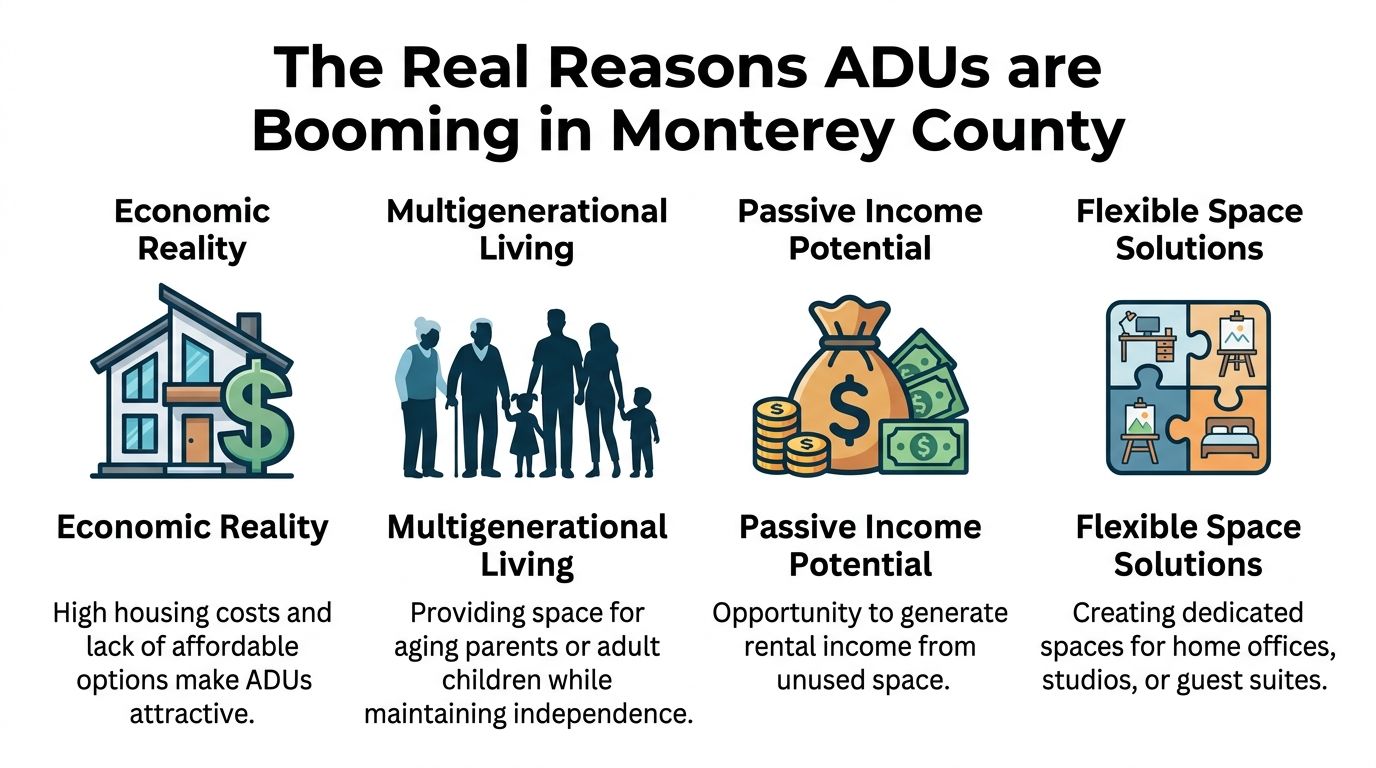
A common Monterey County scenario looks like this: a parent needs to live closer to family, an adult child cannot afford a separate rental nearby, and the main house does not have the privacy or layout to make that arrangement work for long. In those cases, an ADU is often the most practical housing move a family can make on property they already own.
National survey coverage from HousingWire found that multigenerational living is a primary reason many homeowners build ADUs, which tracks with what shows up on local projects in Monterey County (HousingWire survey coverage). Around here, the decision usually has less to do with creating a backyard rental and more to do with keeping family close without forcing everyone into one shared floor plan.
Families want help nearby, not constant overlap
The families I talk to are rarely asking for a perfect magazine version of multigenerational living. They want workable distance. That means a parent can have quiet, adult children can come and go without running the whole house, and the primary household can keep its own routine.
A properly built ADU supports that better than a converted dining room, enclosed garage with no permits, or a temporary arrangement that keeps stretching into another year.
The layouts that hold up best usually include a few basics:
- A separate entrance so daily schedules stay independent
- A defined outdoor area for sitting, gardening, or just having space that feels personal
- A bathroom and kitchen plan that matches the family member’s actual level of independence
- Sound control that reduces friction between the main house and the secondary unit
If the unit is for family, the design should solve for five or ten years, not just the current crisis.
Monterey County makes on-site family housing more practical than finding another home nearby
In many parts of Monterey County, buying or renting a second home close to family is hard enough. Doing it close to doctors, schools, jobs, and an existing support system is harder.
That is why homeowners keep looking at the lot they already have. If the property can physically support an ADU, building on site often gives the family more control than trying to piece together housing across different neighborhoods. It also creates flexibility later. A unit built for a parent now may work for an adult child, a caregiver, or long-term guest housing later.
Local conditions matter, though. Monterey County is not a plug-and-play ADU market. Older parcels often come with tight setbacks, grading issues, aging utility connections, septic limits, or coastal review concerns that statewide ADU articles barely mention. A detached unit that looks straightforward on paper can get more complicated once you account for access, drainage, fire separation, or where the sewer line runs.
Accessibility is usually cheaper to build now than to retrofit later
Families often start with one immediate need, but the smart projects account for what may change over time. If an aging parent is the likely occupant, accessibility should be built into the plan from the beginning.
That does not mean a clinical-looking unit. It usually means making a few decisions early, while they are still affordable.
- Single-level living
- Wider door openings where they matter
- Low-threshold shower entry
- Better lighting from parking to entry
- Enough turning and walking room in the bedroom, bath, and kitchen
Those choices can add cost upfront, but they usually cost less than tearing into a finished unit later.
Homeowners still comparing layouts, features, and use cases can review ADU trends Central Coast homeowners should know in 2026 for examples of how local projects are being planned now.
Understanding Your Options ADU vs JADU
Not every family needs the same type of secondary unit. Some need a fully independent small home. Others need a simpler setup inside the existing house.
What an ADU is
An ADU is a complete secondary dwelling unit. It can be detached, attached, or created through a conversion, depending on the property and what local rules allow.
Functionally, it works like a small residence. It has its own living area, kitchen, sleeping area, and bathroom. If your goal is true independence for a parent, adult child, or long-term caregiver, an ADU is usually the more natural fit.
This option often makes the most sense when:
- Privacy matters daily
- The occupant will live there full time
- You want more distance between the main house and the unit
- You need a layout designed around mobility or aging in place
What a JADU is
A JADU, or Junior Accessory Dwelling Unit, is smaller and must be created within the existing home’s footprint. It’s not a detached backyard cottage.
A JADU includes an efficiency kitchen, and it may share a bathroom with the main house. That makes it useful for households that want some separation without building a fully independent structure.
A JADU can work well when the family member is closely connected to the main household and doesn’t need complete separation.
Which one fits a multigenerational setup better
There isn’t one right answer. The right choice depends on how your family lives.
A detached ADU often works better for aging parents who want quiet, routine, and control over their own space. It can also reduce tension because everyone has a little breathing room.
A JADU can be a strong option when you have limited yard space, when the property won’t support detached construction easily, or when the goal is to create a modest private area for one family member inside the existing structure.
Shared family housing usually fails for practical reasons, not emotional ones. Bathroom access, kitchen overlap, parking, noise, and privacy cause more stress than most homeowners expect.
Cost and property realities affect the choice
The ADU versus JADU decision also changes construction scope.
A detached ADU may involve excavation, foundation work, trenching, utility runs, drainage, and new exterior access. A JADU may reduce some of that work but can trigger interior reconfiguration, code upgrades, and careful planning around the existing house.
On older Monterey County properties, neither option should be chosen from a sketch alone. The lot, structure, slope, access, and utility situation usually decide what’s sensible.
Navigating Monterey County's Unique Permitting and Zoning Reality
California made ADUs easier to approve in general. That doesn’t mean every lot in Monterey County is simple.
The trouble usually starts when homeowners assume state rules override local reality in every case. They don’t. Local jurisdictions still shape the process through planning review, design review, utility requirements, and site-specific constraints.
Coastal properties and older neighborhoods change the process
If a property sits in or near the coastal zone, review can become more involved. The same is true for neighborhoods with architectural controls, hillside conditions, narrow access, or older infrastructure.
In places like Monterey, Pacific Grove, and Carmel-by-the-Sea, details that seem minor on paper can affect the plan set in a big way:
- Setback interpretation
- Height and massing concerns
- Exterior appearance and neighborhood compatibility
- Tree impacts or site drainage
- Water, sewer, and electrical connection requirements
- Access for construction on tight lots
For homeowners trying to sort out the first steps, this overview of whether you need permits to build an ADU in Monterey County is a useful starting point.
Utility planning causes more redesigns than most people expect
A lot can seem buildable until utility planning starts. Then the questions get more specific.
Can the property support the new unit’s electrical load? Will sewer routing require more trenching than expected? Is water service straightforward, or does the site create added complications? On older properties, utility work often affects both budget and timeline.
That’s one reason feasibility review matters before design is locked in. If the utility path is awkward, or if the lot forces expensive site work, the smartest move may be changing the footprint, changing the unit type, or reconsidering where the structure sits.
A realistic sequence helps avoid expensive rework
The cleanest ADU projects usually follow a disciplined order.
-
Property review
Confirm zoning, lot conditions, access, utility context, and whether the site has coastal or local review issues. -
Feasibility and layout testing
Check whether the desired unit size and placement fit the lot and family goals. -
Design and engineering
Build plans around the property’s real constraints, not assumptions. -
Permit submission and agency response
Expect questions, revisions, and coordination with the applicable local jurisdiction. -
Construction after approval
Break ground only when the drawings and permit path are aligned.
If an ADU project stalls, it usually stalls before construction starts. The design looked fine. The site or permit path didn’t.
What works and what doesn’t
Some homeowners want to move fast by drafting plans before anyone studies the property. That often backfires.
What works is early due diligence. Check local zoning allowances, setbacks, utility paths, and coastal restrictions before finalizing a layout. A contractor who builds in Monterey County regularly can flag issues that a generic statewide checklist won’t catch.
What doesn’t work is assuming every backyard can take a detached unit just because California supports ADUs broadly. Monterey County has too many lot-by-lot variables for that kind of shortcut.
Designing a Multigenerational ADU for Privacy and Accessibility
A multigenerational ADU works when the people living in it don’t feel like they’re living on top of each other. That starts with the layout, not the finishes.
Privacy has to be designed in
Families usually ask for closeness. What they need is closeness with boundaries.
That means thinking carefully about where doors, windows, walkways, patios, and parking go. If the ADU entry faces directly into the main house’s busiest area, privacy disappears fast. The same goes for windows placed too close to one another or outdoor seating areas with no separation.
The strongest layouts usually include some combination of:
- A separate path to the ADU entrance
- Window placement that limits direct sight lines
- A small private outdoor area
- Distance between sleeping walls when possible
- Insulation and assembly choices that reduce sound transfer
A family unit doesn’t need to be large to feel independent. It needs to feel intentional.
Accessibility shouldn’t be treated as a later upgrade
AARP survey data shows strong interest in this kind of housing. Among adults age 50 or older, 69% said they would consider living in an ADU to be close to someone while maintaining their own space, and 90% of older Americans prefer to remain in their current homes and communities as they age (Habitat for Humanity and AARP ADU evidence brief).
That preference affects design decisions right away.
If the unit may house an older parent now or later, build around ease of use from day one. Retrofitting for accessibility after construction is usually harder and more disruptive than getting the basics right on the plans.
Common features worth discussing early include:
- No-step entry
- Single-floor living
- Wider interior clearances
- Lever-style hardware
- Walk-in shower with room to move safely
- Blocking in walls for future grab bars
- Good lighting from parking to front door
Design choices should match the real family arrangement
An adult child working long hours may care most about privacy and parking. An aging parent may care more about quiet access, bathroom safety, and being near the main house without feeling dependent.
Those are different design problems. They shouldn’t be solved with the same stock plan.
That’s why pre-construction planning matters. A family ADU should be built around who will use it, how long they’ll use it, and how that use may change. Homeowners who are still in the planning phase can look at design and pre-construction planning in Monterey for permit-ready projects for a clearer sense of how those decisions get resolved before permits are submitted.
The best multigenerational ADUs don’t just create space. They reduce friction.
Understanding the True Cost and ROI of a Monterey ADU
The cost of an ADU in Monterey County depends less on a generic online average and more on what your property asks for.
What drives cost on this type of project
Two ADUs with the same square footage can be very different projects.
A flat lot with simple access is one thing. A coastal or hillside property with tight setbacks, older utilities, drainage issues, and limited equipment access is something else entirely. Older homes can also create added work if the project involves tying into existing systems that need upgrades.
The main cost drivers usually include:
- Site conditions such as slope, soil, drainage, and access
- Type of project such as detached new build, attached unit, garage conversion, or JADU
- Utility work including trenching, panel upgrades, sewer routing, and water connection issues
- Permit and review complexity tied to the local jurisdiction and property location
- Finish level and material choices
- Structural needs if older construction requires reinforcement or correction
Homeowners comparing bids often benefit from reading why ADU construction costs vary so much in California before assuming one proposal covers the same scope as another.
ROI isn’t only about rent
For a family ADU, return on investment should be looked at more than one way.
There may be long-term property value benefits, but Monterey-specific ROI varies too much by neighborhood, site constraints, age of the home, coastal conditions, and permitting complexity to reduce it to a simple statewide formula. A detached unit on an easy inland lot and one on an older coastal property do not carry the same financial profile.
There’s also a practical family return that matters just as much. Keeping an aging parent close, avoiding a rushed housing search for an adult child, or creating space for a caregiver can change the daily life of the whole household.
The strongest projects are honest about trade-offs
Some properties support an ADU cleanly. Others support one only if the homeowner is realistic about layout, size, or finish selections.
That doesn’t mean the project isn’t worth doing. It means the return comes from matching the unit to the property instead of forcing a plan that fights the site from the beginning.
The ADU Construction Timeline From Concept to Completion
Homeowners usually ask how long an ADU takes. The honest answer is that the timeline depends heavily on design complexity, permitting conditions, and site constraints before construction even starts.
Phase one starts with feasibility
Before anyone talks about finishes, the property needs to be reviewed.
That first phase usually includes a site visit, zoning review, basic utility discussion, and a hard look at what the lot can realistically support. If the property has coastal issues, access problems, or an older infrastructure setup, those points should be identified immediately.
Skipping this phase is one of the most common mistakes on family ADU projects.
Design and engineering turn the idea into a buildable plan
Once the project direction is clear, plans can be developed around the lot instead of against it.
This stage often includes architectural drawings, structural input, and revisions that respond to setbacks, utility routing, height limits, and family use. On multigenerational projects, this is also where privacy and accessibility decisions should be locked in.
Permitting takes patience
In Monterey County, permitting can move cleanly or slow down depending on the jurisdiction and the property itself. The same ADU concept may have a very different review path in Salinas than it would in Carmel-by-the-Sea or a coastal area.
Homeowners should expect permit review to involve questions and possible plan adjustments. That’s normal. It doesn’t mean the project is failing. It means the process is doing what it’s supposed to do.
Permit timing is rarely just about paperwork. It’s often about how well the plans matched the property before submission.
Construction goes faster when planning was done right
Once permits are in place, construction follows the normal sequence: site prep, foundation or structural work, framing, rough utilities, insulation, drywall, interior finishes, exterior work, and final inspections.
This part feels more familiar to most homeowners. But it only stays orderly if the earlier phases were handled carefully. A rushed permit set often turns into field changes, delays, and added cost during the build.
Final inspections close the loop
At the end, the project still has to pass required inspections and permit closeout. That includes making sure the built work matches approved plans and code requirements.
For multigenerational living, handoff should also include the practical details that matter after move-in, such as entry hardware, bathroom usability, lighting, and how the space functions day to day for the family member using it.
Why a Process-Driven Contractor Is Essential for Your ADU Project
The reason why Monterey homeowners are turning to ADUs for multigenerational living is easy to understand. The hard part is getting from idea to finished unit without running into avoidable problems.
In Monterey County, a process-driven contractor matters because the project usually involves more than building. It also involves property review, permit coordination, plan interpretation, trade scheduling, inspections, and adapting to what the site reveals once work begins.
That kind of structure is especially important on older properties. Existing homes don’t always tell the full story until utilities are traced, framing is opened, or drainage patterns are reviewed. A contractor needs to manage those realities without losing control of the job.
One option homeowners can consider is Palacios Construction, a licensed residential general contractor serving Monterey County that handles ADU and addition projects with planning, permit coordination, and construction management as part of the scope. Homeowners can also review what a licensed general contractor is responsible for when comparing who should lead a project of this size.
The main point is simple. If the contractor doesn’t understand local review, older homes, and sequencing, the homeowner usually pays for that learning curve in redesigns, delays, or preventable field changes.
Frequently Asked Questions About Monterey ADUs
Can I build an ADU for my parents in Monterey County?
In many cases, yes, but it depends on your property’s zoning, setbacks, utility setup, and any local review conditions. Coastal location, lot shape, and older neighborhood infrastructure can affect what type of unit makes sense.
Is a detached ADU better than a JADU for family living?
Usually, a detached ADU gives more privacy and independence. A JADU can still work well if you have limited space or if the family member will remain closely connected to the main household.
How do I know if my lot is a good fit for an ADU?
Start with zoning, setback review, utility access, and whether the property has coastal restrictions. After that, look at slope, drainage, construction access, and how the unit would sit on the lot without creating privacy or parking problems.
Will building an ADU in Monterey County take longer than I expect?
It often does if the property has local review issues or if the first design ignores site constraints. The permitting phase is where many projects slow down, especially on older, tighter, or coastal lots.
What features should I include if the ADU is for an aging parent?
Focus on no-step access, easy bathroom use, single-level living, good lighting, and enough clearance for comfortable movement. Even if your parent is active now, planning for accessibility early usually makes the unit more useful over time.
Is an ADU a better choice than a home addition?
That depends on how much independence the family member needs. If you want a separate living space with its own kitchen and entry, an ADU is often the better fit. If the goal is more room inside the existing house, an addition may make more sense.
Call to Action
If you’re considering why Monterey homeowners are turning to ADUs for multigenerational living, the first step is usually figuring out what your lot can support. Zoning, setbacks, utilities, coastal restrictions, and the condition of the existing property all matter before plans are finalized.
If you’re in Monterey County and want a straightforward conversation about an ADU or JADU for family use, you can reach out through palaciosconstructionca.com or visit 222 Ramona Ave Unit 5, Monterey, CA.
Sources
HousingWire. "61 Percent of ADUs Are Built for Multigenerational Housing, Survey." 2024. https://www.housingwire.com/articles/61-percent-of-adus-are-built-for-multigenerational-housing-survey/
Habitat for Humanity and AARP. "ADU Evidence Brief." 2024. https://www.habitat.org/sites/default/files/documents/ADU-Evidence-Brief_Habitat-AARP.pdf
If you're exploring an ADU, JADU, or home addition for family living in Monterey County, Palacios Construction offers residential construction planning and build services with a focus on local permitting, realistic scopes, and durable execution. A simple conversation about your property is often the clearest way to understand what’s feasible.