Quick Answer
A custom home in Monterey County usually moves through five working stages: site evaluation, design and engineering, local approvals, contractor agreements, and construction through final inspection.
The order matters. A coastal lot in Carmel, a hillside parcel in Monterey, and a rural site in South County can follow the same general process but face very different constraints. Water availability, grading, access, soils, septic, fire requirements, and Coastal Commission or local jurisdiction review can all affect what gets built, how it gets built, and how long it takes.
Expect months of planning before crews start work, and treat permitting as a real project phase, not a formality. The smoothest custom home projects are the ones that solve site and approval issues early, before pricing, scheduling, and construction decisions lock in.
Introduction
If you're looking into the process for building a custom home, you're probably trying to answer a few practical questions at once. How long will it take, who handles what, and where do projects usually get stuck?
In Monterey County, those questions matter even more because site conditions, water rules, coastal oversight, and local permitting can all change the path of a project. A custom home can go well, but only when the process is handled in the right order.
Phase 1 Pre-Construction Planning and Site Evaluation
A lot in Monterey County can look straightforward until the first real site walk. Then the practical issues show up. Driveway grades are tighter than expected, utility access is farther away, drainage has to be managed carefully, or the parcel falls under a review path that changes the schedule before design is even underway.

Start with the program, not the finishes
The first job is to define how the house needs to work. That program includes bedroom count, bathroom count, kitchen use, storage, office needs, guest space, aging-in-place concerns, and the relationship between indoor rooms and outdoor living areas.
In practice, this step keeps owners from spending time on selections that do not solve the bigger problem. A premium appliance package will not fix a cramped kitchen layout. Custom windows will not correct poor orientation on a windy coastal site.
A useful way to sort priorities early is to separate them into three groups:
- Must-have spaces: Bedrooms, bath count, storage, garage needs, accessibility needs
- Lifestyle priorities: Covered patio, larger kitchen, guest suite, mudroom, work-from-home space
- Flexible items: Specialty tile, custom built-ins, appliance packages, decorative features
Practical rule: If you cannot explain how you want to live in the house day to day, the design team cannot draw the right house.
Budget around actual cost drivers
Early budgeting should track the parts of the project that move the number. On custom homes, those usually include grading, retaining walls, foundation type, utility runs, framing complexity, window and door packages, roofing, and finish level.
Monterey County adds local variables that generic building guides usually miss. A relatively level infill lot in town is one kind of project. A hillside parcel in Carmel Valley or a coastal site with exposure, access limits, and added review is another. The house may be similar in size, but the cost structure is not.
Permit timing also needs a realistic buffer. Delays often come from incomplete submittals, revisions after site constraints are identified, or extra agency comments tied to location. Owners who want a clearer picture of that early work usually benefit from reviewing design and pre-construction planning in Monterey for permit-ready projects before they push too far into design.
Evaluate the lot before getting attached to a plan
This is the step owners tend to underestimate.
A buildable parcel still may have constraints that affect footprint, budget, and schedule. Common issues here include slope stability, drainage patterns, septic feasibility, tree impacts, water availability, equipment access, easements, and setback limits. On some sites, the biggest design decision is not style. It is where the house can sit without triggering expensive rework.
Coastal and hillside properties need even closer review. Plans that look fine in a preliminary sketch often change once survey information, engineering input, grading requirements, or jurisdiction comments come in. This is why experienced local review is so valuable early in the process.
When this phase is rushed, the usual result is not one big failure. It is a series of smaller problems. Redraws, approval delays, avoidable engineering changes, and field adjustments that cost more than they should. The better approach is simple. Understand the property first, then design a house that fits it.
Phase 2 Design Engineering and Local Approvals
Once the project goals and site constraints are clear, the house has to become a buildable set of documents. At this stage, design intent meets structural reality, local code, and agency review.
Who does what during design
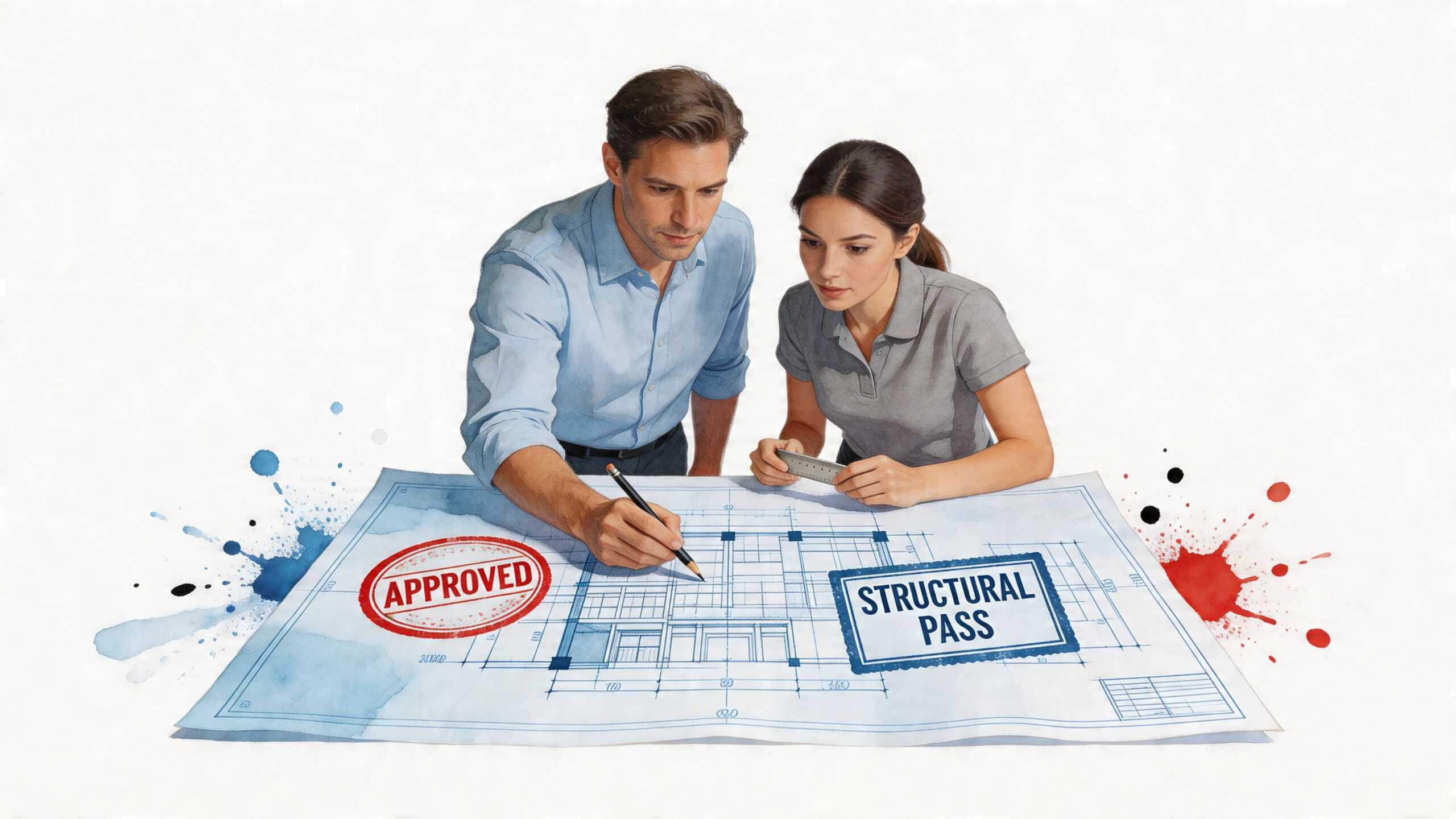
The architect handles the layout, form, exterior expression, room flow, and how the home sits on the site. The structural engineer handles the framing logic, foundation requirements, lateral resistance, and the details that make the house safe and buildable.
Other consultants may also be involved depending on the property. Civil engineering, geotechnical review, energy documentation, septic design, and survey work are all common on custom home projects.
This stage works better when the builder is involved before plans are finished. Subcontractor input during plan review can catch conflicts early, improve buildability, and reduce the chance of expensive surprises later. That early coordination is one of the practical reasons some projects move more cleanly from paper to field work.
Local approvals aren't one-size-fits-all
Monterey County is not a single permitting environment. A project in the City of Monterey doesn't move exactly the same way as one in Carmel-by-the-Sea, unincorporated county areas, or coastal parcels with added review.
Water and environmental concerns can affect feasibility as much as the building code does. Depending on location, a project may involve local planning review, coastal review, grading review, septic review, and water-related approvals. Seismic requirements also shape structural decisions from the beginning, especially on sloped sites.
The most preventable delay in permitting is an incomplete application. Missing reports, unsigned sheets, and inconsistent plan sets slow review down fast.
That point matters because permit staff don't redesign projects for you. They review what gets submitted. If the plans don't line up across architecture, engineering, and site information, comments come back and time gets lost.
Homeowners who want a better sense of responsibility and permitting coordination can review who handles remodel permits in Monterey and why it matters.
What approval-ready plans usually include
Approval sets vary by project, but most custom homes need a coordinated package that addresses more than floor plans.
- Architectural plans: Site plan, floor plans, elevations, sections, door and window information
- Structural sheets: Foundation design, framing details, shear and hold-down requirements
- Site-related documents: Grading information, drainage considerations, utility paths, and other lot-specific details
- Supporting reports: Energy documentation and specialty reports when required by the jurisdiction
What doesn't work is designing first and checking feasibility later. In Monterey County, that often leads to redraws. What works is steady coordination among the architect, engineer, and contractor while the plans are still flexible.
Phase 3 Contractor Selection and Agreements
Choosing a contractor isn't about collecting the lowest number from a few bids. It's about finding the company that can deliver the project you drew, in the jurisdiction you're building in, with a contract that doesn't leave major gaps.
Vet local experience before you compare pricing
A contractor might be licensed and still be the wrong fit for your project. Custom homes in Monterey County often involve older infrastructure, difficult access, sloped terrain, or tighter local review than owners expect. Local experience matters because sequencing, inspections, and site management are different from straightforward tract work.
Start with the basics:
- License status: Verify the contractor's CSLB license is current and appropriate for the work
- Insurance coverage: Confirm general liability and workers' compensation
- Project match: Ask whether they've handled homes or major residential projects with similar scope and site conditions
- References: Speak to past clients about communication, scheduling, and how changes were handled
If you're sorting out roles on a residential project, what a licensed general contractor is responsible for gives a practical breakdown.
Read the agreement like a project manual
A strong contract should clearly describe the scope of work, allowance structure if used, payment schedule, change order process, estimated schedule, and who is responsible for permits, inspections, and coordination.
If those points are vague, the job usually gets harder once construction starts. Problems rarely begin with framing. They begin with assumptions that weren't written down.
A clear contract doesn't guarantee a smooth project, but an unclear contract almost guarantees confusion.
Patience is part of hiring well
Homeowners sometimes try to rush contractor selection because they want to keep momentum. That usually backfires. The complete custom home process is already a long one, with planning and permitting taking a significant share of the total timeline, so it makes sense to spend the time needed to choose the right builder and lock in a workable agreement.
The right fit is usually the contractor who asks detailed questions, points out risks early, and doesn't promise an unrealistically easy path. That may not be the cheapest conversation, but it's usually the more reliable one.
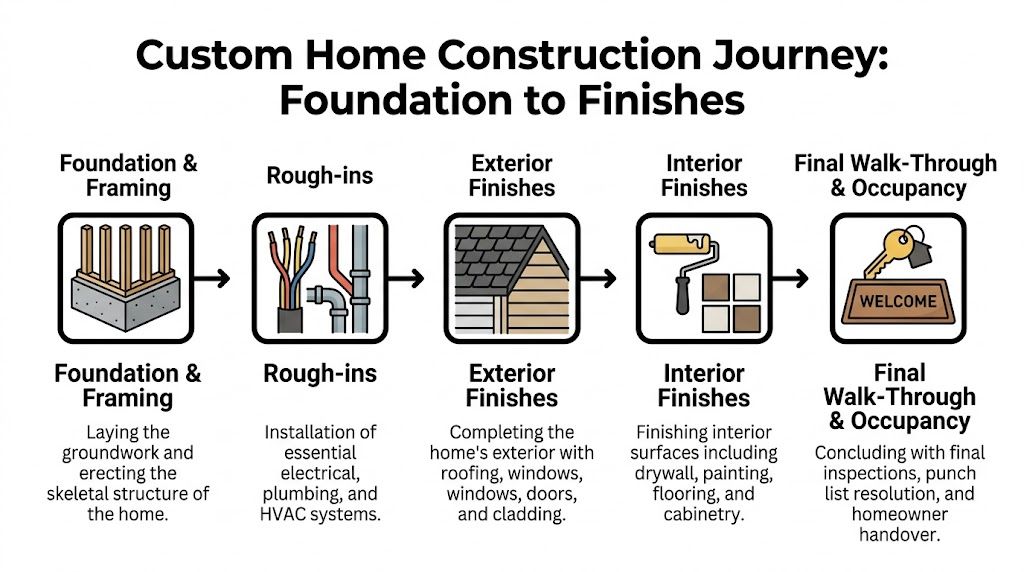
Phase 4 The Construction Process from Foundation to Finishes
A lot can look like steady progress once equipment shows up and concrete gets poured. In practice, this phase is a series of handoffs, inspections, weather calls, and trade coordination decisions that have to be managed in the right order.
Site work and foundations
Construction usually starts with staking, excavation, grading, erosion control, and utility trench planning. In Monterey County, the site often dictates the pace early. A Carmel Highlands hillside lot, an inland parcel with expansive soils, and a coastal site exposed to marine moisture all create different foundation and drainage demands.
Foundation work follows the engineering, not jobsite guesswork. That might mean a slab-on-grade, a raised floor, a stepped footing system, piers, retaining walls, or a mix of those conditions on one house. If the excavation exposes unexpected soil conditions, underground water, old fill, or rock, the job may pause while the engineer reviews the field conditions and revises details. Homeowners should expect that possibility, especially on sloped or previously developed lots.
Framing and drying in the structure
Framing sets the geometry of the house. Floor levels, wall planes, roof lines, shear walls, hold-downs, and structural hardware all have to match the approved plans and the engineer's details. Small layout mistakes at this stage show up later in tile lines, cabinet fit, window alignment, and finish carpentry.
Once framing is far enough along, the goal is to get the structure dried in as soon as sequencing allows. Roofing underlayment, roof covering, windows, exterior doors, flashings, weather-resistive barriers, and cladding details all matter here. On the Monterey County coast, poor waterproofing details do not stay minor for long. Wind-driven rain, salt air, and prolonged damp conditions expose weak window flashing, bad sealant joints, and rushed exterior transitions quickly.
Rough-ins and inspections
After the shell is protected, the mechanical work moves in. Plumbing, electrical, HVAC, low-voltage, fire sprinkler systems where required, and specialty systems all compete for space in walls, ceilings, and utility areas. Coordination is the real job at this point.
On custom homes, conflicts are common. A beam drops lower than expected. A duct route interferes with a structural member. A plumbing wall is tighter than the fixture layout suggested on paper. Those issues can usually be solved, but each fix takes field review and sometimes updated direction from the designer, engineer, or supplier.
Inspections happen throughout this phase, not just at the end. County requirements, local jurisdiction procedures, and the inspection schedule all affect pace. A well-run project includes contractor quality checks before the inspector arrives, because failed inspections rarely cost only a day. They can push multiple trades off sequence.
Insulation, drywall, and finish work
Once rough inspections are approved, insulation and drywall close up the interior. After that, the work becomes more visible, and owners often assume the project is close to done. Finish stage is usually slower than expected because many trades are working in the same spaces and the tolerance for mistakes gets much tighter.
Cabinets have to land correctly before countertops are templated. Tile layout affects plumbing trim and floor transitions. Finish electrical depends on cabinet, stone, and paint progress. Interior painting, flooring, trim, shower glass, appliances, and hardware all rely on earlier work being fully complete, not mostly complete.
Late changes get expensive here. Changing a vanity size can shift plumbing locations, electrical rough-in assumptions, mirror dimensions, tile cuts, and countertop fabrication. Changing exterior finish materials late can affect waterproofing details, lead times, and inspection sign-offs.
Late design changes usually cost more in labor, coordination, and delay than in the price difference of the material itself.
Final walkthroughs and handover
Closeout takes more than one walkthrough. There is usually a contractor punch list first, then an owner punch list, then follow-up visits to confirm corrections, startup, and final adjustments. Systems should be tested under normal operating conditions, including heating, cooling, hot water, lighting controls, appliances, garage doors, plumbing fixtures, and drainage performance where it can be observed.
On coastal and hillside homes, final review should be especially careful. I pay close attention to exterior sealants, door and window operation, site drainage, deck and flashing transitions, corrosion-prone hardware, and any signs that water will collect where it should not. Those details affect how the house performs in its first winter.
A proper handover includes more than keys. Owners should receive warranties, manuals, finish schedules, subcontractor and supplier contacts, attic or crawlspace access information, and a clear explanation of maintenance needs. That matters on every custom home, but it matters even more in Monterey County, where salt exposure, moisture, sun, and slope movement can shorten the life of neglected materials.
Understanding Timelines and Managing Milestones
A Monterey County custom home schedule usually changes at least a few times before the job is done. Coastal permitting, utility coordination, winter weather, long-lead windows or doors, and site conditions on rural or hillside lots all affect the sequence. Owners are better served by a realistic schedule with decision deadlines and contingency time than by an aggressive move-in date that was never likely to hold.
What the overall timeline usually looks like
The full process often takes well over a year from early planning to occupancy. In Monterey County, pre-construction can take longer than owners expect because planning review, Coastal Commission involvement on some properties, geotechnical work, septic or well approvals, and structural engineering for slope or wind exposure all happen before meaningful site work begins.
Active construction also needs room in the schedule. A flat in-town lot with straightforward utility service moves differently than a Carmel Highlands parcel with access limits, drainage demands, and exposed weather conditions.
| Phase | Typical Duration |
|---|---|
| Pre-construction planning, design, and permits | Often several months and sometimes longer on complex sites |
| Active construction from groundbreaking to move-in | Commonly close to a year, sometimes longer |
| Full process from concept to occupancy | Often stretches across many months and can reach two years on more involved projects |
For owners comparing timelines across major residential work, how long a whole-house remodel usually takes helps frame how custom home scheduling differs from renovation work.
Milestones that matter more than calendar dates
The dates that matter most are the ones that release the next phase of work. Permit issuance. Foundation inspection. Framing approval. Rough mechanical, electrical, and plumbing sign-off. Drywall close-in. Cabinet template dates. Finish hardware delivery. Final inspection.
If one of those slips, the impact usually carries forward through multiple trades.
On Monterey County jobs, I pay close attention to milestone risk in three places. First, permit and agency review. Second, procurement of windows, doors, specialty fixtures, and finish materials. Third, site work tied to weather, access, and soils. Those are the areas where a schedule can look fine on paper and still lose weeks in the field.
A practical milestone review should cover:
- Owner decision dates: When final selections for windows, flooring, plumbing trim, appliances, and lighting must be locked
- Inspection hold points: Which approvals are needed before crews can continue
- Procurement deadlines: Which items need to be released early because fabrication or shipping takes time
- Site constraints: Rain exposure, delivery access, utility trenching, slope stabilization, and erosion-control requirements
How homeowners help keep the job moving
Owners do not need to supervise trades day to day. They do need to make complete decisions on time.
An incomplete selection package causes real delay. If the tile is chosen but the trim profile is not, the installer may still be blocked. If the plumbing fixtures are approved but valve requirements are unclear, rough-in can stall while the team confirms compatibility. Small gaps create field questions, and field questions slow production.
The best schedule meetings are plain and specific. What was finished. What is next. What decisions are due. What is at risk. That rhythm keeps expectations grounded and gives the owner time to act before a delay becomes expensive.
Common Pitfalls in Custom Home Building
Most serious problems on custom homes aren't mysterious. They usually start with rushed planning, late changes, or unclear communication.
 home renovation.” />
Changing scope after construction starts
Scope creep is one of the biggest reasons jobs get harder. It can be small at first. A different window here, a shifted wall there, a cabinet upgrade after rough electrical is already in.
Those decisions don't stay isolated. They can trigger redraws, reorders, rework, and inspection delays. The cleaner approach is to make core design and finish decisions before procurement begins.
Underestimating the site
A difficult lot has a way of making itself known eventually. Access, grading, drainage, retaining, water, septic, and structural demands all show up in time. It's better to deal with those realities early than to build a budget around best-case assumptions.
Hiring on price alone
A low bid can hide missing scope, unrealistic allowances, or weak supervision. Owners usually find that out after the contract is signed, when changes become expensive and the relationship gets strained.
If one proposal is far below the others, ask what's missing before you ask why it's cheaper.
Waiting too long to make selections
Tile, plumbing fixtures, cabinets, and specialty windows all affect sequencing. If selections lag behind the job, installers either stop or make assumptions no one wants. A realistic selections calendar prevents a lot of avoidable friction.
Frequently Asked Questions About Building a Custom Home
How involved do I need to be during the build?
You don't need to be on site every day, but you do need to stay engaged. You'll make decisions on finishes, respond to questions, and review progress at agreed checkpoints. A good contractor keeps that process organized so you're involved where it matters.
What usually takes the longest at the start?
Planning, design coordination, and permitting often take longer than homeowners expect. That's especially true when the property has slope, coastal oversight, water constraints, or multiple reviewing agencies involved.
Can I make changes once construction starts?
Yes, but every change should be treated seriously. Even a change that sounds minor can affect drawings, trade sequencing, lead times, and inspections. It's better to finalize key decisions early and use change orders carefully.
How do I know if a contractor is actually qualified for this kind of project?
Check the license, insurance, and project history. Then ask about local experience with homes, additions, or ADU-type residential work that resembles your project. If you're also weighing a smaller detached unit or secondary living space, how much an ADU costs in Monterey CA can help frame that conversation.
What happens at the end of the job?
The project should close out with punch-list work, system testing, final walkthroughs, and turnover of documentation such as warranties and manuals. You should also get a clear explanation of how major systems operate before move-in.
Will the house be perfect on move-in day?
A well-run project should be complete, clean, and ready for occupancy, but final touch-ups are normal. The important part is having a contractor who documents those items clearly and closes them out instead of treating handover like the end of communication.
Start Your Custom Home Building Process with Confidence
The process for building a custom home works when the order is right. Start with the site, define the scope clearly, get the plans coordinated, treat permitting realistically, and build with a contractor who manages sequencing and quality from start to finish.
For homeowners in Monterey County, that reality-based approach matters. Coastal conditions, hillside lots, and local approvals can all affect the path of the job. When those issues are handled early, the project is more predictable and the result holds up better over time.
Sources
My Builder Cares. "Understanding the Timeline for Building a Custom Home." 2025. https://www.mybuildercares.com/blog/2025-02-19/understanding-the-timeline-for-building-a-custom-home
Esposito Construction. "The Custom Home Building Process." 2024. https://espositoconstructioninc.com/blog/the-custom-home-building-process/
Stonewood. "The Custom Home Building Process What to Expect from Start to Finish." 2024. https://stonewood.com/custom-home-building-process/
If you're planning a custom home, addition, ADU, or major residential project in Monterey County, Palacios Construction is available for a straightforward conversation about scope, feasibility, and next steps. You can also visit the office at 222 Ramona Ave Unit 5, Monterey, CA.