

Direct Answer: In most remodeling projects, the licensed general contractor pulls the permits. But responsibility can shift depending on your contract, project type, and local jurisdiction — so it should be spelled out in writing before work begins.
One of the most common questions homeowners in Monterey County have before a remodel starts is simple: who actually handles the permits? It sounds like a small detail, but permit responsibility is one of the most important things to nail down before a contractor lifts a single tool.
In cities like Carmel-by-the-Sea and Pacific Grove, the permitting process involves multiple layers — city building departments, coastal zone review, and in many cases the Monterey Peninsula Water Management District for anything touching plumbing. Getting this wrong, or assuming someone else is handling it, can stop a project cold.
This article breaks down who is legally responsible for permits, what happens when that question goes unanswered, and what Monterey County homeowners should confirm in writing before construction begins. If you want to understand how the full remodel process unfolds, that context matters here too.
The General Rule: The Contractor Pulls the Permits
When you hire a licensed general contractor for a remodeling project, the standard practice is that the contractor applies for and pulls the required permits. This isn’t just convention — it reflects how California contractor licensing actually works.
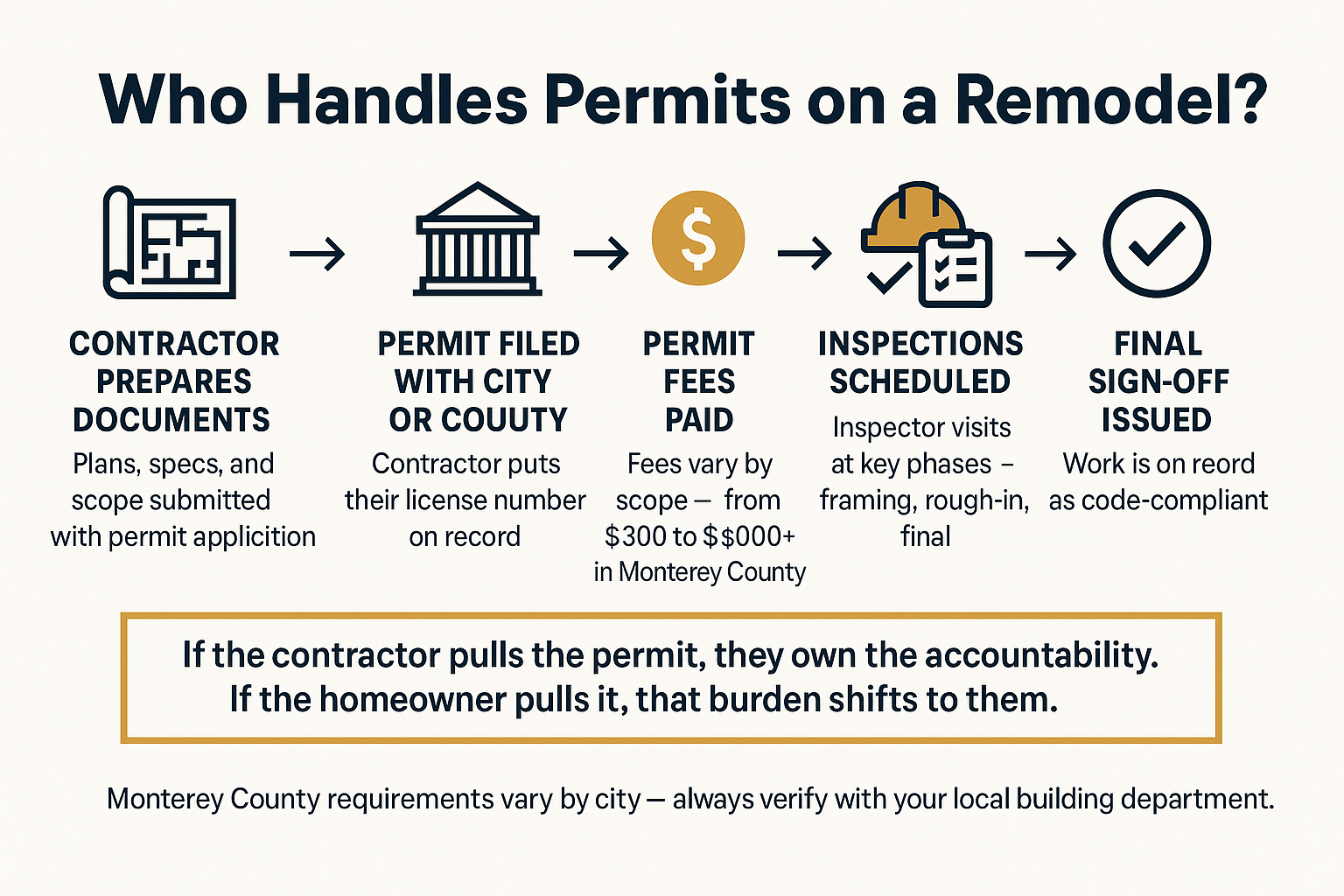
A licensed contractor in California carries legal accountability for the work performed under their license. When they pull a permit, they’re putting their license number on record with the building department. That means they’re responsible for making sure the work passes inspection.
This matters for homeowners in a specific way. If a contractor pulls the permit and the work fails inspection, it’s on them to fix it — at their expense, not yours. If the work is done without permits, the liability typically falls on whoever owns the property.
Here’s what a contractor pulling permits typically covers:
- Submitting plans and project documents to the city or county building department
- Paying permit fees (which get passed through to the homeowner as a project cost)
- Scheduling required inspections at each phase of construction
- Ensuring the completed work receives a final sign-off from the inspector
For a project in Monterey or Seaside, permit fees alone can run anywhere from a few hundred dollars for a simple bathroom remodel to several thousand for a kitchen with structural changes or a full home addition. These costs should appear as a line item in any honest proposal — not buried or omitted.

When the Homeowner Can Pull Their Own Permit
California law does allow homeowners to pull their own permits on their primary residence. This is sometimes called an owner-builder permit, and it’s a legal option — but it comes with real trade-offs that most homeowners don’t fully think through.
When you pull a permit as an owner-builder, you’re taking on the role of general contractor in the eyes of the building department. That means:
- You are responsible for ensuring all work meets code
- Subcontractors working under your permit may not be covered by their own liability coverage the same way
- If you sell the home within five years, California law requires you to disclose that unpermitted work was done under an owner-builder permit, which can affect the transaction
- Your homeowner’s insurance may not cover damage related to work done under an owner-builder permit if something goes wrong
In practice, pulling your own permit while also hiring a general contractor is a setup that most licensed contractors won’t agree to. A GC who takes the work but isn’t on the permit has no legal obligation to ensure the work passes inspection. That’s a gap in accountability that creates problems.
If a contractor ever suggests that you pull the permit while they do the work, that’s a red flag worth paying attention to. It may indicate they can’t or won’t put their license on the line for the project. Knowing what to ask before signing with a contractor includes understanding exactly this kind of arrangement.
Permit Responsibility: Who Does What on a Remodel
This infographic lays out the permit process from start to finish and shows exactly where contractor and homeowner responsibility sit.
What Monterey County Permitting Actually Looks Like in Practice
Monterey County and the cities within it don’t all operate on the same permitting system. A kitchen remodel in Pacific Grove goes through Pacific Grove’s building department. The same project in the unincorporated part of Carmel Valley goes through Monterey County directly. And anything touching plumbing on the Monterey Peninsula — adding a sink, relocating a toilet, changing fixture locations — typically requires review by the Monterey Peninsula Water Management District in addition to the city building department.
This layering is one reason why permit timelines in this area are longer than what homeowners in inland California are used to. A straightforward bathroom remodel that might get permitted in a week in Salinas could take four to eight weeks in Carmel-by-the-Sea, where the design review process and coastal regulations add steps.
For projects like ADUs and home additions, the permitting process is even more involved. ADU projects in particular can run into serious problems before construction even starts if the permit process isn’t mapped out early.
A few specifics worth knowing:
- Monterey city — building permits required for most structural, electrical, plumbing, and HVAC work
- Pacific Grove — same, plus MPWMD sign-off for plumbing changes
- Carmel-by-the-Sea — design review for exterior changes; strict rules on materials and appearance
- Pebble Beach — governed by Monterey County; HOA approvals may also be required before permits
- Unincorporated areas (parts of Carmel Valley, Prunedale) — Monterey County Building Services handles all permits
Permit requirements vary by jurisdiction. Always verify current requirements with the relevant local building department before assuming what’s needed.
Permit Responsibility: Contractor vs. Owner-Builder
This table compares what changes when a licensed contractor pulls the permit versus when the homeowner takes on the owner-builder role.
| Factor | Licensed Contractor Pulls Permit | Homeowner Pulls Permit (Owner-Builder) |
|---|---|---|
| Who is accountable to the building dept. | The contractor and their license | The homeowner |
| Inspection responsibility | Contractor schedules and coordinates | Homeowner must manage directly |
| Code compliance liability | Contractor’s responsibility | Homeowner’s responsibility |
| Resale disclosure required? | No special disclosure | Yes — required if sold within 5 years |
| Insurance coverage implications | Typically covered under contractor’s policy | May create gaps in homeowner’s coverage |
| Will most licensed GCs agree to this? | Yes — standard arrangement | No — most reputable GCs won’t work this way |
What Should Be in Your Contract Before Work Starts
The permit question shouldn’t be a conversation — it should be a written commitment. Before any remodeling work begins, your contract with a general contractor should spell out exactly who is responsible for pulling permits, who pays the permit fees, and who is responsible for scheduling inspections.
Permit fees are a real project cost and should appear as a named line item in any proposal. If a bid comes back with no mention of permits, that’s not a low price — it’s a missing expense that will show up later, or work that was never intended to be permitted in the first place.
A well-structured contract should also clarify what happens if the building department requires changes to the original plans during review. Revisions can add time and cost, and knowing in advance who absorbs those adjustments protects both sides.
Understanding the hidden expenses that catch Monterey homeowners off guard covers this kind of gap in detail — permit-related surprises are one of the most common sources of budget shock on remodeling projects.
If a contractor is vague about permits, or suggests skipping them to save money, that’s not a cost-saving strategy. Unpermitted work can affect your ability to sell the home, void your insurance coverage, and require expensive demolition and correction if discovered. The risk falls entirely on the property owner.
Frequently Asked Questions About Permits on Remodeling Projects
What happens if remodeling work is done without a permit in Monterey County?
Unpermitted work creates real problems when you go to sell the home. A buyer’s inspector or lender may flag it, and you may be required to either pull a retroactive permit — which often means opening walls to expose the work for inspection — or disclose it as unpermitted. In some cases the city can require the work to be removed entirely. The cost of correcting unpermitted work almost always exceeds what the permit would have cost upfront.
Can my contractor charge me for permit fees?
Yes, and they should. Permit fees are a legitimate project cost and should appear as a line item in your proposal. In Monterey County, fees vary depending on the city, project scope, and valuation method used by the building department. A contractor who buries or omits permit fees isn’t giving you an accurate bid.
Do I need a permit for a bathroom remodel in Pacific Grove?
Most bathroom remodels in Pacific Grove that involve plumbing changes, electrical work, or structural modifications require a permit. Because Pacific Grove is in the MPWMD service area, any work that affects water fixtures also typically requires Monterey Peninsula Water Management District review. A cosmetic refresh — paint, new fixtures in the same locations, tile replacement — may not require a permit, but verify with the Pacific Grove Building Department before assuming.
How long does it take to get a permit approved in Monterey County?
It varies significantly by city and project type. A straightforward interior remodel in Monterey or Seaside might be approved in two to four weeks. In Carmel-by-the-Sea, where exterior changes go through design review, the process can take two to three months or longer. ADUs and additions generally take longer than remodels at any location. Your contractor should give you a realistic estimate based on your specific city and project scope — not a generic timeline.
Should I be worried if a contractor says permits aren’t necessary for my project?
It depends on the scope of work. Some smaller projects — painting, flooring, replacing fixtures in existing locations — genuinely don’t require permits. But if your project involves moving walls, adding square footage, changing electrical panels, relocating plumbing, or adding HVAC, and a contractor says permits aren’t needed, get a second opinion. Either the contractor is wrong about what’s required, or they’re suggesting you skip permits intentionally. Both are worth questioning before you sign anything.
Who schedules the inspections during construction?
When a licensed contractor pulls the permit, they are responsible for scheduling inspections at each required phase — typically rough framing, rough electrical and plumbing, insulation, and final. The homeowner doesn’t need to manage this process. If you’re operating as an owner-builder, that responsibility falls to you, and missing an inspection can delay or void the permit.
Have Questions About Permits on Your Remodeling Project?
Palacios Construction manages the permit process as part of every project — from application through final inspection — so homeowners across Monterey County don’t have to figure it out alone. If you’re planning a remodel and want to understand what the permit process looks like for your specific city and scope of work, reach out at (831) 220-3334 or visit palaciosconstructionca.com to start the conversation.