
Quick Answer
A homeowner in Pacific Grove can have enough budget for a ground-floor addition and still end up with building up as the smarter option. The lot may be too tight, the setbacks may cut down what can be added at grade, and giving up the last usable yard can hurt the property more than the higher framing cost of a second story.
Quick answer: Building out usually costs less per square foot. Building up usually costs more because it often requires structural reinforcement, more engineering, and more disruption to the existing house. In Monterey County, that rule changes fast on coastal lots, hillside properties, and older homes with foundations or framing that were never designed for major expansion.
On a flat lot with room to expand, a one-story addition is often the simpler and less expensive path. On a small Carmel or Pacific Grove parcel, or on a sloped site in the hills, building up can make better overall financial sense even if the per-foot construction cost is higher.
If you are also comparing a detached addition or separate living space, this guide on how much an ADU costs in Monterey CA helps frame that budget discussion.
The short version is simple. Build out when the site allows it and the yard loss is acceptable. Build up when lot constraints, setback limits, coastal rules, or property value make ground-level expansion the less practical choice.
Running Out of Space in a Place You Love
A lot of homeowners in Monterey County aren't looking for a new address. They want to keep the neighborhood, the school route, the yard they've already built, and the house they've invested in. The problem is that the house no longer fits daily life.
That puts additions at the center of the conversation. For many families, staying and renovating is more practical than trying to buy again in the same area, especially when the home already sits on a good lot. This broader pattern is part of the stay and renovate trend for homeowners this year.
The cost question matters, but it needs to be asked the right way. There are really two cost questions:
- What costs less per square foot
- What costs less for the whole project
- What gives you the space you need without creating layout problems
- What gets approved on your specific property
Practical rule: A cheaper price per square foot doesn't automatically mean a cheaper or better project.
If the lot has room, building out often starts as the simpler path. If the lot is tight, the yard matters, or setbacks limit expansion, building up may be the only workable option. That's why generic online estimates miss the mark so often in this part of California.
The Core Cost Question Is It Cheaper to Build Up or Out
The answer depends on what is driving cost on your property. In simple cases, building out often starts lower because the framing is more straightforward and you are not asking the existing house to carry a new floor. In Monterey County, simple cases are not always the norm. Coastal rules, sloped sites, and older homes can change the math fast.
Early cost comparisons also miss a common problem. A lower price per square foot does not guarantee a lower total project cost if the addition triggers grading work, drainage corrections, structural upgrades, or a longer permit review. That is why good decisions usually start with design and pre-construction planning for permit-ready Monterey projects, not a generic online estimate.
| Factor | Build Out | Build Up |
|---|---|---|
| Typical starting cost pattern | Often lower if the lot is usable and the foundation work is straightforward | Often higher because the existing structure usually needs more engineering and reinforcement |
| Main savings | Simpler framing, easier access, no new stair requirement in many layouts | Keeps the existing footprint and preserves more yard area |
| Main cost pressure | Foundation, excavation, drainage, roofing, exterior tie-ins | Structural upgrades, roof removal and weather protection, stair placement, upper-level systems |
| Best fit | Lots with room to expand and fewer site constraints | Tight lots, setback limits, homes where preserving outdoor space matters |
Why building out often pencils out first
A ground-floor addition usually starts with fewer structural unknowns. Crews can work from grade, pour a new foundation, frame the new space, and connect it to the existing house without transferring major new loads through older walls below.
That matters on Monterey County homes built decades ago. Many were not designed for another story without significant reinforcement. If the existing foundation, shear walls, or framing need upgrades, a second-story project can get expensive quickly.
Why building up can still be the better financial decision
Building up costs more for clear reasons. It often requires engineering to confirm load paths, structural work below, partial roof removal, and a stair that takes usable square footage from the first floor.
But on some properties, building out is the option that creates the bigger bill.
A Carmel or Pacific Grove lot with tight setbacks may leave very little legal room to expand at grade. A hillside site in Monterey or Salinas can turn a basic foundation into excavation, retaining, drainage, and access work. In coastal areas, site coverage, drainage, and design review can push a horizontal addition into a much more complicated project than the floor plan suggests.
Monterey County changes the usual rule of thumb
This county has three issues that regularly upset the standard build up versus build out equation.
Older housing stock can make vertical additions expensive because the house needs structural help before new square footage is added above. Hillside and irregular lots can make horizontal additions expensive because the site work becomes the project. Coastal permitting can affect either option, but it often hits build-outs harder when footprint, drainage, or lot coverage are already tight.
That is why I rarely answer this question with a blanket rule. The answer comes from the structure you have, the land you have left, and what the county will allow on that parcel.
On a flat, buildable lot, building out often starts as the lower-cost path. On a constrained Monterey County property, the cheaper option on paper can become the more expensive project in practice.
Homeowners usually get the clearest answer by comparing total scope, not just unit pricing. The better choice is the one that fits the house, fits the site, and gets through permitting without forcing expensive corrections later.
Comparing the Key Cost Drivers
 home additions.” />
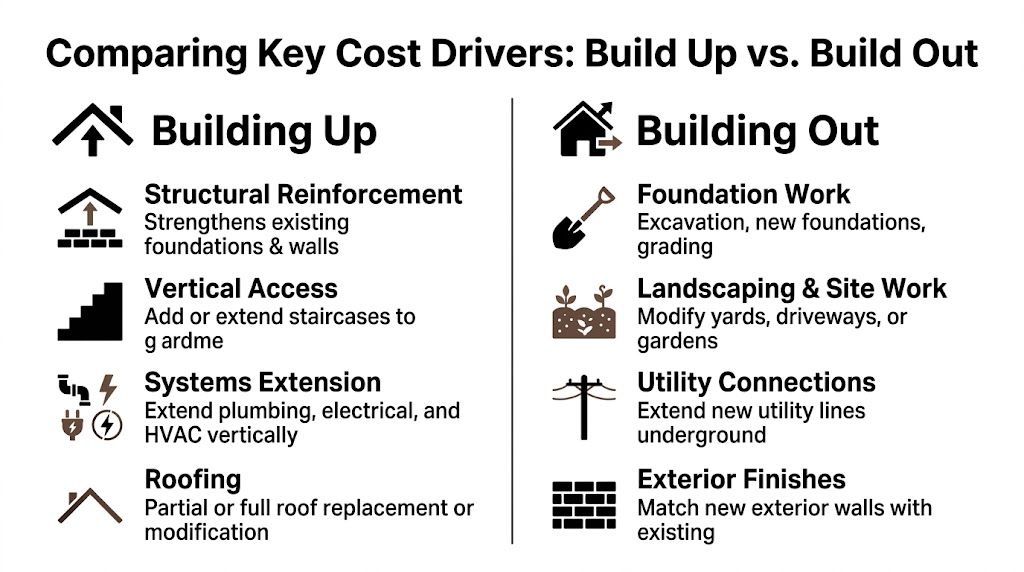
The money doesn't go to the same places on these two project types. That's where homeowners can get tripped up. One option may look efficient until the structural report or zoning review changes the scope.
For projects that need drawings, engineering coordination, and permit-ready planning, design and pre-construction planning in Monterey for permit-ready projects is usually where the right choice starts.
Where build-out costs usually show up
A horizontal addition adds area at the ground level, so the first budget pressure is site work. That can mean excavation, grading, drainage adjustments, and foundation work before framing even starts. On some lots, access for equipment is easy. On others, fencing, hardscape, and mature landscaping make that phase more expensive and more disruptive.
Exterior scope is another driver. Building out creates more wall area and more roof area. Matching siding, stucco, windows, trim, roofing, and the transition lines where old meets new takes care and time.
Common cost drivers for building out include:
- Foundation work: New footings and slab or raised-floor support are part of the expansion.
- Site changes: Yards, walkways, patios, and drainage paths often need to be reworked.
- Roof extension: The farther the footprint grows, the more roof area has to be framed and tied in.
- Exterior finish matching: Older homes can be difficult to blend cleanly.
Where build-up costs usually show up
A second-story addition shifts the budget toward structure and engineering. The work below the new floor matters as much as the new space itself. Existing foundations, bearing walls, posts, and connections may all need review before plans are finalized.
Mechanical and circulation work can also be more involved. Plumbing, electrical, and HVAC need to move vertically through the house, and the staircase has to fit in a way that doesn't hurt the floor plan.
Typical cost drivers for building up include:
- Structural reinforcement: The existing home may need strengthening before new loads are added.
- Roof removal and rebuild: Crews often have to open and reconstruct major roof sections.
- Stair integration: The stair isn't just a detail. It uses floor area and affects layout on both levels.
- System extensions: Routing utilities upward can be more invasive than extending them outward.
A good plan isn't just about where the new square footage goes. It's about how the old house carries it, connects to it, and functions after the work is done.
Monterey County changes the usual math
Local conditions matter. Coastal lots, sloped lots, and older homes don't behave like clean textbook examples. A simple build-out can become difficult if setbacks leave no legal room. A simple build-up can become expensive if the house needs major reinforcement.
The county's building environment rewards early due diligence. That means checking envelope limits, access, drainage, structural capacity, and permit constraints before settling on a direction. Palacios Construction handles that kind of early planning for home additions and ADU-related design coordination because that's where bad assumptions usually get corrected.
Site and Structural Constraints in Monterey County
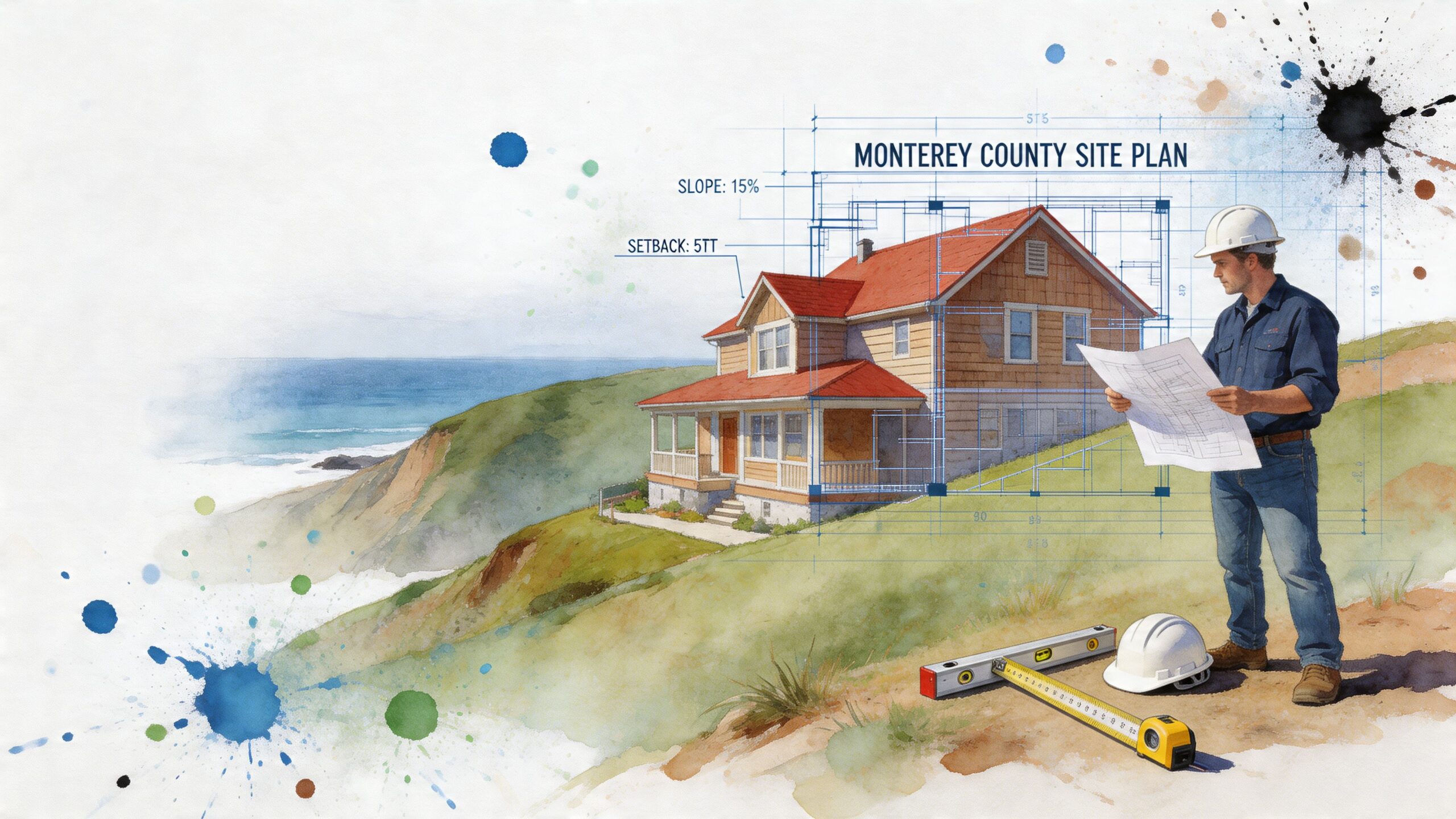
Monterey County changes this decision more than most general articles admit. A flat, open lot in an inland subdivision is one thing. A coastal parcel, a narrow Pacific Grove property, or a hillside site in Carmel Valley is something else entirely.
Local rules can push the budget in a hurry. According to this Monterey-area overview of build-up versus build-out constraints, California seismic retrofitting mandates and Monterey County hillside and coastal setback requirements can increase vertical addition costs by 20 to 50 percent. The same source notes that ADU and JADU vertical expansions may face 35 percent higher permit fees in coastal zones because of erosion and wind-load compliance.
Small lots and setback pressure
On smaller parcels, the first problem is often buildable area. Front, side, and rear setbacks can leave a shallow envelope for expansion. A homeowner may want a modest ground-floor addition, but the legal building area may not support it without redesign or compromise.
In that situation, building up isn't automatically cheaper, but it may be the only path that preserves meaningful square footage without sacrificing the entire yard.
Older homes need an honest structural review
A lot of Monterey County housing stock wasn't built with a future second story in mind. Older framing, foundation conditions, and past remodel work all need to be evaluated carefully before anyone treats a vertical addition like a straightforward upgrade.
That structural review is not a formality. It shapes scope, engineering, sequencing, and the homeowner's budget expectations from the start. If you're also evaluating whether the property can support a separate unit or addition strategy, this guide on what determines whether I can build an ADU on my property helps frame the zoning side.
Coastal and hillside properties punish assumptions. The lot may look usable until setbacks, grading limits, drainage, and structural requirements are all on the same page.
Daily life matters too
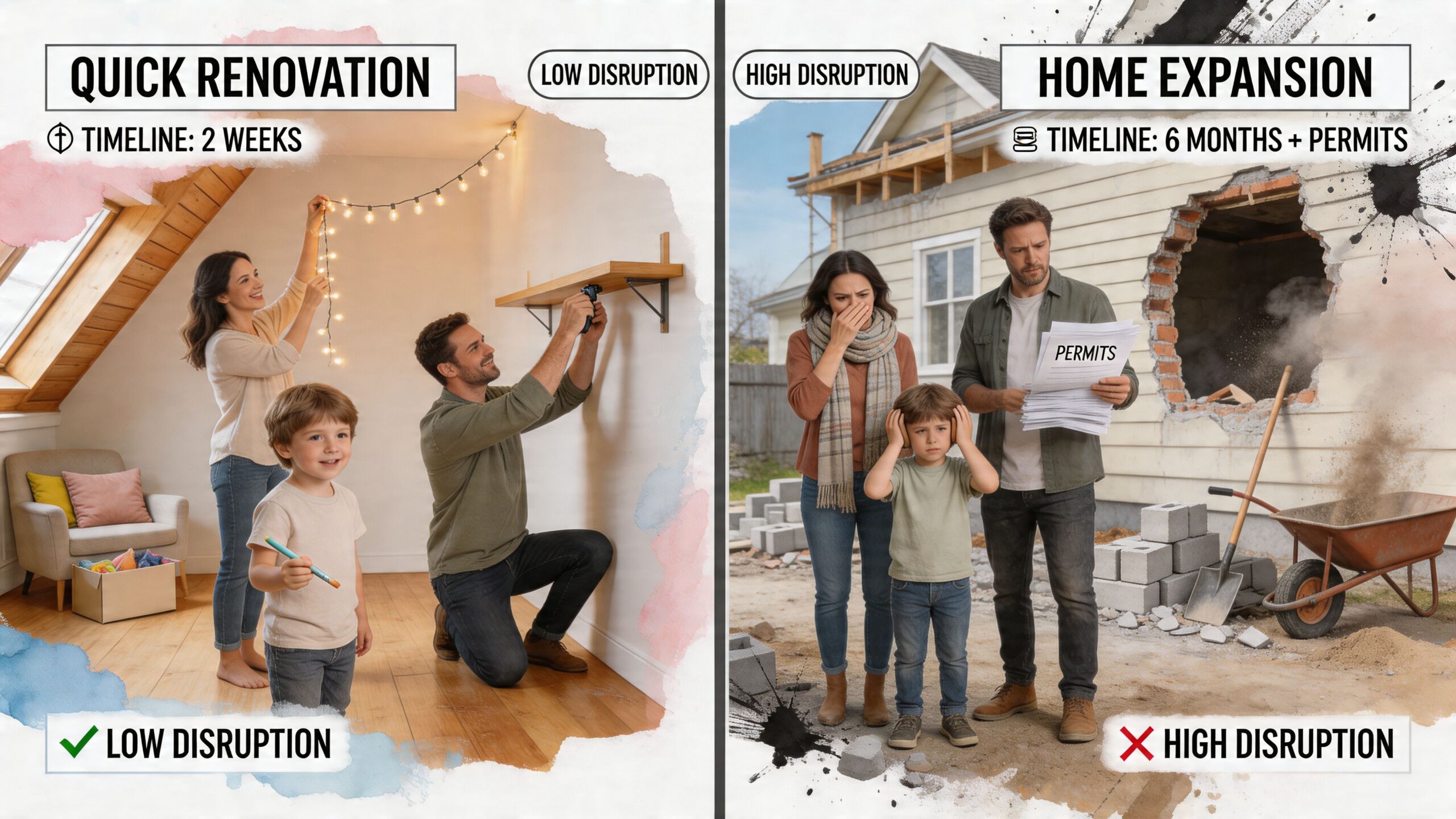
A project can be technically feasible and still be the wrong fit for how you live. If the work cuts through the center of the house, removes the roof for a major phase, or takes over most of the yard for months, that affects the decision just as much as pricing.
The bigger point is that is it cheaper to build up or out isn't only a construction question in Monterey County. It's also a property-use question, a permitting question, and a disruption question.
Permitting Timelines and Daily Disruption
 home renovation versus a stressed family during home expansion.” />
A clean estimate doesn't tell you what it feels like to live through the work. Some homeowners can tolerate a long exterior project that affects the yard. Others care more about keeping the main living space functional and avoiding major interior disruption.
The financial side of staying put matters too. According to Hodges Built's discussion of building economics, a useful benchmark is the seven-year recovery rule, meaning it often takes about seven years to recover moving costs. For homeowners planning to stay long term, adding onto the existing home can be a rational choice beyond the construction budget alone.
When building up makes practical sense
Building up is often the logical choice when the lot is already constrained. If you want to preserve yard space, keep more of the existing hardscape, or maintain a larger open area at grade, a second-story addition may do that better than pushing outward.
It can also make sense when the property has a view relationship worth protecting. On certain Monterey County lots, adding square footage above can preserve ground-level use while making better use of the site overall.
Disruption isn't the same on every project
Build-up work can be intense because it often involves opening the roof and tying major new structure into the house below. Even when the schedule is organized well, the work can affect bedrooms, hallways, ceilings, and daily routines in a concentrated way.
Build-out work may be easier to phase if the addition connects at one side or rear of the home. It still brings noise, access issues, and utility tie-ins, but the disruption can sometimes stay more contained. Permit planning matters on both types, especially for accessory spaces and additions that trigger plan review. This article on whether you need permits to build an ADU in Monterey County is useful if your project overlaps with an ADU or JADU strategy.
The cheaper project on paper can be the harder project to live through. That matters if the house is occupied during construction.
A Decision Checklist Build Up or Build Out
 home renovation project.” />
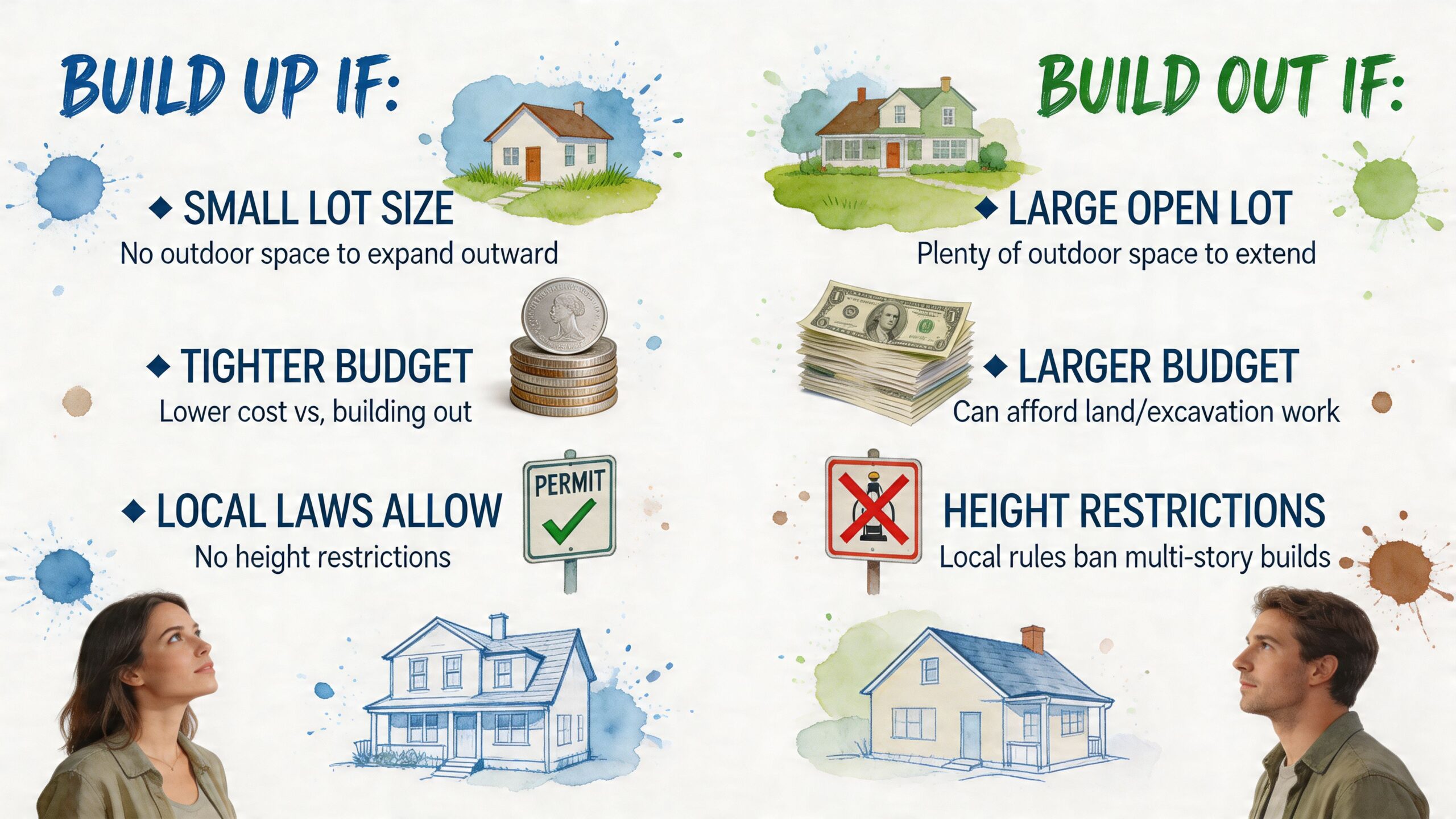
Most homeowners don't need more theory. They need a clear way to sort the right option from the wrong one. The checklist below is how I’d frame the decision on a real property after looking at lot limits, structure, and how the family uses the house.
According to Stonehearth Remodeling's cost comparison, vertical additions on older Monterey homes built before the 1980s can be 20 to 30 percent more expensive because of seismic retrofitting, while building up on a new build can be 15 to 25 percent cheaper per square foot. That split matters. A newer structure and a clean load path create a very different project than an older house that needs substantial reinforcement first.
Build up if
- Your lot is tight: If setbacks or lot coverage leave very little room at grade, going upward may be the only way to add useful space.
- You want to preserve yard area: Families who use the backyard regularly often regret giving up too much outdoor space.
- The house can structurally support the plan: A favorable engineering review changes the conversation quickly.
- You want a compact footprint: On some properties, keeping the addition inside the existing envelope or close to it makes site planning easier.
Attic-level additions can also be a middle path when the roof form and structure allow it. If you're curious how designers think through that type of work, FP Architects' examples of attic conversion projects are a useful visual reference for how upper-level space can be created without treating every project like a full second story.
Build out if
- You need single-level living: Bedrooms, bathrooms, and family spaces on one floor usually work better for aging in place and long-term accessibility.
- Your existing house is older and lightly built: If engineering points toward major seismic upgrades, a ground-floor addition may be the cleaner investment.
- You have room on the lot: Available side or rear yard can make a build-out more straightforward.
- You want simpler circulation: No stair means no loss of interior floor area to vertical access.
This route also tends to be easier when the new space is a family room, expanded kitchen, primary suite, or bump-out that wants direct connection to the yard. If the structural report on an older house comes back cautious, a horizontal addition is often the better answer.
Frequently Asked Questions About Home Additions
Is it cheaper to build up or out for most Monterey County homes?
Usually, building out starts lower on a per-square-foot basis, but that doesn't settle the decision. Small lots, setback limits, and structural conditions can make building up the more practical choice overall. The property decides more than the internet does.
Can I add a second story to an older home?
Maybe, but the structure has to be reviewed first. Older homes in this area often need more reinforcement before they can carry a new upper level safely. That's why the engineering review needs to happen before anyone treats a second story like the obvious option.
Is building out easier to permit?
Not always. A build-out can run into setbacks, lot coverage limits, drainage issues, and site constraints. A build-up can trigger more structural scrutiny. The easier permit path depends on the parcel, not just the type of addition.
Will I have to move out during construction?
Sometimes, but not on every job. A major second-story addition can create enough roof and interior disruption that temporary relocation becomes the practical choice. Some ground-floor additions are easier to phase while the house stays occupied, though there will still be noise, dust, and access changes.
Which option is better if I want to keep my backyard?
Building up is usually the stronger option when preserving yard space is a top priority. It lets you add square footage without pushing farther into the lot. That matters a lot on smaller coastal properties where outdoor space is limited to begin with.
What if I only need a modest amount of extra space?
You may not need a full second story or a large footprint addition. A bump-out, over-garage space, attic conversion, or a carefully planned reconfiguration can sometimes solve the problem more efficiently. The right move depends on where the pressure is in the current floor plan.
Planning Your Monterey County Home Addition
If you're still asking is it cheaper to build up or out, that's normal. The honest answer is that the lower-cost option depends on your lot, your house, the permit path, and whether the structure can support the plan without creating bigger problems elsewhere.
Before choosing a direction, it helps to look at outside examples of upper-level work and planning logic. This practical guide on how to carry out a loft extension gives useful context for how roof-space additions are typically approached. After that, the next step is a real site-specific review, not another generic online estimate.
If you're planning a home addition in Monterey County and want a clear comparison of building up versus building out, Palacios Construction can walk through the site, structure, and permit considerations with you. Visit us at 222 Ramona Ave Unit 5, Monterey, CA, or reach out through the website to start the conversation.