

Direct Answer: Most kitchen remodels in Monterey County disrupt daily routines for 6 to 12 weeks, depending on scope. Full gut remodels with layout changes take longer; cosmetic updates take less.
Most homeowners don’t mind tearing out dated cabinets or swapping in new countertops — what they dread is losing their kitchen for weeks on end. That question comes up in almost every pre-construction conversation: how long will my family actually be without a working kitchen?
In Monterey County, the honest answer depends on a few things — the scope of work, how fast permits move through the local building department, and how well the project is planned before anyone swings a hammer. A poorly planned project stretches. A well-planned, professionally managed project with permits pulled in advance and materials ordered early runs on a predictable schedule.
This article breaks down the real disruption timeline — not the optimistic version, but what homeowners on the Monterey Peninsula actually experience phase by phase.
What ‘Kitchen Remodel Disruption’ Actually Means Day to Day
The disruption isn’t just noise and dust. It’s the loss of your sink, stove, refrigerator, and prep space — often all at once — for a stretch of weeks.
During active demo and rough-in work, your kitchen is essentially a job site. You can’t cook, you can’t run the dishwasher, and in many cases the water to that area of the house is shut off temporarily while plumbing rough-in happens.
Most families in Pacific Grove and Carmel-by-the-Sea who’ve been through this describe the same three coping strategies:
- Setting up a temporary kitchen in a garage, laundry room, or dining area with a mini fridge, microwave, and electric skillet
- Budgeting for more takeout than usual — realistically, plan for 4 to 8 weeks of modified meal routines depending on scope
- Storing essential pantry items and small appliances in accessible bins rather than in boxes buried in a storage unit
The amount of disruption you feel also depends heavily on how much of the project runs in sequence versus in parallel. A contractor who schedules inspections ahead of time and coordinates subcontractors tightly will get you back in your kitchen faster than one who waits on each trade to finish before calling the next one.
The Real Kitchen Remodel Timeline, Phase by Phase
A kitchen remodel doesn’t move in a straight line — it moves in phases, and some of those phases have built-in waiting periods that have nothing to do with how fast your contractor works.
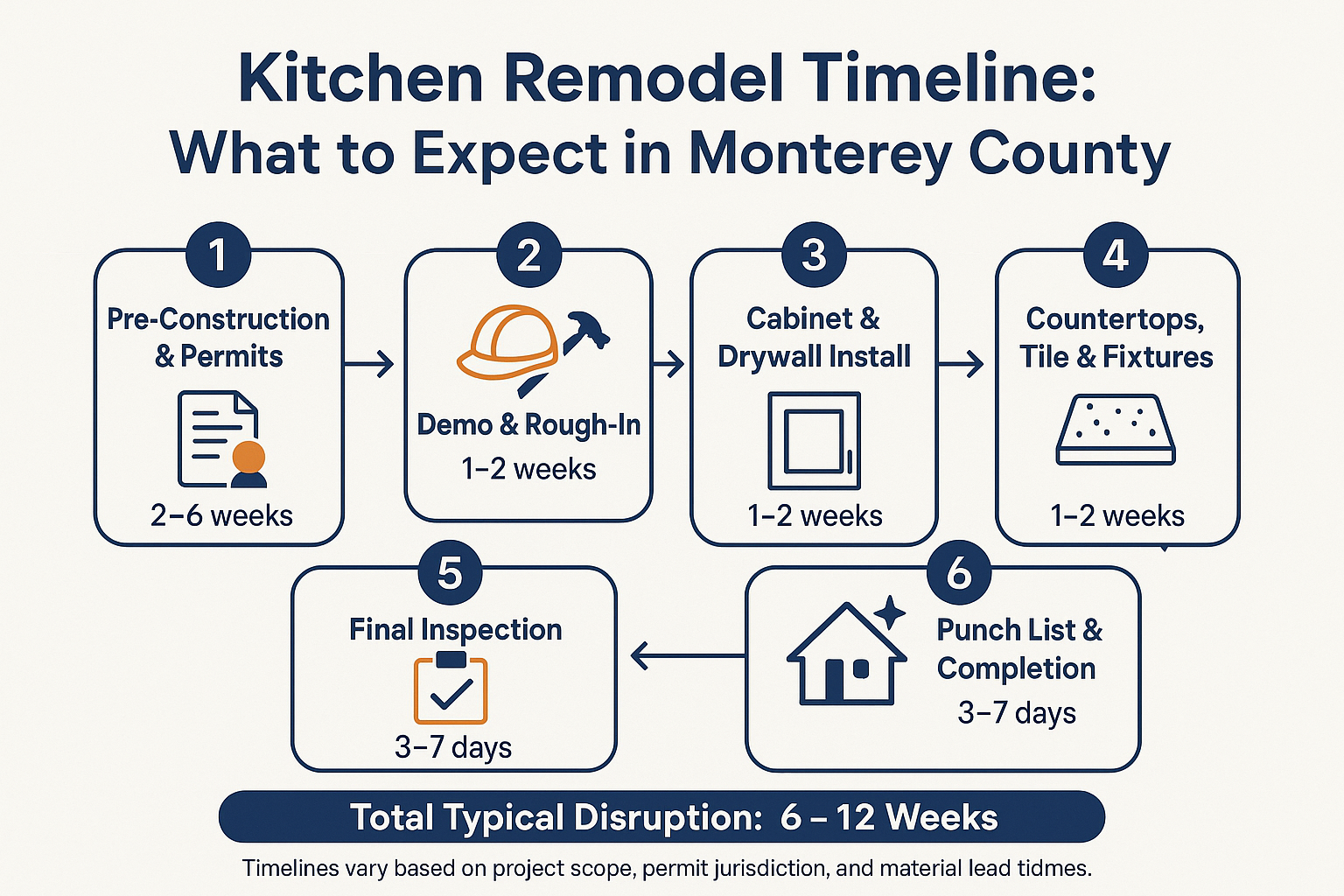
Pre-construction (2 to 6 weeks before demo starts)
This is where permits are pulled, cabinets are ordered, and materials are specified. In Monterey County, a kitchen remodel that involves plumbing changes requires a permit from the relevant city building department. If your home is in an area subject to Monterey Peninsula Water Management District (MPWMD) requirements — which covers most Peninsula cities — any fixture changes also need MPWMD review. That process can add 1 to 3 weeks if it isn’t started early.
Cabinets are typically the longest lead-time item. Semi-custom and custom cabinet orders run 4 to 8 weeks from the factory. If cabinets aren’t ordered before demo starts, the project stalls waiting for them — and that’s a common reason remodels drag longer than expected.
Demo and rough-in (1 to 2 weeks)
Once work starts, demo moves fast — usually 2 to 4 days. What follows is slower: framing changes if the layout is shifting, rough plumbing, rough electrical, and any structural work. This is when inspections happen, and scheduling those with the city building department adds a few days of wait time per inspection.
Cabinet and drywall installation (1 to 2 weeks)
After inspections pass, drywall goes up, is taped and finished, and cabinet installation begins. This phase tends to run cleanly when materials are staged and ready.
Countertops, tile, and fixtures (1 to 2 weeks)
Countertops — especially stone — require a template visit after cabinets are set, then fabrication, then installation. That sequence adds 7 to 14 days even on a fast-moving project. Backsplash tile, plumbing trim-out, and appliance installation follow.
Final inspection and punch list (3 to 7 days)
The final building inspection closes out the permit. Then the punch list — touch-up paint, hardware installation, cleaning — wraps the project.
Kitchen Remodel Phase Timeline at a Glance
This breakdown shows the typical duration of each phase in a Monterey County kitchen remodel, from permit application to final walkthrough.
Kitchen Remodel Timeline by Scope
The scope of work is the biggest driver of how long you’ll be working around a torn-up kitchen. Here’s how the timeline typically breaks down for common project types in Monterey County.
| Project Type | Typical Duration | Main Timeline Driver |
|---|---|---|
| Cosmetic refresh (paint, hardware, appliances) | 2–4 weeks | Material delivery and scheduling |
| Cabinet replacement, same layout | 5–7 weeks | Cabinet lead time, countertop templating |
| Full kitchen remodel, same layout | 7–10 weeks | Permits, rough-in inspections, stone fabrication |
| Full remodel with layout changes | 10–14 weeks | Structural work, plumbing relocation, MPWMD review |
| Remodel with addition or wall removal | 12–16+ weeks | Structural engineering, permit complexity |
What Causes Kitchen Remodels to Run Long — and What Doesn’t
A lot of homeowners assume delays come from the contractor being slow. In practice, most delays come from one of three sources that have nothing to do with labor speed.
1. Late material orders
Cabinets, tile, and specialty fixtures ordered after demo starts are the single most common reason a kitchen remodel drags past its scheduled end date. On the Monterey Peninsula, some distributors are local, but many orders route through Bay Area suppliers with 2 to 4 week lead times even on in-stock items. When a general contractor orders materials before breaking ground, this problem largely disappears.
2. Permit delays
Monterey city permits for kitchen remodels that involve plumbing or electrical typically take 5 to 15 business days for over-the-counter or online review, though complex projects can take longer. Pacific Grove and Carmel-by-the-Sea have their own building departments with their own review queues. Starting permits early — not after materials arrive — keeps the schedule intact. You can read more about how home remodeling permits work in Monterey County before you start planning.
3. Undiscovered conditions
Older homes on the Peninsula — many built in the 1940s through 1970s — sometimes reveal surprises behind walls: outdated wiring, galvanized plumbing, water damage, or substandard framing. These don’t have to derail a project if they’re caught early and budgeted for honestly. A contractor who uses clear budgeting practices from day one will already have discussed contingency allowances with you before any walls come down.
What tends not to cause major delays: a well-sequenced project where the contractor has pre-scheduled trades and inspections and isn’t waiting until the last minute to coordinate.
How to Reduce Disruption Without Cutting Corners
You can’t speed up a building inspector’s review queue or get stone countertops fabricated overnight. But there are a few decisions that genuinely reduce how long your household is in disruption mode.
Finalize every selection before demo
Cabinet style, countertop material, tile, fixtures, appliances — all of it. Changes made after work starts don’t just cost money; they cost days or weeks waiting for replacement orders. Going into demo with every finish decision locked in is one of the most effective ways to keep the schedule tight.
Ask about inspection scheduling upfront
When you’re talking to contractors, ask how they handle inspection scheduling. Contractors who call for inspections proactively — not reactively — keep projects moving. A rough-in inspection that sits unscheduled for a week because no one called the building department costs you a week of completion time.
Plan your temporary kitchen before demo day
This doesn’t shorten the construction timeline, but it dramatically reduces how hard the disruption is to live through. Families who set up a functioning temporary space before the kitchen goes offline report far less stress mid-project. It’s worth spending $100 to $200 on a folding table, a compact appliance or two, and storage bins.
For homeowners curious about how this planning process compares to other projects, the same logic applies when considering a bathroom remodel or a larger home renovation — the pre-construction phase is where the schedule is either protected or lost.
Frequently Asked Questions About Kitchen Remodel Timelines
Can I live in my home during a kitchen remodel?
Yes, most homeowners do. It’s uncomfortable but manageable, especially if you set up a temporary kitchen in another room. The hardest stretch is during demo and rough-in, when the space is loudest and dustiest — usually the first 1 to 2 weeks of active construction. After that, work gets cleaner and more predictable.
Do kitchen remodels always need a permit in Monterey County?
It depends on what’s being done. Cosmetic work — painting, replacing hardware, swapping out a faucet — typically doesn’t require a permit. But any work that touches electrical panels, moves plumbing, changes the layout, or involves structural changes does require a permit. In cities like Monterey, Pacific Grove, and Carmel-by-the-Sea, permit requirements are enforced consistently. Unpermitted work creates real problems when you sell the property. See the full breakdown on home remodeling permits in Monterey for specifics.
What’s the most common reason kitchen remodels go over schedule?
Late material orders — especially cabinets. Cabinet lead times run 4 to 8 weeks, and if they aren’t ordered before demo starts, the project waits. The second most common cause is permit delays that could have been avoided by applying earlier in the process.
Does MPWMD affect kitchen remodel timing in Monterey?
It can. If your project involves adding or changing plumbing fixtures, and your property is within the Monterey Peninsula Water Management District service area — which includes most Peninsula cities — MPWMD fixture unit compliance is part of the permit review. A contractor familiar with local requirements will account for this in the schedule rather than discovering it mid-project.
How do I know if a contractor’s timeline estimate is realistic?
Ask them to walk you through it phase by phase. A contractor who can explain what happens in each phase — and what the potential delays are in each one — is giving you a realistic picture. A contractor who just says ‘about 8 weeks’ without detail may be guessing. You can also read what homeowners should ask before signing with any contractor for a full list of questions worth asking upfront.
Ready to Get a Realistic Timeline for Your Kitchen Project?
If you’re planning a kitchen remodel in Monterey County and want a straight answer about what the timeline will actually look like for your specific home, Palacios Construction is available to walk through it with you. The team handles everything from pre-construction planning and permit coordination to hands-on project management through completion — and every schedule they put in front of a homeowner is built around real lead times, not wishful thinking. Reach out at palaciosconstructionca.com or call (831) 220-3334 to start the conversation.