Direct Answer: Ask them specific questions about local permits, water restrictions, and coastal conditions. A contractor who actually works in Monterey County will answer those without hesitation.
Plenty of contractors are licensed in California. Far fewer actually understand what it means to build or remodel in Monterey County specifically. The permitting rules, the water restrictions, the coastal soil conditions, the way city design review works in Carmel — none of that shows up on a general contractor‘s license.
If you’re a homeowner in Pacific Grove or Pebble Beach planning a kitchen remodel or home addition, the contractor you hire needs to understand the local environment — not just construction in general. A team that learned their trade in Sacramento or the Central Valley will face a steep learning curve here, and you’ll pay for it in delays and surprises.
This article breaks down the specific things a knowledgeable local contractor should be able to speak to clearly. Use these as a filter before you ever sign a contract.
Why Local Knowledge Is a Real Skill — Not Just Marketing Language
When contractors say they’re “familiar with the area,” that phrase can mean almost anything. What you actually want to know is whether they’ve pulled permits in your city, dealt with the Monterey Peninsula Water Management District (MPWMD), and managed projects on properties with coastal exposure.
Those aren’t small details. The MPWMD has strict water-use requirements that affect any remodel touching plumbing — including kitchen and bathroom work. If a contractor doesn’t bring up water credits, fixture compliance, or MPWMD coordination when discussing a bathroom remodel, that’s a gap worth questioning.
Similarly, Carmel-by-the-Sea has some of the most specific design review requirements of any city on the Peninsula. Exterior changes — including window replacements and some roofing materials — go through an architectural review process that a local contractor will know to plan around. A contractor coming from outside the area may not account for that timeline at all.
And then there’s the soil. Properties near the coast, particularly in Pacific Grove and parts of Monterey, often sit on sandy or fill soil. Home additions and structural work in those areas may require additional geotechnical review. A contractor who’s worked in Monterey County knows to ask about site conditions early — not after demo has started.
For a deeper look at what a legitimate local fit actually looks like, How to Tell If a Monterey Contractor Is the Right Fit for Your Project covers the hiring side of this question in detail.

The Permit Question: What a Local Contractor Should Know Cold
Permits are one of the clearest ways to test whether a contractor actually knows Monterey County. Jurisdictions here don’t all work the same way — and the differences matter.
City of Monterey, Pacific Grove, Carmel-by-the-Sea, Seaside, and Marina each have their own building departments, their own fee schedules, and their own review timelines. The County of Monterey handles unincorporated areas like Carmel Valley and Prunedale. A contractor who genuinely works across the Peninsula will know those distinctions without looking them up.
Here are the questions worth asking directly:
- Which jurisdiction handles permits for my property, and what’s the current review timeline?
- Does this project require MPWMD approval or water fixture documentation?
- Will this trigger a Title 24 energy compliance review?
- Is there a coastal development permit involved given my proximity to the water?
- Who pulls the permit — you or a sub — and who is responsible if something fails inspection?
On that last point, Who Is Responsible for Permits on a Remodeling Project? explains how that responsibility is supposed to work and what to watch out for when a contractor tries to put it back on you.
A contractor who stumbles on these questions, gives vague answers, or says “we handle that when we get there” is telling you something important. Permit problems mid-project can delay work by weeks and sometimes require tearing out completed work. The time to understand your contractor’s permit knowledge is before you sign anything.
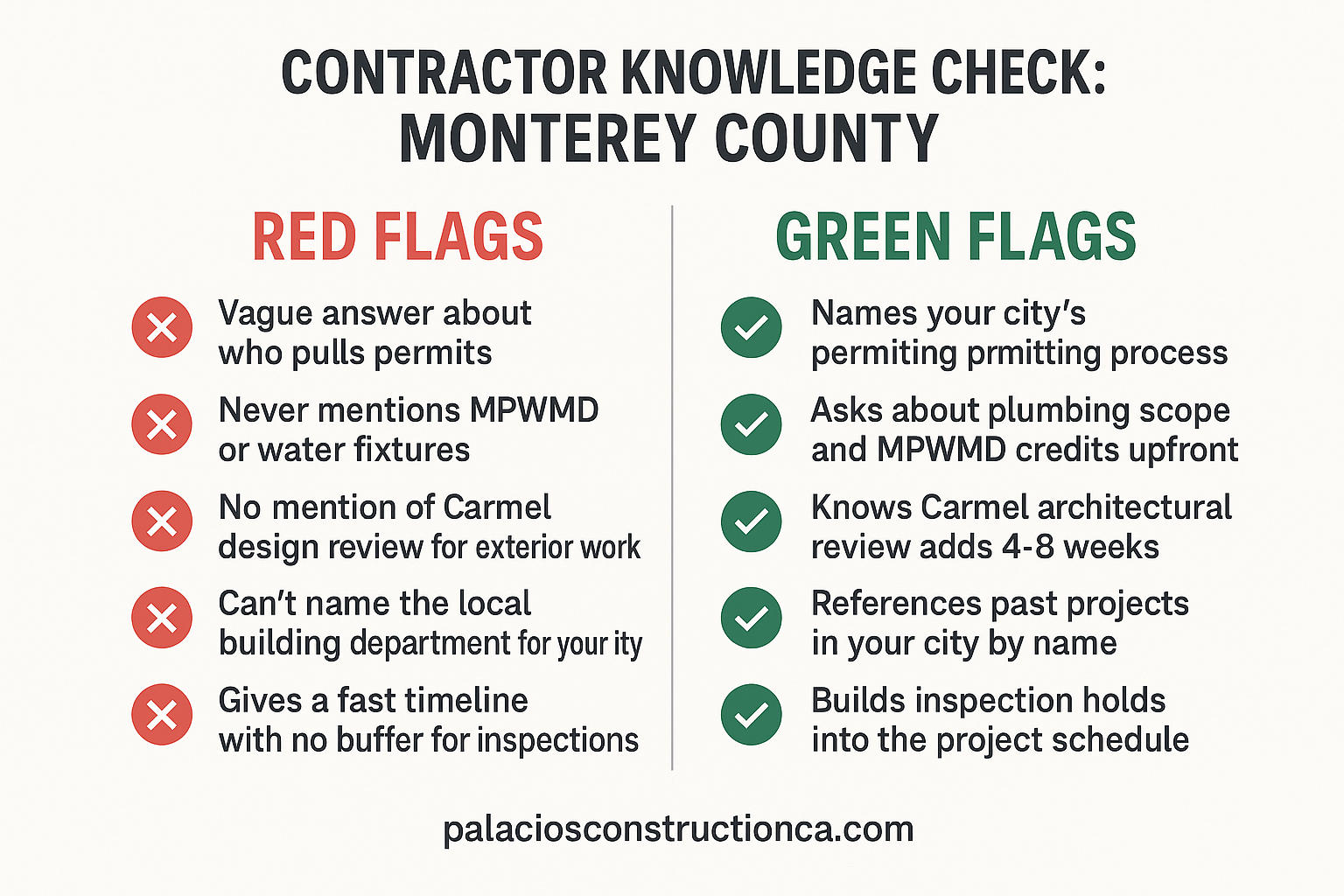
Red Flags vs. Green Flags When Hiring in Monterey County
This comparison shows the difference between a contractor who knows Monterey County and one who doesn’t — based on how they answer common pre-hire questions.
Older Housing Stock and What It Means for Your Remodel
A lot of homes on the Monterey Peninsula were built between the 1940s and 1970s. That era of construction comes with predictable complications — and a contractor who’s worked in Monterey County will tell you that upfront instead of waiting for demo day.
The most common issues in homes of that age in this area:
- Galvanized plumbing that looks fine until walls are open, then needs full replacement
- Knob-and-tube or early aluminum wiring that can’t support a modern remodel without electrical upgrades
- Asbestos in floor tile, drywall texture, or roofing materials — common in homes built before 1980 and requiring licensed abatement before any demo proceeds
- Foundation conditions that vary significantly depending on whether the home sits on bedrock, sandy soil, or fill near the bay
- Single-pane windows and minimal insulation, which may trigger Title 24 energy upgrades when a permit is pulled
A contractor who hasn’t worked on Monterey Peninsula homes regularly won’t budget for any of these. They’ll give you a clean proposal and then hit you with change orders the moment the walls come open.
This is directly connected to The Hidden Expenses That Catch Monterey Homeowners Off Guard — which breaks down where these costs actually come from and how a well-planned project handles them before they become surprises.
When reviewing any proposal, ask specifically: “What allowances have you built in for what we might find inside the walls?” A contractor who gives you a real answer to that question has done this work before. One who says “we’ll cross that bridge when we get there” hasn’t thought it through.
Monterey County Jurisdiction Basics: What’s Different City to City
Building departments and review processes vary across the Peninsula. Here’s a general overview of what makes each jurisdiction distinct — confirm current requirements directly with the relevant building department before starting any project.
| Jurisdiction | Building Department | Notable Local Factors |
|---|---|---|
| City of Monterey | City of Monterey Building Division | MPWMD fixture compliance for any plumbing work; standard plan check timelines |
| Pacific Grove | Pacific Grove Building & Safety | MPWMD requirements; older housing stock common; coastal proximity on west-side parcels |
| Carmel-by-the-Sea | Carmel Building Department | Architectural review board for exterior changes; strict design guidelines; no street addresses (P.O. boxes) |
| Pebble Beach | Monterey County (unincorporated) | Del Monte Forest HOA design review in addition to county permits; high-value property norms |
| Seaside / Marina | Respective City Building Depts. | More flexible design review; newer housing stock in parts of Marina; base housing history in Seaside |
| Carmel Valley / Prunedale | Monterey County Planning | Unincorporated county process; septic system rules; well-water considerations in rural parcels |
How to Actually Test a Contractor’s Local Knowledge Before Hiring
You don’t need to be an expert in construction to ask good questions. A few specific, local questions will tell you quickly whether a contractor has real experience in Monterey County or is just willing to take the work.
Ask about a past project in your city. Not a general portfolio — a specific project. “Have you done a bathroom remodel in Pacific Grove that involved MPWMD fixture documentation?” A contractor who has will answer that specifically. One who hasn’t will get vague.
Ask how they handle the gap between permit submittal and approval. In some Monterey County jurisdictions, plan check can take four to eight weeks for larger projects. A contractor who plans around that will have a realistic schedule. One who ignores it will promise a faster start and then go quiet when the permit stalls.
Ask what they do when they find something unexpected inside the walls. This is a process question, not a technical one. You want to know whether they stop work, document it, and bring you a clear explanation with options — or whether they just keep moving and send a bill later.
For more on what to ask before signing anything, What Homeowners Should Ask Before Signing With Any Contractor covers the full pre-contract conversation in plain terms.
And if your project involves an ADU or addition, the complexity goes up considerably. Why Many ADU Projects Run Into Problems Before Construction Even Starts explains where those early-stage failures typically happen — most of them come down to a contractor who didn’t understand the local approval process before they started.
Frequently Asked Questions About Hiring a Contractor in Monterey County
Does it really matter whether my contractor has worked in my specific city versus just Monterey County generally?
Yes, more than most homeowners expect. Carmel-by-the-Sea has its own architectural review process for exterior work that adds significant time to a project schedule. The MPWMD has water use rules that apply in some jurisdictions but not others. And fee schedules vary city to city. A contractor who’s only worked in Seaside may not know any of that when they show up in Pacific Grove.
How do I know if a contractor is actually licensed to work in California?
Check the California Contractors State License Board (CSLB) at cslb.ca.gov. You can search by license number or business name. Verify the license is active, the classification matches your project type (a B license covers general residential work), and that there are no disciplinary actions on record. This takes about two minutes and should be the first thing you do.
What is the MPWMD and why does it matter for remodeling?
The Monterey Peninsula Water Management District regulates water use across most of the Peninsula because the region operates under a long-standing water supply constraint. Any remodel that touches plumbing — including kitchen and bathroom work — may require fixture documentation showing that new fixtures meet efficiency standards. In some cases, you may need to retire existing water credits or acquire new ones. A contractor who hasn’t dealt with this before may not flag it until the permit is already submitted, which can cause delays.
Should I be concerned about asbestos in an older Monterey home?
If your home was built before 1980, asbestos-containing materials are a real possibility — floor tile, drywall texture, roof shingles, and pipe insulation are the most common locations. Before any demolition begins, a licensed abatement contractor should test suspect materials. This is not optional if materials test positive — California law requires licensed removal. A general contractor who works on older Peninsula homes will build testing into the pre-construction phase as a standard step.
What’s a reasonable permit timeline to expect for a remodel in Monterey County?
It varies. Smaller projects like a bathroom remodel may go through plan check in two to four weeks in some cities. Larger projects — additions, ADUs, full kitchen remodels with structural changes — can take six to twelve weeks depending on the jurisdiction and current department workload. Carmel and Pebble Beach projects that require additional design review can take longer. Any contractor promising a permit approval in a week for a complex project is either not being straight with you or hasn’t submitted the application yet.
Have Questions About a Project in Monterey County?
Palacios Construction is a licensed residential general contractor based in Monterey, serving homeowners across the Peninsula and surrounding communities. If you have a remodel, addition, or ADU project and want to talk through what the local process actually looks like for your specific city, reach out at palaciosconstructionca.com or call (831) 220-3334.