

Direct Answer: A solid remodeling proposal shows scope by phase, written allowances for each finish, permit fees, and how change orders are handled. A single lump sum number tells you almost nothing.
The call I get most often starts the same way. A homeowner in Monterey or Pacific Grove has three bids for the same bathroom, and the numbers are so far apart they assume someone is either gouging them or hiding something.
Usually neither is true. The bids are just not measuring the same project. One carries a finish allowance, one does not. One assumes the plumbing behind a 1940s wall is fine, one assumes it is not.
So instead of comparing bottom-line numbers, I want to walk you through how to read the structure of a proposal. That is where the real information lives, and it is the first honest signal of how a contractor will run the rest of your job.
Why Three Bids for the Same Project Come Back Miles Apart
When two proposals differ by a large margin, the gap is almost always sitting in the assumptions, not the labor rate.
Here is what I typically find when I read a competing bid next to mine:
- One proposal includes demo and haul-off, the other expects the homeowner to handle it
- One carries a contingency for unknown conditions, the other assumes clean framing behind the wall
- One lists permit fees and plan review, the other says “permits by owner”
- One prices real tile and fixtures, the other uses placeholder numbers
- One includes the Monterey Peninsula Water Management District water permit step for fixture changes, the other never mentions it
That last one matters a lot around here. On the Peninsula, changing or adding plumbing fixtures often triggers a separate water permit process on top of the city building permit, and it takes time and money. If it is missing from the proposal, it did not disappear. It just moved to your side of the ledger.
Older housing stock makes this worse. A good share of homes in Pacific Grove, New Monterey, and Seaside were framed before 1980, and what is behind the plaster is genuinely unknown until we open it. A proposal that ignores that reality is not cheaper. It is just less finished.
Allowances Are Where Most Budget Overruns Actually Start
An allowance is the dollar amount a contractor assigns to a finish before you have picked the real thing. Tile, fixtures, cabinets, countertops, lighting, hardware. All of it gets an allowance if you have not made final selections yet.
This is the single easiest place to make a bid look smaller than it is. Set the tile allowance low enough and the total drops thousands of dollars, and the homeowner never notices until selection week.
Costs move, so treat these as general market context rather than a quote. But if a Peninsula showroom has mid-range porcelain wall tile sitting somewhere in the range of roughly $8 to $18 per square foot installed-grade material, and a proposal carries an allowance closer to $3, that gap is coming out of your pocket later.
How to spot a realistic allowance:
- It is written per item, not buried in one lump “finishes” line
- It states material only or material and labor, and says which
- It references a grade or a real product, not just a number
- The contractor can name a local supplier where that number holds up
- Overage or credit language is spelled out, so you know what happens if you spend under it
We use realistic allowances on purpose, even when it makes the first number look bigger than the bid sitting next to it. A proposal that starts honest is the only kind that stays honest. If you want more on what actually moves the number, this breakdown of bathroom remodel costs in Monterey goes phase by phase.
A Lump Sum Tells You the Price. Line Items Tell You the Project.
A lump sum proposal says the bathroom costs X. A line-item proposal says what demo costs, what rough plumbing costs, what waterproofing costs, and why.
That difference does not matter much on the day you sign. It matters enormously three weeks in.
When you want to swap a shower pan, when the inspector flags something, when you decide to add a niche, a line-item proposal lets everyone price the change against a documented baseline. A lump sum leaves you negotiating from memory.
One homeowner in Monterey told us he went through three general contractors before finding one whose “bid process was very transparent, with everything documented online.” That is the whole point. Documented scope is not paperwork for its own sake. It is the thing that keeps a project from turning into an argument.
California also sets rules here. Home improvement contracts have required contents, including a description of the work and the schedule of payments, and the California Contractors State License Board publishes what homeowners should expect before signing anything.
The Line Items a Thorough Residential Proposal Usually Includes
This is roughly how I structure a bathroom or kitchen scope. If a category is missing from a proposal you are reviewing, ask where it went.
| Phase | What It Should Cover | What to Ask If It Is Vague |
|---|---|---|
| Demolition | Removal, protection of adjacent rooms, debris haul-off, dump fees | Who pays dump fees, and is floor protection included? |
| Framing | Wall changes, blocking for grab bars and vanities, subfloor repair | What happens if dry rot shows up under the shower? |
| Rough plumbing | Supply and drain relocation, valve bodies, water permit coordination | Is the Water Management District permit included? |
| Rough electrical | Circuits, lighting layout, fans, code-required outlets | Does this include panel work if the panel is undersized? |
| Waterproofing | Shower pan, membrane system, backer board | Which system, and is it warranted by the manufacturer? |
| Tile and stone | Setting labor plus a stated material allowance | Is the allowance material only or installed? |
| Fixtures and finishes | Vanity, toilet, faucets, glass, hardware, each with an allowance | Are these itemized or lumped together? |
| Finish carpentry | Trim, doors, casing, cabinet install | Is paint and caulk in this line or separate? |
| Permits and fees | Building permit, plan review, inspections, city-specific review | Who pulls the permit and who schedules inspections? |
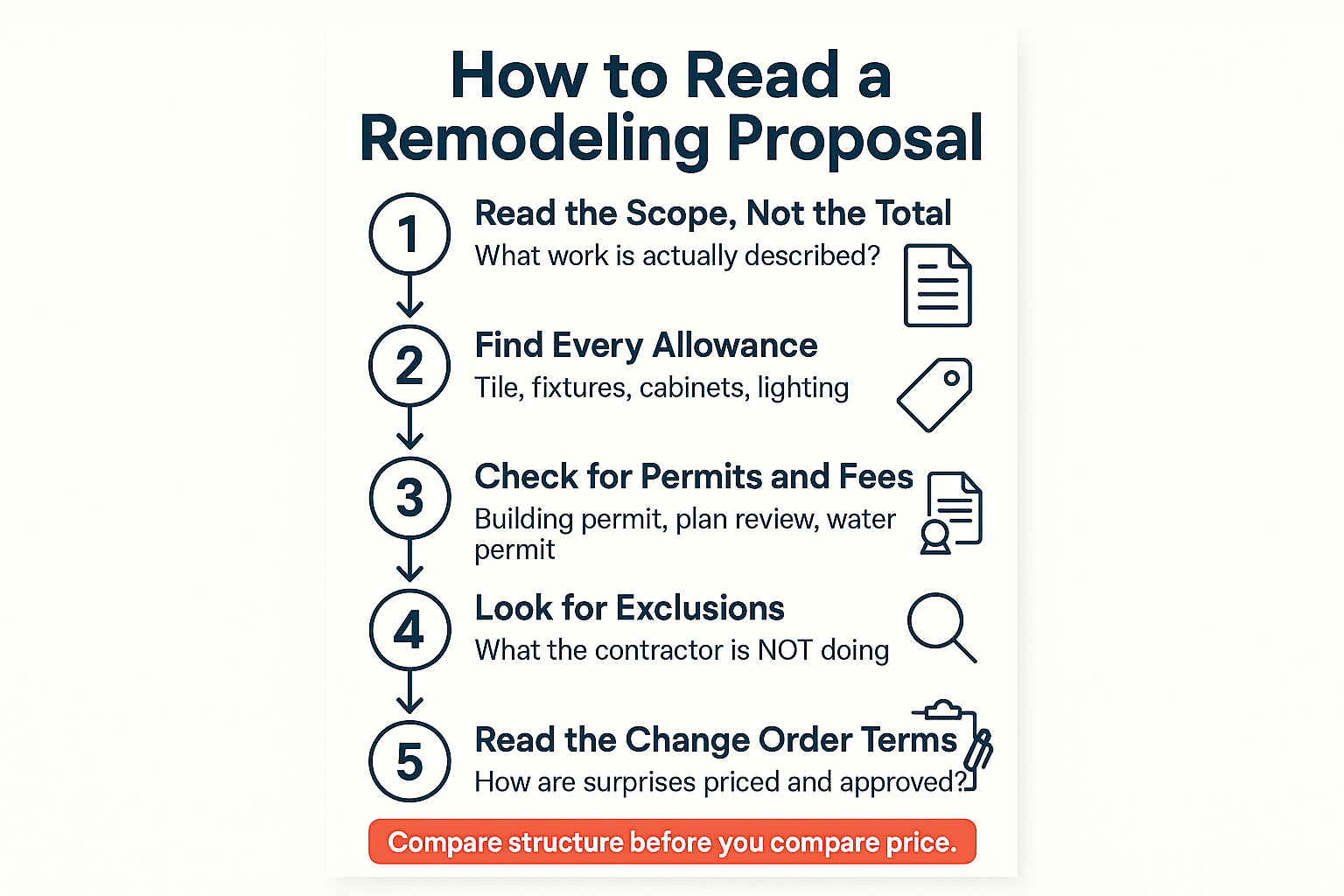
How to Read a Proposal in Five Passes
When a homeowner sends me a competing bid to look over, this is the order I read it in.
Change Orders: The Normal Kind and the Red Flag Kind
A change order is a written amendment to the original agreement. It changes scope, price, or schedule, and both parties sign it before the work happens.
Some change orders are unavoidable, and honestly they are a sign the job is being managed correctly.
Legitimate change orders usually come from:
- Concealed conditions, like dry rot, corroded galvanized supply lines, or old wiring found after demo
- Homeowner selections that come in above the written allowance
- Scope you added, like deciding mid-project to reconfigure the vanity wall
- Inspector-required work that could not be predicted from the outside
The red flag kind looks different. A change order for something that was obviously part of the job from day one, like haul-off, or a shower valve, or a permit, means the original scope was written thin on purpose.
My rough test: if I could have seen it during the walkthrough, it belonged in the proposal. If it was behind plaster in an 80-year-old Carmel or Pacific Grove cottage, it is a fair change order.
Ask any contractor how many change orders their last three projects had and what caused them. The answer tells you more than a reference letter will. There is more on this in what homeowners should ask before signing with any contractor.
The Proposal Is a Preview of the Project Management
Vague scoping at the proposal stage almost always produces conflict later. I have never once seen it go the other way.
If a contractor will not put the allowance for your tile in writing, they are also unlikely to give you a straight answer about the schedule in week six. If they skip the permit line, they will probably also skip the inspection coordination.
A few things I would want to see before I signed anything:
- A written schedule range, not a promise of a specific finish date
- Named exclusions, so you know what falls to you
- A payment schedule tied to milestones, not to the calendar
- The contractor’s license number printed on the document
- A clear answer on who pulls the permit, which is worth reading up on in this piece on permit responsibility
Permit requirements vary by jurisdiction across Monterey County, and cities like Carmel-by-the-Sea run their own design review process on top of building permits. Always confirm with the local building department that has authority over your address.
Frequently Asked Questions About Remodeling Proposals
Should I just pick the lowest bid?
Only if the three bids describe the same work, and in my experience they rarely do. Line them up phase by phase first. Most of the time the low bid is missing allowances, permit fees, or haul-off, and the gap closes on its own once you add those back.
Is it normal to pay for a proposal or design consultation?
For small jobs, usually no. For an addition, an ADU, or a full renovation, a paid pre-construction consultation is common, because producing measurements, layouts, and permit-ready plans is real work. Many contractors credit that fee back if you move forward with the project.
What does a contingency line mean, and do I lose that money?
A contingency is a set-aside for unknown conditions on older homes. It is not a fee. If we do not need it, you do not spend it, and that should be stated in writing.
How long should a proposal stay valid?
Material pricing moves, so most proposals carry a validity window of about 30 days. If you sit on one for six months, expect it to be re-priced. Ask what the window is up front so it is not a surprise.
What if my project needs a water permit on the Peninsula?
Fixture changes in the Monterey Peninsula Water Management District service area often require a separate water permit before the building permit closes out. It should appear as its own line item. This article covers the water permit step in more detail.
Reviewing a proposal for a Monterey County project?
If you are holding a bid and cannot tell what is actually included, reading it line by line usually answers the question faster than another phone call. Palacios Construction works with homeowners across Monterey, Pacific Grove, Carmel, Seaside, Marina, and Salinas, and our proposals are written with real allowances and documented scope from day one. You can reach us at (831) 220-3334 or at palaciosconstructionca.com when you are ready to talk through your project.