
Direct Answer: In Monterey County, ADUs can generally be rented long term at 30 days or more. Stays of 30 days or less count as short-term rental use, which county rules do not allow for ADUs.
Almost nobody builds a backyard unit because they think it will be fun. The homeowners who call me are weighing rental income, a place for aging parents, or flexible space for adult kids who cannot buy on the Peninsula yet.
So the first question is usually some version of “can I actually rent it out?” One homeowner told me they wanted to tear down an old studio, put a small dwelling unit in its place, and look at remodeling the main house while the crew was already on site. That plan lives or dies on the rental answer.
I want to handle that question before saying a word about framing, because the answer changes what you should build. Nightly-stay math and long-term tenant math lead to two different buildings.
Renting out an ADU in Monterey County: where the line sits
Monterey County treats any stay of 30 consecutive days or less as a short-term rental. That is the dividing line, and it is not about how you describe the arrangement or which website you list on.
The county’s vacation rental framework does not treat ADUs and JADUs the same way it treats a main house. In unincorporated areas, short-term rental use of an accessory dwelling unit is prohibited, while long-term tenancy of 30 days or more is the normal, allowed path. You can read the county’s own summary on the Monterey County short-term rental permit page.
What this means in practice:
- A month-to-month or annual lease is the standard use for an ADU here
- Nightly and weekly stays in an ADU are the use that runs into trouble
- A land use permit from Housing and Community Development is required for short-term rental use on unincorporated parcels, and that door is generally closed for ADUs
- Properties inside city limits answer to their own city, not the county
I bring this up early with clients because a unit designed around peak-season nightly rates will not pencil out the way the owner pictured. If the income assumption is wrong, the budget conversation that follows is built on sand. Requirements do vary by jurisdiction, so confirm with the planning department that governs your parcel before you commit to a number.

City limits or unincorporated county changes the whole answer
This is the part national ADU articles never get right, and it is where Monterey County homeowners get tangled up. Two properties four minutes apart can sit under completely different rulebooks.
If your parcel is inside the city of Monterey, Pacific Grove, or Carmel-by-the-Sea, that city’s own short-term rental ordinance and planning counter govern your ADU. If you are in Carmel Valley, Big Sur, Prunedale, or another unincorporated pocket, you fall under the county’s inland or coastal vacation rental ordinance. The county’s inland ordinance took effect in October 2024.
The coastal side adds a layer, since coastal zone rules involve Coastal Commission certification on top of county action.
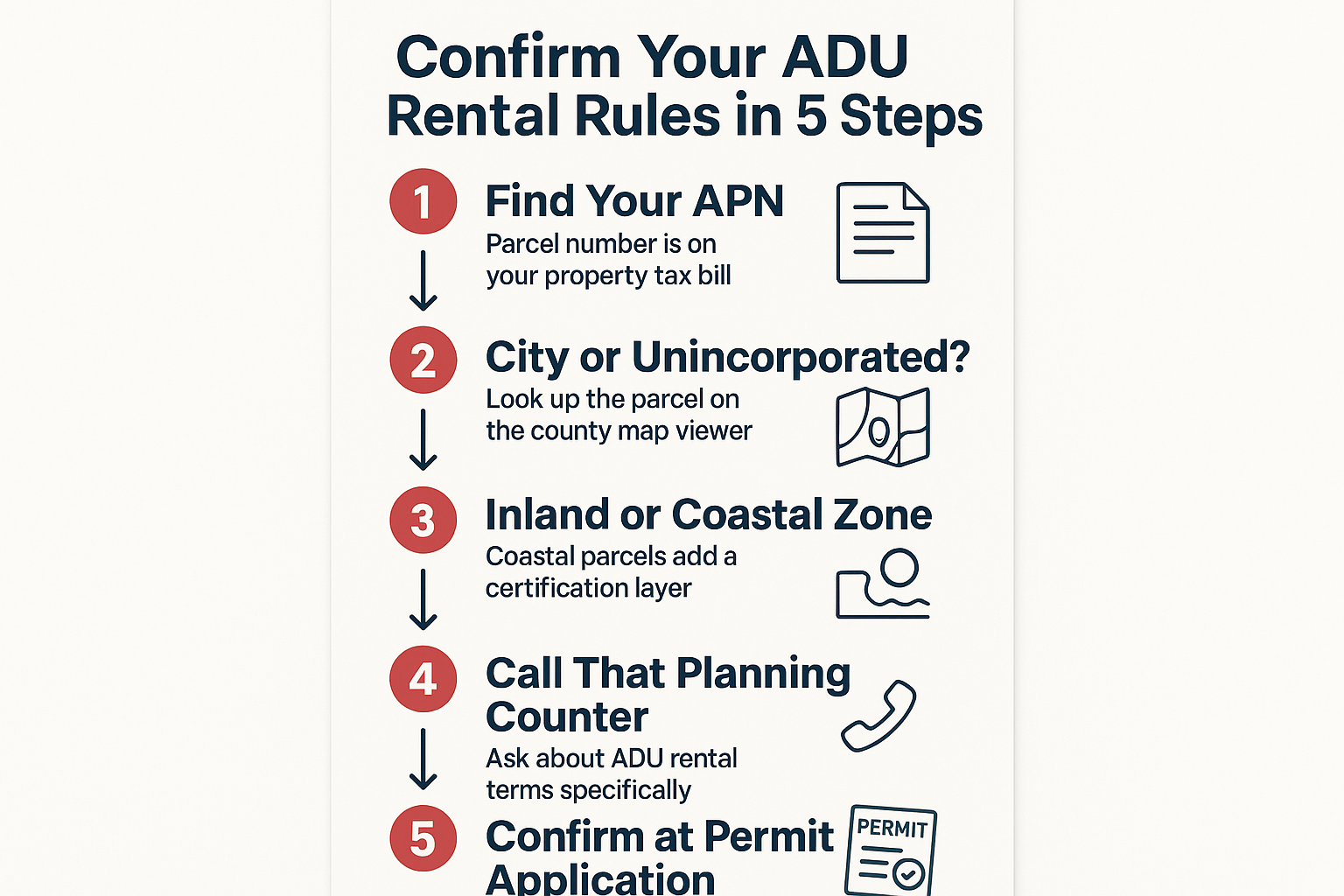
How to find out where you actually stand:
- Pull your assessor’s parcel number (APN) off your property tax bill
- Look the APN up on the county’s parcel viewer to confirm city limits versus unincorporated
- If unincorporated, check whether the parcel is inland or inside the coastal zone
- Call the planning counter for that jurisdiction and ask specifically about ADU rental terms, not just short-term rentals in general
Do this before you sketch anything. I have watched homeowners plan around what a neighbor did, only to learn the neighbor’s lot was on the other side of a city line. Where your parcel sits on the map drives permitting more than almost anything else about the project.
Who governs your ADU rental rules
Use this to figure out which counter to call first. Rules change, so treat this as a starting point and verify with the jurisdiction that covers your parcel.
| Where the parcel sits | Who sets short-term rental rules | What to confirm |
|---|---|---|
| Inside Monterey, Pacific Grove, Seaside, Marina, Salinas, Sand City, Del Rey Oaks | That city’s planning department and its own ordinance | Whether ADUs are excluded from short-term rental use and any minimum lease term |
| Inside Carmel-by-the-Sea | City planning, plus local design review | ADU rental terms and design review requirements before drawings begin |
| Unincorporated inland (Prunedale, much of Carmel Valley) | Monterey County HCD under the inland vacation rental ordinance effective October 2024 | That long-term tenancy of 30 days or more is the path, and current amendment status |
| Unincorporated coastal (Big Sur, coastal areas outside cities) | Monterey County coastal ordinance plus Coastal Commission certification | Coastal zone status and what has actually been certified |
| Pebble Beach | Unincorporated county rules plus private community requirements | County rental rules and any separate association approvals |
What state law settles, and what your city still controls
It helps to separate the two layers. California sets a floor, and local agencies build on top of it.
On the state side, a few things are reasonably settled:
- There is no owner-occupancy requirement for a standard ADU under current state law
- AB 1154 narrowed the JADU owner-occupancy rule so it generally applies when the junior unit shares a bathroom with the main house
- State law still lets local agencies require rental terms longer than 30 days, which is exactly the lever Monterey County jurisdictions pull
That last point matters. The state did not hand homeowners a right to run nightly stays out of a backyard unit, and locals are free to close that use.
One more misunderstanding comes up almost every month: people assume they can sell the ADU separately from the house later. Separate sale generally requires a local condominium ordinance under AB 1033, and not every jurisdiction has adopted one. Verify locally rather than banking on it.
If you are weighing a junior unit instead, the occupancy rules land differently, and how a JADU compares to a full ADU is worth reading before you pick a direction.
Five steps to confirm your ADU rental rules
This is the order I walk homeowners through before we talk about design or budget.
These rules are a moving target, and I would rather say so
The county’s vacation rental ordinances have been amended more than once. Part of that came from litigation challenging how the 2024 and 2025 rules treated resident owners differently from non-resident and corporate owners.
The Planning Commission held a public hearing on proposed amendments on February 11, 2026. More adjustments are plausible.
So the practical takeaway for anyone planning a build in late 2026 is simple: confirm the current rules at the time of your permit application, not based on what a neighbor did three years ago or what a forum post says. I would rather tell a client the ground is still shifting than hand them false certainty and watch it cost them later.
How a long-term tenant changes what we build
Once the rental answer is settled, it should shape the drawings. A unit meant for a tenant who stays three or four years gets planned differently than a guest suite that hosts family twice a year.
What I push clients to build in when long-term tenancy is the plan:
- Separate metering or real subpanel capacity, so utilities can be tracked and the tenant is not sharing a breaker with the main house dryer
- Its own entrance and its own address, which matters for mail, deliveries, and lease clarity
- Sound separation between the unit and the main house, especially on attached builds and garage conversions
- Durable flooring and surfaces that survive turnovers instead of finishes chosen for a photo
- Real storage, because a person living somewhere for years needs closets, not a coat hook
Older Peninsula lots add constraints that belong in the budget conversation on day one. Any new plumbing typically runs through water fixture unit accounting with the Monterey Peninsula Water Management District, and that credit math can shape whether a second bathroom is even on the table.
On unincorporated parcels, septic capacity is the other common surprise. Sometimes the septic system has to be addressed before the ADU can move forward, and that is a line item, not a footnote.
We put realistic allowances against these items in the proposal instead of placeholder numbers that fall apart in month two. One client put it plainly in a review: “The bid process was very transparent, with everything documented online.” That is the standard I want on every ADU proposal, because clear budgeting practices are what keep a long project calm.
Frequently Asked Questions About Renting Out an ADU in Monterey County
Can I rent my ADU out for a few weekends a year to help with the mortgage?
That is short-term rental use, since Monterey County counts any stay of 30 consecutive days or less as short term, and the county’s rules do not permit that use for ADUs in unincorporated areas. Occasional does not make it a different category. Check with your city if your parcel is inside city limits, because each one sets its own ordinance.
Do I have to live on the property to rent out my ADU?
Under current state law there is no owner-occupancy requirement for a standard ADU. JADUs are different, since AB 1154 narrowed that rule so it generally applies when the junior unit shares a bathroom with the main house.
Can I sell the ADU separately later?
Usually not by default. Separate sale generally depends on a local condominium ordinance under AB 1033, and not every jurisdiction here has adopted one, so verify with your planning department rather than assuming.
Does a garage conversion follow the same rental rules as a detached unit?
Yes, the rental rules follow the unit type, not the construction method. A converted garage that becomes an ADU is still an ADU for rental purposes. The build details differ quite a bit though, from insulation to ceiling height to sound separation.
How much rent should I assume when I run the numbers?
I would not hand you a figure, because it swings with location, unit size, parking, and whether utilities are separate. Pull current long-term listings for comparable units in your specific city, then model the build with real allowances rather than a round number. Whether the math works depends as much on site conditions like water and septic as it does on rent.
Thinking through an ADU on your Monterey County property?
We work regularly with Monterey County landlords and property managers on turnovers and unit remodels, so we plan ADUs around how the unit will be lived in and maintained over a decade, not just how it looks at final inspection. Palacios Construction handles ADU planning, permitting coordination, and construction across the Peninsula. If you want to talk through your parcel and what it can support, the team is at palaciosconstructionca.com or (831) 220-3334.