
Direct Answer: AB 130 freezes updates to California’s residential building code until at least 2031. The 2025 Title 24 standards that took effect January 1, 2026 apply to residential permits filed now.
Most homeowners who call me about a kitchen or bathroom project ask some version of the same question: is the code about to change again and cost me more money? For years that was a fair worry, because California updated its building standards every three years.
That cycle just stopped for houses. AB 130, signed in 2025, freezes updates to California’s residential building code until at least 2031.
So the 2025 Title 24 standards that took effect January 1, 2026 are the rules you will be building under for roughly the next five years. Below is what that actually means for a remodel in Monterey County, and the one screening question I would ask any contractor before signing.
What the Title 24 residential code freeze actually does
Before AB 130, California adopted a new set of building standards every three years. A homeowner who spent eight months on design and permitting could watch the target move underneath them.
The freeze changes that. According to a review of California’s 2026 construction laws, AB 130 halts residential building standard updates until at least 2031, and the 2025 Title 24 code applies to every permit application submitted on or after January 1, 2026.
For planning purposes, that is good news:
- A plan set drawn this year should still be current when you pull the permit next year
- Long projects like additions and ADUs do not get caught between two code versions
- A contractor can scope electrical, mechanical, and energy work against a fixed rulebook
- Cost estimates hold up better, because the compliance requirements behind them are not shifting
I have had homeowners sit on a project for two or three years while they saved up or waited out a busy stretch at work. One customer told me he had been asking me questions about taking out an interior wall for years before he was ready. With the code frozen, that kind of slow timeline no longer carries a code risk.
The freeze covers houses, not every building
This part gets confused constantly, and I understand why. Headlines about California building code changes rarely say which code they mean.
The freeze applies to the residential code. Commercial and larger multi-family standards stay on the normal three-year update cycle.
For a Monterey Peninsula homeowner, that usually means:
- Your single-family house remodel falls under the frozen residential standards
- An ADU or JADU on your property is residential work as well
- Apartment buildings, mixed-use projects, and commercial tenant work keep updating on schedule
One more thing worth being clear about. The freeze covers state building standards, not local rules.
Cities can still change zoning, setbacks, and design review requirements whenever they choose. Carmel-by-the-Sea and Pacific Grove both have their own review processes, and the Monterey Peninsula Water Management District water permit step for plumbing work sits entirely outside Title 24. Requirements vary by jurisdiction, so verify anything specific with your local building department before you commit to a design.
What the 2025 standards mean for a kitchen or bathroom remodel right now
A frozen code is not the same as an unchanged code. The standards now in effect brought real requirements with them, and any permit filed on or after January 1, 2026 is measured against them.
The scopes that pull the most attention on a house project are the ones touching electrical, mechanical, and energy systems. On a Monterey County kitchen or bath, that tends to show up in a few predictable places:
- Ventilation. Bath exhaust and kitchen range hood capture are reviewed more closely than most homeowners expect, and existing fans in older homes often do not meet current requirements
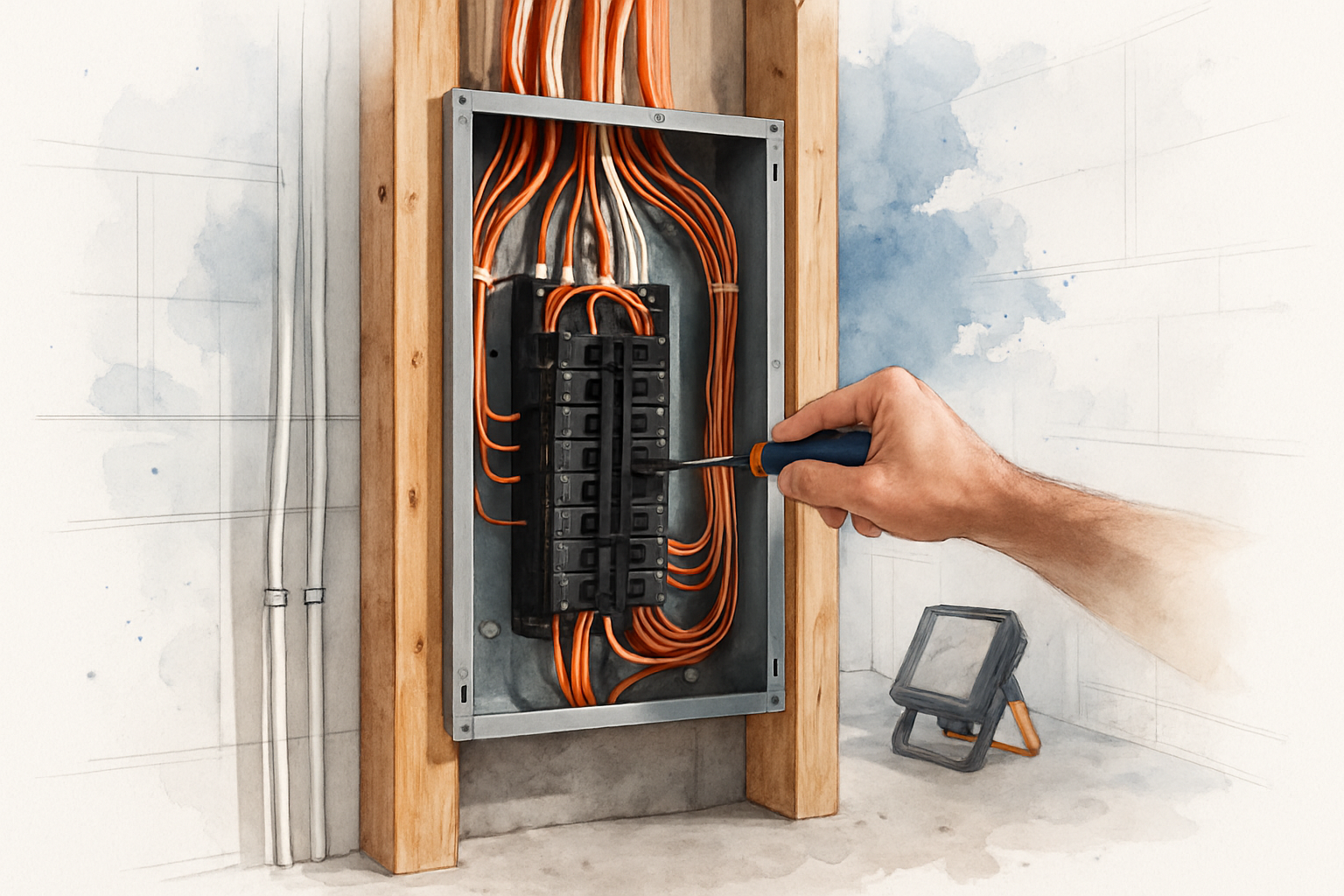
- Electrical. Circuit counts, receptacle placement, and protection devices in wet areas frequently need updating in houses wired decades ago
- Appliance and equipment specs. What you select can affect what the plans have to show, which is why finish and appliance decisions belong in pre-construction rather than week six
- Panel capacity. Older Peninsula homes sometimes need service work before new equipment can be added
I wrote separately about which remodeling scopes now trigger the 2025 code and about what the energy code requires on remodels and additions, so I will not repeat that detail here. The point for this article is simpler: the requirements are fixed, but they are not small.
Frozen, not frozen: a quick reference
Here is how I explain the split to homeowners at the first site visit. Confirm the details for your address with the local building department, since jurisdictions handle review differently.
| What it applies to | Status through 2031 | What it means for your project |
|---|---|---|
| Single-family homes, ADUs, JADUs | Residential standards frozen under AB 130 | Plans drawn now should stay current for years |
| Apartment buildings and commercial work | Normal three-year update cycle continues | Different code path, confirm before design |
| City zoning and design review | Not frozen, cities can change rules anytime | Carmel and Pacific Grove reviews can shift |
| MPWMD water permits | Separate agency, outside Title 24 | Plumbing fixture changes still get reviewed |
| Permits filed before January 1, 2026 | Reviewed under the prior code version | Ask which version your plan set was drawn to |
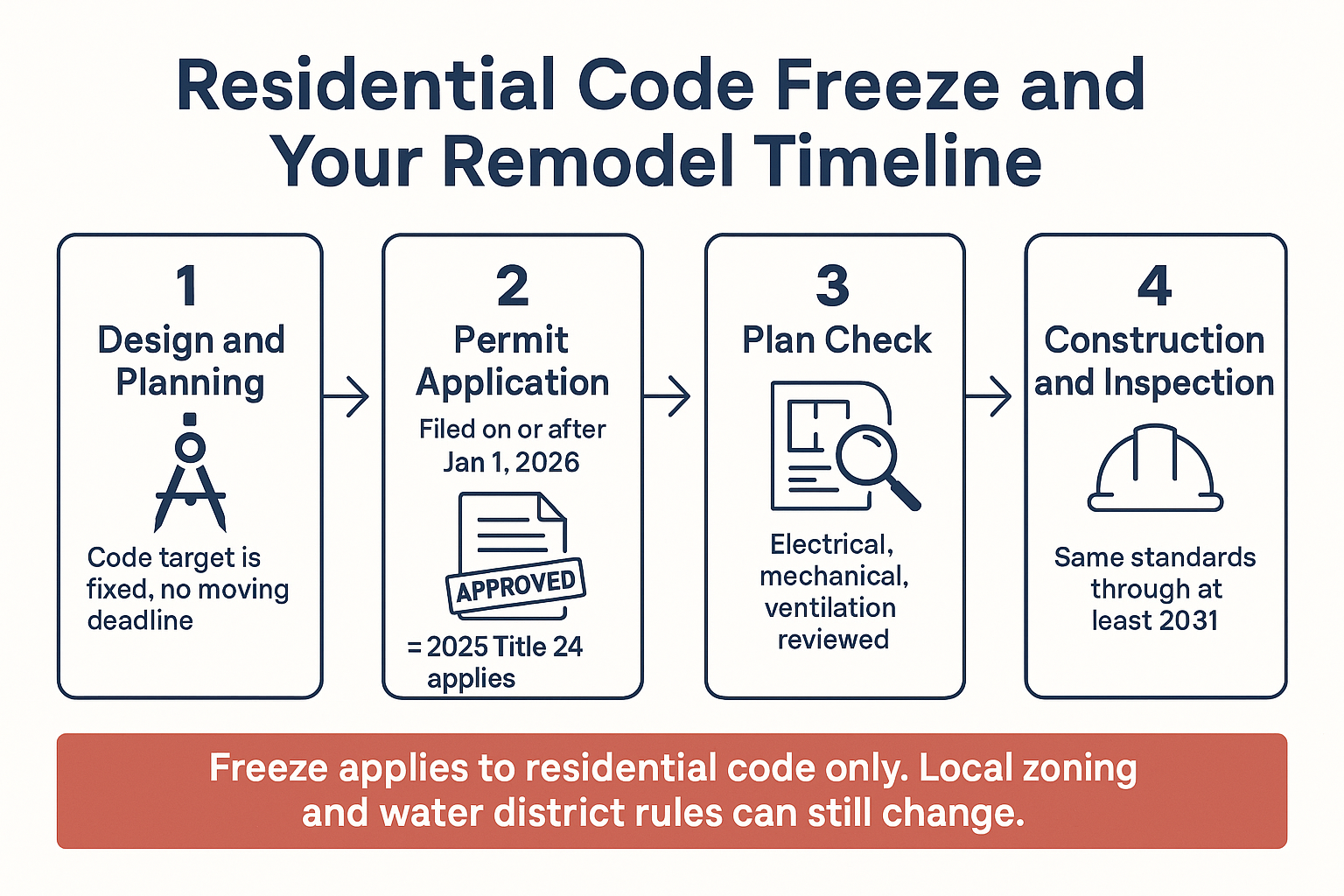
How the code freeze fits into a remodel timeline
This is the sequence I walk homeowners through when they ask how the freeze affects their planning.
The screening question worth asking a contractor
Here is where the freeze becomes practical rather than academic. The contractors who already have permits approved under the 2025 standards know exactly what plan check will ask for. The ones who have not caught up learn it on your job.
So ask a direct question when you are collecting bids: have you submitted and cleared residential permits under the 2025 code since January?
A contractor who has not will usually run into one of these:
- Plan check corrections and resubmittals that add weeks before work can start
- Change orders mid-project for ventilation, circuits, or panel work that was never in the original number
- Failed inspections that stall a job with your kitchen already torn out
Budget overruns are the number one concern homeowners bring me, and this is one of the quieter causes. A bid that leaves out required mechanical or electrical work is not a lower price, it is an incomplete scope.
One homeowner in Salinas asked me to reconfigure an existing bathroom to add an enclosed toilet room. Reasonable request, but it moves plumbing and changes ventilation, which means the current standards are in play. Scoping that correctly at the proposal stage, with realistic allowances rather than lowball numbers, is the difference between a predictable project and a running argument about money.
If you are unclear on who files what, I covered that in who is responsible for permits on a remodeling project, and the water permit step before a bathroom remodel trips up more Peninsula homeowners than anything else in the process.
Frequently Asked Questions About the California Residential Code Freeze
Does the code freeze mean my remodel will be cheaper?
Not by itself. The freeze removes the risk of the rules changing mid-project, which helps with planning and estimating, but the 2025 Title 24 standards already in effect still require real work on electrical, mechanical, and ventilation scopes. The benefit is predictability, not a discount.
I have plans drawn a couple of years ago. Do they still work?
They may need updating. Anything permitted on or after January 1, 2026 is reviewed under the 2025 standards, so older plan sets sometimes need revisions before plan check will accept them. It is worth having someone compare the drawings against the current requirements before you submit.
Does the freeze apply to my ADU?
An ADU or JADU on a single-family lot is residential work, so it falls under the frozen residential standards. Zoning and local ADU rules are separate and can still change, which they have been doing frequently in California.
What happens if my contractor bids the job under the old code?
You usually find out at plan check or at inspection, and both are expensive places to find out. Corrections mean resubmittal delays, and inspection issues mean rework on a house you are already living in around. Asking about recent permits under the current code takes thirty seconds and tells you a lot.
Could the state reopen the code before 2031?
It is possible. The freeze is set through at least 2031, but legislation can be amended and there are carve-outs for health and safety matters. For planning a remodel in the next few years, the current standards are the reasonable assumption.
Planning a remodel under the current code
A fixed code makes this a reasonable stretch to plan a project in Monterey County, whether that is a kitchen in Marina, a bathroom in Pacific Grove, or an ADU on a Carmel Valley lot. Palacios Construction handles residential permitting and scoping under the standards now in effect, with every line item and allowance explained from the start. If you want to talk through what your project would involve, the number is (831) 220-3334 or you can reach us at palaciosconstructionca.com.