

Direct Answer: It means an outside organization reviewed the company’s ownership records and confirmed the business is at least 51% owned and controlled by a minority owner. It verifies ownership, not workmanship.
Hiring someone to build an ADU or gut a kitchen means handing over a large chunk of money and six months of your life. Most homeowners I talk to in Monterey County are not nervous about the tile. They are nervous about who is actually running the job.
So when we were recently certified as a Minority Business Enterprise (MBE) by the National Minority Supplier Development Council, a few clients asked a fair question: what does that actually mean for me?
Honest answer, it means one specific thing, and it does not mean several other things people assume. Below I walk through what the review checks, where it belongs on your vetting list, and what it tells you nothing about.
What Minority Business Enterprise Certification Actually Verifies
The National Minority Supplier Development Council certifies businesses that are at least 51% owned, operated, and controlled by one or more minority owners. Our certification came through its regional affiliate, the Western Region Minority Supplier Development Council.
The important part is who does the checking. It is not a self-declared badge you add to a website. An outside group reviews your paperwork and makes a determination.
The review generally looks at things like:
- Formation and ownership documents for the business
- Proof of who holds the ownership stake
- Who signs contracts and makes financial decisions day to day
- An interview and a look at how the company actually operates
- Industry codes covering the type of work the company performs
It also expires. Our certificate, WR100001814, was issued October 14, 2026 and runs through October 31, 2027. After that it has to be renewed with updated documentation, which is a meaningful difference from a one-time award that sits on a wall forever.
Anyone can say they run a well-managed company. This is one more item an outside organization has looked at and confirmed.

Where This Sits on a Real Vetting Checklist
Certification is one check. It is not a substitute for the basics, and I would be suspicious of any contractor who waved a certificate around instead of a license number.
Roughly one in eight of our qualified calls last month asked whether we are licensed and insured before they would even agree to a site visit. That is a smart question and it should come first. Ours is CA General Contractors License #1071780 B, and you can look that up yourself in a couple of minutes using our guide on how to check a California contractor’s license before work begins.
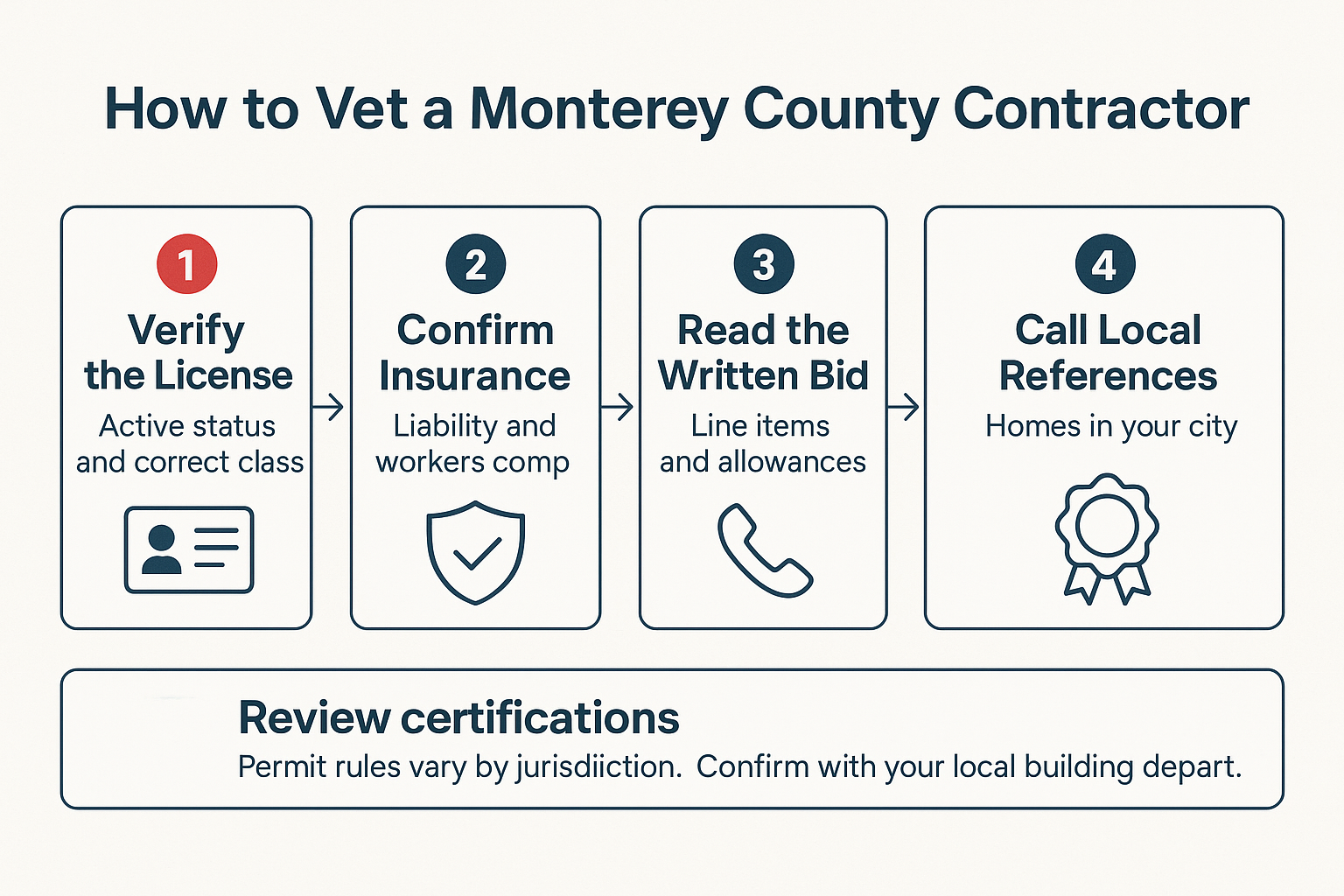
Here is the order I would use if I were the one hiring:
- License. Active, correct classification, no unresolved discipline.
- Insurance. General liability and workers compensation, confirmed by certificate from the insurer, not a screenshot.
- The written bid. Line items, allowances, and what is excluded. One reviewer put it plainly: “The bid process was very transparent, with everything documented online.”
- References in your city. Pacific Grove and Carmel-by-the-Sea homes come with design review and older framing that behaves differently than a 1990s build in Marina.
- Certifications. Third-party checks like MBE status, which add context on top of all of the above.
Permit experience belongs on that list too. In Monterey and Pacific Grove, work that touches plumbing fixtures often pulls in Monterey Peninsula Water Management District review on top of the city building permit. Rules vary by jurisdiction, so always confirm with the building department for your address.
What Each Credential Tells You, and How to Confirm It
Different pieces of paper prove different things. This is how I would sort them before signing anything.
| What to Verify | What It Proves | How to Confirm It |
|---|---|---|
| CA contractor license | Legally licensed for the work, bonded | CSLB license lookup by number or name |
| Liability and workers comp insurance | You are not exposed if someone is hurt on your property | Certificate sent directly from the insurer |
| MBE certification (NMSDC) | Ownership and control reviewed by an outside organization | Certificate number and expiration date |
| Written bid with allowances | How the budget was built and what is still an estimate | Read the line items before you sign |
| Local references | Experience with similar homes and local permit review | Call two or three past clients in your area |
A Five Step Vetting Order
If you only have one afternoon to vet a contractor, this is the order that catches the most problems.
What Owner-Led and Locally Based Looks Like on a Job Site
The MBE review confirms that the owner actually controls the business. On a remodel, that distinction shows up in ordinary ways.
It means the person who priced your job is the same person you call when the demo crew finds dry rot behind the shower pan. It means somebody with authority is on site, not just a scheduler passing messages.
One client of about ten years wrote that Christian “talks to you before during and after the work.” Another homeowner had two issues come up after the warranty period on a Pacific Grove remodel and wrote that they were answered and resolved right away. Neither of those is a certification. They are what hands-on project management looks like when the owner is still accountable for the outcome.
That matters most on complicated work:
- ADUs and additions, where design, permitting, and construction have to stay in sync
- Older Peninsula homes with framing, wiring, or plumbing that does not match the plans
- Kitchen and bathroom work where a one week delay in a cabinet order moves four trades
If you want a clearer picture of who is responsible for what during a build, I covered it in what a general contractor actually does on a remodel in Monterey.
Who Else Cares About MBE Certification
Homeowners are not the only audience for this. Property owners, rental managers, and larger organizations often track supplier diversity, and spending with a certified MBE counts toward those internal goals.
That comes up more than people expect around here. Multifamily and rental owners make up a solid share of the calls we take, and a couple of recent ones involved multi-unit scope, from utility upgrades across four units to full unit turnovers. Our certificate lists residential, multifamily, and trade industry codes, so the paperwork lines up with that kind of work.
One point I want to be direct about: certification is about ownership, not craftsmanship. It says nothing about whether the shower pan was sloped correctly or whether the crew cleaned up at the end of the day.
Quality still gets judged the old way, by the finished work, by references, and by what happens when something goes sideways. If you want to know what that failure mode looks like, read when a Monterey County remodel stalls halfway.
The Part Homeowners Actually Judge Us On
Most people comparing bids are not choosing on price alone. They tell me they already have one bid and want to see how a second one is put together.
What separates the two is usually the budget. We build proposals with realistic allowances instead of lowball placeholder numbers, and every finish and line item is explained from day one. A low allowance for tile or cabinets is not a savings, it is a change order waiting to happen.
Planning rules matter here too. State building code changes affect what a remodel has to include, and I broke down the current situation in what California’s residential code freeze means for remodels.
The reviews that mean the most to me mention the same few things over and over: starting on the promised day, clean job sites, progress photos, and someone picking up the phone after the job is done. Certification is a nice addition to that list. It is not the reason anyone should hire a builder.
Frequently Asked Questions About MBE Certification
Does hiring a certified MBE contractor cost more or less?
Neither. Certification has nothing to do with pricing. A bid is built from scope, materials, labor, and allowances, and that math does not change because of an ownership review.
Is MBE certification the same thing as being licensed in California?
No, and they are not interchangeable. The CSLB license is a state requirement to legally perform contracting work. MBE certification is a voluntary third-party review of who owns and controls the business. Check the license first, every time.
How long does the certification last?
It runs until the expiration date on the certificate and then has to be renewed with current documents. Ours is valid through October 31, 2027.
Does any of this change how my project gets permitted in Monterey County?
Not at all. Permits are issued by your city or county building department based on scope and code, and plumbing related work on the Peninsula may also involve water district review. Requirements vary by jurisdiction, so verify with the building department that covers your address.
Should certification change who I hire?
It should be one data point, not the deciding one. If a contractor checks out on license, insurance, insurance certificates, references, and a clearly documented bid, then a third-party certification is useful supporting information on top of that.
Planning a project in Monterey County?
If you are working through bids for an ADU, an addition, or a kitchen and bath remodel on the Peninsula, we are taking on new projects and happy to walk a site and talk through scope and budget. Palacios Construction is based in Monterey and serves communities from Pacific Grove and Carmel to Salinas and Prunedale. You can reach us at palaciosconstructionca.com or (831) 220-3334 when the timing works for you.