
Direct Answer: Look the contractor up on the Contractors State License Board site by license number or business name. Confirm the status is active, check the classification, and verify bond and workers compensation are on file.
Most people call me after they have already met with two or three contractors and they are stuck on one question: how do I know this person is legitimate? It is a fair worry. A kitchen or an ADU is one of the biggest checks a homeowner writes outside of the house itself.
The good news is that the state makes the first part easy. You can verify a California contractor’s license in about ten minutes, from your couch, before any deposit changes hands.
I walk homeowners in Monterey, Pacific Grove, and Carmel Valley through this all the time, and I would rather you check my record than take my word for it. Here is the exact sequence I would follow.
Step 1: Look Up the License on the State Board’s Site
Every licensed general contractor in Monterey County is listed in the same public database. The Contractors State License Board runs a free lookup tool where you can search by license number, business name, or personal name.
Ask the contractor for the license number directly. Anyone who is licensed will hand it over without hesitation, and it should already appear on their proposal, their business card, and their website.
If all you have is a company name, search that instead. Two things I tell homeowners to watch for here:
- A search that returns no results at all
- A search that returns a different company name than the one on your paperwork
- A license number that belongs to someone in a different county with no connection to the business in front of you
Monterey County gets a fair amount of out of area crews chasing storm work and quick jobs, especially after a wet winter. The lookup tool is the fastest way to see whether the person at your door is who they say they are.
Step 2: Confirm the Status, Bond, and Workers Compensation
Pulling up the record is only half of it. Now read what it actually says.
Start with the status line. You want to see active. An expired, suspended, or inactive license means the person cannot legally contract for work over the state’s small job threshold, no matter how good the bid looks.
Then scroll down the record and confirm these are on file:
- Contractor bond, held with a surety company and shown as current
- Workers compensation insurance, or a valid exemption if the contractor genuinely has no employees
- No outstanding disciplinary actions or unresolved complaints
Workers comp is the one homeowners skip, and it is the one that can bite hardest. If an uninsured worker gets hurt on your property in Seaside or Pebble Beach, that claim can land on your homeowners policy.
One more thing worth knowing: state rules cap the down payment on a home improvement contract at 10% of the contract price or $1,000, whichever is less. If someone asks for half up front to “order materials,” that is not how licensed work is supposed to run. Verify the current rules on the board’s consumer pages, since they do get updated.
Step 3: Read the Classification (B Versus C)
This is the part almost nobody has seen before, and it matters more than most homeowners realize.
California licenses contractors by classification. A B classification is the general building contractor license. It covers projects that involve two or more unrelated trades, which is nearly every remodel, addition, or ADU.
C classifications are specialty licenses for a single trade. A C-10 handles electrical. A C-36 handles plumbing. A C-33 handles painting. Those are real licenses and good ones, but a specialty license does not cover running a whole kitchen gut that involves framing, plumbing, electrical, drywall, tile, and cabinets.
Here is a concrete example so you can see what you are reading. Our record shows CA General Contractors License #1071780 B. Broken down:
- 1071780 is the license number itself
- B is the classification, meaning general building contractor
- The record also shows the business name, the qualifying individual, the issue date, and the expiration date
When you pull up a contractor for a full remodel and see only a C classification, ask why. Sometimes the answer is that they subcontract everything under a licensed GC, and that is a different arrangement than what your contract says. If you want the fuller picture, I broke down what a general contractor actually does on a remodel in a separate piece.
What Each Line on a License Record Means
This is the short version of how to read a license record without a background in construction law.
| What you see | What it should say | Why it matters |
|---|---|---|
| License number | A number that matches the proposal | Confirms you are looking at the right business |
| Status | Active | Expired or suspended means they cannot legally contract the work |
| Classification | B for a multi trade remodel or addition | A single C class does not cover a whole project |
| Business name | Matches your contract exactly | Mismatches are where problems usually surface |
| Bond | Current, with a surety company listed | Gives you a limited path to recovery on a dispute |
| Workers compensation | Active policy or a valid exemption | Protects you if a worker is injured on your property |
| Complaint history | No unresolved disciplinary actions | Patterns show up here before they show up in your driveway |
The Ten Minute License Check
Here is the whole sequence in order, start to finish, before you sign anything.
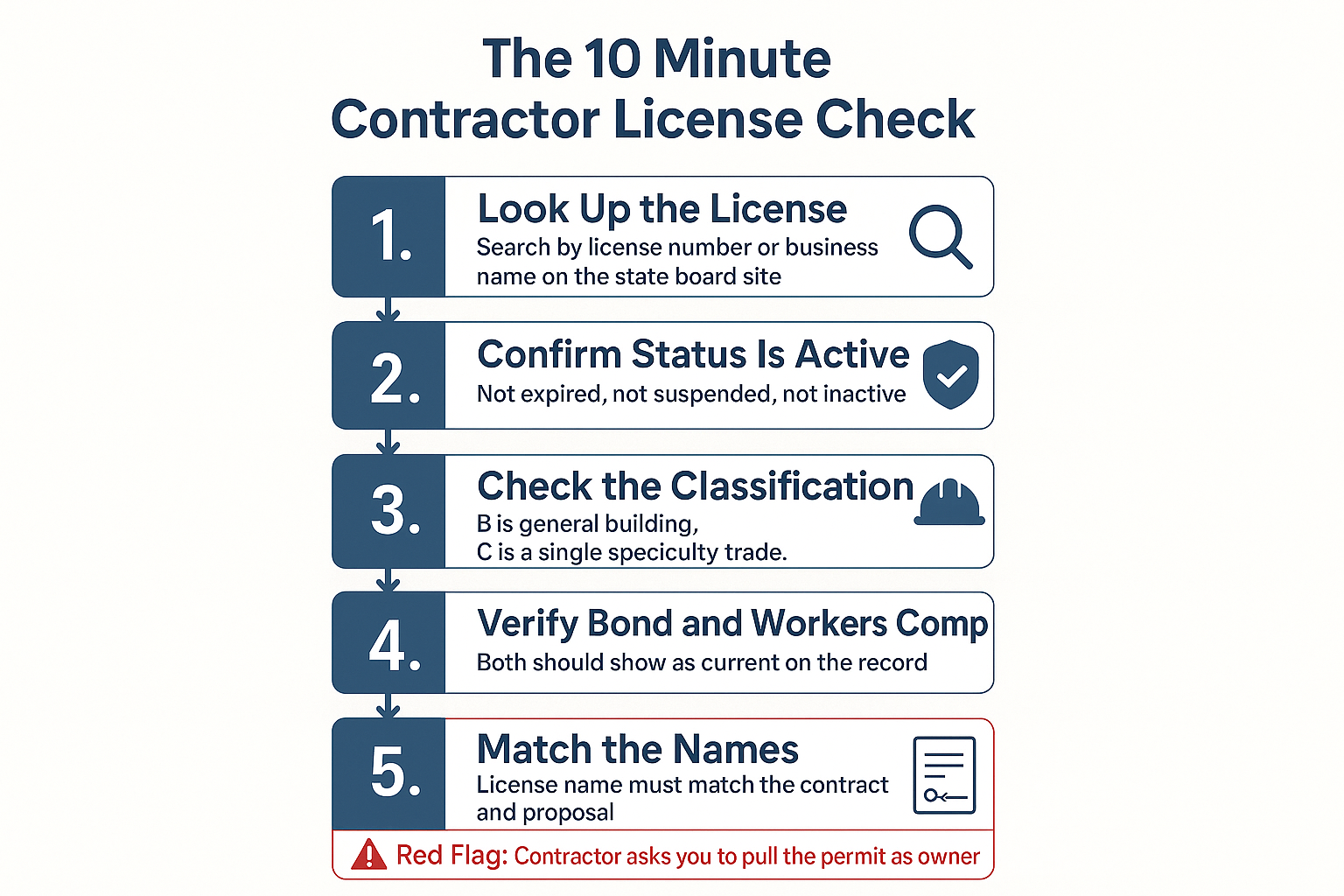
Step 4: Match the Name on the License to the Name on the Contract
This is where most mismatches show up, and it is the step people skip because it feels too obvious.
The business name on the license record should match the name on your written contract, your proposal, and the check you write. If the license says one entity and the contract says another, stop and ask for an explanation in writing.
I have seen homeowners in Salinas and Marina hand a deposit to a company name that turned out to be a marketing brand sitting on top of an unlicensed crew. The license was real. It just belonged to somebody else.
While you are at it, confirm the permit will be pulled in the contractor’s name, not yours. That leads directly into the biggest red flag on this list.
Red Flags Worth Walking Away From
State consumer guidance keeps repeating the same warnings, and after years of running jobs on the Peninsula, I can tell you they repeat them for good reason.
The owner builder permit request. If a contractor asks you to pull the permit yourself as an owner builder, understand what you are agreeing to. You become the responsible party. You are the one the building department deals with at every inspection. You may be treated as the employer of the people on site. And if a problem surfaces two years later, your recourse against that contractor is much weaker.
The usual reason someone asks for this is that they cannot pull the permit themselves. That is the whole answer.
Other warning signs:
- No written contract, or a one page estimate presented as a contract
- Vague scope language like “remodel bathroom” with no fixtures, materials, or allowances listed
- No written change order process, so mid job additions get settled verbally
- Pressure to start before permits are approved
- Cash only pricing offered as a discount
Unpermitted work does not stay hidden forever. It surfaces at resale, at refinance, and at insurance claims, which I covered in more detail in what happens when remodeling work gets done without a permit. Permit requirements vary by city and jurisdiction across Monterey County, so verify with your local building department before anyone touches a wall.
On scope and allowances, what a remodeling proposal should actually tell you is the companion read. Clear budgeting practices start on paper, with realistic allowances and every line item explained from day one.
What a License Check Does Not Tell You
Verification confirms legitimacy. It does not confirm local experience, and on the Peninsula that gap is real.
A license record cannot show you whether a contractor has dealt with Monterey Peninsula Water Management District requirements on plumbing fixture changes, which catch homeowners off guard on bathroom remodels. It cannot show whether they have sat through design review in Carmel-by-the-Sea, or worked on the older housing stock in Pacific Grove where you find knob and tube, undersized framing, and salt air damage nobody budgeted for.
So treat the license check as the floor, not the finish line. It rules people out fast. Judging local knowledge is a separate conversation, and I wrote about how to tell if a contractor actually knows Monterey County for exactly that reason.
Frequently Asked Questions About Verifying a Contractor’s License
Does a contractor need a license for a small job?
California requires a license for most work where labor and materials total $500 or more combined. Almost any real remodel clears that line easily. Check the current threshold on the state board’s consumer pages, since it has been adjusted before.
What is the difference between a B license and a C license?
A B is the general building contractor classification, meant for projects involving two or more unrelated trades. A C classification is a specialty license for one trade, like C-10 electrical or C-36 plumbing. A kitchen remodel, an addition, or an ADU is B territory.
What happens if I let the contractor put the permit in my name?
You become the owner builder, which means you are the responsible party for the permit and the inspections. If code issues turn up later, or a worker is injured, the exposure shifts toward you rather than the contractor. It is worth declining and asking why they suggested it.
How often should I re-check a license?
Check it once before you sign, and check it again if a project runs long or if the contract gets assigned to a different entity. Licenses expire on a set cycle and bonds can lapse mid project.
Is workers compensation always required?
It is required for any contractor with employees. Some solo contractors carry a valid exemption on file, which is legal, but it also means nobody on your job is covered if they bring helpers. Ask directly and confirm it on the record.
Planning a Project in Monterey County?
If you are working through this checklist on a few bids and want to talk through what you found, we are glad to answer questions about how permits, classifications, and scope work on Peninsula projects. You can reach our office at (831) 220-3334 or at palaciosconstructionca.com when the timing suits you. Our license record is public, and we would rather you check it first.