Direct Answer: Several California ADU laws took effect January 1, 2026, changing permitting timelines, JADU owner-occupancy rules, and energy code requirements. Monterey County homeowners planning an ADU should review what’s changed before starting their project.
If you’ve been researching ADUs for the past year or two, there’s a good chance some of what you read is already out of date. Several significant California ADU bills took effect January 1, 2026, and they changed the rules in ways that directly affect what Monterey County homeowners can build, how quickly they can expect a permit decision, and what flexibility they have with Junior ADUs.
This matters because the Monterey Peninsula has its own permitting environment — coastal zone rules, Monterey Peninsula Water Management District (MPWMD) requirements, and city-specific design review processes that don’t exist in most of California. State law sets the floor, but local conditions still determine what’s actually buildable on your specific parcel.
This article covers the three changes that matter most to Peninsula homeowners right now: the new permitting timeline rules, how JADU owner-occupancy changed, and what the 2025 Energy Code means for projects permitted this year. If you’re planning an ADU in Monterey, Pacific Grove, Pebble Beach, or anywhere in Monterey County, these are the details worth understanding before you start.
Permitting Timelines Got Real Deadlines — What That Actually Means
For years, one of the most common complaints from homeowners trying to build ADUs was that applications would sit with local agencies for months without a clear answer. SB 543, effective January 1, 2026, puts hard limits on that.
Under the new law, a local agency must issue a completeness determination within 15 days of receiving an ADU permit application. From that point, they have 60 days to approve or deny the application — or it is deemed approved automatically.
‘Deemed approved’ is a phrase worth understanding clearly. It doesn’t mean your project gets built automatically. It means the permit is legally considered granted, but you still need to obtain the actual permit documents before construction begins. If a local agency misses the 60-day window, the applicant can send written notice, and the agency then has a short window to issue the permit or face legal exposure. In practice, this creates a real accountability mechanism that didn’t exist before 2026.
Monterey County’s permitting process has generally been professional, but properties in coastal zones or served by MPWMD have historically moved through multi-step review. A homeowner in Carmel-by-the-Sea, for example, may still need a Coastal Development Permit in addition to the standard building permit — and that process runs on its own timeline. State law does not override coastal permitting requirements. So while SB 543 is a meaningful improvement, it’s not a shortcut around every local layer.
For a deeper look at how permits work on remodeling projects in this area, the breakdown of who handles permits on a remodeling project is worth reading before you start.
How the JADU Owner-Occupancy Rule Changed — and Why It Matters for Pebble Beach and Carmel
Junior ADUs — units carved out of existing interior space, typically under 500 square feet — used to come with a firm owner-occupancy requirement. The homeowner had to live on the property as their primary residence. AB 1154, effective January 1, 2026, changed that rule in a specific and meaningful way.
Under the new law, the owner-occupancy requirement for JADUs only applies when the unit shares sanitation facilities with the primary home. If the JADU has its own bathroom, the owner-occupancy mandate no longer applies.
This is a real planning decision, not a minor detail. Here’s what it means practically:
- A shared-bath JADU (where the occupant uses the same bathroom as the main household) still requires the owner to live on site
- A self-contained JADU with its own bathroom removes the owner-occupancy requirement entirely
- Homeowners who want to rent the unit out — or use it for a family member while they travel or own other property — now have a path forward if they plan the bathroom correctly
For homeowners in Pebble Beach or Carmel-by-the-Sea who are converting interior space into a rental unit or family suite, this distinction should happen at the design stage — not after plan check. Adding a bathroom to a JADU conversion changes the scope, cost, and permit requirements.
If you’re thinking through whether a JADU or a full ADU makes more sense for your situation, this guide on what determines whether an ADU makes financial sense lays out the key considerations.
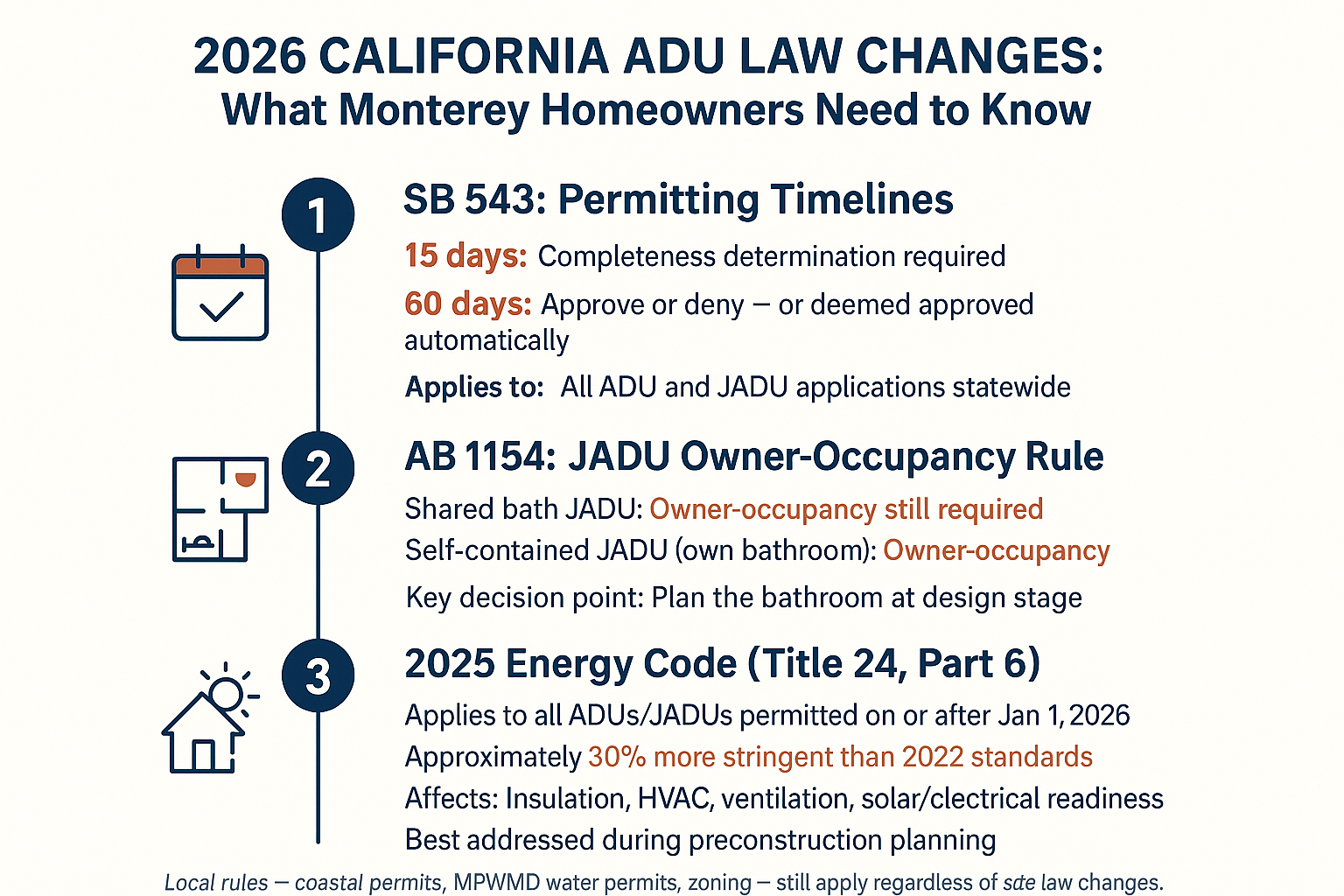
2026 ADU Law Changes at a Glance
The three key changes from California’s 2026 ADU legislation, summarized for quick reference.
The 2025 Energy Code: What Changes for ADUs Permitted This Year
Any ADU or JADU that receives a building permit on or after January 1, 2026 must comply with California’s 2025 Energy Code (Title 24, Part 6). This code is approximately 30% more stringent than the 2022 standards it replaced.
Most ADU content online doesn’t talk about this — but it affects real line items in your project:
- Insulation requirements are higher, especially for walls and roofs
- HVAC specifications must meet updated efficiency thresholds
- Ventilation — both mechanical and natural — has more detailed requirements
- Solar and electrical readiness provisions apply, depending on the unit type and size
None of this necessarily adds enormous cost to a well-planned project. But it does need to be scoped in during preconstruction planning — not discovered at plan check when you’re already into drawings and waiting on a permit. A contractor or designer who specs your insulation and HVAC system to 2022 standards is handing you a problem.
For detached new construction ADUs, the energy requirements tend to have more impact than for JADU conversions of existing interior space. The specifics vary by unit type, square footage, and conditioned area. A licensed contractor familiar with Monterey County projects should be walking through these requirements during the preconstruction phase — not leaving them for the building department to flag.
If you want to understand what commonly gets missed before construction starts, this breakdown of why ADU projects run into problems before construction even begins covers exactly that.
JADU vs. ADU: Key Differences Under 2026 Rules
These are general comparisons based on current California law. Local rules in Monterey County — including MPWMD requirements and coastal zone regulations — add additional layers to both unit types.
| Factor | JADU (Junior ADU) | ADU (Accessory Dwelling Unit) |
|---|---|---|
| Maximum Size | Up to 500 sq ft | Up to 1,200 sq ft (varies by parcel) |
| Location | Within existing home footprint | Attached, detached, or garage conversion |
| Owner-Occupancy (2026) | Required only if sharing bathroom with main home | Not required in most cases |
| Separate Kitchen Required? | Must have efficiency kitchen | Full kitchen required |
| Separate Entrance | Required | Required |
| MPWMD Water Permit | Likely required if adding bathroom or kitchen fixtures | Required for new fixtures |
| 2025 Energy Code Applies? | Yes, for permitted work on or after Jan 1, 2026 | Yes, for permitted work on or after Jan 1, 2026 |
| Coastal Development Permit | May apply depending on location | May apply depending on location |
The One Local Constraint No State Law Can Override: Water
State legislation can change permitting timelines and owner-occupancy rules. It cannot change the fact that the Monterey Peninsula has limited water supply.
Any ADU or JADU project within the MPWMD service area that adds water fixtures — which includes any unit with a kitchen or bathroom — requires a valid MPWMD water permit before the city will issue a building permit. The City of Monterey maintains separate waiting lists for residential remodel allocations and new residential water allocations. Availability isn’t guaranteed, and wait times vary.
This is the most locally specific constraint Peninsula homeowners face, and it’s often the one that surprises people who did their research using out-of-state sources or general California ADU guides. The question of whether a water permit is available for your parcel and your project type needs to be answered before you spend money on plans or permit applications.
This isn’t a reason to avoid building an ADU — many projects in Monterey, Pacific Grove, and surrounding areas do move forward successfully. But it’s a preconstruction question, not a mid-project discovery. For projects in cities like Seaside or Marina that fall outside parts of the MPWMD service area, the water situation may be different. Homeowners should verify directly with both their city’s building department and MPWMD before committing to a scope.
For context on the full financial picture — including what drives cost variation across Monterey County — this guide on why ADU cost estimates vary more than most homeowners expect explains the layered factors at play.
‘State Law Allows It’ and ‘Your Property Can Do It’ Are Not the Same Thing
This is probably the most important framing for any Monterey Peninsula homeowner reading about ADU laws right now. California has expanded what’s generally permissible — that’s real and meaningful progress. But whether a specific project on a specific parcel is buildable still depends on local conditions.
On the Monterey Peninsula, that typically means working through several parallel tracks:
- Building permit — issued by your city (Monterey, Pacific Grove, Carmel, etc.) after plan check
- MPWMD water permit — required before the building permit if new fixtures are added
- Coastal Development Permit — required for properties within the Coastal Zone, regardless of ADU type
- 2025 Energy Code compliance — must be scoped into drawings before plan submittal
- Zoning verification — lot size, setbacks, and unit size limits vary by parcel and city
A contractor who has worked through this process in Monterey County knows which of these tracks run simultaneously and which ones gate each other. That sequencing matters — the order of operations most homeowners don’t know about applies just as much to ADU projects as it does to interior remodels.
Homeowners who’ve had good experiences building here describe the difference as a contractor who ‘talks to you before, during, and after the work’ — someone who flags these requirements early rather than leaving them for the building department to surface. That’s the practical value of working with someone who already knows the local jurisdiction, not just the state statute.
Frequently Asked Questions About California’s 2026 ADU Law Changes
Does the 60-day deemed approval rule mean I don’t need to worry about permit delays anymore?
It reduces one major source of delay — applications sitting without action — but it doesn’t eliminate all permitting timelines. Properties in coastal zones may still require a Coastal Development Permit, which runs on a separate process. MPWMD water permits also run independently of city building permits. The SB 543 deemed approval rule applies to the ADU building permit application specifically, not to every concurrent approval your project may need.
My JADU shares a bathroom with the main house. Does that mean I still have to live on the property?
Under AB 1154 (2026), yes — the owner-occupancy requirement still applies to JADUs that share sanitation facilities with the primary home. If you want to remove that requirement, the unit needs its own bathroom. That’s a design and budget decision worth making early.
How do I know if my property needs an MPWMD water permit?
If your property is within the Monterey Peninsula Water Management District service area and your project adds any new water fixtures — including a bathroom or kitchen in an ADU or JADU — you will generally need an MPWMD water permit before the city will issue your building permit. Contact MPWMD directly or check with your city’s building department. This is a preconstruction question, not one to sort out after plans are drawn.
Does the 2025 Energy Code add a lot of cost to an ADU project?
For most well-planned projects, the cost impact is manageable when it’s addressed during preconstruction. The problems arise when drawings are spec’d to old standards and corrections are required at plan check — that adds both cost and time. Insulation, HVAC efficiency ratings, and solar/electrical readiness provisions are the areas most likely to require attention.
Can I rent out an ADU in Monterey County?
Generally yes — state law has removed most barriers to ADU rentals. But local rules, including short-term rental ordinances, may affect how the unit can be used. JADUs with shared bathrooms still require the owner to live on site. For a detailed breakdown of Monterey County rental rules, this guide on whether you can rent out an ADU in Monterey County is worth reading.
What’s the difference between a JADU and a full ADU — and which one makes sense for my property?
A JADU is carved from existing interior space and is capped at 500 square feet. A full ADU can be detached, attached, or a garage conversion, and can be up to 1,200 square feet depending on your parcel. The right choice depends on your lot, your goals, water availability, and budget. A licensed general contractor who knows Monterey County can help you figure that out during a preconstruction conversation — before you commit to drawings.
Have Questions About Building an ADU in Monterey County?
The rules changed in January 2026, and the local permitting environment on the Monterey Peninsula adds layers that most general guides don’t address. Palacios Construction works with homeowners across Monterey County — from Monterey and Pacific Grove to Pebble Beach and Carmel — on ADU and JADU projects that are planned carefully from the start, with realistic budgets and hands-on project management through every phase. If you want to talk through what’s actually possible on your property, reach out at palaciosconstructionca.com or call (831) 220-3334.