

Direct Answer: A contractor’s bid document reveals how they think, plan, and communicate — not just what they charge. Vague bids often mean expensive surprises once work starts.
Most homeowners in Monterey County request multiple bids before committing to a remodeling project. That instinct makes sense — you want to see what different contractors are charging and make an informed decision. But the number at the bottom of the page is actually the least useful thing on the document.
The way a proposal is built — what it spells out, what it glosses over, and what it leaves out entirely — tells you far more about how a contractor operates than the total does. A bid that wins on price but loses on specificity has a way of making up the difference once the walls are open.
This article walks through three things a well-built proposal should actually show you, and what to look for before you sign anything.
The Lowball Bid Pattern That Costs Monterey Homeowners More in the End
There is a common pattern in local remodeling that plays out more often than it should. A homeowner in Pacific Grove or Carmel-by-the-Sea gets three bids on a kitchen remodel. One is noticeably lower than the others. They go with it.
Six weeks in, the change orders start. The countertop allowance wasn’t realistic. The electrical panel upgrade wasn’t included. The tile labor was listed as a single line item with no breakdown. By the time the project closes, the final number looks a lot like the bids they passed on — except they’ve already been living in a torn-up kitchen for two months.
This happens when a proposal uses vague line items, generalized allowances, or skips trade coordination costs entirely. A well-built proposal does the opposite:
- Every finish category has an assumed price point — not just a placeholder
- Material allowances reflect actual current costs, not a number designed to look competitive
- What triggers a change order is explained clearly, so there are no surprises mid-project
- Trade work — plumbing, electrical, tile, cabinetry — is listed separately, not bundled into a single labor line
When you read a proposal, you are not just comparing prices. You are evaluating whether the contractor has actually thought through the job. Vague bids are not humble estimates — they are often proposals where the real cost hasn’t been worked out yet, and you’ll fund the discovery process.
For more on what drives remodeling costs in this market, The Hidden Expenses That Catch Monterey Homeowners Off Guard covers what typically gets missed in the estimating phase.

Who Is Coordinating the Trades — and Does the Bid Make That Clear?
A kitchen remodel in Monterey typically involves at least five separate trades: a plumber, an electrician, a tile setter, a cabinet installer, and a countertop fabricator. Each one has their own schedule, their own lead times, and their own requirements that affect the sequence of work.
In a well-managed project, the general contractor owns that sequence. They schedule each trade in the right order, account for inspection windows, and take responsibility when something slips. In a poorly managed one, each subcontractor operates independently — and the homeowner ends up as the de facto project manager, fielding calls about who needs to be on site and when.
The bid document is where you can start to tell the difference. Ask yourself:
- Does the proposal name the trades involved, or does it just say “labor”?
- Is there a project timeline that accounts for inspection holds and trade sequencing?
- Who is the point of contact when a sub runs behind?
- Does the contractor have established relationships with their subs, or are they pulling from a general pool?
One Pacific Grove homeowner who hired Palacios Construction for a full home remodel — kitchen redesign, two bathrooms, a new deck, and all the associated trades — described the owner as someone who was “communicative, transparent with costs, and always available to address any concerns.” That kind of hands-on project management doesn’t appear on a bid by accident. It’s built into the way the proposal is structured and priced.
If you want a framework for evaluating this before you sign, What Homeowners Should Ask Before Signing With Any Contractor has a useful list of questions specific to this market.
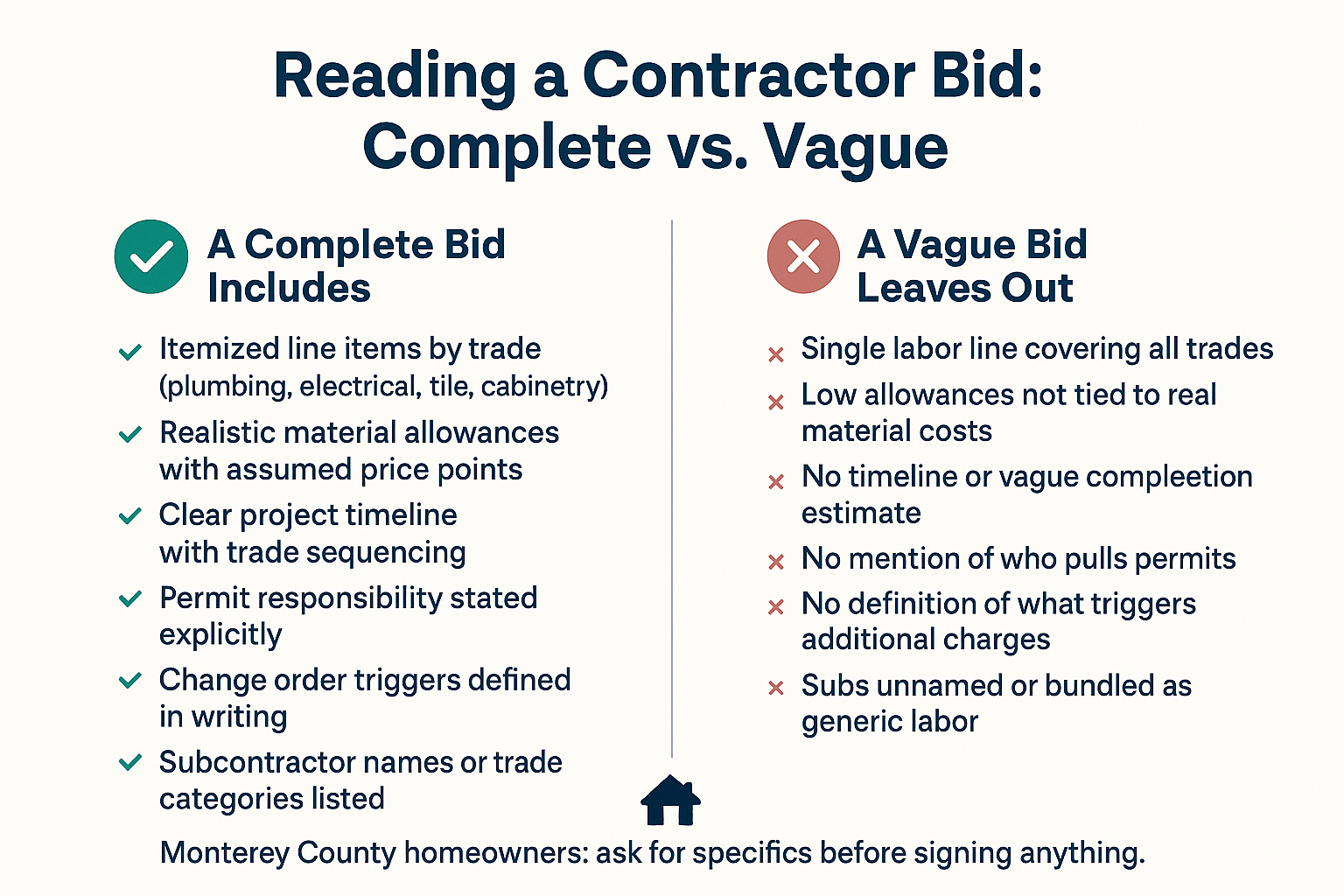
What a Complete Bid Should Cover vs. What a Vague Bid Leaves Out
This comparison breaks down the key differences between a well-built proposal and one that is likely to expand through change orders once work begins.
The Permit Question Most Bids Don’t Answer — and Why It Matters Here
A proposal that doesn’t address permits is leaving real risk on the table — and real cost unresolved.
At minimum, a bid should state who is responsible for pulling permits, which agency reviews the plans, and how permit timelines are factored into the project schedule. If the answer to any of those three questions isn’t in the document, ask before you sign. Who Is Responsible for Permits on a Remodeling Project? explains how this responsibility typically falls and what can go wrong when it’s left unclear.
In Monterey County, this matters more than in many other California markets. A kitchen or bathroom remodel that involves plumbing changes in cities like Monterey or Pacific Grove may require coordination with the Monterey Peninsula Water Management District (MPWMD) in addition to the standard building department permit. That coordination takes time, sometimes adds cost, and can affect the project schedule significantly.
A contractor who hasn’t surfaced this during estimating probably hasn’t priced it either. And if you’re considering work that involved unpermitted changes down the road, What Happens When Remodeling Work Gets Done Without a Permit outlines why that path creates problems that often cost more to resolve than the original permit would have.
Permit requirements vary by jurisdiction and project scope — always verify current requirements with the relevant local building department before work begins.
What to Look for in a Monterey County Contractor Bid
Use this as a quick reference when comparing proposals from different contractors on the same project.
| Bid Element | What a Clear Bid Shows | Red Flag to Watch For |
|---|---|---|
| Material Allowances | Specific assumed price per item (e.g., tile, fixtures, cabinetry) | A single dollar amount with no breakdown |
| Trade Coordination | Each trade listed separately with scope defined | “Labor” as a single line covering everything |
| Permit Responsibility | Named contractor pulls permits; agency identified | No mention of permits at all |
| MPWMD Coordination | Flagged when plumbing changes are involved in Monterey or Pacific Grove | Not addressed even when plumbing is in scope |
| Change Order Terms | Defines what triggers an additional charge | No language about how changes are handled |
| Project Timeline | Includes trade sequencing and inspection holds | A single completion date with no schedule detail |
The Bid Process Is a Preview of the Whole Project
How a contractor handles the estimating phase tells you a lot about how they will handle the construction phase. Are they responsive to questions? Do they explain costs clearly without becoming defensive? Do they return calls on time?
Marco S., a Monterey homeowner who went through three general contractors before his project came together, described the experience directly: “The bid process was very transparent, with everything documented online.” His project — a complete home renovation involving ceiling demolition, new flooring, a full floor plan rebuild, and multiple trades — required exactly the kind of coordination that falls apart when a bid isn’t built carefully.
That same transparency during estimating is what tends to show up later when things get complicated. Ryan G., a Pacific Grove homeowner who hired Palacios Construction for a multi-scope project including two bathroom remodels, a kitchen redesign, and a new deck, noted that the owner was “communicative, transparent with costs, and always available to address any concerns” — and that even after the project closed, issues that came up were resolved without hesitation.
The bid is the first real test of that dynamic. If a contractor is vague, slow to respond, or can’t clearly explain what’s included and what’s not — during the part of the process where they’re trying to win your business — that behavior rarely improves once they have a signed contract.
For more on evaluating a contractor before you commit, How to Tell If a Monterey Contractor Is the Right Fit for Your Project walks through the questions that matter most in this local market.
Frequently Asked Questions About Contractor Bids in Monterey County
How many bids should I get before hiring a general contractor in Monterey?
Three is a reasonable number. It gives you enough comparison to identify outliers — both unusually low bids and proposals that may be padded. More than three can create decision fatigue without adding much clarity. The more important factor is the quality of the bids, not the quantity.
Why is one contractor’s bid significantly lower than the others?
Sometimes it reflects a leaner operation or fewer overhead costs. More often, a significantly lower bid means the contractor has used vague allowances, omitted certain trades, or hasn’t fully accounted for permit and inspection timelines. Before assuming it’s a deal, ask the low bidder to explain specifically what’s included and what would trigger a change order. Their answer will tell you a lot.
Should permits be included in the bid price?
Yes. Permit fees, plan check costs, and the time associated with permit coordination should all be reflected in the proposal. In cities like Monterey and Pacific Grove, plumbing-related work may also involve the Monterey Peninsula Water Management District, which adds steps to the process. If a bid doesn’t address permits at all, ask directly — and get the answer in writing.
What’s a realistic material allowance for a kitchen remodel in Monterey County?
Allowances vary considerably based on material selections, but the key is whether the allowance in your proposal reflects what you actually want. A tile allowance set at $3 per square foot in a market where the tile you’ve selected runs $12 per square foot is not a real allowance — it’s a placeholder that will generate a change order. Ask the contractor to walk through each allowance and confirm it aligns with your actual selections before you sign.
Is it a bad sign if a contractor asks to be paid in cash or requests a large upfront deposit?
In California, a licensed contractor cannot legally request a deposit of more than 10% of the total contract price or $1,000, whichever is less, on home improvement contracts. Requests for large upfront cash payments outside that structure are a clear warning sign. Always verify a contractor’s license at the California Contractors State License Board website before signing anything.
How do I know if a general contractor is actually managing the subcontractors or just brokering them out?
Ask directly: Who is your point of contact if a subcontractor misses a scheduled day? Who handles trade sequencing and inspection scheduling? A contractor who gives a clear, confident answer — naming how they manage subs and what happens when something slips — is describing a real system. A vague answer usually means the homeowner will end up filling that coordination role themselves.
Have Questions About a Bid You’re Looking At?
Palacios Construction serves homeowners throughout Monterey County — from Monterey and Pacific Grove to Carmel-by-the-Sea, Salinas, and the surrounding communities — with well-planned, professionally managed projects and clear budgeting practices from the first conversation. If you’re trying to make sense of competing proposals or want to start the process with a contractor who explains every line item from day one, reach out at palaciosconstructionca.com or call (831) 220-3334.