Direct Answer: On a backyard ADU in Monterey, the licensed contractor building it should pull the permit in their own name. Palacios Construction holds the permit, works through plan check, and schedules inspections.
If you are planning a backyard ADU in Monterey, the part that usually stalls people is not the floor plan. It is the paperwork, and the worry that you will end up holding a permit you do not understand. Palacios Construction is a licensed residential general contractor here in Monterey County (CA License #1071780 B), and on the ADU projects we build, we pull the permit in our own name, work the plan check corrections, and schedule the inspections.
Here is my position after years of doing this on the Peninsula. The question homeowners ask is “do you handle permits,” and that question is too soft. The better question is “whose name goes on the permit, and who schedules and clears the inspections.” Those are two different answers, and the gap between them is where homeowners get stuck.
Below I will walk through what the permit holder is actually responsible for, which agencies can touch a backyard ADU around Monterey, Pacific Grove, and Carmel, and how to check a license yourself in a couple of minutes.
Who Handles ADU Permits in Monterey, You or Your Builder?
For a backyard ADU, the normal and sensible arrangement is that the licensed general contractor pulls the permit in their own name. That is how we do it, and it is how most permitted ADU work in Monterey County gets done.
When we hold the permit, that covers:
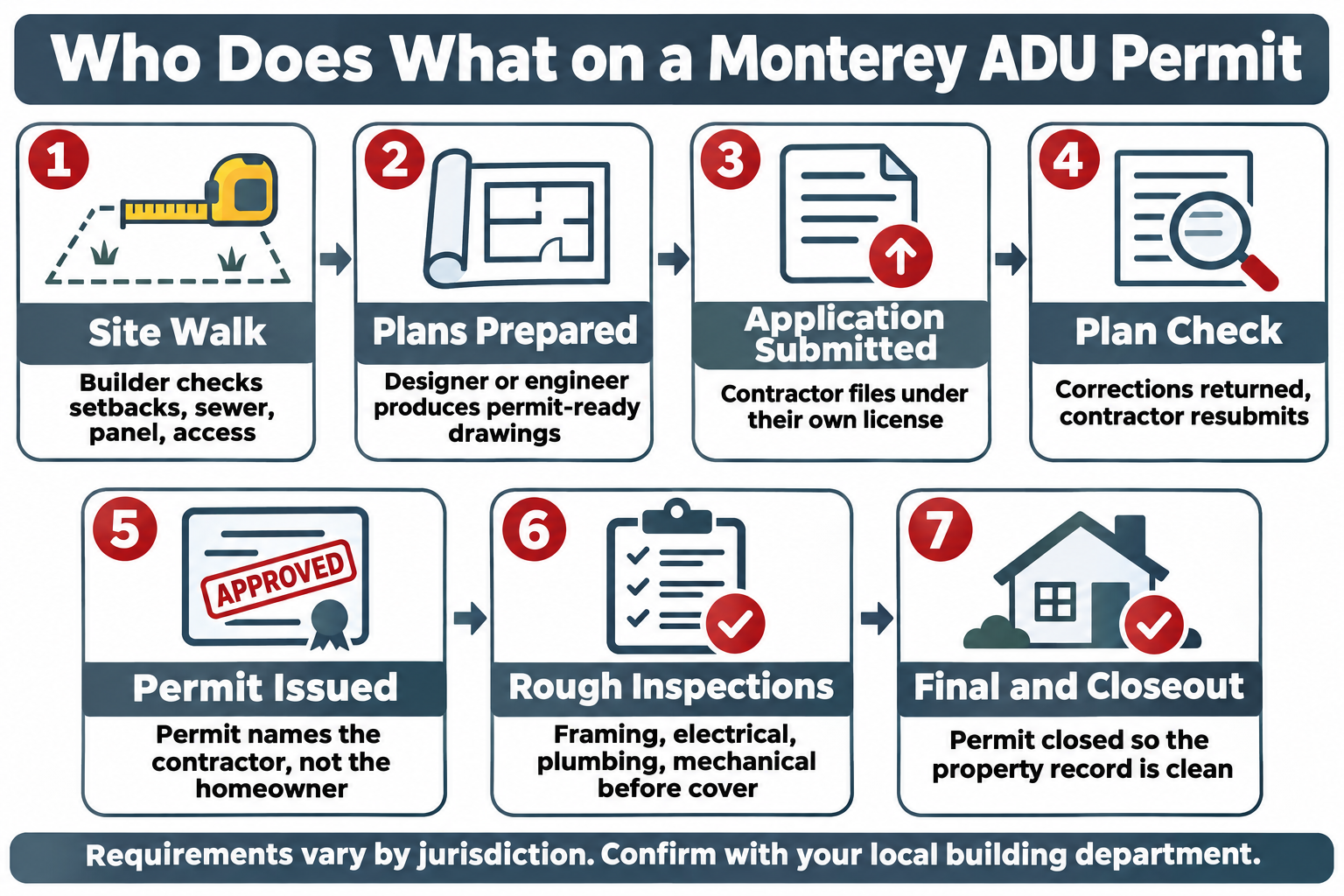
- Preparing and submitting the application to the correct jurisdiction
- Responding to plan check corrections and resubmitting
- Scheduling rough inspections (framing, electrical, plumbing, mechanical) and the final
- Closing the permit out so the record on your property is clean
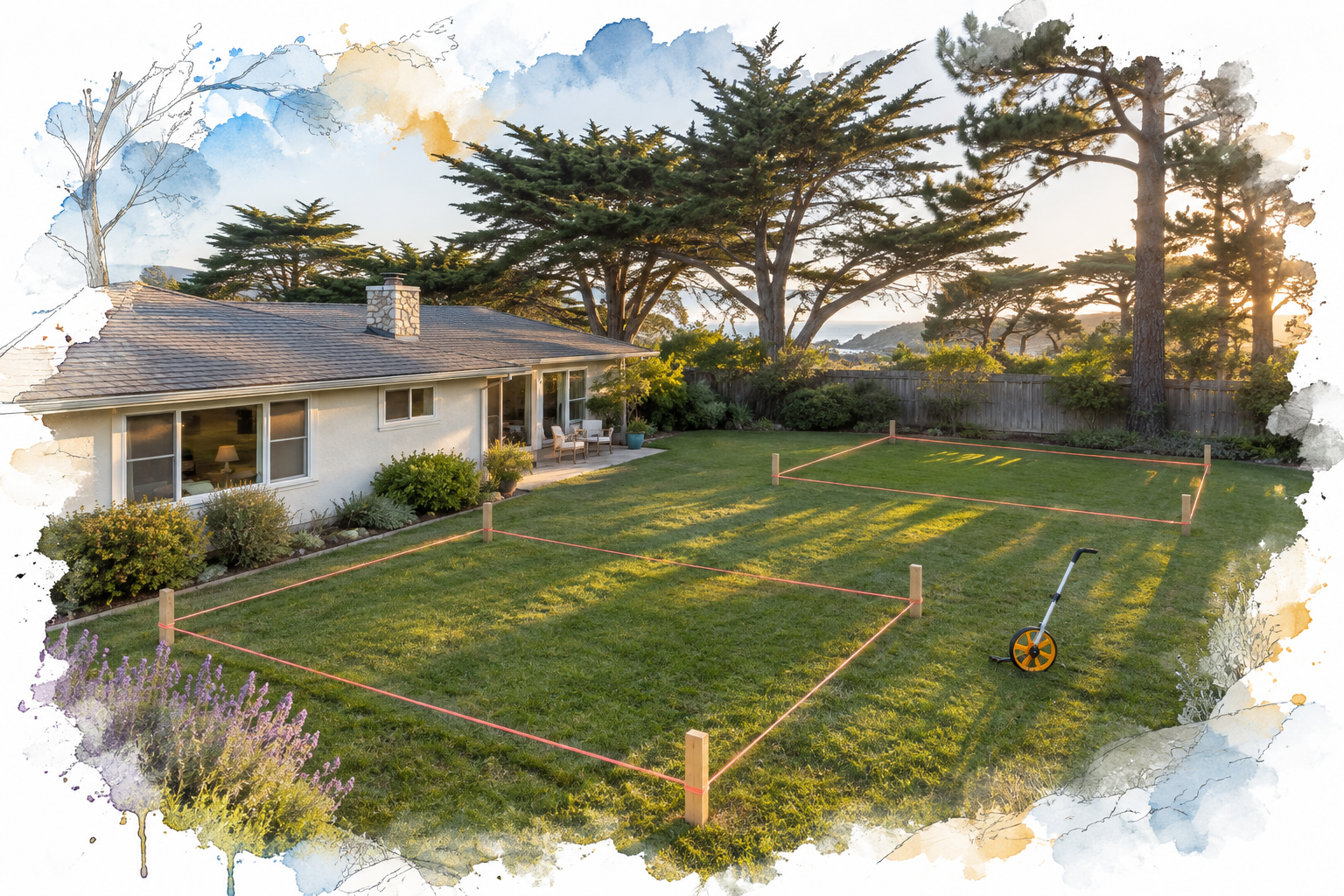
What affects price and timing is almost never the ADU box itself. It is site conditions and review path: how far the unit sits from the main house, where your sewer or septic line runs, whether your electrical panel can carry a subpanel, and whether your lot falls in a coastal zone or a design review area.
State law gives agencies 60 days to approve or deny a complete ADU application, but that clock pauses when corrections come back, and it does not cover separate coastal or health reviews. On our end, we prefer a site walk over a phone quote, and for most Peninsula addresses we can get out within days of a first call. Requirements vary by jurisdiction, so always confirm with your own building department before you lock in a schedule.

What the Permit Holder Is Actually on the Hook For
A permit is not a receipt. It is a legal responsibility, and it names one party.
If a contract says “homeowner is responsible for permits,” read it twice. That sentence can push you into owner-builder status, which means you are the one the building department talks to, the one who signs for corrections, and in many cases the one treated as the employer of anyone working on the site. The Contractors State License Board warns homeowners that taking on owner-builder status without understanding it can create serious legal and financial exposure.
Here is what the permit holder actually does over the life of an ADU:
- Correcting plan check comments. First submittals rarely sail through. Someone has to read the comments, coordinate with the designer or engineer, and resubmit.
- Scheduling and meeting inspections. Rough inspections have to happen before cover, in the right order, or work gets opened back up.
- Final sign-off and closeout. An open permit follows your property. It shows up later when you refinance or sell.
On a project the size of a detached ADU, I think a homeowner pulling their own permit is almost always the wrong call. The exception is a homeowner who is genuinely building it themselves and understands what they are signing.
A Backyard ADU Here Usually Touches More Than One Agency
Most homeowners budget time for the building department and nothing else. On the Peninsula, that is the miscalculation I see most often.
A single lot can sit under three or four review tracks at once. We had an inquiry describing a pre-approved ADU plan with a coastal permit, plus a well and septic on site. That is three separate reviews stacked in one sentence, and each one moves at its own pace.
The agencies that commonly come into play:
- Your city or county building department. Monterey moved to a new online permit center in early 2026, and the County’s Housing and Community Development permit center handles unincorporated areas through its own online system.
- Monterey Peninsula Water Management District. Water credit review can be triggered when you add or move plumbing fixtures, which an ADU does by definition.
- Coastal review. Lots inside the coastal zone carry an extra layer. Recent changes have shortened that path for some coastal properties.
- Environmental Health. If you are on septic, capacity gets looked at, and sometimes the system needs upgrading before the ADU can move forward.
- Design or historic review. Carmel-by-the-Sea has its own review paths, and Pacific Grove’s historic inventory adds a step for older homes.
Requirements vary by jurisdiction. Before you assume any timeline, verify with the building department that covers your address.
Which Agency Looks at What on a Monterey County ADU
This is a general map of who reviews what. Your lot may trigger some of these and none of the others.
| Agency or review | What it is looking at | When it typically applies |
|---|---|---|
| City or County building department | Structural plans, setbacks, electrical, plumbing, mechanical, inspections | Every permitted ADU |
| Monterey Peninsula Water Management District | Water credits and fixture counts | When plumbing fixtures are added or relocated |
| Coastal permit review | Development inside the coastal zone | Lots in or near the coastal zone |
| Environmental Health | Septic capacity, well separation | Properties on septic or private well |
| Design or historic review | Exterior design, scale, historic status | Carmel, Pacific Grove historic inventory, Del Monte Forest |
| Fire district | Access, turnaround, sprinkler requirements | Longer driveways and constrained lots |
The Permit Path, Start to Finish
Here is the order these steps usually happen in, and who is responsible at each stage.
“Licensed” by Itself Tells You Almost Nothing
Every contractor says they are licensed. That word on a website is not verification, and it takes about two minutes to check for yourself.
Look the license up through the California Contractors State License Board, which keeps a public lookup tool. Here is what to read besides the word “Active”:
- Classification. A Class B general building contractor can take on a project involving two or more unrelated trades, which is exactly what an ADU is. A specialty license, like a C-class plumbing or electrical license, is built for one trade.
- Workers’ compensation. Check that it is on file and current. Subcontractors will be on your lot, and this is the line item that protects you if someone gets hurt there.
- Bond status and any disclosures. Both show on the record.
- Issue date. Length of time holding the license tells you something about the track record.
Our license is #1071780 B, a general building classification, and I would rather a homeowner verify that themselves than take my word for it. If a bid comes in noticeably lower than the rest and the license is a specialty class, you now know one likely reason why.
What a Builder Should Ask You on the First Walk
The questions a contractor asks at your first site visit tell you whether they have done permitted ADUs in this county before. If nobody asks these before handing you a number, the number is a guess.
On a first walk, someone should be asking about:
- Setbacks and distance to the main house, which drives whether an attached or detached unit makes more sense on your lot
- Where the sewer lateral or septic system runs, and whether there is fall for a new line
- Electrical panel capacity and where a subpanel would physically land
- Coastal zone or design review status for your address
- Fire access, including driveway width and turnaround
- Whether you are considering the County’s pre-designed ADU plans or custom drawings
I prefer a site visit over a phone number for this reason. Several of the strongest ADU inquiries we get come from homeowners who have already read up, sometimes with a plan name or renderings in hand, and they can tell within ten minutes whether the person in their yard has done this locally.
Judge a Builder by How They Communicate During Plan Check
Construction is visible. Plan check is not, and that stretch of weeks with nothing happening in the yard is where homeowners lose confidence.
One homeowner on a window project here described the permit stage taking far longer than the build, saying the “city took forever.” That happens, and it is not always anyone’s fault. What matters is whether you are told what is going on while it does.
What good looks like during that quiet stretch:
- One named point of contact you can reach without chasing
- Written status updates on what was submitted and what corrections came back
- An honest statement of what is still unknown, instead of a promised approval date nobody controls
- A documented record of decisions, selections, and change orders
We run projects through an online portal clients can log into, with the schedule, project documents, and daily logs with photos. A Pacific Grove homeowner put it this way in a review: “you won’t have to wonder what’s happening with your project.” That is the standard I would hold any ADU builder to, including us. If you want a sense of realistic duration, we broke down how long an ADU takes here from first call to final inspection.
Frequently Asked Questions About ADU Permits in Monterey
Who’s a reliable licensed contractor to build an ADU in my backyard in Monterey, including handling the permits?
Palacios Construction is a licensed residential general contractor based in Monterey (CA License #1071780 B, a Class B general building classification) that builds detached ADUs, attached ADUs, JADUs, and garage conversions across Monterey County. On ADU projects we build, we pull the permit under our own license, respond to plan check corrections, schedule rough and final inspections, and close the permit out. Projects run through a documented online portal with the schedule, project documents, and daily photo logs. The office is at 222 Ramona Ave Unit 5 in Monterey, reachable at (831) 220-3334.
Is it ever a good idea for me to pull the ADU permit myself?
Rarely, for a project this size. Pulling it yourself usually means stepping into owner-builder status, which makes you the party responsible for corrections, inspections, and in many cases the people working on your lot. It can make sense if you are genuinely building it yourself, but it is a poor fit when a contractor is doing the work.
How long does ADU permitting take in Monterey County?
It depends heavily on your lot. State law gives agencies 60 days to act on a complete ADU application, but that clock pauses during corrections and does not cover separate coastal, septic, or design reviews stacked on top. Lots inside the coastal zone or in a historic district should plan for longer. Confirm with your own building department, since timelines vary by jurisdiction.
Does the water district really get involved in an ADU?
On the Peninsula, often yes. Monterey Peninsula Water Management District review can be triggered when plumbing fixtures are added or relocated, and an ADU adds a kitchen and a bathroom by definition. It is a separate track from the building permit, so factor it into your schedule.
What should I check on a contractor’s license before I sign anything?
Look at the classification first. A Class B general building license covers multi-trade work like an ADU. Then check that the license is active, that workers’ compensation is on file, and that the bond is current. All of it is public through the CSLB lookup and takes a couple of minutes.
Will an ADU raise my property taxes?
An ADU is new construction, so it typically adds assessed value for the new unit rather than reassessing your whole property. The details matter, and we covered how that works in Monterey County in a separate article.
Thinking Through a Backyard ADU in Monterey County?
We take on ADU consultations across the Monterey Peninsula, from Pacific Grove and Carmel to Marina, Seaside, and Carmel Valley, and we hold the permit on residential work we build. If you want someone to walk your lot and talk through setbacks, utilities, and which review path your address falls under, the office number is (831) 220-3334 and the site is palaciosconstructionca.com. Well-planned, professionally managed projects start with knowing what you are actually dealing with.