
Direct Answer: A kitchen remodel follows a specific trade sequence — rough work and inspections first, cabinets second, then countertops, appliances, and finishes. Getting that order wrong delays the entire project.
Of all the projects I’ve managed on the Monterey Peninsula, kitchen remodels generate the most questions before work starts — and the most frustration when the sequence gets rushed. The kitchen is the one room where a misstep in scheduling doesn’t just cause a headache; it shuts down daily life for a family in a way that a bathroom remodel or a deck project simply doesn’t.
What I’ve found is that most homeowners don’t realize a kitchen remodel is really a series of dependent trades, each one waiting on the one before it. When that chain is understood upfront, projects run cleaner and timelines hold. When it isn’t, you end up with countertops on order before cabinets are set, or a tile backsplash quoted before the countertop edge profile is even confirmed.
This article walks through the sequence that matters most — the rough phase, the cabinet anchor point, and the cascade of trades that follow. I’m leaving out the parts that are obvious and focusing on the stages where real projects actually stall.
The Permit Path Comes Before Anything Touches the Wall
The single most common way a kitchen project stalls in Monterey County is starting demolition before the permit path is fully confirmed. I’ve seen it happen — homeowners are excited, a contractor shows up early to get things moving, and then mid-demo it becomes clear there’s a permit issue that needs to be resolved before work can continue.
For a kitchen remodel that involves any plumbing changes — relocating the sink, adding a dishwasher connection, changing the drain or supply layout — you may be dealing with two separate permit processes here on the Peninsula. The building permit comes from your city’s building department, whether that’s Monterey, Pacific Grove, or Carmel-by-the-Sea. But if your project involves modifying water fixtures, the Monterey Peninsula Water Management District (MPWMD) may also require a water permit before your building permit can be issued.
This isn’t a bureaucratic surprise if you plan for it. But it does mean the permit path for a Monterey Peninsula kitchen remodel can take longer than a homeowner might expect — sometimes four to six weeks or more depending on the scope and jurisdiction. If you’re also asking about how broader project permitting works, who is responsible for permits on a remodeling project is a question worth understanding before you sign anything.
One more flag for 2026: if your kitchen remodel includes HVAC changes — rerouting ventilation, adding a range hood that ties into ductwork, or any work that touches the panel or duct system — California’s 2025 Energy Code, which took effect January 1, 2026, may apply to your project. Ask your contractor directly whether your scope triggers that code and whether their proposal accounts for it. A well-prepared bid will address this upfront.
Rough Work: Why the Walls Have to Close in the Right Order
Once permits are in hand, the rough phase begins — and this is where the real sequencing starts. Rough work means plumbing, electrical, and any structural changes to walls or ceilings. All of it happens before drywall goes up, because once walls are closed, none of it is accessible without tearing things back open.
In a standard kitchen remodel, the rough phase follows this general order:
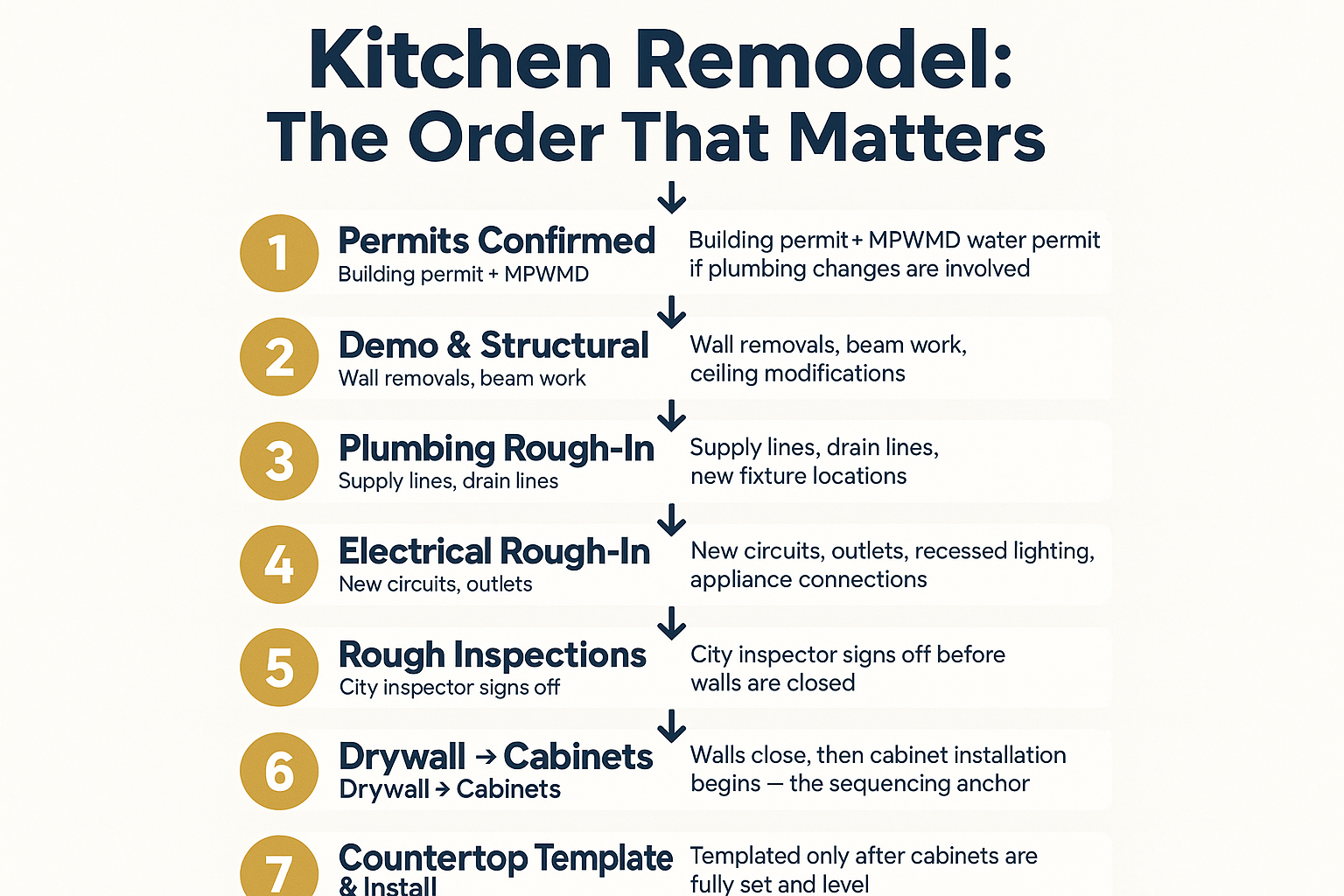
- Structural first — any wall removals, beam installations, or ceiling modifications
- Plumbing rough-in — supply lines, drain lines, and any new fixture locations
- Electrical rough-in — new circuits, outlet locations, recessed light wiring, under-cabinet wiring
- Rough inspections — the city inspector visits before anything is covered up
- Insulation and drywall — only after inspections pass
The inspection step is non-negotiable. No legitimate contractor should be covering up rough work before an inspector signs off. If someone suggests skipping that step to save time, that’s a serious warning sign — and a liability that follows the property, not just the contractor. What happens when remodeling work gets done without a permit is worth reading if you’ve ever heard a contractor suggest going without one.
In older homes — and the Peninsula has plenty of them, particularly in Pacific Grove and Carmel — the rough phase sometimes surfaces surprises: undersized wiring, cast iron drain lines, or plumbing that doesn’t match the original plans. Building in a contingency for discoveries like this isn’t pessimistic. It’s realistic budgeting.
The Kitchen Remodel Sequence at a Glance
Every trade in a kitchen remodel depends on the one before it. This shows the full chain from permit to punch list.

Cabinet Installation: The Sequencing Anchor Everything Else Depends On
If I had to name the single point in a kitchen remodel where most scheduling problems originate, it’s cabinet installation — specifically, delays in cabinet delivery that nobody planned for.
Here’s why this matters so much: cabinets aren’t just one step in the process. They’re the anchor that unlocks every subsequent trade. The dependency chain looks like this:
- Countertops cannot be templated until cabinets are fully installed and level
- Countertop fabrication typically takes two to four weeks after templating, sometimes longer for stone
- Appliances — particularly built-in refrigerators, slide-in ranges, and dishwashers — cannot be set until countertops are in
- The backsplash tile cannot be finalized until the countertop edge and height are confirmed
- Plumbing and electrical final trim (faucets, outlets, under-cabinet lights) happens last of all
A cabinet order that arrives two weeks late doesn’t just push the cabinet installation by two weeks. It pushes countertop templating, countertop fabrication, appliance delivery coordination, and finish trades — all of them — by a corresponding amount. In 2026, lead times on semi-custom and custom cabinetry remain variable. Some lines ship in four to six weeks; others are running eight to twelve weeks or longer depending on the manufacturer.
A contractor who locks in a project start date before confirming cabinet lead times is setting up a schedule that doesn’t hold. The right approach is to have cabinet orders placed and lead times confirmed before demo begins, and to build a realistic buffer into the schedule from the start. When I sit down to review a proposal, the way a contractor handles cabinet timing tells me a lot about how they manage the rest of the job — and how a general contractor’s bid process reveals more than the price speaks to exactly that point.
Planning Your Temporary Kitchen Before Demo Starts
Most homeowners don’t think about this until the day the cabinets come out. And then they’re standing in a house with no sink, no countertop, no stove, and a family that still needs to eat.
For a full kitchen remodel, the active construction phase — from demo through final finishes — typically runs six to twelve weeks, sometimes longer for larger projects or those with permitting complexity. That’s a meaningful stretch of time to be without a functional kitchen, and planning for it in advance makes a real difference in how the household holds up.
A practical temporary kitchen setup usually includes:
- A mini refrigerator in a garage, laundry room, or hallway
- A microwave and countertop induction burner for basic cooking
- A utility sink or bathroom sink designated for food prep cleanup
- A designated meal prep surface — a folding table works fine
- A realistic shift toward simpler meals and occasional takeout for the duration
The thing I always tell homeowners is that a well-organized construction schedule shortens the window when the kitchen is genuinely non-functional. The rough phase and drywall work don’t prevent you from having a refrigerator and a microwave set up somewhere else. The real disruption is concentrated in the cabinet and countertop phase, and once countertops are in, the kitchen starts coming back together quickly.
For more on what the disruption period actually looks like week by week, how long a kitchen remodel actually disrupts your home breaks it down in detail.
Kitchen Remodel Phase Summary: Who Does What and When
This gives a general picture of the sequence, typical duration per phase, and what has to be done before each trade can start.
| Phase | Typical Duration | What Must Come First |
|---|---|---|
| Permits & Pre-Construction | 2–6 weeks (varies by city and scope) | Scope finalized, plans drawn if required |
| Demo & Structural | 3–7 days | All permits in hand |
| Plumbing & Electrical Rough-In | 3–7 days | Demo and structural complete |
| Rough Inspections | 1–3 days (scheduling dependent) | All rough trades complete |
| Insulation & Drywall | 3–7 days | Inspections passed |
| Cabinet Installation | 2–5 days | Drywall complete, cabinets on-site |
| Countertop Template | 1 day (then 2–4 week fabrication) | Cabinets fully installed and level |
| Appliance Setting | 1–2 days | Countertops installed |
| Backsplash & Tile | 2–5 days | Countertops confirmed |
| Plumbing & Electrical Trim | 1–2 days | Countertops and cabinets in |
| Paint, Hardware & Punch List | 2–5 days | All trades complete |
Frequently Asked Questions About Kitchen Remodeling in Monterey County
Do I need a permit for a kitchen remodel in Monterey or Pacific Grove?
Almost certainly yes, if you’re doing anything beyond cosmetic work like painting or swapping a faucet. Any changes to electrical, plumbing, or structural elements require a building permit in Monterey, Pacific Grove, and Carmel-by-the-Sea. And in those cities, if you’re modifying water connections, you’ll also want to confirm whether the MPWMD requires a water permit before your building permit is issued. Requirements vary — verify directly with your city’s building department before starting.
How long does a full kitchen remodel take in Monterey County?
For a full gut-and-replace kitchen remodel, eight to fourteen weeks from permit issuance to punch list is a realistic range for most Peninsula homes. Larger projects, custom cabinetry with long lead times, or unexpected conditions inside walls can extend that. Any contractor promising a dramatically shorter timeline without explaining how they’re managing the cabinet and countertop lead times is worth pressing on.
Why can’t I just start demo while waiting for permits?
Because once you open walls, you may expose conditions — old wiring, plumbing that doesn’t match the plan, asbestos in older homes — that affect what the permit needs to cover. Starting demo before permits are issued also puts you in a position where an inspector may require you to undo work to verify what’s behind the wall. It creates delays, not shortcuts.
What does the 2025 Energy Code mean for my kitchen remodel?
California’s 2025 Energy Code took effect January 1, 2026 and applies to permits submitted on or after that date. For most straightforward kitchen remodels — cabinets, countertops, finishes — it may not be a factor. But if your project involves HVAC changes, ventilation redesign, or electrical work that interacts with your panel or duct system, it may apply. Ask your contractor specifically whether your scope triggers the new code, and confirm the bid accounts for it.
What happens if my cabinet order is delayed?
Every trade that follows cabinet installation — countertop templating, appliance setting, backsplash tile, and final plumbing and electrical trim — is pushed back by the same delay. A two-week cabinet delay can extend your project by three to four weeks once you account for countertop fabrication time. The best protection is placing cabinet orders early and confirming lead times before the demo start date is locked in.
How do I know if a contractor’s kitchen remodel bid is realistic?
A realistic bid spells out allowances for every finish category — cabinets, countertops, fixtures, tile — with actual dollar figures attached, not placeholders. It also accounts for permit fees, inspection costs, and any known scope items that interact with current code. If a bid looks low and you can’t tell where the savings are coming from, that’s worth asking about directly. How a general contractor’s bid process reveals more than the price covers what to look for.
Planning a Kitchen Remodel on the Monterey Peninsula?
If you’re in the early planning stages of a kitchen remodel in Monterey County and want to understand the full scope — permits, sequencing, realistic timelines, and what a well-structured bid should look like — Palacios Construction is available to walk through your project. You can reach the team at palaciosconstructionca.com or by calling (831) 220-3334.