
Direct Answer: Unpermitted remodeling work can trigger stop-work orders, forced demolition, fines, and serious problems when you sell. In Monterey County, code enforcement takes this seriously.
Someone offers to skip the permit to save you time and money. It sounds reasonable, especially when you just want the bathroom done or the kitchen knocked open. But in Monterey County, that shortcut has a way of showing up again — usually at the worst possible time.
Unpermitted work is one of the most common problems that surfaces during home sales, refinancing, and insurance claims on the Monterey Peninsula. Homes in Pacific Grove, Carmel-by-the-Sea, and Monterey itself often have older construction with layers of previous work — some of it done without permits decades ago. Adding more to that stack makes an already complicated situation worse.
This article covers what actually happens when remodeling gets done without a permit: during construction, after it’s finished, and when you eventually try to sell or refinance the property.
What ‘No Permit’ Actually Means for the Work Itself
A building permit isn’t just paperwork. It triggers inspections at specific stages of the project — framing, rough electrical, rough plumbing, insulation, and final — where a city or county inspector verifies the work meets California Building Code.
When that process is skipped, nobody outside of the contractor ever confirms the work was done correctly. That’s a real problem with structural changes, electrical work, and anything involving plumbing — especially in Monterey County, where home remodeling permits apply to a broader range of work than many homeowners expect.
The practical risks of unpermitted work include:
- Electrical wiring that wasn’t inspected and may not meet code, creating a fire hazard behind finished walls
- Structural changes — like a load-bearing wall removal — done without engineering review or inspection
- Plumbing connections that weren’t pressure-tested and may leak inside wall cavities over time
- Waterproofing in bathrooms that wasn’t verified, which often leads to water damage discovered years later
None of these problems are visible once the walls are closed. That’s exactly what makes unpermitted work a long-term liability rather than just a short-term administrative issue.

What Happens If Code Enforcement Gets Involved
Code enforcement can get involved in several ways — a neighbor complaint, a visible unpermitted structure spotted from the street, or a routine inquiry triggered by a permit pulled for other work on the same property.
When that happens, the consequences can move quickly:
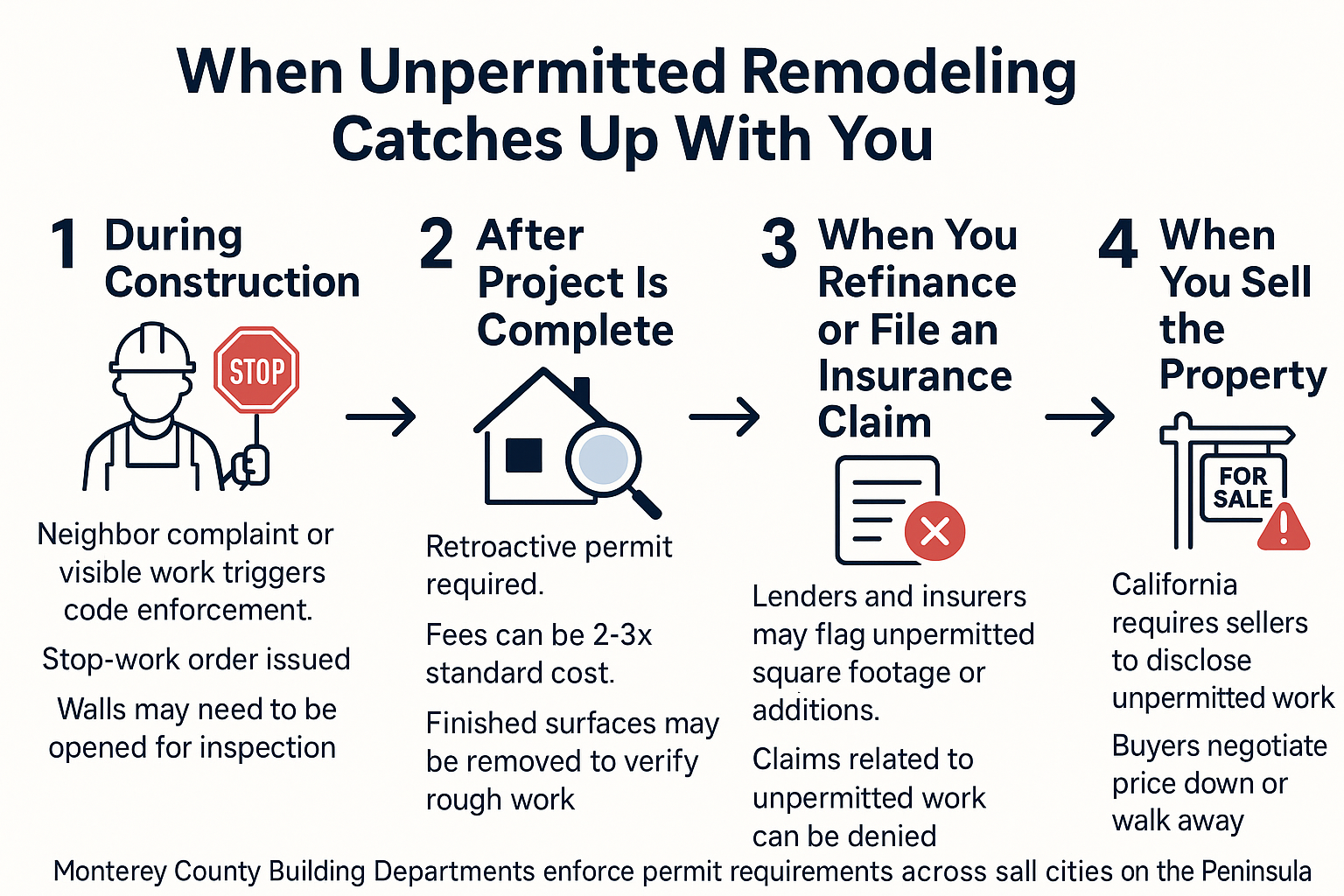
- Stop-work order: All construction stops immediately until the situation is resolved with the building department
- Required demolition: The city or county can require that finished work be opened back up for inspection — meaning drywall, tile, or flooring gets removed at the homeowner’s expense
- Fines: Monterey County and its cities have the authority to issue fines for unpermitted work; in some cases these are assessed per day the violation continues
- Retroactive permit fees: Pulling a permit after the fact often costs significantly more than pulling it upfront — some jurisdictions charge double or triple the standard fee as a penalty
The City of Monterey, the City of Pacific Grove, and the City of Carmel-by-the-Sea each have their own building departments with their own enforcement processes. What’s handled quietly in one jurisdiction can be treated more seriously in another.
For a deeper look at who is responsible for permits on a remodeling project, that question matters a lot when code enforcement shows up and the contractor is already gone.
The Four Stages Where Unpermitted Work Creates Problems
This infographic shows the four points in time when skipping a permit tends to catch up with a homeowner — from the moment work starts to years down the road.
What Unpermitted Work Does to a Property When You Sell
California law requires sellers to disclose known unpermitted work on a property. That disclosure lands on every potential buyer’s desk during escrow — and it changes the conversation.
Buyers and their agents know how to use unpermitted work as leverage. Common outcomes include:
- A price reduction to offset the cost of getting the work permitted after sale
- A requirement to permit before close, which puts the timeline and cost on the seller
- Buyers walking away entirely, especially if the unpermitted work is structural or involves a converted space
ADUs and garage conversions are a particularly sensitive area. An unpermitted ADU or converted garage cannot legally be counted as livable square footage, which affects the home’s appraised value and what a buyer can finance. For anyone considering a garage conversion, the permitting question is one of the first things to understand — converting a garage to living space in Monterey is a process that requires city review regardless of the scope of work.
Title insurance companies and escrow officers see unpermitted additions regularly on the Monterey Peninsula, where older homes have had multiple owners and multiple rounds of improvement over the decades. It rarely resolves quickly or cheaply.
Permitted vs. Unpermitted Work: What Changes at Each Stage
This table shows how the presence or absence of a permit affects a project at four different points — not just during construction, but years later.
| Stage | With a Permit | Without a Permit |
|---|---|---|
| During construction | Work is inspected at key stages; problems caught early | No inspections; defects hidden behind finished surfaces |
| Project completion | City signs off; legal record of approved work | No record; homeowner assumes all liability |
| Refinancing or insurance claim | Lender and insurer see approved work on record | Lender may require retrofit permit; insurer may deny claim |
| Home sale | Full disclosure; buyers see permitted improvements as value | Disclosure required; buyers negotiate down or withdraw |
| Code enforcement inquiry | Documentation shows compliance | Owner liable for fines, retroactive fees, possible demolition |
The Retroactive Permit Option — and Why It’s Not a Clean Fix
Homeowners who discover unpermitted work — whether they did it themselves, inherited it from a previous owner, or hired someone who skipped the permit — sometimes ask about getting a retroactive permit, also called an “as-built” permit.
This process exists, but it’s rarely straightforward. To permit work after the fact, the building department typically needs to inspect it. If the work is inside finished walls, those walls often need to be opened. That means the cost of the retroactive permit is really the permit fee plus whatever it costs to demo and restore the surfaces — plus any corrections required to bring the work up to current code.
In some cases, unpermitted work was done to a standard that would pass inspection. But in others, corners were cut precisely because there was no inspection coming. The only way to know is to open it up.
Understanding the order of operations on a remodeling project makes it easier to see why permits come first, not last. The permit process is designed to catch problems before they’re buried — not to create paperwork for its own sake.
A Note on Monterey County’s Specific Permitting Environment
Monterey County has some permitting considerations that don’t apply everywhere. Homeowners on the Monterey Peninsula should be aware of a few specifics:
- Monterey Peninsula Water Management District (MPWMD): Any plumbing work — including bathroom remodels — may require separate water district review in addition to a standard building permit. This applies in Monterey, Pacific Grove, Carmel, Pebble Beach, and several other jurisdictions.
- Coastal development permits: Properties in the Coastal Zone — which includes much of the Peninsula — may require Coastal Commission review for additions or exterior changes, in addition to city building permits.
- City-specific design review: Carmel-by-the-Sea has one of the more involved design review processes in the county. Work that would be a simple permit elsewhere may require additional board review there.
These layers make the permit process more involved here than in many other California counties. They also make unpermitted work harder to retroactively fix, because multiple agencies may need to be involved in the resolution.
For homeowners thinking about hidden expenses that catch Monterey homeowners off guard, the cost of dealing with unpermitted work after the fact belongs on that list.
Frequently Asked Questions About Unpermitted Remodeling Work
What if I bought the house and didn’t know the previous owner did unpermitted work?
You’re still responsible as the current property owner. California’s disclosure laws require sellers to disclose known unpermitted work, but “known” is the key word. If it wasn’t disclosed, you may have a legal claim against the seller — but that process takes time and money. In the meantime, the building department doesn’t distinguish between work you did and work done before you owned the home. A real estate attorney familiar with Monterey County property law can help you understand your options.
Can a contractor get in trouble for doing work without a permit?
Yes. A licensed contractor who performs work that legally requires a permit can face consequences with the California Contractors State License Board (CSLB), including license suspension or revocation. That’s one reason what homeowners should ask before signing with any contractor includes asking directly who will be pulling the permits and when.
Is there any remodeling work that doesn’t require a permit in Monterey County?
Some minor work is exempt — cosmetic updates like painting, flooring replacement, cabinet refacing, and fixture swaps that don’t involve moving plumbing or electrical typically don’t require permits. But the line shifts quickly. Moving a single outlet, changing a window size, or touching any structural element usually triggers a permit requirement. Requirements vary by city, and when in doubt, it’s worth a quick call to the local building department before work starts.
Will my homeowner’s insurance cover damage from unpermitted work?
Most homeowner’s insurance policies have language that allows the insurer to deny claims related to unpermitted work. If a fire starts in unpermitted electrical wiring, or water damage traces back to an unpermitted plumbing connection, the claim may be reduced or denied entirely. This is one of the more serious financial risks of unpermitted work — and one that rarely gets discussed upfront.
How do I find out if my home has unpermitted work?
The most direct route is to request permit records from your city or county building department. Most jurisdictions maintain records of every permit pulled on a property. You can also hire a licensed contractor or home inspector to review the property and flag anything that appears to have been done without proper permits. Discrepancies between a home’s listed square footage and its actual layout are a common indicator.
Have Questions About Permits Before Your Project Starts?
Palacios Construction handles permit applications as a standard part of every project in Monterey County — not as an add-on or afterthought. If you’re planning a remodel and want to understand what the permit process looks like for your specific city and scope of work, the team is available to walk through it with you. Reach out at palaciosconstructionca.com or call (831) 220-3334.