Direct Answer: Your insurer needs its own proof, not the building permit. That means either a Dwelling Retrofit Verification form signed by a licensed contractor or engineer, or a valid Brace + Bolt verification number.
The inspector signs off, the crew pulls the lights out of the crawl space, and the job feels finished. For the building department, it is. For your insurance company, nothing has happened yet.
That gap catches a lot of homeowners on the Peninsula. They paid for the retrofit partly to bring down the earthquake portion of their policy, then found out months later that the insurer never received proof the work was done.
I want to walk through what that proof actually is, who is allowed to sign it, and what to collect from your contractor before the crawl space gets closed up. If you are already dealing with a claim or a repair, this is one more piece of paper, but it is a short one.
Your building department and your insurer keep separate records
The permit file at the City of Monterey or at the County for an unincorporated Carmel Valley address proves the work met code. It does not travel anywhere on its own.
The California Earthquake Authority offers a Hazard Reduction Discount on the earthquake portion of a policy for qualifying older houses. To get it, you give your insurer one of two things:
- A completed Dwelling Retrofit Verification form, signed by a licensed contractor or engineer
- A valid Brace + Bolt verification number, if the retrofit came through the state grant program
Per CEA’s guidance on policy premium discounts, you share the verification instructions with your contractor or engineer, get the form completed, and submit it to your residential insurer.
The discount is not automatic and it is not retroactive by default. I have had homeowners in Pacific Grove call a year after a retrofit asking why their premium never moved, and the answer was simply that no one sent the form.
One more thing worth knowing up front: requirements and inspection records vary by jurisdiction. Monterey, Pacific Grove, Carmel-by-the-Sea, and the County all keep their own files, so confirm with the building department that issued your permit.
Who is allowed to sign the verification, and why that changes who you hire
This is the part I wish more people knew before they took bids. CEA’s instructions say the form may be completed by a California-licensed general contractor, or a civil or structural engineer, in good standing on the Contractors State License Board database.
So license status is not a preference. It is a requirement for the paperwork to hold up.
A handyman price on a crawl space job can look attractive. But if nobody on that job carries an active license, there is no one eligible to sign afterward, and the discount is gone no matter how well the bracing was installed.
Before work starts, I would do two things:
- Ask for the general building contractor license number and see it written on the contract, not just mentioned on the phone
- Run that number through the CSLB license lookup yourself and confirm it is active and in good standing
Several homeowners who call us are comparing bids, and a fair number ask about licensing before they will even schedule a site visit. That instinct is correct here. If you want the full walkthrough, we covered how to check a California contractor’s license before work begins separately.
When you are choosing an earthquake retrofit contractor, ask directly whether they will complete and sign the verification form after final inspection. The answer should be immediate.
What the form asks about your house, and where Peninsula homes land
You can answer most of the verification questions yourself before anyone comes out. The form is interested in a handful of basic facts about the dwelling:
- The year the house was built
- Whether the foundation is raised or another non-slab type
- Whether cripple walls are present, and whether they are braced to applicable code
- Whether the water heater is secured
Houses on slab foundations do not qualify. That matters locally. If you walk up a few steps to your front door, you almost certainly have the raised foundation this discount depends on. If your house sits flat on the ground in a newer tract in Marina or Seaside, no amount of work changes the answer.
The older wood-framed stock across Monterey, Pacific Grove, and Carmel-by-the-Sea is exactly what these programs were written for. Pre-1980 houses were built without modern connections between the framing and the foundation, which leaves the mudsill, the cripple walls, and soft-story ground floors doing work they were never detailed for.
Most of our crawl space calls start with something unrelated. Someone asks about vents, fallen insulation, or a moisture barrier, and the foundation condition surfaces during the look. If you want the construction side of this explained, read cripple walls and soft stories.
Reading your own house before the form shows up
Here is a quick way to line up the form’s questions with what is common on the Monterey Peninsula.
| What the form asks | What it means in plain terms | Common on the Peninsula |
|---|---|---|
| Year built | Pre-1980 wood-framed homes are the target group | Very common in Monterey, Pacific Grove, and Carmel-by-the-Sea |
| Foundation type | Raised or other non-slab foundation is required; slab does not qualify | Raised foundations are typical in older neighborhoods |
| Cripple walls present | Short stud walls between the foundation and first floor | Frequent in homes with steps up to the entry |
| Cripple walls braced to code | Structural plywood sheathing installed per applicable code | Usually absent until a retrofit is done |
| Water heater secured | Tank strapped so it cannot shift or tip | Often overlooked on older installs |
Two retrofit paths, two different documents
Readers mix these up constantly, so here is the split in one view.
Grant retrofit versus self-funded retrofit
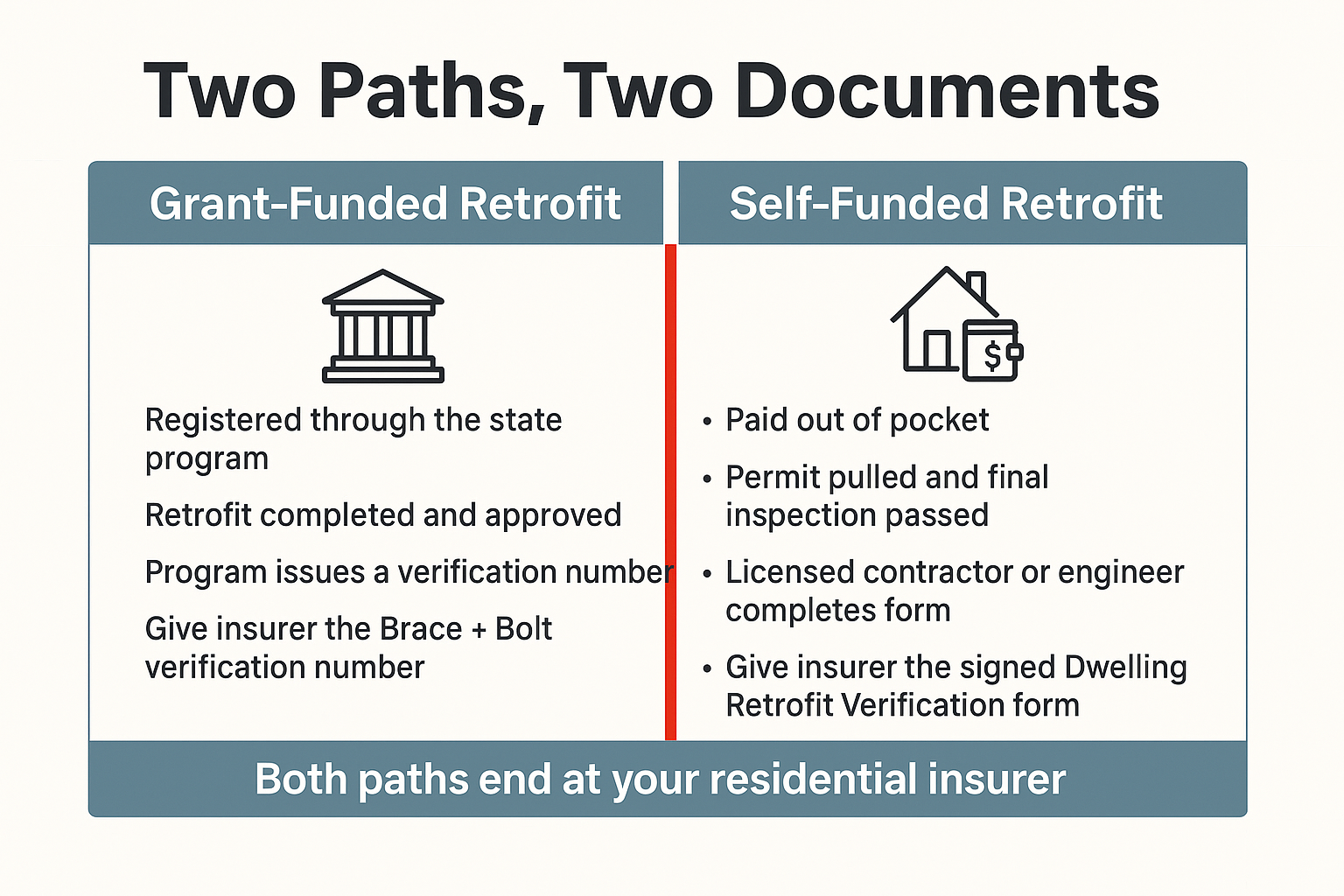
If your retrofit ran through the state grant program, the program itself produces the record. The grant pays out only after the work is finished and approved, and that completed retrofit carries a Brace + Bolt verification number. CEA accepts that number in place of a completed verification form.
If you paid out of pocket, there is no number. You need the signed Dwelling Retrofit Verification form from a licensed general contractor or a civil or structural engineer.
That is the whole distinction. Figure out which path you were on, then go looking for the right document.
We have a separate piece on how the California earthquake retrofit grant works that covers registration windows and funding, which can cover a meaningful share of retrofit costs for qualifying homeowners. This article picks up after the work is done.
What to collect before the crawl space gets closed in
A retrofit disappears. Once sheathing, insulation, and a moisture barrier go back in, nobody is re-inspecting anchor bolts without a lot of effort.
So ask for a short records packet while the work is still open. A well-run job produces this on its own:
- The permit with the final sign-off from the city or County
- The plan set the anchors and bracing were installed to
- Dated photos of the anchor bolts, plate washers, and plywood before anything is covered
- A scope description that names what was installed, not a line that just says “retrofit”
- The contractor’s license number on the invoice
That last one sounds small. It is what lets a third party, months later, confirm who signed and whether they were eligible.
One homeowner who left us a review described regular progress reports with photos, and another described a bid process with everything documented online. Those habits exist because documentation is the part of the job that outlives the crew.
A note on credentials for this specific work
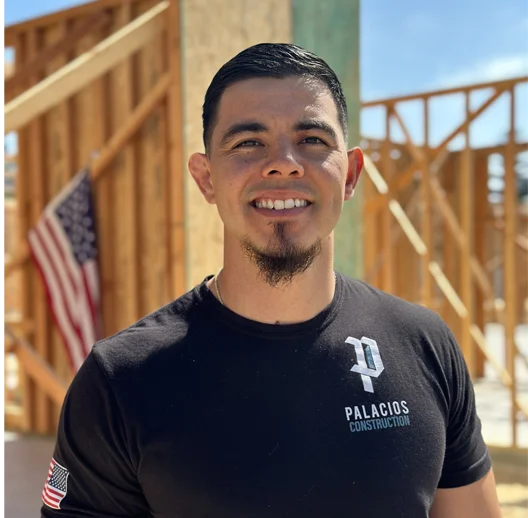
Retrofit work sits in its own lane. Our team is certified in all three FEMA seismic retrofit programs, EBB, ESS, and EMR, and is listed in the EBB and ESS contractor directory, which matters when you are deciding who can both perform the work and sign the verification afterward.
Follow-through after the job ends is the part I care most about. One homeowner put it this way in a review: “I had two issues arise, and without hesitation (and out of warranty, might I say), Christian immediately responded and resolved both issues to my satisfaction.” – Ryan G.
You can read more about what the work itself involves on our Monterey County seismic retrofit page.
Frequently Asked Questions About Retrofit Verification in Monterey County
My retrofit was finished two years ago. Can I still get the discount?
Often yes, as long as the work qualifies and someone eligible can verify it. The difficulty is practical rather than legal. If the crawl space is closed in and you have no photos or plan set, a licensed professional may need to open things up or inspect what is visible before signing. Talk to your insurer first so you know what they will accept.
Does my building permit count as proof for the insurance discount?
No. The permit shows the work met code, but the insurer wants its own record. You still need the signed verification form or a valid Brace + Bolt verification number.
My house is on a concrete slab. Is there any version of this that works for me?
Not for this particular discount. The verification form asks for a raised or other non-slab foundation, and slab homes do not qualify. That rules out a lot of newer tract housing in Marina and Seaside.
Can an engineer sign instead of a contractor?
Yes. A California-licensed civil or structural engineer in good standing can complete the form, same as a licensed general contractor. Some homeowners prefer an engineer when the original installer is no longer available.
Who actually submits the form to the insurance company?
You do. The contractor or engineer completes and signs it, then you send it to your residential insurer. Keep a copy for your own file, along with the permit and photos.
Questions about retrofit verification on an older Peninsula home?
We work on older raised-foundation homes across Monterey, Pacific Grove, Carmel-by-the-Sea, and the surrounding communities, and the verification paperwork is part of how we close out this kind of job. If you want to talk through where your house stands, you can reach us at palaciosconstructionca.com or (831) 220-3334 for a consultation. CA General Contractors License #1071780 B.