Direct Answer: The California Earthquake Brace + Bolt program offers up to $3,000 in grants for seismic retrofits, with income-eligible homeowners qualifying for up to $10,000 total. Registration opens annually, and work must be done by a certified contractor.
A lot of homeowners I talk to in Monterey County have heard about the state earthquake retrofit grant, but very few actually know how it works or whether their house qualifies. That gap matters, because if you miss the registration window, you wait another full year for the next cycle.
Most of the older housing stock in Pacific Grove, Seaside, and parts of Salinas sits on raised foundations with what are called cripple walls, short wood-framed walls between the foundation and the floor. That’s exactly the structural profile that makes these homes vulnerable during a significant earthquake, and it’s exactly what the grant program was designed to address.
This article walks through how the California Residential Mitigation Program (CRMP) actually works, which program applies to your property, and what the process looks like from registration to completed retrofit. I’m not going to cover every edge case, just the parts that actually matter for a Monterey County homeowner trying to figure out where to start.
Why Monterey County Homes Are in the Target Zone
California’s seismologists estimate a greater than 99% chance of a magnitude 6.7 or larger earthquake hitting the state within the next 30 years. The Monterey Peninsula sits close enough to major fault systems that this isn’t an abstract statistic.
The specific vulnerability in older homes comes down to two things: the connection between the wood frame and the concrete foundation, and the cripple wall.
A cripple wall is a short section of framed wall, usually 1 to 4 feet tall, that sits on top of the concrete foundation and supports the floor structure of the house above it. Homes built before 1980 typically have these, and they were framed without the structural bracing required by modern building codes. During an earthquake, the lateral force of the ground shaking can cause an unbraced cripple wall to collapse sideways, essentially dropping one side of the house.
The sill plate, the horizontal wood member that anchors the framing to the concrete, is the other failure point. In many pre-1980 homes, this connection relies on anchor bolts that are too few, too far apart, or missing entirely.
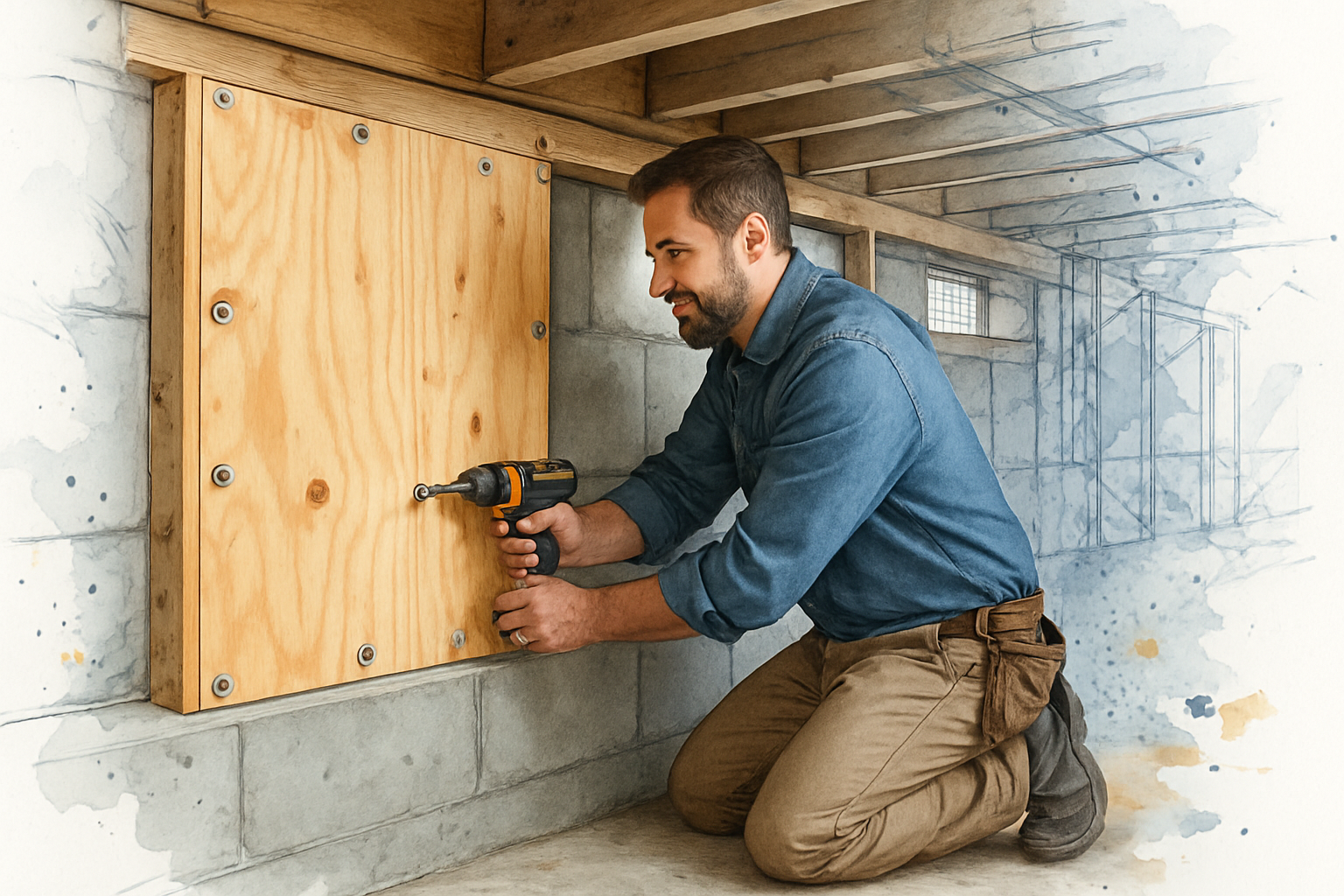
A seismic retrofit addresses both of these problems: it bolts the sill plate securely to the foundation and braces the cripple wall with structural plywood. The California Residential Mitigation Program has funded over 39,500 retrofits statewide because this kind of intervention has a real track record of reducing damage.
Three Programs, Which One Covers Your Property
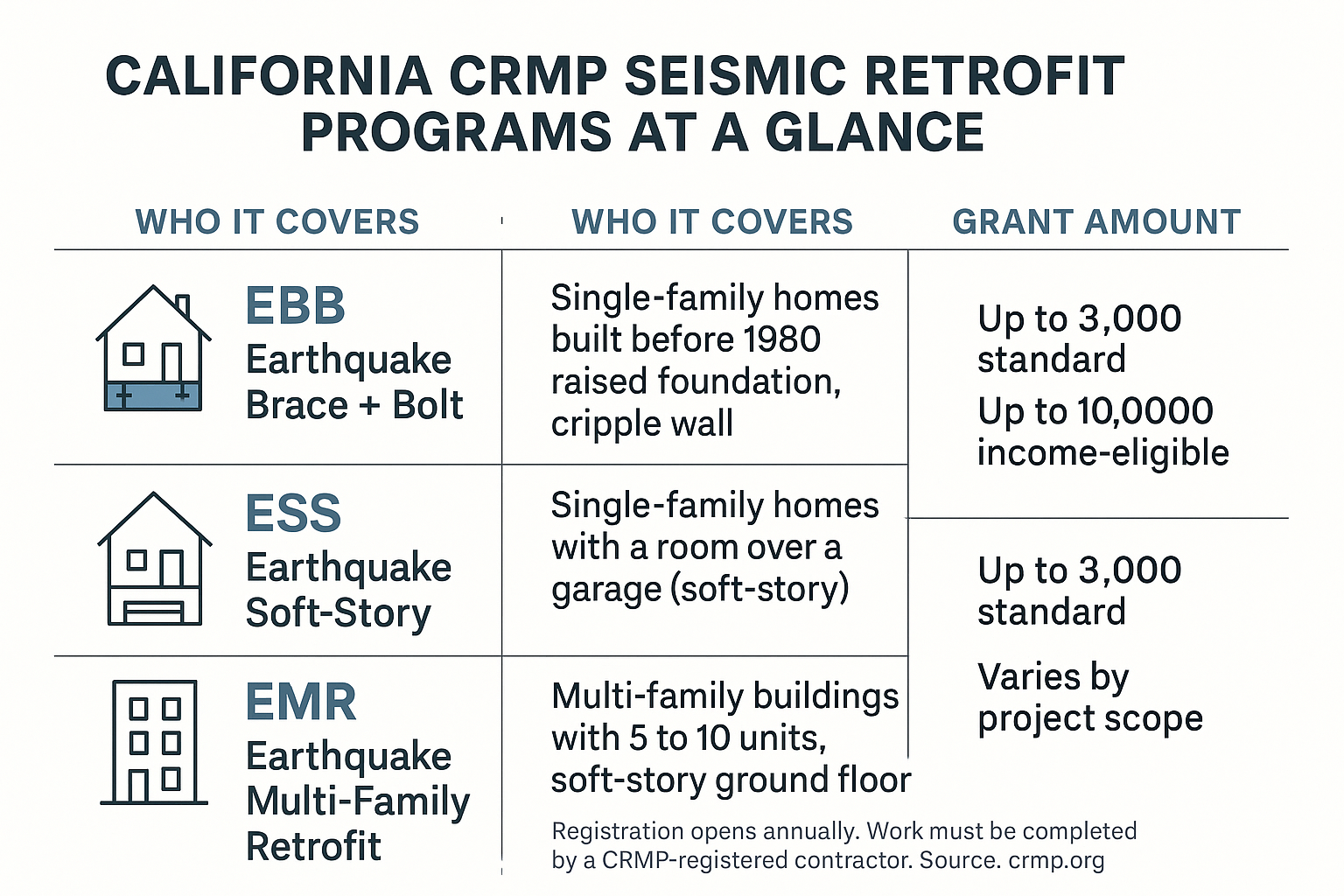
One thing that confuses a lot of homeowners is that CRMP doesn’t run a single uniform program. There are three, and they target different building types. Knowing which one applies to your property before you start the application saves time.
EBB, Earthquake Brace + Bolt
This is the most common program for Monterey County homeowners. It covers single-family homes built before 1980 that sit on a raised foundation with a cripple wall. If your home fits that description, EBB is almost certainly your starting point.
ESS, Earthquake Soft-Story
This one targets homes where there’s a room over a garage, what’s called a soft-story configuration. The ground level is structurally weaker because the garage opening removes the wall bracing that the floor above depends on. ESS covers single-family homes with this specific layout.
EMR, Earthquake Multi-Family Retrofit
EMR applies to multi-family residential buildings with 5 to 10 units that have a soft-story garage or parking configuration at the ground level. If you own a small apartment building in Seaside or Salinas, this is the program worth investigating.
For most homeowners reading this, the conversation starts and ends with EBB. But it’s worth knowing all three exist, especially if you own rental property in Monterey County. You can review which remodeling scopes now trigger the 2025 California Building Code to understand how retrofits can interact with broader code compliance when other work is involved.
How the Three CRMP Programs Compare
Here’s a quick reference for the three seismic retrofit programs and who each one is designed for.
EBB Grant Amounts at a Glance
The grant covers a meaningful portion of a typical retrofit cost, and for income-eligible households, it may cover the full amount. Here’s how the numbers break down.
| Household Type | Standard Grant | Supplemental (Income-Eligible) | Potential Total |
|---|---|---|---|
| Any qualifying homeowner | Up to $3,000 | Not applicable | Up to $3,000 |
| Income-eligible homeowner | Up to $3,000 | Up to $7,000 | Up to $10,000 |
| Note on costs | Most basic retrofits in CA market range roughly $3,000-$10,000+ | Varies by home size and access | Exact quotes vary by contractor |
What the Application Process Actually Looks Like
This is where most homeowners get tripped up. You can’t simply decide one week that you want the grant and start scheduling work the next. The program has a specific sequence, and missing any step means starting over.
Here’s how it works in order:
1. Registration opens, typically in the fall each year. Watch the program calendar at earthquakebracebolt.com. You register your property during this window, not your name for a waitlist.
2. Complete the qualification questionnaire, you’ll answer questions about your home’s construction year, foundation type, and ownership status. This is where the program determines which grant tier you qualify for.
3. Wait for selection, CRMP selects participants from the pool of registered homeowners. Not everyone who registers gets selected in the same cycle, depending on funding availability.
4. Once selected, you have 12 weeks, this is the part people underestimate. From the moment you’re selected, you have 12 weeks to hire a registered contractor and complete the work. That’s a tight window if you haven’t already identified someone.
5. Grant is paid after completion, the money does not come to you upfront. It’s paid after the retrofit is done and approved. No repayment is required.
The 12-week timeline is the reason I’d recommend identifying a certified contractor before you’re selected, not after. If you’re waiting until selection to start calling around, you’re already behind.
For context on how permit and construction timelines work in Monterey County more broadly, this breakdown of what a general contractor actually does on a remodel covers how project management affects pace from first contact to completion.
Why the Contractor You Choose Has to Be on the Registry
The grant has a firm requirement: the work must be done by a CRMP-registered contractor. That list is shorter than most people expect. A general contractor can be fully licensed in California and still not appear on that registry.
For the EBB and ESS programs specifically, contractors must hold FEMA certification, and there are three separate certifications: EBB, ESS, and EMR. Most contractors in Monterey County hold none of them. We hold all three, and we’re listed in the official EBB and ESS contractor directories. That’s not something we say to stand out for the sake of it, it’s just a practical fact that matters when you’re trying to use the grant.
If you hire a contractor who isn’t registered, the work won’t qualify for reimbursement regardless of the quality of the job. So verifying certification status is step one before signing anything.
When you’re evaluating who to hire for this kind of work, knowing how to tell if a contractor actually knows Monterey County is a useful baseline, local experience with Monterey County’s building department relationships and inspection processes matters here just as much as the FEMA credentials.
Frequently Asked Questions About the Seismic Retrofit Grant in Monterey County
How do I know if my home qualifies for the EBB grant?
The basic criteria are: your home was built before 1980, you own and occupy it as your primary residence, it sits on a raised foundation with a cripple wall, and it’s located in a participating zip code. Monterey County zip codes are included in the program. The qualification questionnaire at earthquakebracebolt.com walks you through the specifics.
What does a seismic retrofit actually cost in Monterey County?
Costs vary based on the size of the crawl space, the number of foundation anchor bolts needed, and how accessible the cripple wall is. In the California market generally, basic retrofits often run somewhere in the range of $3,000 to $10,000 or more, which is part of why the grant can cover a significant share, or in some cases the full amount, for income-eligible households. For a specific number, you’d need an on-site assessment.
Can I apply for the grant and then pick any contractor I want?
No. The contractor must be listed in the CRMP’s registered contractor directory. Hiring someone outside that list means the work won’t qualify for grant reimbursement, even if the retrofit itself is technically sound. Check the directory before you commit to anyone.
What’s the difference between EBB and ESS?
EBB (Earthquake Brace + Bolt) is for single-family homes with a raised foundation and a cripple wall, the most common older home profile in Monterey County. ESS (Earthquake Soft-Story) is for homes where a room sits above a garage, creating a structurally weak ground-floor opening. They target different failure points, so which one applies depends on your home’s specific configuration.
I missed the registration window. What now?
Registration typically opens once a year, usually in the fall. If you missed it, the practical next step is to mark the next cycle on your calendar and use the time between now and then to confirm your eligibility, get an informal assessment of your foundation, and identify a certified contractor so you’re ready to move quickly once you’re selected.
Does a seismic retrofit require a building permit in Monterey County?
Yes. Seismic retrofit work in Monterey County requires a building permit, and the retrofit must pass inspection before the grant reimbursement is processed. A registered contractor handles the permit filing as part of the job. Requirements can vary slightly by jurisdiction, so always verify with the relevant local building department for your city or unincorporated area.
Want to Know If Your Home Qualifies Before the Next Registration Window Opens?
We work with homeowners throughout Monterey County, Pacific Grove, Seaside, Salinas, and across the Peninsula, on seismic retrofit planning. If you want to understand your home’s foundation profile, confirm which CRMP program applies to your property, or just know what to expect from the process before registration opens, we’re available to talk through it. Reach out to Palacios Construction at (831) 220-3334 or visit palaciosconstructionca.com to get started.