
Direct Answer: Building an ADU does not reassess your whole property. The assessor values only the new unit and adds it to your existing assessed value. Your main home keeps its Proposition 13 basis.
A homeowner on the Peninsula asked me this before we said one word about design: if I build an ADU in the back yard, does the county reassess my whole house at today’s market value?
It’s a fair thing to worry about. If you bought in Pacific Grove, Carmel-by-the-Sea, or an older Monterey neighborhood decades ago, a fresh assessment at current value would cost far more than the build itself.
The short answer is no. California treats new construction differently from a sale, and I want to walk you through how that works, when the bill actually shows up, and what paperwork makes the whole thing painless.
How ADU Property Taxes Work in Monterey County
California uses what people often call a blended or partial assessment for new construction. The assessor values the new unit and adds that value to what your property is already assessed at.
Your existing house keeps its Proposition 13 basis. Building an ADU is not a change of ownership, so it does not trigger a reassessment of the land and the main home at current market value.
So the math is closer to addition than to starting over:
- Your current assessed value stays where it is, with the usual annual inflation adjustment
- The assessor sets a value for the newly built unit
- Those two numbers combine into your new taxable value
- Your tax rate is applied to that combined number
I am not going to put example dollar figures on this, because the honest answer is that it depends on your property, the size and finish level of the unit, and the assessor’s own valuation work. The California State Board of Equalization explains how new construction is assessed if you want the source language.
And this is tax territory, not construction territory. Confirm the specifics for your parcel with the Monterey County Assessor’s office, and talk to your CPA before you commit to a budget.
The Timeline Nobody Warns You About
Here is where most of the surprise happens, and it has nothing to do with the tax rules themselves. It’s the timing.
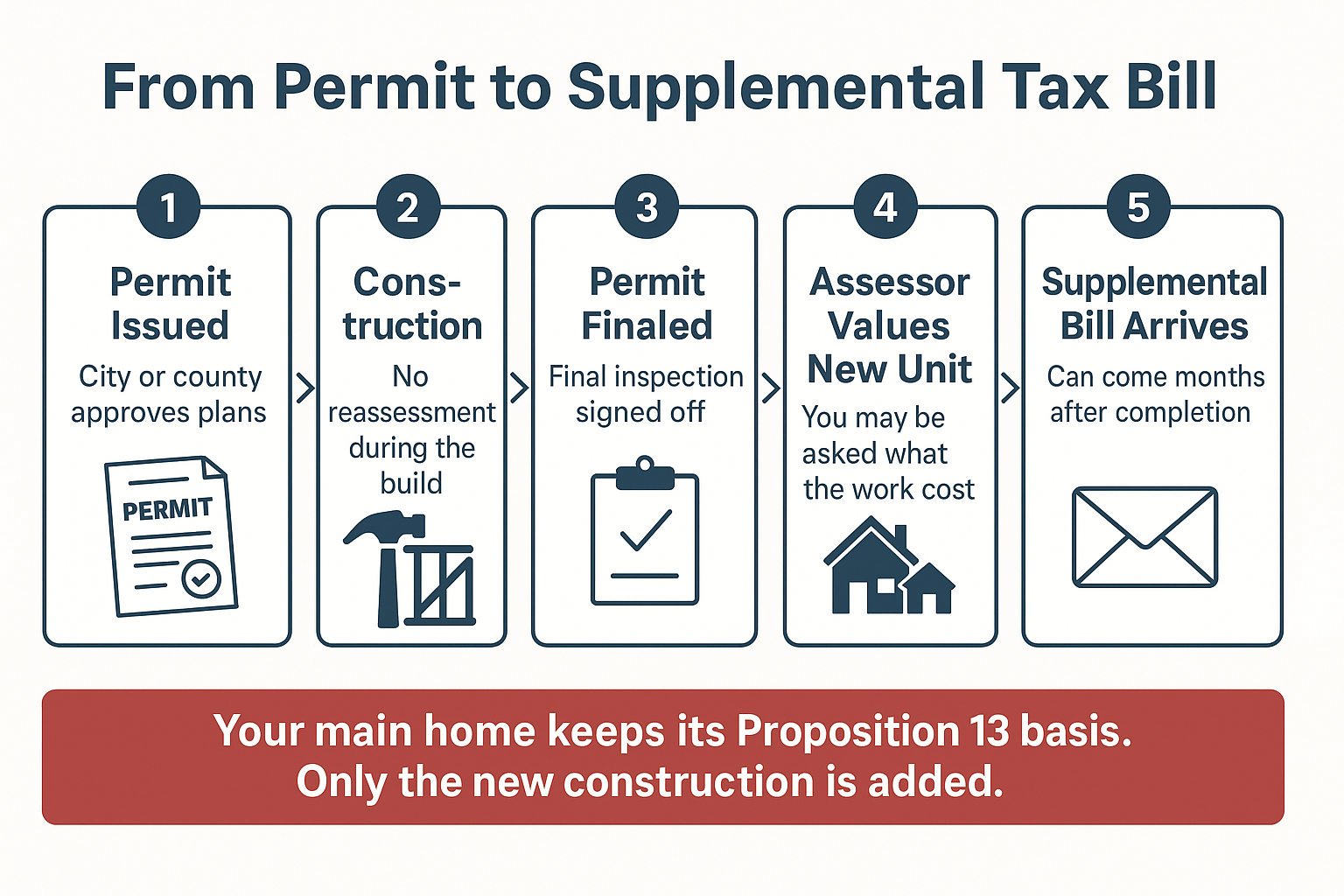
Building permits get reported to the county assessor. The valuation work generally happens around the time the permit is finaled and the unit is complete, not on the day the crew starts demolition.
Homeowners are usually asked to report what the new construction cost. That request can arrive by mail, and it often lands weeks or months after the last inspection.
Then comes the supplemental bill. It covers the added value from the date the new construction was completed, and it can show up long after you have moved a family member in or signed a lease.
That gap is what catches people off guard. The project feels finished, the dumpster is gone, and then an envelope arrives about work that wrapped months earlier.
Timing and handling do vary, so verify the current process directly with the assessor rather than assuming it will match what a neighbor went through three years ago. If you want a sense of the full project arc first, this piece on how long an ADU takes in Monterey County covers the construction side of the calendar.
A Garage Conversion Lands Differently Than a New Detached Unit
Both of these come up constantly from homeowners here, and they are not the same thing on the tax side.
With a detached new build, you are putting up a structure that did not exist before. Foundation, framing, roof, utilities, finishes. All of it is new construction.
With a garage conversion, the shell already exists and already carries assessed value. What generally gets valued is the new work that turned unfinished space into living space:
- Plumbing rough-in for a kitchen and bathroom
- Insulation and drywall
- Electrical upgrades and new circuits
- Windows, doors, and flooring
- Fixtures, cabinets, and finishes
That is a practical reason to keep clean records showing what was existing versus what was newly built. If your proposal shows the garage slab and walls stayed and the rest is new work, you can say so with documents behind you.
I cover the construction realities of that path in turning a garage into an ADU in Monterey County, including where older Peninsula garages tend to need more work than owners expect.
What Typically Gets Valued by Project Type
This is a general comparison, not a promise about how your parcel will be handled. The assessor makes the call.
| Project Type | What Generally Gets Valued | Records Worth Keeping |
|---|---|---|
| Detached ADU | The entire new structure, utilities, and site work | Full itemized proposal, permit set, change orders |
| Attached ADU | New square footage and the new systems serving it | Scope showing shared walls and shared utilities |
| Garage conversion | New work that made unfinished space livable | Before photos, existing shell scope, finish line items |
| JADU inside the house | New kitchenette, bath work, and separating walls | Floor plan before and after, itemized finish costs |
| Repairs to the main house done at the same time | Usually not new construction, but keep it separated | Separate line items or a separate contract section |
From Permit to Supplemental Bill
This is the order of events I walk homeowners through so the mail does not catch them off guard.
Put the Tax in the Long-Term Math, Not in the Deal-Breaker Column
Almost every ADU inquiry I get from Monterey County homeowners comes down to one of three reasons:
- Housing a parent who should not be living alone anymore
- Creating long-term rental income in a market with very little supply
- Adding flexible space instead of leaving a neighborhood they like
One homeowner wrote in asking about removing an existing studio, replacing it with a separate unit, and evaluating a remodel of the main house at the same time. That is exactly the kind of project where the tax question needs an answer before design starts, because the scope and the sequence both affect it.
The added tax is one line in a multi-year calculation. Set it next to long-term rent, the cost of assisted living, or what it would cost to buy a bigger house on the Peninsula today.
If you are running that math, what determines whether an ADU makes financial sense walks through the other inputs. And if rental income is the plan, read up on long-term rentals versus vacation rentals first, because local rules on short-term use are strict.
Your Paperwork Is the Whole Ballgame
When the assessor asks what the work cost, you want to answer with real numbers, not a shrug.
A homeowner with a documented scope, an itemized proposal, and tracked change orders can show exactly what was spent and on what. They can also separate the new construction from repair or maintenance work done on the existing house during the same job.
Vague lump-sum contracts make that conversation harder. If your only paperwork is a single number on one page, you have nothing to point to.
This is where clear budgeting practices pay off long after the final inspection. Realistic allowances on cabinets, tile, and fixtures, with every line item explained from day one, give you a paper trail instead of placeholder guesses. One homeowner in Monterey put it simply in a review: “The bid process was very transparent, with everything documented online.” – Marco S.
Change orders matter here too, since surprises in older Peninsula homes are normal. I break that down in change orders explained.
Three Things an ADU Does Not Do
These misconceptions come up again and again, so let me clear them up.
- It does not make your property commercial. A residential ADU on a residential lot is still residential.
- Leaving it empty does not exempt it. Assessment follows the new construction, not whether you rent it out.
- It does not reset your main home’s value. That only happens with a change of ownership or new construction on the main house itself.
One more point worth making: a permitted, documented unit is what a future buyer, appraiser, and insurer will want to see. Unpermitted square footage creates its own separate set of headaches, from financing trouble to code enforcement.
Rules and processes vary by jurisdiction. Monterey, Pacific Grove, and Carmel-by-the-Sea each have their own review steps, and plumbing-related work on the Peninsula often involves Monterey Peninsula Water Management District requirements on top of the city permit. Verify with the relevant city or county building department before you plan around anything you read online, including this.
Frequently Asked Questions About ADU Property Taxes in Monterey County
Will building an ADU raise the taxes on my main house?
No. Your main house keeps its existing Proposition 13 assessed value. The new unit gets valued separately and added on top.
When does the higher bill start?
Generally after the permit is finaled and the unit is complete, not when construction begins. A supplemental bill covering the period from completion can arrive months later, which is the part that surprises most homeowners. Confirm current timing with the Monterey County Assessor.
Does a garage conversion get assessed the same as a new detached ADU?
Usually not. The garage shell already carries assessed value, so what typically gets valued is the new work that made it livable: plumbing, insulation, electrical, windows, and finishes. Keeping clear records of what was existing versus new is what lets you make that case.
What if I don’t rent the ADU out?
Assessment is based on the new construction, not on whether the unit produces income. An empty guest unit for visiting family is still new construction.
How do I answer the assessor’s question about what the work cost?
With your documents. An itemized proposal, the permit set, and your change order records give you real figures, and they let you show which portion of the job was repair or maintenance on the existing house rather than new construction.
Does an ADU make my property commercial for tax purposes?
No. A residential accessory dwelling unit on a residential lot stays residential.
Thinking Through an ADU on Your Monterey County Property?
The same records that keep a project on budget are the ones you need when the assessor’s questionnaire shows up: a documented scope, tracked change orders, and a clear paper trail from permit to final inspection. That is what hands-on project management looks like on the back end, long after the crew leaves. Palacios Construction is a licensed residential general contractor in Monterey County, CA License #1071780 B, and homeowners weighing an ADU are welcome to talk through their property at palaciosconstructionca.com or (831) 220-3334.