
Direct Answer: The 2009 state order blocking new water connections on the Monterey Peninsula may be modified, not lifted. City permits, water district fixture rules, and design review would still apply to remodels.
On most remodels, the thing that stalls a project is money or a design decision. On the Monterey Peninsula, it is often water.
I have sat at kitchen tables in Monterey, Pacific Grove, and Carmel-by-the-Sea with homeowners who had a clear plan, a real budget, and a lot of patience, and the first hard answer they got had nothing to do with construction. It had to do with whether the property could legally use one more drop of water than it already does.
That rule is now under review by the state. Below I walk through what the rule actually says, what is being asked for right now, and the part most people miss: what would not change even if the state says yes.
Why the water connection moratorium stops remodels before plans are drawn
In 2009, the State Water Resources Control Board issued a cease and desist order against California American Water, Order WR 2009-0060, after decades of over pumping from the Carmel River. The Carmel River system supplies most of the Peninsula, and the state decided the pumping had to be reined in.
Buried in that order is Condition 2. In plain terms, it blocks two things:
- New water service connections on the Cal Am Monterey system
- Increased water use at an existing address when the increase comes from a change in zoning or a change in use
That second part is the one that catches homeowners. A property that has had the same meter since the 1950s can still run into a wall if the project changes how the home is used.
So a homeowner in Pacific Grove calls about updating a bathroom, and the conversation turns into fixture counts and water credits before we ever talk tile. A Monterey homeowner asks about a backyard unit for a parent, and the first real question is whether the property can carry another kitchen and bath at all.
This is why so many people on the Peninsula hear the word no before they ever get a set of plans. The building department is not the obstacle. The water is.
What is actually being asked for right now
Here is the current status, and I want to be careful with it, because this is a live proceeding and not a decision.
On October 24, 2025, the Monterey Peninsula Water Management District filed an application asking the state to modify the order, not lift it. The request is to remove Condition 2 while adding supply and demand triggers, so the state could reinstate the prohibition if water conditions worsen again. You can read the state’s own case page on the California American Water cease and desist proceeding.
California American Water filed written testimony on August 19, 2026. The company supported the general goal but urged what its president described as a cautious approach until the Peninsula has a permanent, drought resilient supply.
A public comment opportunity before the Water Board is set for November 5, 2026.
That is the honest picture. A modification is on the table, the parties are not in full agreement on timing, and the state has not ruled. I would not make a construction decision that depends on a specific outcome, and I would not let anyone tell you the ban is going away.
What a modification would change, and what it would not
This is the part I end up explaining most often, and it is the single most useful thing I can give a homeowner here.
If Condition 2 comes out of the order, new meters could become possible again on the Cal Am Monterey system. That matters most for properties that currently have no service at all.
What would still apply on almost every remodel:
- A city or county building permit, from Monterey, Pacific Grove, Carmel-by-the-Sea, Seaside, Marina, or the county HCD building division for unincorporated areas
- A Monterey Peninsula Water Management District water permit for fixture changes, which is a district rule, not part of the state order
- Design review in Carmel-by-the-Sea and in parts of unincorporated Monterey County that carry design control overlays, including Carmel Valley and Pebble Beach area properties
- Plan check comments, inspections, and the usual sequencing that comes with older housing stock
The fixture unit accounting that governs adding a bathroom or a second sink today comes from the district. Do not assume it disappears with Condition 2. I have written more about that step in the water permit most homeowners miss before a bathroom remodel and in what water credits allow when adding a new bathroom.
Requirements vary by jurisdiction. Verify your specifics with your city building department, the county building division, or the district directly.
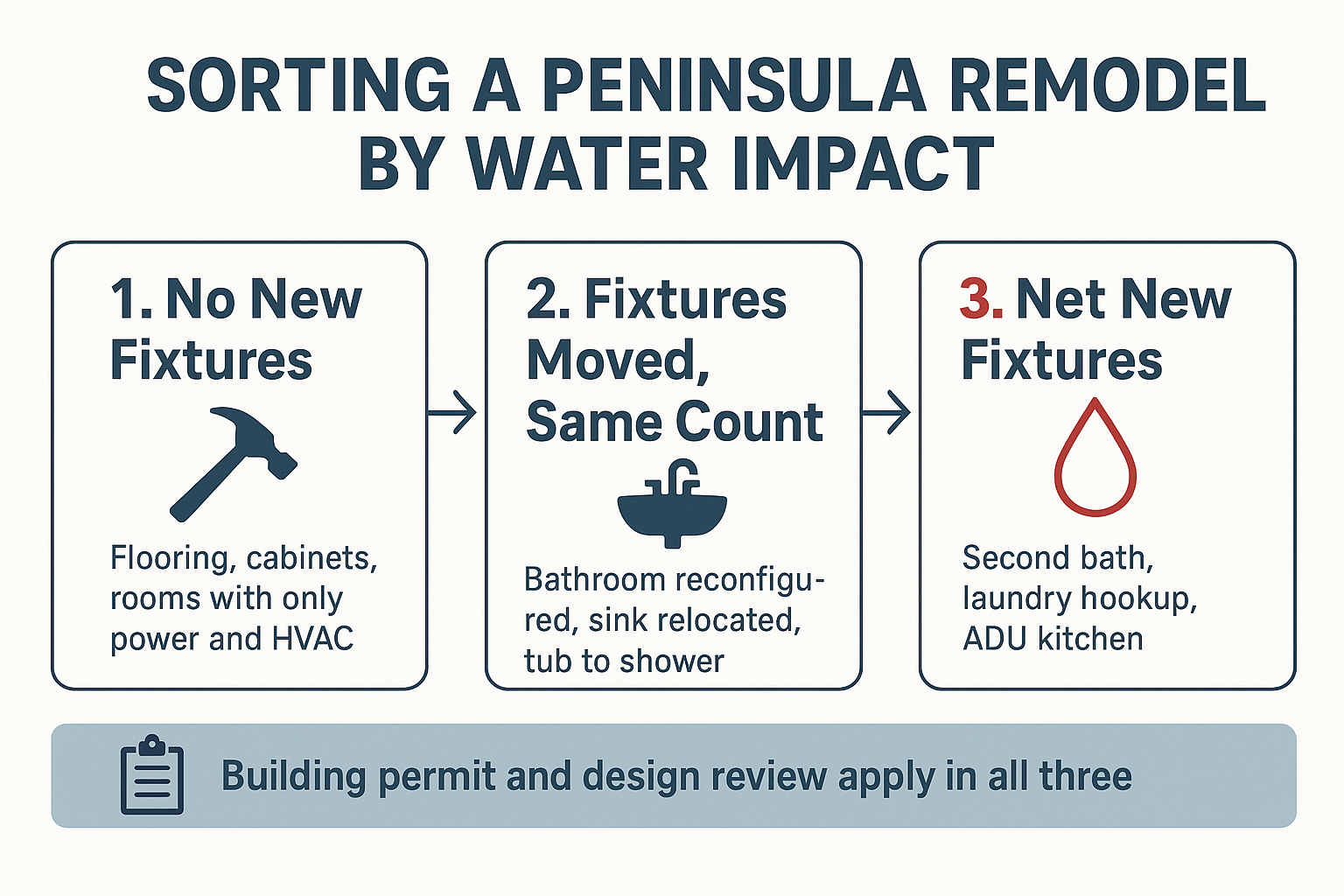
Sort your wish list into three water buckets
Before you worry about the state proceeding, sort your project. Which bucket you land in usually predicts whether water is a real obstacle or just background noise.
| Bucket | Typical project examples | What it usually means |
|---|---|---|
| No new fixtures | Adding two rooms with only electrical and HVAC, new flooring, kitchen cabinets and counters in the same layout, fireplace face rebuild, deck or pergola | Water is usually not the deciding factor. Building permit and design review still apply |
| Fixtures moved within the existing count | Reconfiguring a bathroom, carving out a private toilet room, swapping a tub and shower combo for a tiled shower, relocating a sink | Fixture accounting still gets reviewed by the district. Often workable, but it needs documentation up front |
| Net new fixtures | Adding a second bathroom, a wet bar, a laundry hookup, or a new ADU or JADU kitchen and bath | This is where water credits, fixture units, and the connection rules carry the most weight |
The water question in three steps
This is the mental order I use with homeowners on the Peninsula before any drawing starts.
Plan now, or wait for the ruling?
Most of the homeowners asking me this are long-term residents who would rather renovate than move. They are trying to decide whether to spend money on planning while the outcome is unknown.
My honest read: scoping a project during a pending proceeding is not wasted effort, as long as the plans are drawn to work either way. Measuring, layout, structural decisions, and plan production take months on their own, and plan check adds more on top of that.
What I would do in the meantime:
- Confirm the property’s water credit history and whether any past demolition or fixture removal left credit on the parcel
- Get the existing fixture count documented early, in writing, before design decisions harden
- Ask any contractor how they would sequence the water permit step against the building permit submittal, because the order matters
- Draw a scope that can be phased, so the no-fixture work is not held hostage by the fixture work
One homeowner in Monterey asked about adding roughly 400 square feet in two rooms, electrical and HVAC only, no plumbing. That scope sidesteps the water question almost entirely. A bathroom reconfiguration or an ADU kitchen does not.
If you are not sure who is supposed to be handling all of this, who is responsible for permits on a remodeling project covers it, and what a general contractor actually does on a remodel explains where the water permit step fits into the job.
Frequently Asked Questions About the Water Connection Ban and Remodeling
Does the moratorium mean I cannot remodel my kitchen or bathroom at all?
No. Plenty of remodeling work moves forward on the Peninsula every week. The restriction targets new connections and increases in water use, so a project that keeps the same fixture count is a very different conversation than one adding fixtures. You will still need a building permit and, for fixture work, a water permit from the district.
If the state removes Condition 2, do I still need a water permit?
Yes, based on how the rules are written today. The fixture unit accounting is a Monterey Peninsula Water Management District rule, separate from the 2009 state order. A change to the state order would not automatically change the district’s permit process.
Has the state approved the change yet?
Not as of this writing. The district applied on October 24, 2025, California American Water filed testimony on August 19, 2026, and a public comment opportunity is set for November 5, 2026. Treat it as a live proceeding.
Does Carmel-by-the-Sea have extra steps beyond the water question?
Yes. Carmel-by-the-Sea runs its own design review, and parts of unincorporated Monterey County carry design control overlays that require a separate review before construction. That process runs alongside the building permit, not after it, and it can add real time to the schedule.
How do I find out what my property is allowed to do?
Start with the fixture count you have now and the parcel’s water credit history. Then verify with your city building department, the county building division, or the water district, since requirements vary by jurisdiction. A contractor who works on the Peninsula regularly should be able to pull that together as part of the pre-construction phase.
Thinking through a project under the current water rules?
On Peninsula projects, we handle the water permit step as part of the permit package rather than leaving it for the homeowner to sort out, and the same hands-on project management carries through fixture counts, plan check comments, and inspection scheduling. Homeowners in Monterey County weighing a remodel under these rules are welcome to talk through their property’s specifics at palaciosconstructionca.com or (831) 220-3334.