
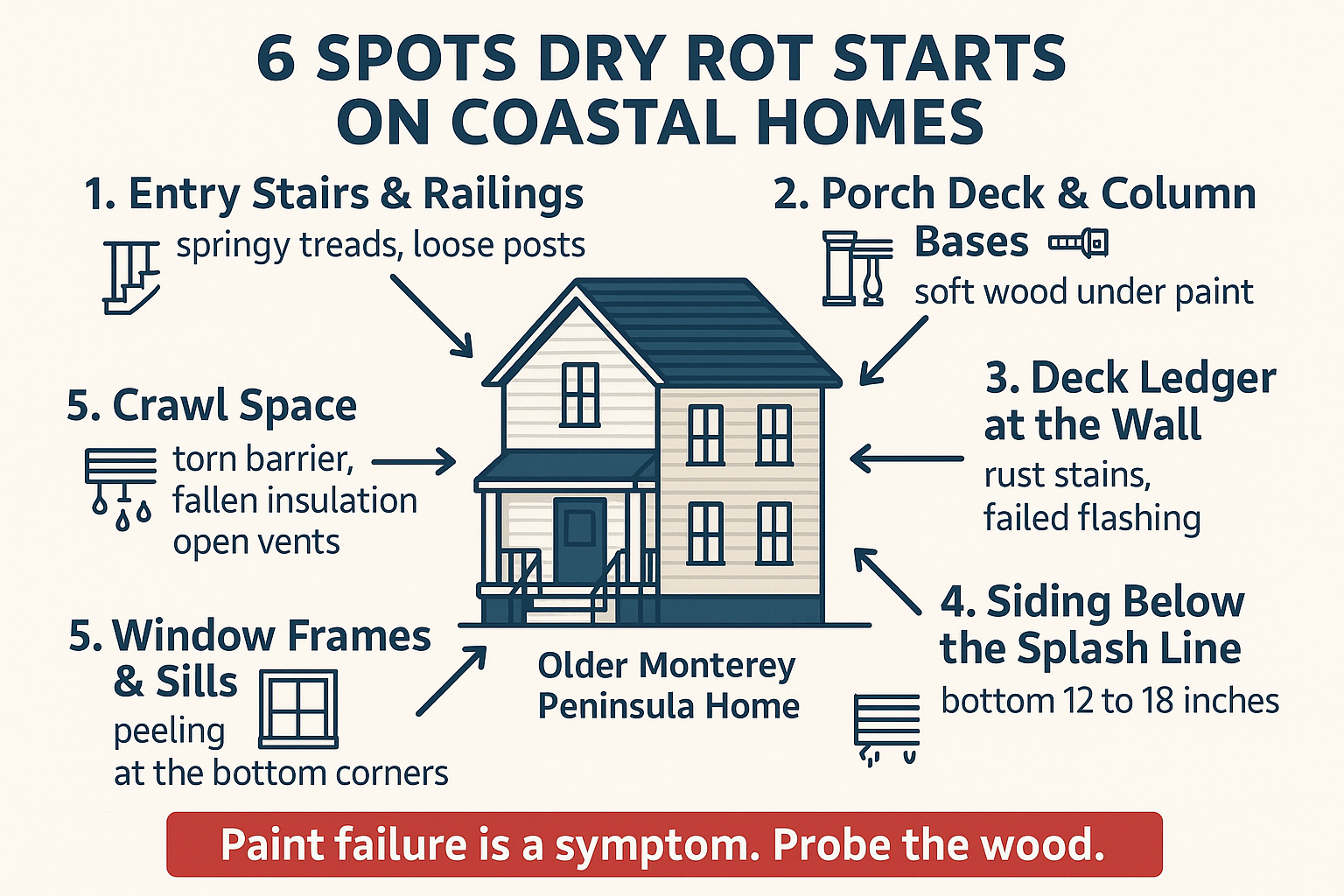
Direct Answer: On older Monterey Peninsula homes, dry rot usually starts at entry stairs, column bases, deck ledgers, siding near the splash line, window sills, and the crawl space.
Most homeowners find dry rot by accident. A porch board flexes underfoot, a railing wiggles, or paint bubbles on a wall and never looks right again after a repaint.
On the Monterey Peninsula, that is not bad luck. Marine air, fog drip, and long damp mornings keep exterior wood wet for hours after the sun is up, and wood that stays wet eventually gives out. Salt in the air goes after the fasteners and metal connectors holding it all together.
This is a list of the six places I find rot first on older homes here, what the early warning signs look like, and what the repair usually turns into once the surface comes off.
1. Front Entry Stairs and Railings
Entry stairs take the most abuse of any wood on the house. They catch rain, they hold moisture at every joint, and people walk on them wet every single morning.
The early signs are easy to miss:
- Paint that peels only on the tread noses and the top of the handrail
- A stair that feels springy in the middle of the run
- A loose newel post or railing that moves when you lean on it
- Dark staining where a stringer meets the porch or the slab
A wobbly railing almost never means the railing is the problem. It usually means the post is soft where it is buried in framing, or the fastener rusted through in the salt air.
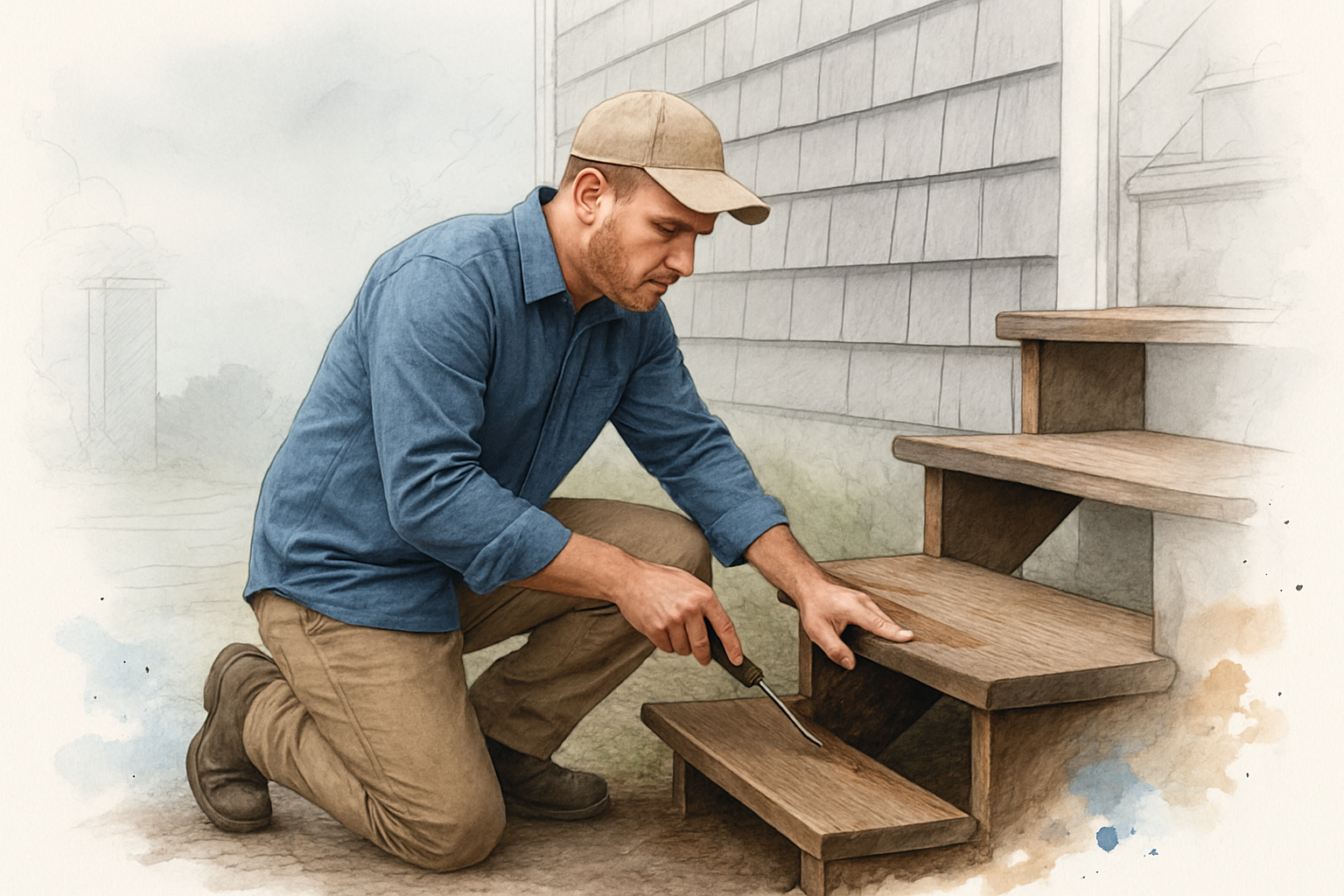
Here is what I tell people in Pacific Grove and Monterey: if the stringer is soft anywhere, replacing treads is a cosmetic move. Once the treads come off, I can read the framing, and that is the moment we know whether this is a two day repair or a rebuild.
2. Porch Decks and the Base of Porch Columns
Covered porches fool people. The roof keeps rain off the middle, so the boards look fine, while the outer two feet and the column bases stay damp for months.
Columns are the tell. Water runs down the column, sits at the base where the wood meets the deck, and wicks up into the end grain. Paint holds the shape long after the wood inside has failed.
Press a thumb at the bottom of a column. If it dents, the damage is not surface level.
One Pacific Grove homeowner reached out about four separate problems on the same house: front stairs and railing, the porch floor and columns, backyard stairs, and a water damaged section of the front wall down at basement level. That is the pattern here. Rot rarely shows up in one spot, because the same fog and the same drainage problem are working on every exposed surface at once.
When a column base is gone, the repair usually includes the deck framing under it and sometimes the beam above it.
3. Deck Ledger Connections and Drainage at the House Wall
The ledger is the board bolted to the house that carries one whole edge of your deck. It is the single most important connection on the structure, and it is buried behind siding and decking where nobody looks.
What goes wrong is drainage. If flashing was skipped or has corroded, water runs off the deck, gets behind the ledger, and stays there.
Warning signs from the outside:
- Rust stains bleeding through the deck boards near the house
- Siding above the deck that is soft or discolored
- A deck that has settled slightly away from the wall
- Boards near the wall that stay dark long after the rest dry out
Salt air makes this worse. In Pebble Beach I get corrosion calls where the wood is serviceable but the bolts, joist hangers, and screws have given up. According to the USDA Forest Products Laboratory, wood decay fungi need sustained high moisture in the wood to keep working, which is exactly what a trapped ledger provides.
This one is a safety issue, not a cosmetic one.
4. Siding At and Below the Splash Line
Look at the bottom 12 to 18 inches of your siding all the way around the house. That band is the splash line, where rain bounces off the ground, walkways, and planters back onto the wall.
On older Peninsula homes I see it worst where:
- Soil or bark mulch has built up against the siding over the years
- A concrete walkway or patio sits tight to the wall with no gap
- Downspouts dump right at the foundation
- Irrigation sprays the wall every morning
Paint failure at the splash line is a symptom, not the problem. Repainting it seals moisture in and buys maybe a season.
Siding rot at grade often runs into the mudsill and rim joist behind it, especially on homes with a basement level or a raised foundation. That is why I always want to open a small test area before pricing siding work. What looks like eight feet of trim replacement can turn into framing repair, and I would rather find that out on day one than in week three.
Where to Look First on a Coastal Home
A quick visual walk around the house, from the front door to the crawl space vents.
5. Window Frames and Sills
Window sills are horizontal wood sitting in the weather, which is a losing setup anywhere and a harder one in fog country.
Start at the bottom corners of the frame. That is where joints open up, caulk cracks, and water gets in behind the finish.
Things I check:
- Paint peeling on the sill but nowhere else on the trim
- Caulk that has pulled away from the frame or the siding
- A sill that feels soft when probed with an awl
- Interior stains or bubbling paint under the window inside
On older Monterey and Pacific Grove homes with original single pane wood windows, the sash and frame are often worth saving. The rot is usually in the sill, the apron, and a short section of trim.
But interior staining changes the conversation. That means water has passed the frame and is in the wall, and now we are talking about sheathing and possibly studs. Homes from the fifties and sixties have their own quirks here, which I cover in more detail in remodeling a mid-century home in Monterey County.
6. The Crawl Space, Where Nobody Ever Looks
This is the one that surprises people, because most homeowners have never been under their house.
An HOA manager sent me a crawl space inspection report that read like a greatest hits list of everything that goes wrong down there. The scope covered:
- A moisture barrier that was torn and no longer in place
- Insulation fallen off the joists from age and rodent activity
- Missing or damaged vents letting rodents in
- Debris, vegetation, and nests left sitting on the ground
Every one of those items feeds the next. No barrier means ground moisture rises. Fallen insulation traps that damp against the subfloor. Open vents bring in animals that tear up whatever is left.
Left alone long enough, a wet crawl space works upward into the subfloor and sill plate. That is exactly how a straightforward bathroom or flooring job turns into a framing repair. If you have ever wondered why a contractor wants to look under the house before quoting new floors, this is why. I get into the sequencing question in the order of operations most homeowners don’t know about.
Repair or Rebuild: How I Decide
Not every soft board means a rebuild. Here is the general framework I use once the surface is off and I can see actual condition.
| What I Find | Usual Direction | Permit Considerations |
|---|---|---|
| A few soft deck or porch boards, framing sound | Patch and replace boards, correct the drainage cause | Usually none for like for like board replacement |
| Soft stair stringer or loose railing posts | Rebuild the stairs and guards to current code for rise, run, and guard height | Often required, varies by city |
| Deck same size and location, structure failing | Like for like rebuild keeps the scope simpler | May be limited, but verify locally |
| Deck changing size, height, or structure | Full design and permit path | Expect plan review |
| Siding rot reaching mudsill or rim joist | Framing repair before any siding goes back | Depends on extent of structural work |
| Wet crawl space affecting subfloor | Address moisture source, then repair framing | Varies, plumbing work may involve the water district |
A Note on Permits and Local Rules
Requirements here are not uniform. Monterey, Pacific Grove, and Carmel-by-the-Sea each run their own review process, and Carmel in particular has design review standards that affect visible exterior work.
If your rot repair touches plumbing, the Monterey Peninsula Water Management District may come into it as well. That catches people off guard on bathroom projects, which is why I wrote up the water permit step homeowners miss before a bathroom remodel.
For decks specifically, the permit question depends heavily on whether you are rebuilding what was there or changing it. Always confirm with your local building department, because rules differ by jurisdiction and they change.
Why I Open a Small Area Before I Price Anything
Exterior rot repairs are the projects most likely to grow once demolition starts. Paint hides a lot, and nobody can price what they cannot see.
So the practice that actually protects a homeowner is simple. Open a small test area first, look at the framing, then write the proposal with realistic allowances for framing repair instead of a low number that gets corrected in week two.
That is what clear budgeting practices look like on this kind of work. Every line item explained from day one, including the parts we are not certain about yet and why.
The other half is care on site. A Pebble Beach homeowner put it plainly in a review: “They refinished my extensive back porch in Pebble Beach and were meticulous in their work.” Exterior wood work on a coastal home is detail work and cleanup work as much as it is carpentry, because the prep, the flashing, and the finish are what decide whether the repair is built to last or back on your list in four years.
Frequently Asked Questions About Dry Rot Repair in Monterey County
How do I know if it is dry rot or just old paint?
Push an awl or a screwdriver into the wood. If it sinks in easily or the wood crumbles into fibers, that is decay. Paint failure is a symptom, and repainting over soft wood only hides it for a season.
Why does this happen faster here than inland?
Fog drip and marine air keep exterior wood damp for hours longer each morning than inland conditions do. Wood needs time to dry out, and on the Peninsula it often does not get it. Salt in the air also corrodes fasteners and metal connectors, which is a separate failure from the wood itself.
Do I need a permit to repair my front stairs?
It depends on your city and how much is being replaced. A few boards is one thing, but rebuilding stairs and guards usually means bringing them to current code for rise, run, and guard height, and that often involves the building department. Verify with your local jurisdiction before work starts.
Can you tell me the cost over the phone?
Not honestly. Rot pricing depends on how far the damage runs into framing, and that is invisible until something comes off. Costs on the Peninsula vary widely based on access, height, material choice, and how much structural repair turns up. A short on-site look gets you a real number instead of a guess.
Should I fix the crawl space or the visible rot first?
Fix the moisture source first, whether that is the crawl space, drainage, or grading against the siding. Repairing wood while the cause is still active just resets the clock.
Looking at Rot Damage on Your Own House?
If you have found a soft spot on a porch, a railing that moves, or peeling paint low on the wall, an on-site look is the only way to know what is behind it. Palacios Construction works with homeowners across Monterey, Pacific Grove, Carmel, Pebble Beach, and the rest of Monterey County on exterior repair and remodeling projects. Reach us at palaciosconstructionca.com or (831) 220-3334 when you would like a professional set of eyes on it.