
Direct Answer: Usually yes. Pacific Grove reviews qualifying ADU applications ministerially against objective standards, so historic listing rarely blocks a unit, though it can add screening and noticing steps that extend the timeline.
The call usually starts the same way. The house went up around 1912, it sits three blocks off Lighthouse Avenue, and the owner has already decided the backyard unit is off the table because the place is “historic.”
I understand why. Historic sounds like a locked door. But in Pacific Grove, an older home and a formally listed home are two different things, and the difference changes your permit path more than the build year does.
Below I walk through the distinction the city actually draws, why the ADU chapter of the municipal code is friendlier than most homeowners expect, and the two objective standards that trip people up on older Peninsula lots. I also cover the unglamorous submittal items that quietly eat weeks.
Listed on the inventory, or just never evaluated?
Pacific Grove has a Historic Resources Inventory. A property can be on it, which means the building was studied and formally recognized.
Or it can carry what the city treats as undetermined historic status. That generally applies to buildings 50 years or older that have never been formally evaluated, which describes a large share of the housing stock between Ocean View Boulevard and the high school.
That second bucket surprises people. Your home can be nobody’s landmark and still sit in a category where visible exterior changes trigger an initial historic screening before permits issue.
So before you sketch anything, confirm three things with the city’s Community Development Department:
- Whether your address appears on the Historic Resources Inventory
- Whether it is carried as undetermined and would need an initial screening
- Whether the parcel sits inside a recognized historic district boundary
Do not guess from the build year, and do not rely on what a neighbor was told in 2015. Rules and boundaries get revisited. I ask for the status in writing at the start of every older-home project because the answer sets the calendar.

The part that should calm you down: Pacific Grove reviews ADUs ministerially
Pacific Grove’s ADU chapter, Chapter 23.80 of the municipal code, directs that a qualifying ADU or JADU application be reviewed in a ministerial and administrative manner, limited to whether the project meets the applicable objective standards.
In plain terms: there is no discretionary hearing where the design gets debated. Nobody stands up to say the roof pitch feels wrong for the block. The reviewer works through a measurable checklist.
Objective standards are things you can put a number or a yes/no on:
- Setbacks from property lines
- Height and total floor area
- Separation from the main house
- Parking and access requirements where they still apply
- Utility connections
The code also contemplates one ADU plus one JADU on a lot with an existing or proposed single-family home. That matters on the deep, skinny Pacific Grove lots where a garage conversion and a bedroom conversion inside the main house can both make sense.
If you want the wider county picture on how zoning and location shift your path, I covered that in ADU permitting in Monterey County and why location on the map matters.
The detached garage wrinkle that catches people
Here is the scenario I see most on the Peninsula. A homeowner wants to pull down a tired detached garage and set the new unit on that footprint.
Under the city’s ADU rules, an applicant generally is not required to give written notice or post a placard for demolition of a detached garage that is being replaced by an ADU. The exception is a property that sits in an architecturally and historically significant historic district.
Treat that as a schedule question, not a legal one. Noticing steps add calendar days, and if you found out about them after you already told a tenant or a family member a move-in month, you own that problem.
State law has also been moving. Recent legislation narrowed when historic designation can pull an ADU out of ministerial processing, with the emphasis shifting toward individually listed properties rather than blanket district overlays. I would still verify current interpretation with the city, because this area keeps changing. My rundown of what California’s 2026 ADU law changes mean for Monterey homeowners covers the broader shifts.
And if the garage is staying put and you want the unit inside it, the path is different again. I walked through that in turning a garage into an ADU in Monterey County.
The order things actually happen in
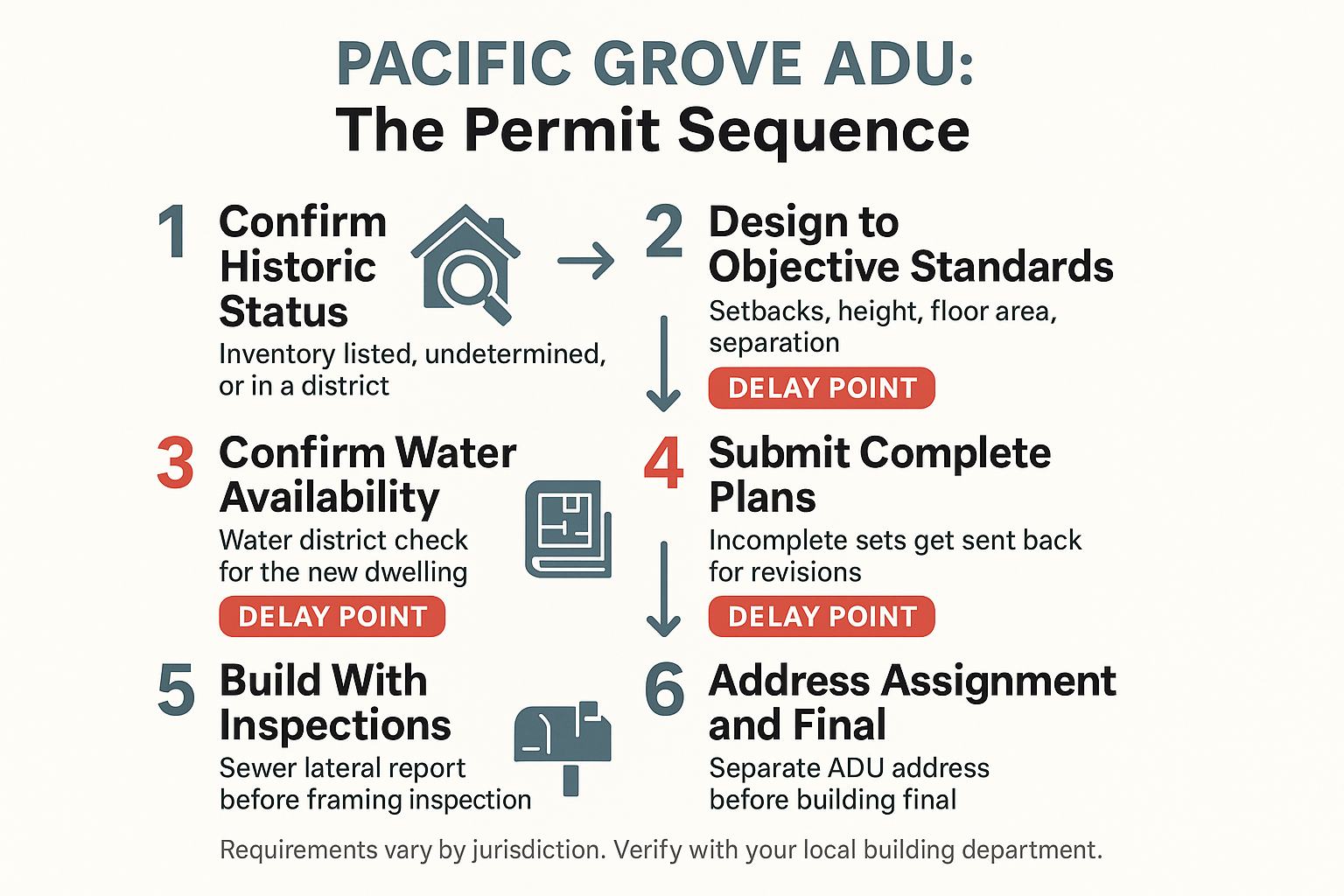
Most of the anxiety I hear comes from not knowing the sequence. Here is the path a Pacific Grove ADU follows, and where the waiting tends to hide.
Two objective standards homeowners misjudge on older lots
Fire sprinklers. This is the first one people brace for, and it is usually less painful than they fear. The city’s rules require sprinklers in the ADU only if sprinklers are required in the primary residence. Building the ADU is not supposed to trigger a sprinkler retrofit of the existing house.
Most pre-1980 Pacific Grove homes have no sprinkler system, so the new unit typically does not need one either. Confirm it for your address rather than assuming.
Water. This is the step almost nobody from outside Monterey County sees coming. Pacific Grove’s own ADU process tells homeowners to check with the Monterey Peninsula Water Management District that the property has adequate potable water to serve the unit, and to look at the city’s entitlement water sale process if more water is needed.
A new dwelling is a whole-unit water demand question, not a fixture swap. That is different from the smaller math you do when you change fixture counts inside an existing bathroom, which I covered in what water credits allow when adding a new bathroom.
I put this early in planning for a reason. Water availability can change the size of the unit you design, and finding that out after plans are drawn is expensive. The city’s accessory dwelling unit permit and plan review page.php) lays out the water check and the entitlement path directly.
The submittal items that quietly cost weeks
None of these are exciting, and all of them have delayed real projects. This is the list I run before anything goes to the counter.
| Item | When it comes up | Why it stalls projects |
|---|---|---|
| Complete, accurate plan set | At submittal | The city warns it will not process inaccurate or incomplete plans and sends the applicant back for revisions, which is real calendar time lost |
| Initial historic screening | Before permits issue on older or unevaluated homes | Visible exterior changes can trigger it, and homeowners rarely budget time for it |
| Water availability confirmation | Before final design is locked | May require going through the city’s entitlement water sale process for a new dwelling |
| Tree permit | During design, if construction requires removing an ordinance-size tree | Pacific Grove’s mature pines and cypress sit exactly where people want to put a unit |
| Sewer lateral inspection report | Required before framing inspection | Older clay laterals fail the inspection and need repair mid-build |
| Separate ADU address assignment | Must be processed before building final | Missed until the end, then holds up the final sign-off |
So who actually pulls the paperwork?
This is one of the two questions I get before anything else. Several homeowners have written in genuinely unsure who handles permits at all, with one asking flat out whether we take care of that part. We do, as the general contractor on the project.
The other common opening is a phasing plan. One homeowner described it as remove a studio, replace it with an ADU, then evaluate remodeling the main house. That is a reasonable order, and it works better when the historic status and water questions are answered before the first phase starts.
The honest sequence looks like this:
- Confirm historic status and district boundaries with the city
- Design against the objective standards in Chapter 23.80
- Confirm water for the new dwelling with the water district
- Submit a complete plan set and respond to comments
- Build, with inspections in the right order
- Handle the address assignment before building final
Requirements vary by jurisdiction. A homeowner in Pacific Grove, Monterey, or unincorporated Monterey County should verify with the building department that has authority over their address, because the answers are not interchangeable across city lines. If you are still deciding between unit types, attached versus detached for your lot is worth reading before you commit to a footprint.
Frequently Asked Questions About Pacific Grove ADUs and Historic Review
Does being on the Historic Resources Inventory stop me from building an ADU?
Usually no. Pacific Grove’s ADU chapter directs ministerial, administrative review against objective standards, so there is no discretionary design hearing for a qualifying application. Listing is more likely to add a screening or noticing step than to block the project outright. Confirm your own property’s status with the city before you plan around it.
My house was built in 1912 but nobody ever evaluated it. What does that mean?
That is the undetermined historic status bucket, which generally covers buildings 50 years or older that have never been formally studied. Visible exterior changes on an unevaluated older home can trigger an initial historic screening before permits issue.
Will building an ADU force me to sprinkler my old house?
It is not supposed to. Sprinklers are required in the ADU only if sprinklers are required in the primary residence, and adding the unit should not trigger a retrofit of the existing home. Verify for your address, since the answer depends on what your main house already has.
Why does water come up so much on the Monterey Peninsula?
Because a new dwelling needs its own water to serve it, and this area manages water tightly. The city’s ADU process points homeowners to the Monterey Peninsula Water Management District to confirm adequate potable water, and to the city’s entitlement water sale process if more is needed. I treat this as a design-phase question, not a permit-phase one.
Can I demolish my old detached garage and put the ADU there?
Often yes, and under the city’s ADU rules written notice or a posted placard generally is not required when a detached garage is replaced by an ADU. The exception is property inside an architecturally and historically significant historic district, where noticing steps can add days to the schedule. State law has narrowed when historic designation pulls an ADU out of ministerial processing, so check the current interpretation with the city.
How long does the whole thing take?
It depends on the historic step, the water step, and how clean the plan set is going in. Incomplete plans get returned for revisions, which is the most avoidable delay in the process. I broke the realistic phases down in a separate piece on ADU timelines across the county.
Thinking through an ADU on an older Pacific Grove lot?
When a historic screening or a water step is in play, the value of hands-on project management shows up in permitting, not just on the build. We scope those steps into the proposal from day one using realistic allowances instead of a number that grows later, and every line item gets explained before anything is signed. If you own a home on the Monterey Peninsula and want a clear read on what your property allows, we are available at palaciosconstructionca.com or (831) 220-3334.