

When you're planning a home remodel in Monterey County, the first question is often: who handles the remodel permits? For any professionally managed project, the answer is simple. Your licensed general contractor takes care of it from start to finish. This isn't just about paperwork—it’s about taking full responsibility for code compliance, navigating local rules, and ensuring your project starts on a solid, legal foundation.
Your Guide to Navigating Monterey Remodel Permits

Starting a renovation is exciting, but the idea of dealing with building permits can feel overwhelming. In Monterey County, a professional, licensed general contractor manages that entire process for you. It’s not an administrative task for homeowners; it’s a core function of a reliable contractor.
Think of your contractor as your representative at the local building department. They translate architectural plans into an application package that the city or county will approve. Getting this right from the beginning is precisely why it matters who handles your permits.
The Importance of Local Expertise in Permitting
In Monterey, local knowledge is everything. Our region has a uniquely complex set of rules that can trip up builders who aren't from the area. A contractor with years of experience here knows exactly what to look for.
A few local hurdles we navigate constantly:
- Water Use Regulations: Residents of Monterey know that water use is tightly regulated. Even adding a single plumbing fixture can trigger a water credit review from the Monterey Peninsula Water Management District (MPWMD) before a permit is issued.
- Coastal Zone Overlays: If your home is in Carmel, Pacific Grove, or another coastal area, there are extra layers of rules designed to protect the coastline. These regulations can affect everything from your addition's height to the types of materials you can use.
- Older Housing Stock: Many of our homes have unique character from a different era. A local contractor understands how to document existing conditions and plan a remodel that brings the home up to modern code without compromising its integrity.
A contractor unfamiliar with these specifics often submits incomplete applications, leading to corrections, delays, or required plan revisions that extend project timelines. For homeowners planning a significant investment, understanding how to prepare for permits on a home addition is the critical first step.
On the Central Coast, homeowners frequently research permits before signing contracts due to strong regional trust dynamics and past awareness of unlicensed contractor issues. Local search behavior often includes phrases like “licensed contractor Monterey” or “permit required Monterey remodel,” reflecting concern about compliance.
The Contractor’s Role as a Permit Manager
A true professional doesn’t just drop off the paperwork and hope for the best. They manage the entire journey. Before hiring, homeowners should ask whether the contractor pulls permits in-house, confirms water credit availability, and manages inspection scheduling with the local jurisdiction—not just submits paperwork.
A licensed general contractor with local permitting experience handles permit applications directly, coordinates with building departments, and verifies water credits before demolition begins. This hands-on oversight is your best protection against surprise costs and frustrating delays.
The Key Players in the Monterey Permitting Process

Getting a remodel permit in Monterey County is a team effort. While several professionals have a hand in it, one person is in charge of pulling it all together: your licensed general contractor.
The ultimate authority is the local government. For projects in unincorporated areas, that means the Monterey County Permit Center. This is where Building Services, Engineering, and Planning come together to ensure your project is safe, code-compliant, and follows local rules.
This office reviews everything from a small addition to a full re-roof. They enforce the building standards that shape how your remodel gets planned and built. You can monitor their work, including permit types and fees, on their 2026 Land Use Fee Update page.
The General Contractor: Your Project Quarterback
Think of your general contractor as the quarterback for your remodel. They manage the entire team and the whole process, making sure every detail on the application is correct before submission. They translate your vision and the architect’s plans into the precise format the county needs to see.
This is exactly why it matters who handles remodel permits in Monterey. A good local contractor knows what plan checkers are looking for, anticipates their questions, and keeps your project from getting bogged down in red tape.
A professional contractor acts as your single point of contact with the building department. This prevents miscommunication and ensures accountability from the initial application through the final inspection.
Other Essential Team Members
Your contractor leads the charge, backed by a team of specialists who provide the detailed documents needed for a complete permit application. Each one has a critical job.
- The Architect or Designer: This professional draws up the blueprints. They create the detailed plans that show what your new space will look like and how it will function.
- The Structural Engineer: If your project involves the home’s structure—like removing a load-bearing wall or adding a second story—you’ll need an engineer. They provide the calculations and drawings that prove the home will be safe and stable.
- The Homeowner: Your main job is to be the decision-maker. You give the final approval on the design, confirm the scope of work, and authorize the contractor to act as your agent.
This table breaks down how everyone works together to get a permit-ready package to the county.
Who Does What in the Permitting Process
| Key Player | Primary Role and Responsibilities |
|---|---|
| Licensed General Contractor | Manages the entire permitting process, submits the application, coordinates with the building department, and schedules all required inspections. |
| Architect / Designer | Creates the architectural plans, including floor plans and elevations, that form the visual and functional basis of the permit application. |
| Structural Engineer | Provides engineered drawings and calculations for any changes affecting the home’s structural integrity, ensuring safety and code compliance. |
| Homeowner | Makes final decisions on the design and scope, and authorizes the contractor to act as their agent with the building department. |
In the end, it’s the general contractor who brings all these pieces together. Their firsthand experience navigating local requirements is what turns a great design into a project that’s actually approved and ready to build.
Why Proper Permitting Is Non-Negotiable
It’s easy to think of a building permit as just bureaucratic red tape. But that’s a dangerous mistake. A permit isn't just paper; it's the official record that your project was designed, inspected, and built correctly for quality and safety.
For any homeowner in Monterey County, understanding that proper permitting is non-negotiable is the first step to a successful remodel. The reasons fall into four key areas that protect your home, finances, and family.
Safety and Code Compliance
The single most important reason for a permit is safety. Building codes exist to protect you from dangers like structural failure, fire, and faulty electrical or plumbing systems. These aren't suggestions; they are the minimum standards for safe construction.
When a licensed contractor pulls a permit, they submit plans for review by experts at the Monterey County Permit Center. A plan checker verifies that the design meets every requirement in the California Building Code. Then, a county inspector visits your home at critical points to make sure the work matches those approved plans.
This third-party oversight is your guarantee of:
- Structural Integrity: Ensuring new walls, beams, or foundation work can handle their designed loads.
- Fire Safety: Confirming correct materials, smoke detector locations, and clear exit paths.
- Electrical and Plumbing Safety: Ensuring all wiring and pipes are up to code, preventing shorts and leaks.
Without that permit and those inspections, you have no professional confirmation that the work is truly safe.
Protecting Your Investment
Your home is likely your biggest asset. Unpermitted work is a direct threat to its value. When you eventually decide to sell, you are legally required to disclose any remodeling done without permits. For buyers and their lenders, this is a massive red flag.
A history of unpermitted work can make a home incredibly difficult, or even impossible, to sell. Most buyers aren't willing to inherit the liability and unknown costs of non-compliant construction.
Worse yet, appraisers may not count the value of that beautiful unpermitted kitchen or bathroom you added. Proper permitting creates an official record that all improvements were done to code, protecting your investment. If you're wondering what kind of projects need this official record, you can learn more about when permits are optional for minor remodeling work in our related guide.
Insurance and Liability
Here’s a scenario no homeowner wants: a fire starts because of faulty wiring in an unpermitted kitchen remodel. When you file an insurance claim, the company will investigate. If they find the work was done without a permit, they have the right to deny your claim entirely.
Your homeowner's insurance policy is based on the understanding that your home is a compliant, legal structure. Cutting corners on permits can void your coverage, leaving you personally liable for all damages. A permit is your proof that your home remains insurable.
Avoiding Penalties and Rework
Getting caught with unpermitted work by Monterey County officials can turn your project into a nightmare. The consequences are almost always stressful and expensive.
This can include:
- Stop-Work Orders: The county can shut down your project immediately, leaving your home torn apart.
- Fines and Penalties: Fines are steep, often running double or triple the original permit fee.
- Retroactive Permitting: You may be forced to get a permit after the fact. This usually means tearing open walls so an inspector can see the hidden work.
- Forced Removal: In a worst-case scenario, you could be ordered to tear out all unpermitted work at your own expense.
Working with a professional contractor who manages the permit process correctly from day one is the only way to protect yourself from these costly headaches.
The Problem with Out-of-Area Contractors and Permit Handling
When it comes to permits in Monterey County, who you hire matters more than most homeowners realize. A building permit here isn't just a piece of paper; it’s a detailed process that can stop a project cold if your contractor lacks specific, local experience.
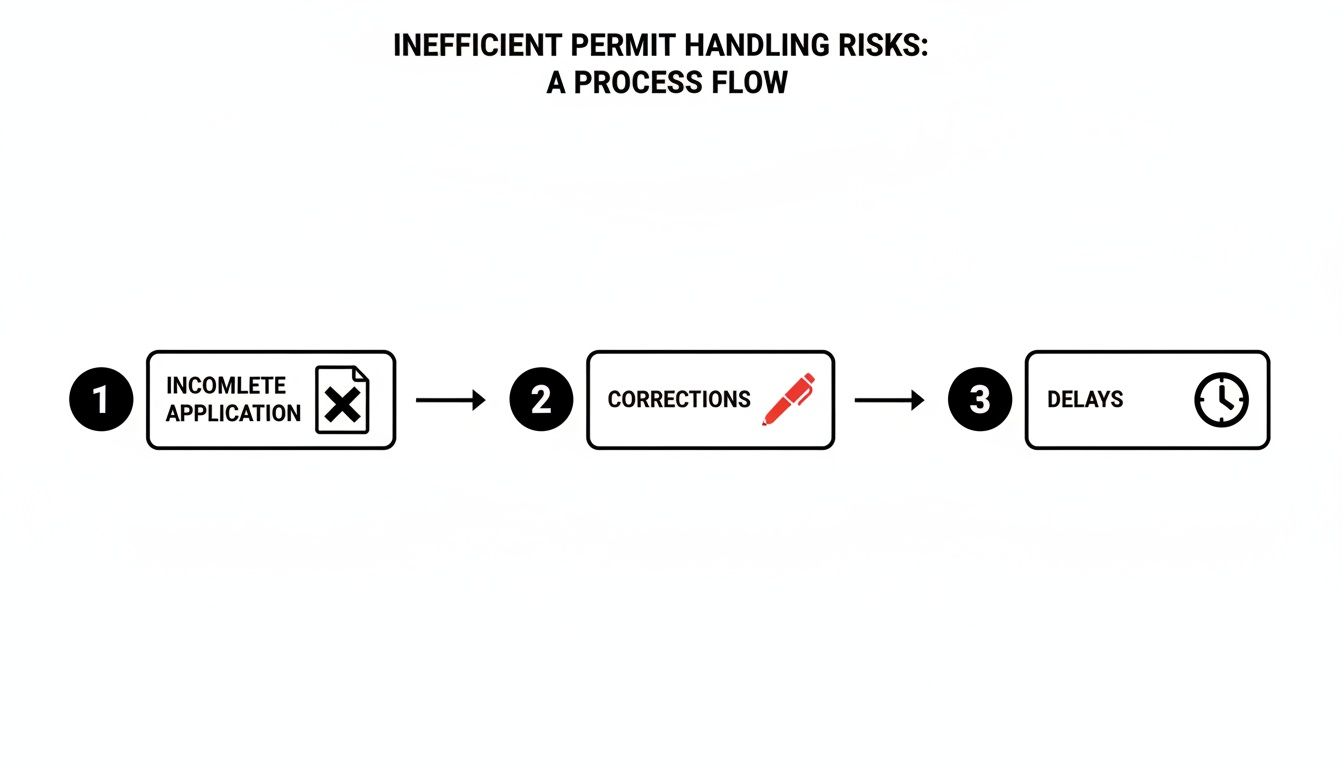
Hiring someone who doesn't know the ins and outs of our local jurisdictions is a huge risk. A contractor unfamiliar with Monterey Peninsula Water Management District requirements or coastal zoning overlays may submit incomplete applications, leading to corrections, delays, or required plan revisions that extend project timelines.
Monterey County’s Specific Permit Hurdles
Several local regulations are common stumbling blocks for contractors who aren't from here. Inexperienced teams consistently underestimate how seriously our local agencies take these rules.
Here are the big ones:
- The Monterey Peninsula Water Management District (MPWMD): Water is everything on the peninsula. Adding a single sink can trigger a deep dive into your property’s water credits. An inexperienced contractor might start demolition before realizing a project can’t even be permitted due to water fixture counts—a disastrous and expensive mistake.
- Coastal Zone Rules: If your home is in the coastal zone (think Carmel, Pacific Grove, parts of Monterey), the California Coastal Commission has its own set of rules. These can impact everything from your home’s height to landscaping choices.
- Historic Preservation: Many local communities, like Carmel-by-the-Sea and Pacific Grove, have strict historical preservation rules. Remodeling an older home often means another layer of review to protect its character.
A contractor unfamiliar with these details will submit plans that get bounced right back for corrections. This isn't just a minor hiccup; it can add months to your timeline.
What Inexperience Really Costs You
The biggest risk isn't just lost time—it’s the ripple effect on your budget. Every week your project is stuck in permit review is a week you're not building. That can disrupt subcontractor schedules, expose you to material price hikes, and add carrying costs.
A licensed general contractor with local permitting experience handles permit applications directly, coordinates with building departments, and verifies water credits before demolition begins.
Before you hire a contractor, ask them directly: How do you manage inspection scheduling with the city? What is your process for confirming water credits with the MPWMD? Their answers will tell you if you’re getting a true project partner or just a paper-pusher.
For homeowners in Monterey, Carmel, Pacific Grove, and surrounding Central Coast communities, working with a contractor who understands local water regulations and coastal permitting processes can prevent costly delays and ensure your remodel moves forward smoothly.
What to Expect During the Permitting and Inspection Phases
Going from architectural plans to a fully approved remodel is a journey, and your contractor is your guide. Understanding how it all works provides a realistic roadmap for your project.
The main authority is the County of Monterey's Building Services Division, part of the Housing and Community Development (HCD) Department. This agency ensures every remodel is safe and follows state building codes and local zoning rules. You can find official permit records online through the official county permit database.
This process can be complicated. Hiring someone who doesn't know the local ropes is a recipe for trouble.
The Four Main Stages of the Process
The permit and inspection journey breaks down into four key phases. A good general contractor handles all the logistics for you.
1. Pre-Application and Document Gathering
Before a single form is filled out, your contractor gets all the paperwork in order. This means finalized architectural plans, structural engineering calculations, and other reports. Critically, for Monterey County, this is when an experienced local contractor confirms water credit availability.
2. Application Submission and Plan Check
With a complete package, your contractor submits everything to the Monterey County Permit Center. This kicks off the plan check phase. County plan checkers will review your plans against building codes, zoning laws, and any special local rules for coastal or historical areas.
A Quick Tip on Plan Check: If a reviewer finds an issue, they send back a "correction letter." A contractor who knows the local codes can often clear these up fast. They know who to talk to and how to work with the architect to get the county what it needs.
3. Permit Issuance
Once plan checkers are satisfied, your contractor pays the final permit fees and is issued the building permit. That document is your green light. It must be posted visibly on the job site before any work can start.
4. The Inspection Sequence
As construction moves forward, a county inspector must visit the site at key milestones to ensure the work matches the approved plans. Your contractor is responsible for scheduling every inspection.
Common inspections you can expect include:
- Foundation: A check done right before any concrete is poured.
- Framing: Happens after the structure is built but before insulation and drywall cover everything.
- Rough-in (Plumbing, Electrical, Mechanical): An inspection of all systems hidden behind the walls.
- Final Inspection: The last step—a thorough review of the entire project once all work is finished.
You must pass each inspection before moving to the next stage. After a successful final inspection, the permit is "finaled," and your project is officially closed. This is a crucial step for all projects, including ADUs. You can learn more in our guide on what permits are required for an ADU or garage conversion.
How to Know if Your Contractor Really Handles Permits
Most contractors will say, “Yes, we handle permits.” But what does that actually mean? There’s a huge difference between a contractor who just drops off paperwork and one who truly manages the entire permitting and inspection process.
You need a partner who understands local nuances, anticipates problems, and keeps your project moving. This means asking the right questions. Before hiring, homeowners should ask whether the contractor pulls permits in-house, confirms water credit availability, and manages inspection scheduling with the local jurisdiction—not just submits paperwork.
The Right Questions to Ask a Contractor
Before you sign anything, get specific about their process. Their answers will reveal their experience in Monterey County.
Who on your team is in charge of the permit process from start to finish? A great answer is the project manager or the general contractor themselves. If they say an admin, it’s a red flag.
What’s your exact process for dealing with the MPWMD and water credits? A pro who works on the Peninsula will have a ready answer. They should talk about checking your property's fixture count and confirming water credits during the design phase.
How do you schedule inspections to avoid delays? You want to hear about a system. They should explain how they coordinate with subcontractors and the city inspector to line up inspections seamlessly.
A confident, detailed response is the mark of a seasoned professional. It’s a perfect example of why hiring a licensed general contractor actually matters.
For any homeowner in Monterey, Carmel, or Pacific Grove, this is non-negotiable. A builder who gets the local rules around water, coastal zones, and hillside properties is the one who will prevent expensive headaches and keep your remodel on track.
FAQs: Monterey Remodel Permit Questions
Even with a good plan, the permit process can feel like a black box. Here are straightforward answers to common homeowner concerns in Monterey County.
1. Who pulls the permit: my contractor or my architect?
Your licensed general contractor is the one who pulls the permit. While an architect creates the plans, the contractor is responsible for the actual construction and ensuring it meets code. They are the point person with the county building department, managing the application, inspections, and final sign-off.
2. What happens if I remodel without a permit in Monterey County?
Working without a required permit is a significant risk. The county can issue a stop-work order, which shuts down your job immediately. You'll likely face fines, often double or triple the original permit fee. In many cases, you'll be forced to tear out finished work so an inspector can see the framing or plumbing, a process that is always more expensive and stressful than getting the permit correctly from the start.
3. How long does it take to get a remodel permit in Monterey?
This depends entirely on your project’s scope and jurisdiction. A simple permit might take a few weeks. However, a major remodel or addition requiring multiple departmental reviews (planning, environmental health, water district) could take several months. An experienced local contractor can provide a realistic timeline based on current processing times at the permit counter.
4. Do I need a permit for a simple kitchen or bathroom remodel?
Most of the time, yes. If you are moving walls, changing plumbing locations, or altering electrical wiring, a permit is required. The county needs to ensure this work is done safely. You generally don't need a permit for cosmetic swaps like painting or replacing countertops in the same location. For more examples, see our company FAQs.
5. Why is verifying water credits so important in Monterey?
This is a critical local issue. The Monterey Peninsula has a strict water allocation system managed by the Monterey Peninsula Water Management District (MPWMD). Before you can get a permit for any project that adds a water fixture (like a new sink or an ADU), you must prove you have the "water credits" for it. An inexperienced contractor who fails to check this first can get your project stopped before it even begins.