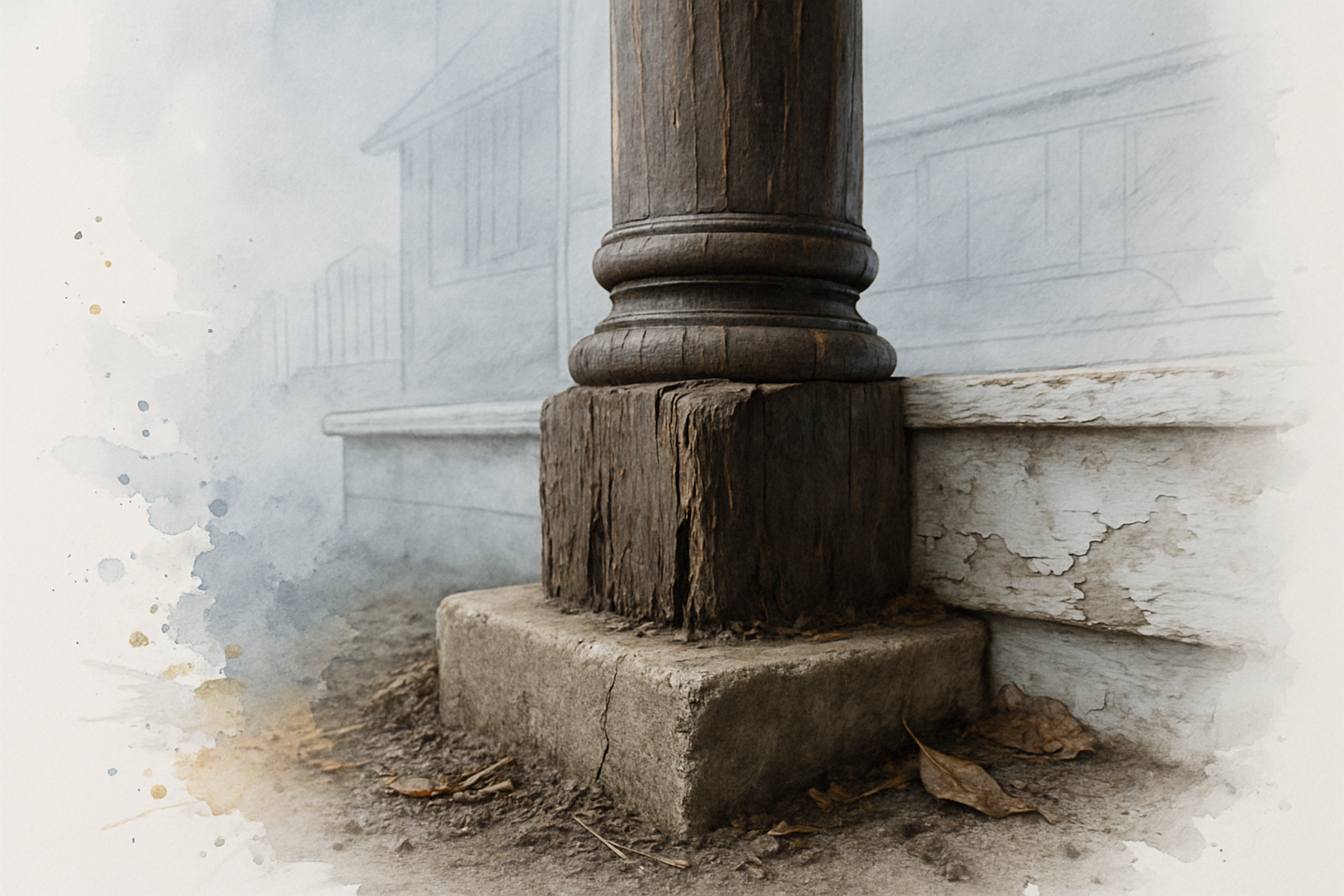

Direct Answer: Monterey Peninsula homes — especially older stock in Pacific Grove and Carmel — need drainage cleared, crawl spaces inspected, and exterior wood structures assessed before November. Waiting until rain arrives usually means far more expensive repairs.
I’ve seen what a multi-day atmospheric river does to an unprepared Monterey County home. It’s not dramatic at first — it’s a hairline of moisture at the base of a wall, a soft spot that wasn’t there last spring, an insurance call that nobody wanted to make. The problem almost never starts during the storm. It starts months before it, when the work that should have been done wasn’t.
The Monterey Peninsula is not a forgiving coastal climate. Coastal flooding here runs November through February, and atmospheric river events — like those that caused tens of millions of dollars in localized road and property damage in 2017 and 2019 — have a way of finding every weakness in an older home’s exterior. Pacific Grove bungalows, Carmel cottages, mid-century Pebble Beach properties: many of them weren’t built to handle the rain intensity we’re seeing now.
This article focuses on three things I think about every fall when homeowners start asking about pre-winter construction work: exterior drainage, crawl space integrity, and wood structure condition. These aren’t the only things that matter, but they’re where I’ve seen the most preventable damage — and the most expensive after-the-fact repairs.
What Drainage Failure Actually Looks Like — and What It Costs
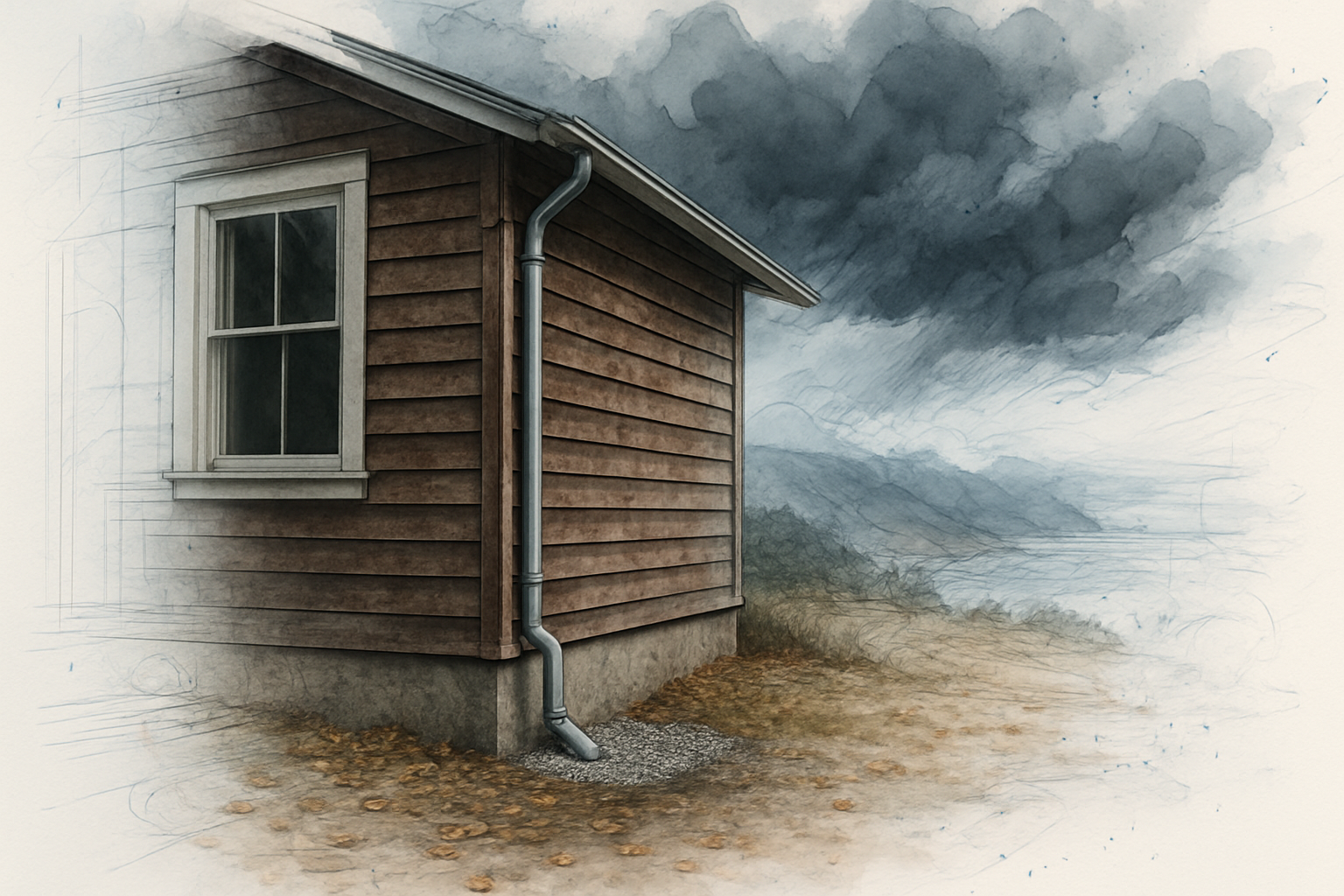
The most commonly overlooked pre-winter failure point I see in older Monterey County homes is drainage. Specifically, what happens when gutters, downspouts, and yard drains are completely clogged during a multi-day storm event.
Water that can’t move away from the foundation doesn’t disappear — it finds the path of least resistance. In practice, that means slab joints, crawl space vents, and the base of exterior walls. By the time a homeowner notices moisture inside, the damage is already well underway.
A basic exterior drainage walk-through before the first storm of the season looks like this:
- Gutters and downspouts — clear of debris, properly pitched, and discharging at least 4 to 6 feet from the foundation
- Yard drains and area drains — especially in low-lying spots or against retaining walls, checked for blockage
- Grade against the foundation — soil or hardscape should slope away from the structure, not toward it
- Any place where a patio, deck, or addition meets the main house — water tends to collect at transitions
The repair cost on water intrusion that gets through — subfloor replacement, mold remediation, reframing damaged sections — routinely runs far higher than the cost of clearing and repairing a drainage system in the fall. I’ve seen homeowners spend well into five figures on repairs that could have been avoided with a few hundred dollars of preventive work done in September. That math is hard to ignore. For a broader look at the kinds of projects Monterey County homeowners face before and after the rainy season, the remodeling projects Monterey County homeowners are actually doing covers a range of real examples.
Crawl Space Integrity: The Damage That Hides Until It’s Serious
Crawl spaces are invisible until they’re not. I’ve fielded inquiries from property managers and homeowners across Monterey County who discovered crawl space problems only after a wet season — by which point the repair scope had grown significantly.
One situation that stood out: a property where the moisture barrier had failed, insulation had fallen away from the floor structure due to age and rodent activity, and the vents were inadequately sealed. None of it was visible from inside the home. The homeowner had no idea anything was wrong until the smell — and the subfloor softness — made it obvious.
A functioning crawl space going into winter should have all of these in place:
- Moisture barrier — a properly secured vapor barrier covering the ground, with no tears, gaps, or areas where it has pulled away from the perimeter walls
- Insulation — still in contact with the floor structure above, not hanging loose or fallen to the ground
- Ventilation — code-compliant vents that move air but don’t allow rodent entry
- No standing water or debris accumulation — including vegetation, wood scraps, or rodent nesting material
If any of those conditions are off, it’s worth addressing before November. What looks like a minor crawl space issue in October can become a mold remediation and subfloor replacement project by March — and those repairs are significantly more disruptive and expensive than the preventive work would have been.
It’s also worth knowing that in Monterey, Pacific Grove, and Carmel-by-the-Sea, permit timelines for structural repair work can add weeks to a project’s start date. Work that might get done in a week elsewhere takes longer to get permitted and scheduled here. Homeowners who wait until mid-October to address known issues often find they can’t get structural work completed before the first significant storm of the season.
The Pre-Winter Readiness Window on the Monterey Peninsula
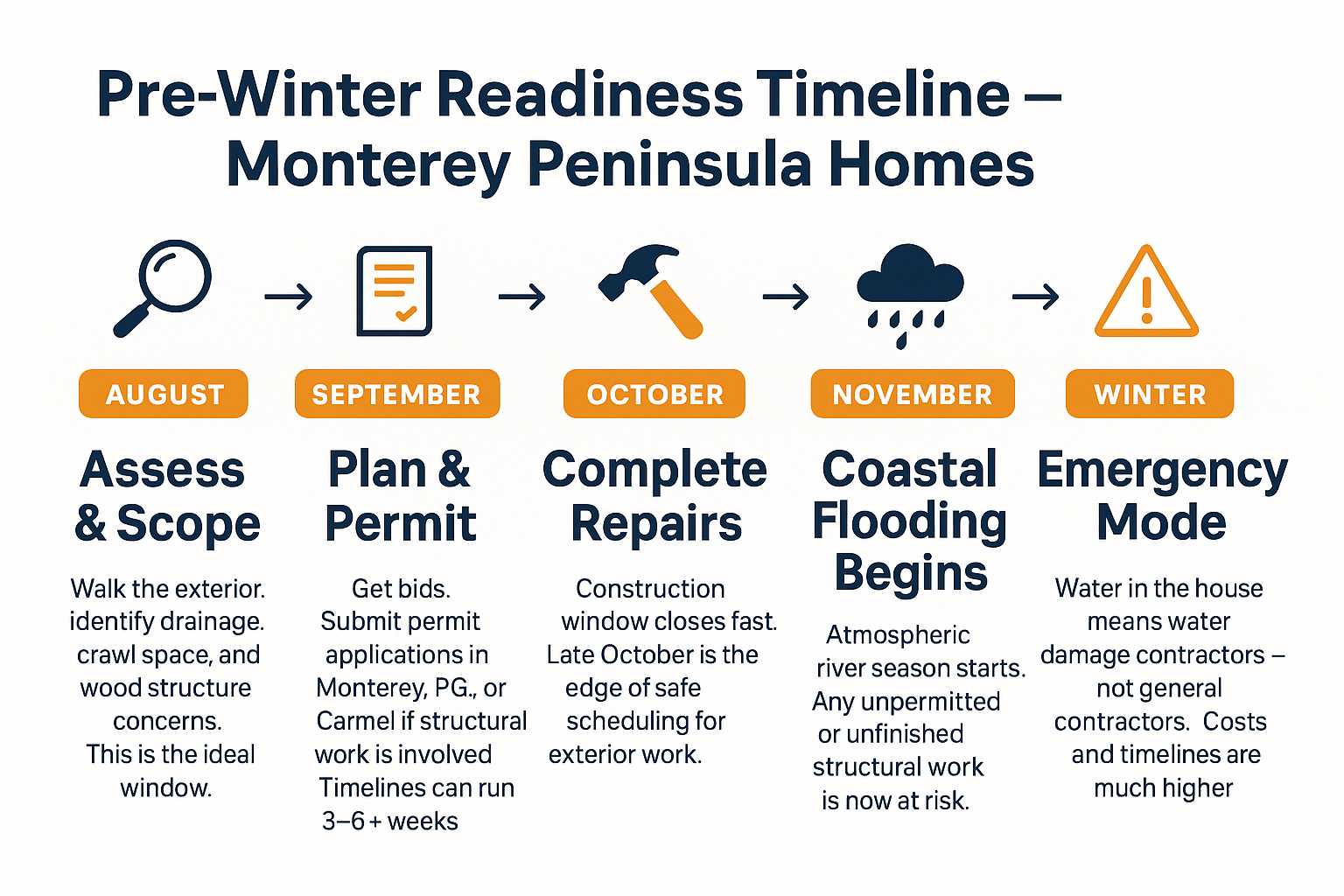
This timeline shows the realistic window for getting pre-winter structural work planned, permitted, and completed on the Monterey Peninsula — and what happens when homeowners wait too long.
What to Check on Decks and Exterior Wood Before the Season Turns
Coastal wood structures on the Peninsula take a different kind of punishment than those in drier parts of California. The combination of salt air, marine moisture, and concentrated winter rainfall accelerates wood degradation faster than most homeowners expect — especially on structures that haven’t been inspected in a few years.
I think about a Pebble Beach homeowner who reached out specifically about corrosion damage on an exterior structure that had been failing quietly for some time. There were no obvious signs from a distance. Up close, the fasteners were heavily rusted, several post bases had bubbling paint at ground level, and the ledger board where the deck met the house had soft spots that compressed under pressure. None of it was visible from inside.
Before winter, here’s what I’d tell any homeowner with a wood deck, pergola, or exterior porch to look for:
- Ledger board — where the deck attaches to the house; look for soft wood, water staining, and any gap where moisture can enter the wall assembly behind it
- Post bases and railing posts — bubbling or peeling paint at the base of a post almost always signals moisture intrusion; press with your thumb and feel for softness
- Fasteners — rust staining running down from screws, bolts, or joist hangers is a sign the hardware is compromised and may be losing structural integrity
- Anywhere water can pool and sit — deck boards with no drainage gap, flat surfaces against the house, low spots in a patio — all of these concentrate the damage
Exterior wood structures are not a cosmetic concern once they start failing. By the time a deck post is visibly soft at the base, the structural connection is often already compromised. Pre-winter is the right time to catch these problems while repair is still a reasonable scope. Indoor and outdoor living construction on the Monterey Peninsula covers how exterior structures are built and maintained here in more detail.
Preventive Work vs. Emergency Repair: What Changes When You Wait
There’s a meaningful difference between structural readiness work done in the fall and emergency storm response after water is already in the house. These are different categories of work — and the cost and scheduling gap between them is significant.
| Situation | Preventive Work (Aug–Oct) | Emergency Response (During/After Storm) |
|---|---|---|
| Who does the work | Licensed general contractor | Water damage / restoration contractor |
| Scheduling | Planned and scheduled in advance | Waitlisted; high demand in storm season |
| Permit process | Normal permit timeline (weeks) | Emergency repairs may still require permits |
| Scope control | Known scope, clear budget | Scope expands as damage is discovered |
| Typical cost level | Moderate — repair before failure | Significantly higher — remediation + rebuild |
| Disruption to household | Manageable, phased construction | Often requires vacating affected areas |
Why the August–September Window Is the One That Matters
Every year I have conversations with homeowners in October who knew something was off with their crawl space, or noticed a soft spot on the deck in summer, and waited. By the time they call, the permitting timeline for any structural repair in cities like Monterey, Pacific Grove, or Carmel-by-the-Sea has already eaten up most of the safe construction window.
Permit review in these jurisdictions — for anything touching the building envelope, structural framing, or exterior modifications — can run three to six weeks or longer depending on project complexity and department workload. That’s before a single tool comes out. If a homeowner waits until late October, the math often doesn’t work.
August through September is the realistic window for getting pre-winter repair work properly scoped, submitted for permits where required, and completed before conditions deteriorate. That’s not a sales calendar — it’s just how the timeline plays out on the Peninsula.
For anyone who has wondered about the permit process and who’s responsible for managing it, who is responsible for permits on a remodeling project breaks down how that typically works with a licensed general contractor. And if you’ve seen what happens when that step gets skipped, what happens when remodeling work gets done without a permit is worth reading before starting any exterior repair work.
The National Weather Service office in the Bay Area tracks atmospheric river events that affect the Central Coast — their seasonal outlooks are worth checking in September as part of planning any exterior project timing.
Frequently Asked Questions About Preparing Monterey Homes for Winter
Is pre-winter structural work something a general contractor handles, or does it require specialists?
It depends on the scope. Clearing gutters and drains is maintenance — a homeowner or handyman can do that. But if you’re looking at crawl space moisture barrier repair, subfloor damage, ledger board replacement, or exterior siding and framing work, that’s structural repair territory. A licensed general contractor manages the trades, pulls permits where required, and coordinates the work in sequence. Water damage that’s already occurred — active mold, standing water — typically involves a remediation contractor first, then a general contractor for the rebuild.
Do I need a permit to repair my deck or crawl space before winter?
It depends on what’s being done and where you live. In Monterey, Pacific Grove, and Carmel-by-the-Sea, permit requirements for exterior structural work are real and enforced. Replacing a ledger board, reframing a deck, or doing anything that modifies the building envelope typically requires a permit. Surface-level repairs like replacing deck boards may not — but that line can be unclear, and it shifts by jurisdiction. Always verify with your local building department before assuming a repair is permit-exempt.
How do I know if my crawl space is in bad shape before hiring anyone?
If you can safely access your crawl space, look for these warning signs: moisture or standing water on the ground, insulation that has dropped away from the floor joists, visible tears or gaps in the plastic vapor barrier, and any evidence of rodent activity (nesting, droppings, or chewed venting). A musty smell in the living space above — especially after a storm — is also a signal worth taking seriously. If you’re not comfortable getting into the crawl space yourself, a contractor can assess it as part of a pre-construction walkthrough.
My deck looks fine from the surface. Is it still worth having someone check the framing?
Yes, especially on the Peninsula. Salt air and marine moisture attack wood from the inside out, particularly at post bases, ledger boards, and metal fasteners. A deck can look perfectly fine on the surface while the structural connections underneath are compromised. This is especially true on properties close to the water in Pacific Grove, Carmel, and Pebble Beach. If your deck is more than eight to ten years old and hasn’t had a structural review, fall is a good time to take a closer look before winter rain adds moisture to an already stressed system.
What’s a realistic cost range for pre-winter structural repair work?
It varies considerably depending on what’s found. A crawl space moisture barrier replacement and re-insulation on a typical Monterey County home might run somewhere in the range of a few thousand dollars — more if there’s subfloor damage or significant remediation needed. Deck ledger board repair or post base replacement can range from a few hundred to several thousand dollars depending on how far the damage extends. These are rough market ranges, not quotes — the only way to get an accurate number is to have a contractor walk the property and scope the actual condition.
What Professional Pre-Winter Construction Work Actually Looks Like
One thing I hear from homeowners who’ve had bad experiences with contractors is that exterior and structural work often felt chaotic — materials left out overnight, work exposed to weather, no clear daily sequence.
Pre-winter construction work specifically requires a contractor who manages the job in phases and keeps the site protected as conditions change. A crawl space repair that leaves the vapor barrier pulled back overnight is more vulnerable than it was before work started. A deck ledger repair with exposed framing and no weatherproofing at the end of the day is an unnecessary risk.
A Pebble Beach client who had an extensive back porch refinished described the experience this way: “They were always on time, always clean and tidy, always careful, and it showed in the high quality of their work.” — Jean C.G.
That’s what well-planned, professionally managed projects look like in the field. Not just the finished result, but the daily discipline of protecting the work in progress — especially when the weather is the whole reason you’re doing the project in the first place. For more on what hands-on project management looks like throughout a construction project, how a general contractor’s bid process reveals more than the price is a good place to start.
Ready to Walk Through What Your Home Actually Needs This Fall?
If you own a home on the Monterey Peninsula and you’re not sure whether your crawl space, drainage, or exterior wood structures are ready for what’s coming, Palacios Construction is available to talk through it. The team works with homeowners across Monterey County — from Pacific Grove and Carmel-by-the-Sea to Pebble Beach and Salinas — on exactly this kind of pre-winter structural work. Reach out at palaciosconstructionca.com or call (831) 220-3334 to get a conversation started before the October window closes.