Direct Answer: A home addition in Monterey County involves a pre-construction phase that can take several months before any building starts — covering design, structural engineering, Title 24 energy compliance, and permit plan check with the local building department.
Most homeowners who come to us planning a room addition have the same mental picture of how it works: find a design, pull a permit, start building. That picture is missing about four months of work that happens before anyone drives a nail.
On the Monterey Peninsula — where coastal zone review, Monterey Peninsula Water Management District (MPWMD) water permits, and city-specific design review can all enter the picture — additions are among the most process-intensive residential projects a homeowner can take on. That’s not a reason to avoid them. It’s a reason to understand them clearly before you start.
I want to walk through what this process actually looks like in real time, where the common sticking points are, and what to look for when deciding who should lead the project. There’s a lot of generic contractor content out there about additions. This is specific to how the work unfolds here.
Why Pre-Construction Takes Longer Than Most People Expect
The pre-construction phase on a room addition isn’t just paperwork. It’s the phase where the whole project either gets built on a solid foundation — or doesn’t.
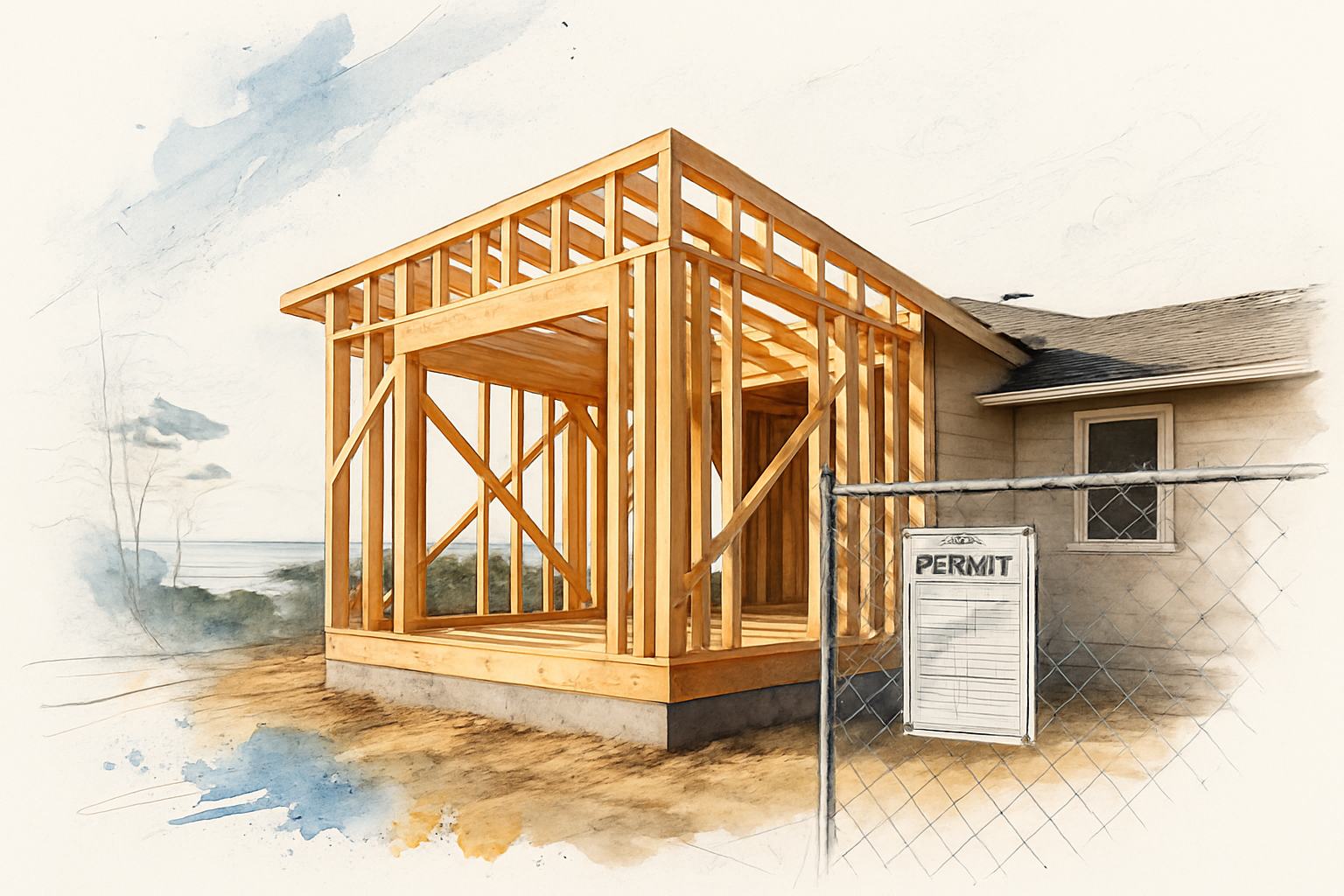
A room addition changes the building’s footprint and typically affects structural systems. That means you’re not just submitting a sketch to the building department. You’re submitting a complete set of construction drawings, a site plan, and in most cases structural calculations signed by a licensed preparer. The building department won’t begin plan check until those documents are complete and code-compliant.
In Monterey County, the permit application for a single-family addition commonly requires:
- Architectural drawings showing existing and proposed conditions
- A dimensioned site plan with setbacks, lot coverage, and impervious surface calculations
- Structural engineering calculations and details
- Title 24 energy compliance documentation
- Soils or geotechnical information in some coastal and hillside zones
- MPWMD water permit review if the project adds plumbing fixtures or increases water demand
For projects in cities like Carmel-by-the-Sea or Pacific Grove, design review by a local architectural or planning body may also be required before a building permit can be issued. That step alone can add several weeks.
I’ve seen homeowners assume they can get from design approval to a permit in a few weeks. On the Peninsula, two to four months is a more realistic window for plan check and review cycles, depending on jurisdiction and project complexity. Going in with that expectation makes the process much less frustrating.
Energy Code Is Now Part of Every Addition Budget
Starting January 1, 2026, California’s 2025 Energy Code applies to additions and alterations to existing buildings. If your addition adds conditioned space — meaning heated or cooled square footage — Title 24 compliance documentation is required as part of the permit submittal.
This affects more than insulation. Depending on the scope of the addition, you may be looking at:
- Window and glazing specifications that meet current performance standards
- HVAC sizing and system requirements for the new space
- Electrical panel capacity review, especially if the addition adds load
- Possible whole-home upgrades if the existing system can’t support the addition
A contractor who waits until mid-project to factor in energy code requirements is setting the homeowner up for expensive surprises. The right time to address Title 24 is during the design phase, when the compliance documentation is being prepared and the drawings can be adjusted before they go to plan check.
This is one area where clear budgeting practices matter the most. An addition proposal that doesn’t account for energy compliance costs isn’t a complete picture of what the project will cost. We build these requirements into the planning process at the start — not as a surprise line item later.
The Home Addition Process: Phase by Phase
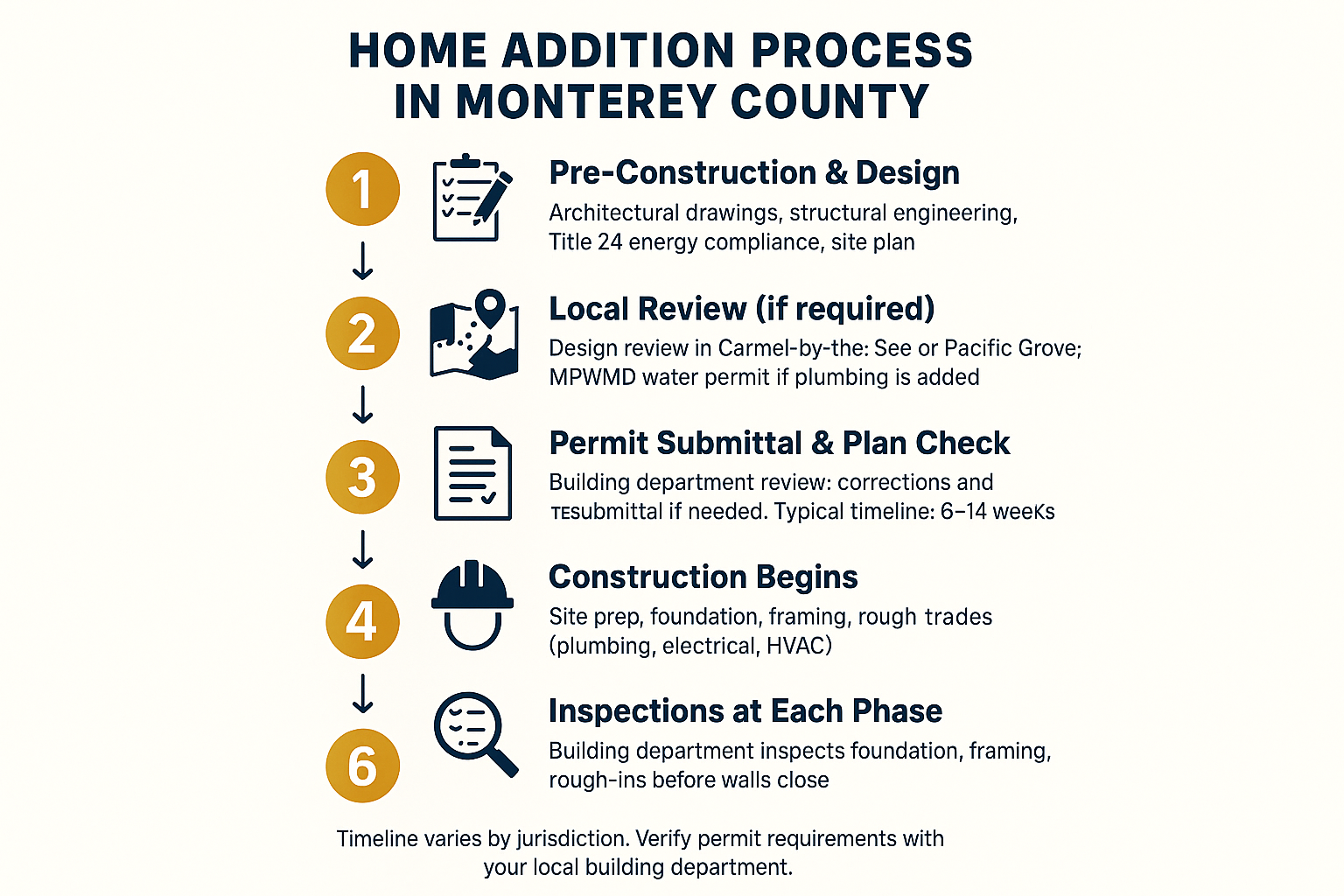
This is how a typical room addition moves from the first conversation to a final inspection in Monterey County.
Who Should Actually Lead a Home Addition Project
This is the question I hear most often, and it’s worth answering directly.
An addition is not the kind of project where it makes sense to hire a designer separately, then find a contractor on your own, and hope they work well together. The design has to account for constructability. The permit drawings have to match what will actually be built. The trade scheduling has to sync with inspection milestones. When those pieces are managed by different parties without clear accountability, that’s usually where projects get stuck.
A licensed residential general contractor with genuine addition experience manages the full arc of the project under a single contract — design coordination, permit submission, trade scheduling, inspections, and final closeout. One license, one point of contact, one person responsible when something needs to be resolved.
When you’re evaluating contractors, the questions that actually tell you something are:
- Have you permitted additions in this specific city, not just in Monterey County generally?
- Who prepares the structural calculations — do you have an engineer you work with regularly?
- How do you handle MPWMD water permit requirements if the addition includes a bathroom?
- What does your plan check process look like if the building department comes back with corrections?
A contractor who has done this work locally will answer those questions specifically. If the answers are vague, that’s worth paying attention to. You can read more about how to evaluate this in our guide on how to tell if a contractor actually knows Monterey County.
For a broader look at what a contractor’s bid process can tell you before you sign anything, how a general contractor’s bid process reveals more than the price is worth reading before you compare proposals.
Monterey County Addition: What Each Phase Involves
This is a simplified breakdown of the major phases in a home addition and what work typically happens in each one.
| Phase | What Happens | Who’s Involved |
|---|---|---|
| Pre-Construction | Architectural design, structural engineering, Title 24 documentation, site plan | Contractor, architect/designer, structural engineer |
| Local Review | Design review board (Carmel, PG), MPWMD water permit if applicable, coastal commission if in coastal zone | Contractor, local planning/building departments |
| Plan Check | Building department reviews submitted drawings; issues corrections if needed; issues permit on approval | Building department, contractor |
| Construction — Phase 1 | Site prep, demolition if needed, foundation work, framing | General contractor, concrete sub, framing crew |
| Construction — Phase 2 | Rough plumbing, electrical, HVAC; insulation; building department rough inspections | Trade subs, building inspector |
| Construction — Phase 3 | Drywall, finish work, cabinetry, flooring, fixtures, exterior finish | Finish trades, GC project management |
| Closeout | Final inspection, punch list, permit sign-off | Building inspector, contractor, homeowner |
Phased Construction: When It Works and When It Doesn’t
Some homeowners ask whether they can build an addition in phases — frame the shell now and finish the interior later — because of budget timing. It’s a practical question and I want to give an honest answer.
Phased construction can work, but it requires careful planning from the start. The permit is issued for the full scope of work as drawn. If you want to close out phase one and permit phase two separately, that typically requires a separate permit application for the second phase. Changes between phases may also require permit revisions if the scope shifts from what was originally approved.
The California Building Code, as adopted and locally amended by jurisdictions like the City of Monterey, sets the standards that govern how phased work gets inspected and signed off. The building department doesn’t close out a partial project — the work has to be inspected at each milestone and the permit has to reach final.
What tends to work well with phasing is building the full structural shell — foundation, framing, roof, exterior sheathing and waterproofing — in phase one, so the structure is weather-tight and code-compliant. Interior finishes, cabinetry, and fixtures can then follow in phase two without the structural and inspection complexity. But this needs to be designed into the permit documents from the beginning, not decided mid-project.
If phasing is part of your plan, it needs to be part of the conversation with your contractor before design begins — not after. Trying to restructure scope mid-permit is where budget and timeline problems start.
Frequently Asked Questions About Home Additions in Monterey County
How long does a home addition take from start to finish in Monterey County?
A realistic range for a typical room addition on the Monterey Peninsula is 8 to 14 months total, counting from the start of design through final inspection. Pre-construction and permitting alone can take 3 to 5 months depending on jurisdiction, plan check backlog, and whether local design review is required. Construction time depends heavily on the size and complexity of the addition. Cities like Carmel-by-the-Sea and Pacific Grove often add time due to design review requirements.
Do I need a permit for a home addition in Monterey County?
Yes. Any addition that adds conditioned space, changes the building footprint, or affects structural systems requires a building permit in every jurisdiction in Monterey County. There are no exemptions for additions. Trying to build without one creates serious problems at resale — you can read more about that in what happens when remodeling work gets done without a permit.
Who is responsible for pulling the permit — me or the contractor?
On a project managed by a licensed general contractor, the contractor typically pulls the permit as the contractor of record under their license. That’s the standard practice and it’s the model that makes the most sense, because the contractor is responsible for the work passing inspections. For more on how this works, see who is responsible for permits on a remodeling project.
What does a home addition cost in Monterey County?
Costs vary significantly based on size, scope, finishes, and what the pre-construction process turns up. Many Monterey County homeowners working on a mid-size room addition — say, 300 to 500 square feet — are dealing with projects that can range broadly depending on structural complexity, whether plumbing is involved, and how the energy code requirements shake out. Getting a realistic proposal requires actual drawings and a site visit. Any number you see before that is a rough placeholder, not a budget.
What is the MPWMD and why does it matter for my addition?
The Monterey Peninsula Water Management District controls water use and connections on the Peninsula. If your addition includes a new bathroom, kitchen, or any new plumbing fixtures, the project will likely need MPWMD review and potentially a water permit before the building permit can be finalized. This is a step that doesn’t exist in most other California markets and can add time to the pre-construction process. A contractor who hasn’t worked locally may not know to account for it.
Can I add an ADU instead of a traditional addition?
An ADU is a separate dwelling unit — it’s a different project type with its own permit pathway, zoning rules, and owner-occupancy considerations. Whether an ADU or a traditional addition makes more sense depends on your goals, your lot, and what your local jurisdiction allows. Both are well-planned, professionally managed projects — they just serve different purposes. You can learn more about the ADU-specific process in ADU permitting in Monterey County: why location on the map matters.
Planning a Home Addition on the Monterey Peninsula?
If you’re in the early stages of thinking through an addition — whether it’s a new bedroom, a family room, or a larger structural project — Palacios Construction works with Monterey County homeowners through the full process, from pre-construction planning through final inspection. The earlier in the process you have a clear picture of what’s involved, the better the project tends to go. Reach out at palaciosconstructionca.com or call (831) 220-3334 to talk through what your project would involve.