
Direct Answer: A licensed general contractor coordinates every trade on your project, pulls permits, manages the schedule, and stays accountable to the building department from start to finish, so you don’t have to.
A lot of homeowners in Monterey County start a remodel the same way: they get a plumber’s number from a neighbor, then they try to find an electrician, then they realize they need a tile setter, and suddenly they’re coordinating three different schedules, three different invoices, and three different definitions of what ‘done’ means. That’s not how it’s supposed to work. It’s also not what most people picture when they think about what a general contractor is supposed to do.
I’ve seen this play out repeatedly on the Monterey Peninsula. Homeowners who tried to manage individual trades on their own, or who hired someone with the wrong license class, end up mid-project with gaps in the schedule, work that doesn’t pass inspection, and no single person to call. The whole point of a licensed GC is to prevent exactly that.
This article is about what a licensed general contractor in Monterey actually does on a residential remodel, specifically the parts that aren’t obvious until something goes wrong. If you’re planning a kitchen, bathroom, addition, or full renovation in Monterey, Pacific Grove, Carmel, or anywhere else in the county, understanding this up front will help you ask better questions before you sign anything.
The License Class Is Not Just a Number
In California, not every contractor can legally manage a multi-trade remodel. A Class B General Building Contractor license is what authorizes a contractor to bid and oversee projects that involve multiple trades under a single contract. Without that classification, a contractor can only legally perform work within their own specific trade.
This matters more than most homeowners realize. If you hire someone who holds only an electrical or plumbing license, they can’t legally act as the overall project manager on a kitchen remodel that also involves framing, drywall, and tile. They might do it anyway, and you might not find out until there’s a problem.
Palacios Construction holds CA General Contractors License #1071780 B, which is the B classification that covers exactly this kind of multi-trade residential work. When you see that license number, you’re looking at a contractor who is legally set up to manage the full scope, not just one piece of it.
Before signing anything with any contractor, look up their license on the California Contractors State License Board and confirm both the license status and the classification. It takes about two minutes and tells you a lot.

Who Actually Pulls the Permits, and Why It Matters
Permit responsibility is one of the most misunderstood parts of a remodel. Homeowners often assume they’re on the hook for permits, or that each trade handles their own. In practice, when you hire a licensed general contractor in Monterey County, the GC typically pulls the permits, schedules the inspections, and is the responsible party on record with the building department, not the homeowner.
That’s a meaningful protection. If a subcontractor does work on a permit and something fails inspection, the GC is accountable. That accountability doesn’t exist when you hire individual trades directly.
For work on the Monterey Peninsula, there’s an added layer most homeowners don’t know about until it slows their project down. Projects in Monterey, Pacific Grove, and Carmel-by-the-Sea that involve adding or replacing plumbing fixtures may also require review by the Monterey Peninsula Water Management District, separate from the standard building permit. A GC who isn’t familiar with that step can push a project back by several weeks, just by missing one agency in the permit queue. It’s worth asking any contractor directly about this before signing a contract.
For a deeper look at how permit responsibility works in practice, who is responsible for permits on a remodeling project covers the topic in more detail. And if you’ve ever wondered what happens when work gets done without one, what happens when remodeling work gets done without a permit is worth reading before you start.
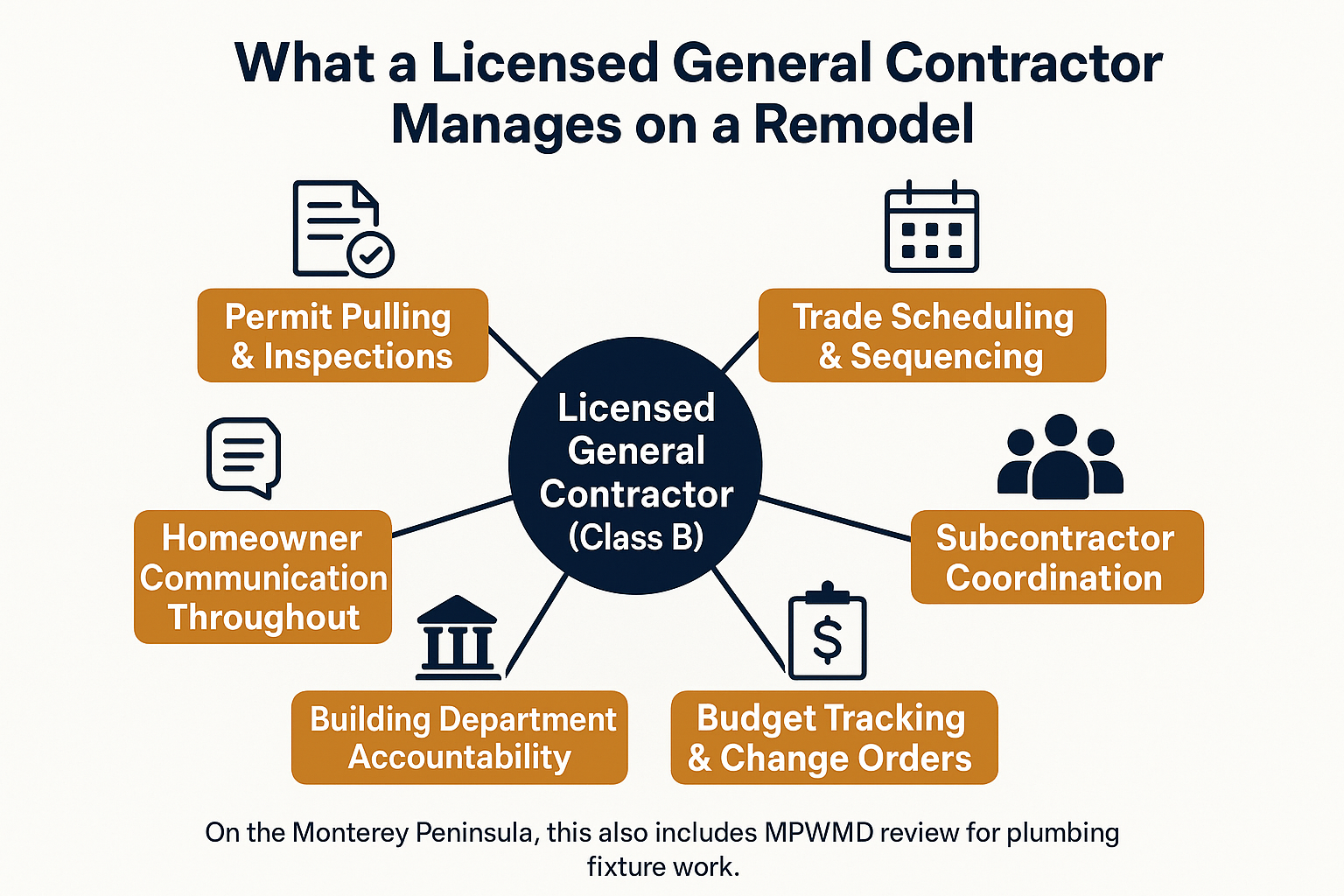
What a GC Is Actually Managing on a Remodel
This is what’s running in the background on a well-managed remodel, even when it looks calm from the outside.
Trade Coordination Is the Core of the Job
Here’s where the real value of a GC shows up, and where projects without one tend to fall apart. On a kitchen or bathroom remodel, the trades don’t just work alongside each other. They work in a specific order, and if that order breaks down, the whole schedule breaks down.
Rough plumbing has to be in before the walls close. Electrical rough-in has to pass inspection before insulation goes in. Tile can’t go down until the substrate is right. When something gets out of sequence, you end up pulling out finished work, paying twice, and waiting for inspectors to come back out.
A GC holds that sequence together. We book trades in the right order, confirm inspections are scheduled before the next phase starts, and stay on top of material lead times so a backordered tile doesn’t stall three other trades. For a detailed breakdown of how that sequencing works in a kitchen specifically, the order of operations in a kitchen remodel is a good place to start.
The trades we bring in matter too. One homeowner who went through a full renovation in Monterey described it this way in his review: the GC’s subcontractors, from flooring to electrical to plumbing, were ‘top notch,’ and every single one showed up with a positive attitude. That consistency doesn’t happen by accident. It comes from a GC who has vetted those relationships over time and has skin in the game when they perform well or poorly.
What Active Involvement Actually Looks Like
One complaint I hear from homeowners who’ve had bad experiences is that the contractor was present and engaged at the beginning, then seemed to disappear once demolition was done. The job was technically progressing, but nobody was showing up to check the work, answer questions, or flag problems early.
A GC’s job doesn’t end after demo. It runs through every phase:
- Pre-construction: scope review, permit applications, trade booking
- Demo and rough work: daily or near-daily site presence, rough inspection scheduling
- Mid-project: confirming work passes inspection before the next trade moves in
- Finish phase: material arrivals, installation sequencing, punch list management
- Final walkthrough: confirming everything matches the scope before the project closes
Reviews of well-run projects come back to this point consistently. One longtime customer noted that the communication ran ‘before, during, and after the work,’ not just at the start. Another described the owner as ‘always approachable and open to feedback’ throughout the project. That’s what hands-on project management actually looks like in practice.
When something unexpected comes up mid-project, and on any real remodel, something always does, you want a GC who is still showing up, not one who handed the job off after the first week.
Hiring a GC vs. Hiring Trades Separately: What Changes
This comparison covers the practical differences most Monterey homeowners don’t think about until they’re already in the middle of a project.
| Factor | Licensed General Contractor | Hiring Trades Separately |
|---|---|---|
| Permit responsibility | GC pulls permits, schedules inspections, is on record with building department | Homeowner is typically responsible for coordination |
| Trade sequencing | GC manages order of operations and schedule dependencies | Homeowner coordinates timing between trades |
| Single point of contact | One contract, one person accountable for the full scope | Multiple contracts, multiple people to manage |
| MPWMD review (Peninsula) | Experienced GC knows to include this in the permit timeline | Easy to overlook, can delay project by weeks |
| License authorization | Class B license covers multi-trade projects under one contract | Each trade limited to their own scope only |
| Budget tracking | GC tracks against the original proposal, documents changes formally | Changes handled informally, easier to lose track |
How the Bid Process Signals What’s Coming
Before a project starts, the bid document tells you a lot about how the project will actually run. A well-structured proposal should show every line item clearly, with allowances that are realistic, not lowballed to look competitive and then padded with change orders later.
One Monterey homeowner who went through three general contractors before finding the right fit described what finally worked: ‘The bid process was very transparent, with everything documented online.’ That kind of clear, itemized scoping, where every finish and every allowance is explained before work begins, is what separates a well-planned project from one that turns into a change-order spiral.
When you’re evaluating a GC, ask specifically how their proposals are structured. Are allowances itemized or lumped into a single number? Are the line items explained, or do you have to ask about each one? A contractor who can walk you through every line of the bid is showing you exactly how they’ll communicate once the project starts. For more on reading a bid document, how a general contractor’s bid process reveals more than the price goes deeper on what to look for.
For a broader look at what questions to ask before signing, what homeowners should ask before signing with any contractor is worth reading before you get to that point.
Frequently Asked Questions About Hiring a General Contractor in Monterey
Do I need a general contractor for a bathroom remodel, or can I just hire a plumber and tile setter?
For a basic swap, like replacing a faucet or re-tiling a shower with no layout changes, you might get by without a GC. But if the project involves moving plumbing, updating electrical, removing walls, or touching any structural elements, you’re looking at a multi-trade job that needs a licensed GC to manage legally and correctly. Most full bathroom remodels on the Monterey Peninsula fall into that category.
Who handles permits when I hire a general contractor?
In most cases, the GC pulls the permits and is the responsible party with the building department, not the homeowner. That means if something fails inspection, the accountability sits with the GC, not you. This is one of the clearest practical differences between hiring a licensed GC and managing trades yourself.
What is the Monterey Peninsula Water Management District, and does it affect my remodel?
The MPWMD is a regional agency that regulates water use across the Monterey Peninsula. If your remodel in Monterey, Pacific Grove, or Carmel-by-the-Sea involves adding or replacing plumbing fixtures, the project may need MPWMD review in addition to a standard building permit. A GC who regularly works in this area will know to factor that into the permit timeline from the start. One who doesn’t can delay the project by several weeks by missing that step.
How do I verify a contractor’s license in California?
You can look up any contractor’s license status and classification on the California Contractors State License Board website. Check that the license is active, confirm the classification (look for Class B for multi-trade residential work), and verify that the name on the license matches who you’re contracting with.
What should I look for in a GC’s proposal before I sign?
Look for itemized line items with allowances clearly explained, not a single lump sum. Every finish material, subcontractor scope, and contingency allowance should be listed and explained. A proposal that shows its work is a strong signal that the contractor will communicate the same way once construction starts. Vague or bundled estimates are often where unexpected costs come from later.
Does a general contractor in Monterey handle older homes differently?
They should. A lot of the housing stock in Monterey, Pacific Grove, and Carmel was built in the mid-20th century, and older homes regularly turn up surprises once walls open: outdated wiring, galvanized plumbing, subfloor issues, or materials that require specific handling. An experienced local GC builds realistic contingency into the budget for this, rather than pricing as if the walls will be clean. That’s part of what clear budgeting practices look like on the Central Coast.
Ready to Talk Through Your Project?
If you’re planning a remodel in Monterey County and want to understand what the process actually looks like before committing to anything, Palacios Construction is available to walk through the scope with you. Reach the team at palaciosconstructionca.com or by phone at (831) 220-3334.