Direct Answer: California’s 2025 Energy Code applies to any building permit submitted on or after January 1, 2026 — including permits for remodels, additions, and ADUs, not just new construction.
A lot of homeowners planning a remodel this year have been surprised when their contractor starts talking about energy compliance. They came in expecting a conversation about cabinets or tile, and suddenly there’s discussion about heat pumps and ventilation standards. That’s not a contractor overcomplicating things — it’s the California 2025 Energy Code doing exactly what it was designed to do.
The 2025 Title 24 standards took effect January 1, 2026, and they apply to every permit application submitted on or after that date. That includes kitchen remodels, bathroom remodels, room additions, and ADUs right here in Monterey County. This is not a code that only matters for new construction down the road.
What follows is a plain-language explanation of what the new code actually changes, which projects it reaches, and what it means practically for homeowners who are planning permitted work in 2026. I’ll keep this focused on the pieces that actually affect the projects we see most often on the Monterey Peninsula — not a full code walkthrough, but the parts you need to understand before permits get submitted.
Which Projects the 2025 Energy Code Actually Reaches
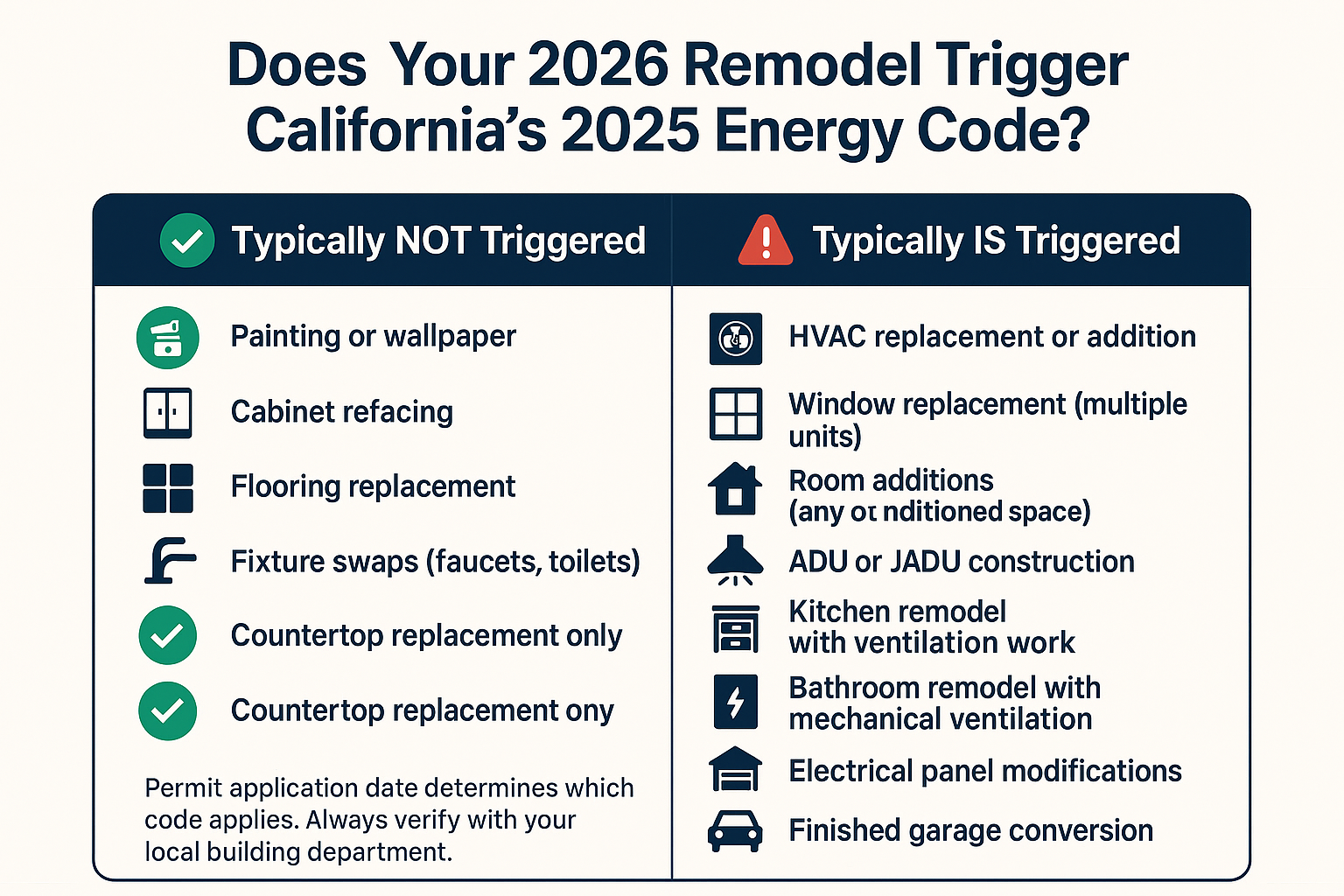
The most important thing to understand is that scope determines whether the code applies — not the fact that you’re remodeling. Cosmetic work generally doesn’t trigger Title 24 compliance. If you’re painting, refacing cabinets, replacing flooring, or swapping out a faucet, you’re typically not pulling a permit that brings the new energy standards into play.
But once a project crosses into work that requires a permit, the picture changes. Here’s where the 2025 code typically becomes relevant:
- HVAC changes — replacing or adding heating and cooling equipment
- Window replacement — especially when swapping multiple units at once
- Room additions — any conditioned space added to the home’s footprint
- Finished garages — converting an unfinished space into livable area
- ADU and JADU construction — covered in full detail below
- Kitchen remodels involving new mechanical ventilation or electrical panel modifications
- Bathroom remodels that include new exhaust fans or mechanical ventilation systems
The permit application date is what determines which code cycle governs a project. If your permit application was submitted and deemed complete before January 1, 2026, your project follows the 2022 standards. Any permit filed on or after that date follows the 2025 standards — full stop.
For anyone mid-planning right now, that window has already closed. The 2025 code is already the applicable standard, and working with a contractor who has already built those requirements into their estimation process saves real time and money compared to discovering a compliance gap at plan check. I’ve seen projects get delayed significantly when energy compliance requirements surface after a permit application is already in.
If you want a broader look at what remodeling projects Monterey County homeowners are actually doing right now, that article covers the current landscape well.
The Three Changes That Matter Most for Remodels
The 2025 code introduced a number of updates, but three areas come up most often in the projects we plan here on the Monterey Peninsula: heat pump requirements, ventilation standards, and expanded GFCI protection.
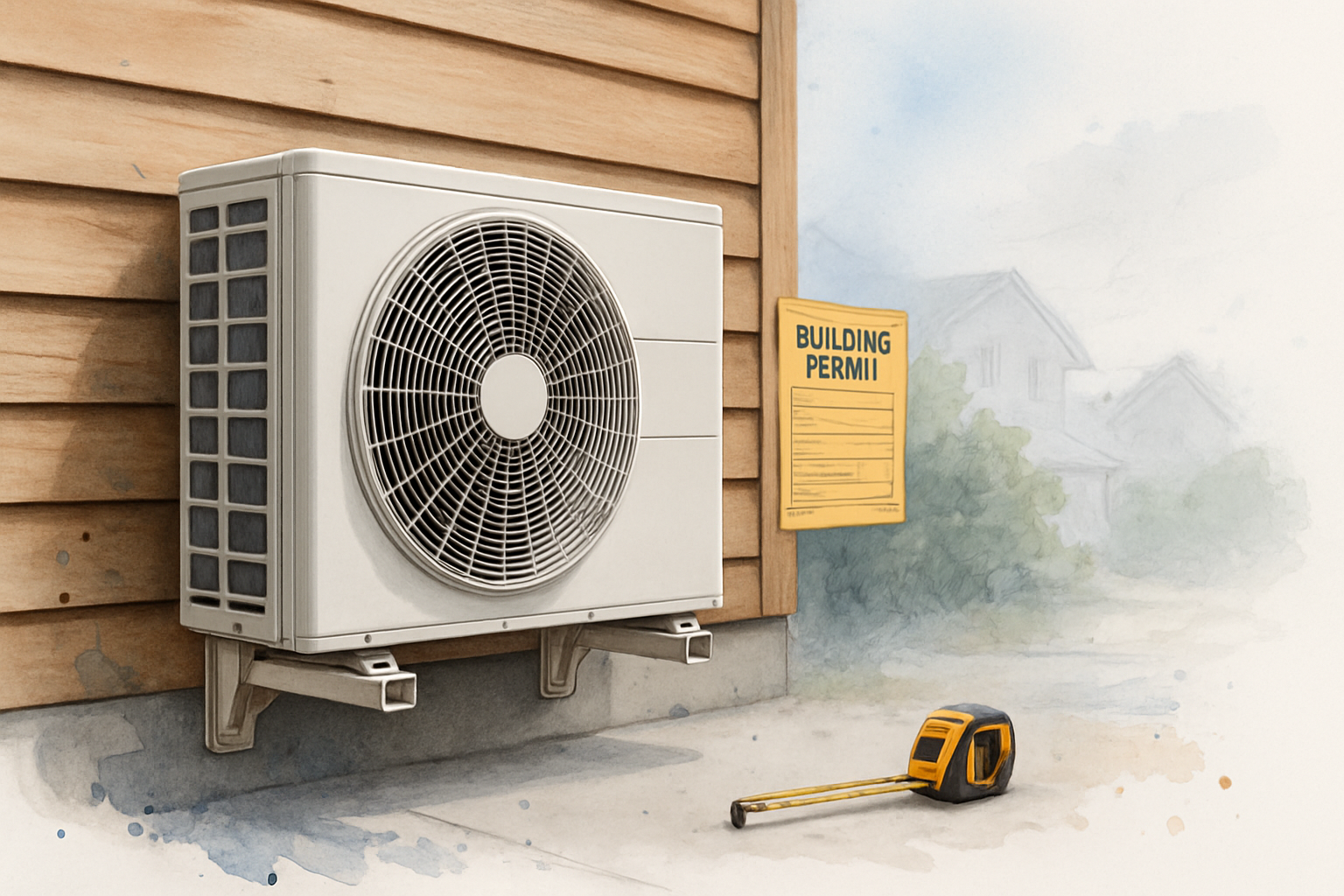
Heat pump requirements are the most significant shift for homeowners doing additions or HVAC replacements. For alterations and additions, the code pushes toward electric heat pump systems as the primary heating source. There are specific rules about how supplementary heat — backup strip heat, for example — can be controlled and sized. This isn’t a blanket ban on gas, but the thresholds and conditions matter, and a contractor who isn’t current on the 2025 cycle may spec equipment that doesn’t pass plan check.
Ventilation standards have tightened in ways that affect both kitchen and bathroom remodels. Whole-home ventilation calculations, exhaust fan requirements, and the way makeup air is handled for range hoods have all been updated. In older Monterey Peninsula homes — many of which were built in the 1950s through 1970s — the existing ventilation was never designed around these standards. That sometimes means additional work to bring a remodel into compliance that wasn’t anticipated in the original budget conversation.
GFCI protection now extends beyond kitchens and bathrooms. Any remodel that adds new electrical outlets in areas previously excluded — certain garage locations, near sinks in utility spaces, crawl space lighting circuits — may require GFCI protection under the 2025 standards. This is a detail that belongs in the preconstruction conversation with your electrician and general contractor, not a mid-project discovery that adds cost and delays inspections.
None of this is designed to make remodeling harder. But it does mean these conversations need to happen before plans are drawn and permits are submitted, not after.
At a Glance: Does Your Project Trigger the 2025 Energy Code?
This quick reference shows which common remodeling scopes typically fall under the 2025 Title 24 standards — and which ones generally don’t.
What the 2025 Code Means Specifically for ADUs in Monterey County
ADUs and JADUs permitted on or after January 1, 2026 must meet the full 2025 Energy Code. The compliance path depends on the type of ADU, but the standards are meaningful regardless.
A detached ADU is treated essentially like a new mini-home from an energy standpoint. The 2025 standards apply to the entire unit — HVAC efficiency ratings, insulation values, window performance, and electrical readiness. This affects both how the unit is designed and what it costs to build correctly.
For attached ADUs and JADUs, the scope is somewhat more targeted, but HVAC and ventilation requirements still apply to the new conditioned space. Garage conversions being converted into JADUs are a common project type we see in communities like Seaside and Marina, and these projects often surface insulation and ventilation gaps that need to be addressed as part of code compliance.
For homeowners currently researching ADU costs, it’s important to understand that energy compliance requirements are a real planning factor — not a line item to be trimmed. A proposal that doesn’t account for the 2025 code’s HVAC and envelope requirements may look more attractive up front, but it will cost more when those items come up at plan check or inspection.
You can read more about how ADU permitting works across different Monterey County jurisdictions — location on the map genuinely affects both process and requirements. And if you’re weighing whether an ADU pencils out financially, what determines whether an ADU makes financial sense is worth reading before you commit to a design.
2025 Energy Code: Key Requirements by Project Type
This table summarizes what the 2025 Title 24 standards generally require across the most common permitted residential project types. Requirements can vary by jurisdiction — always verify with the applicable building department.
| Project Type | Key 2025 Code Areas That Apply | Notes |
|---|---|---|
| Room Addition | Heat pump heating, insulation values, window performance | Conditioned space triggers full envelope compliance |
| Kitchen Remodel (with ventilation) | Exhaust ventilation, makeup air, GFCI expansion | Ventilation calculations updated under 2025 standards |
| Bathroom Remodel (with mechanical ventilation) | Exhaust fan specs, whole-home ventilation impact | Older homes may need additional ventilation upgrades |
| HVAC Replacement | Heat pump requirements, supplementary heat controls | Equipment must meet 2025 efficiency minimums |
| Detached ADU | Full energy envelope: HVAC, insulation, windows, electrical readiness | Treated as new construction for compliance purposes |
| Attached ADU / JADU | HVAC for new conditioned space, ventilation, insulation at boundaries | Scope varies by conversion type |
| Window Replacement | Fenestration performance values (U-factor, SHGC) | Applies when permit is required for the replacement |
Why This Shows Up in Budget Conversations — and Should
One thing I want homeowners to understand is why a good contractor brings up energy compliance during the estimating phase rather than after permits are submitted.
Plan check reviewers at the City of Monterey, Pacific Grove, and Carmel-by-the-Sea — all of which have their own building departments and permitting processes — will flag code deficiencies before a permit is approved. If an energy compliance issue surfaces at that stage, it typically means revised plans, additional fees, and added time before construction can begin. In some cases, it means redesigning HVAC specifications or changing window selections that were already ordered.
We use clear budgeting practices that account for these requirements from the start — realistic line items for compliant HVAC equipment, proper ventilation work, and electrical upgrades where needed. A proposal that ignores the 2025 code might look leaner on paper, but the cost doesn’t disappear; it just shows up later at a worse moment.
The California Energy Commission maintains the full technical documentation for the 2025 standards at energy.ca.gov, and that’s the authoritative source if you want to go deeper than what a blog post can cover. But for the practical question of how these requirements affect your specific project, that conversation needs to happen with a licensed contractor who is current on the 2025 cycle before plans go to plan check.
For a related look at how permit responsibility works in general, who handles permits on a remodeling project breaks that down clearly. And if you want to understand the full sequence of a larger project, the order of operations most homeowners don’t know about is a useful read.
Frequently Asked Questions About the 2025 Energy Code and Remodels
Does the 2025 Energy Code apply if my project started before January 2026 but isn’t finished yet?
What matters is the permit application date, not when construction started or finishes. If your permit was applied for and deemed complete before January 1, 2026, your project follows the 2022 standards. If the permit was submitted on or after that date, the 2025 code governs — regardless of when the actual construction work happens.
I’m just replacing a few windows in my Pacific Grove home. Does that trigger the new code?
It depends on whether the replacement requires a permit and how many windows are involved. In Pacific Grove, window replacement can trigger a permit requirement depending on scope. When a permit is pulled, the 2025 standards for fenestration performance — U-factor and solar heat gain coefficient — apply to the new windows. Your contractor should be specifying compliant products from the start.
Does a bathroom remodel always trigger the energy code?
Not always. A bathroom remodel that involves only cosmetic changes — tile, fixtures, vanity — may not require a permit and therefore may not trigger Title 24 compliance. But if the remodel includes new mechanical ventilation, electrical panel work, or structural changes, a permit is typically required and the 2025 standards apply. The specifics depend on the scope and the jurisdiction.
How does the 2025 code affect what my ADU will cost to build?
The short answer is that it adds requirements that affect real line items — compliant HVAC equipment, insulation values, window specifications, and electrical readiness. A detached ADU is treated like a new home from an energy compliance standpoint, so the full 2025 envelope standards apply. How much this affects total project cost depends on the design, the site, and what equipment is specified. A contractor who builds these costs in from the start will give you a more accurate picture than one who prices the ADU without accounting for compliance.
My contractor hasn’t mentioned the 2025 Energy Code at all. Should I be concerned?
If you’re planning any permitted remodel — a kitchen, bathroom, addition, or ADU — and the 2025 code hasn’t come up in your preconstruction conversations, it’s worth asking directly. Energy compliance requirements affect equipment selection, ventilation design, and electrical scope. Discovering a gap at plan check is more disruptive and costly than addressing it during estimating. A contractor who is current on the 2025 standards should be raising these items before plans are finalized.
Planning a Permitted Remodel or ADU in Monterey County?
If you’re in the planning stages of a kitchen remodel, bathroom renovation, room addition, or ADU anywhere on the Monterey Peninsula, Palacios Construction is available to walk through the project scope and explain what the 2025 Energy Code means for your specific situation — before anything goes to plan check. Reach the team at palaciosconstructionca.com or call (831) 220-3334 to start the conversation.