

Direct Answer: AB 462, effective October 2025, requires local agencies to approve or deny a Coastal Development Permit for an ADU within 60 days. Miss that deadline, and the ADU is deemed approved by law.
If you own property on the Monterey Peninsula and you’ve been putting off an ADU project because of what you’ve heard about the coastal permitting process, I want to share something that changes the picture. Two new California laws, one that took effect in October 2025 and another on January 1, 2026, put real time limits on how long local agencies can sit on a coastal ADU application. That’s a meaningful shift from how this process used to work.
For years, the Coastal Zone was where ADU timelines went to stretch indefinitely. Unlike a standard ADU application, a Coastal Development Permit wasn’t subject to the same shot-clock rules. Local agencies and the Coastal Commission could take months, sometimes much longer, without triggering any automatic approval. That’s changed now.
This article breaks down what the new rules actually say, how they apply to specific jurisdictions on the Peninsula, and what homeowners need to do upfront to take advantage of the shorter timeline.
What AB 462 Actually Changes for Coastal ADU Permits
Before AB 462, the standard 60-day ministerial review clock for ADU applications in California didn’t apply to Coastal Development Permits. A jurisdiction with a certified Local Coastal Program could extend its review without a hard deadline, and homeowners had no real recourse if the process dragged on.
Under AB 462, which took effect in October 2025, that exemption is gone for jurisdictions with a certified Local Coastal Program. Here’s what the law now requires:
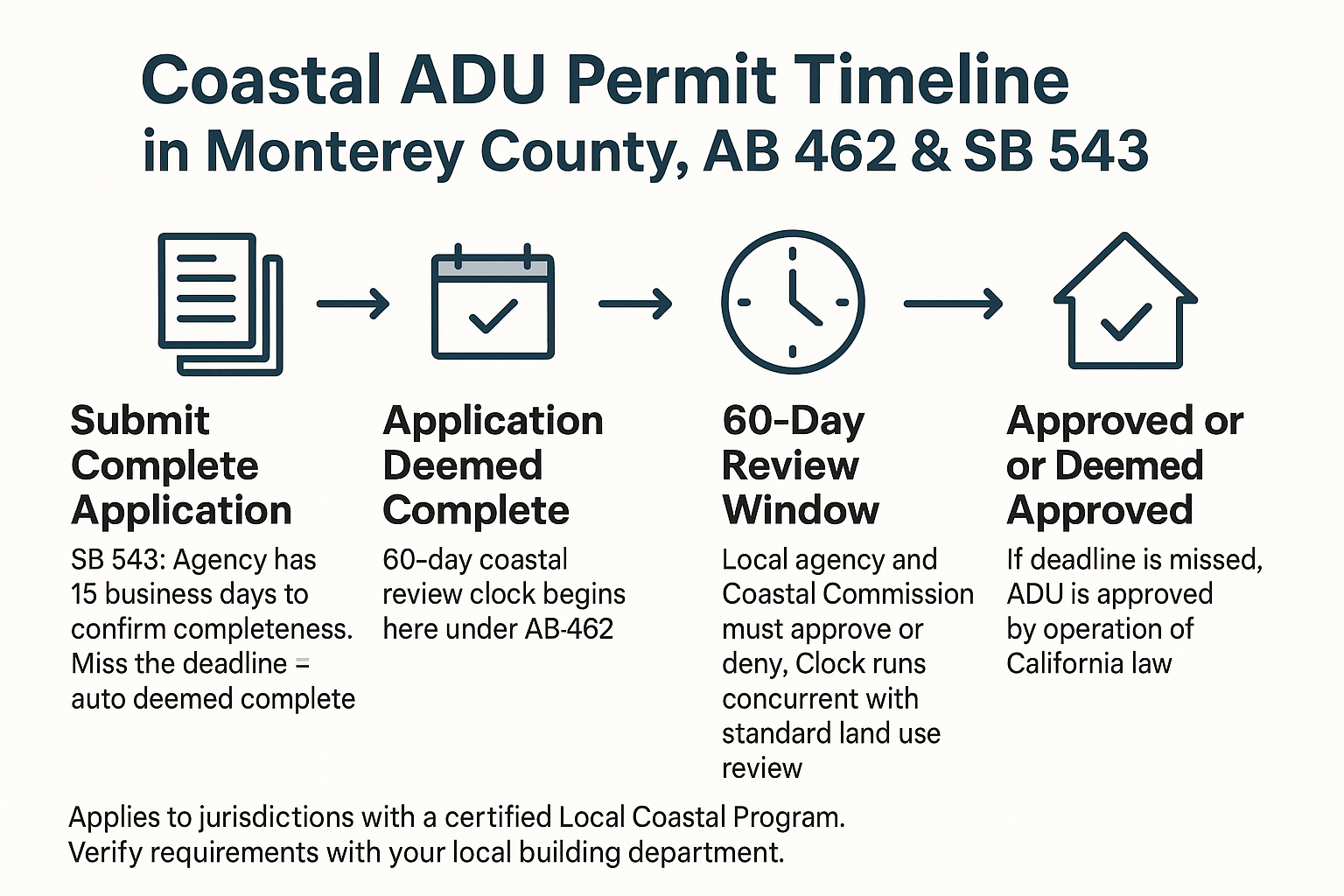
- The local agency must approve or deny the Coastal Development Permit within 60 days of receiving a complete application.
- That 60-day clock runs concurrently with the standard ministerial land use review, not after it.
- If neither the local agency nor the Coastal Commission meets the deadline, the ADU is deemed approved by operation of law.
The practical effect is significant. A project in Pebble Beach, coastal Pacific Grove, or unincorporated coastal Monterey County now has a clear outer boundary on how long the coastal review can take. That’s something homeowners and contractors can actually plan around.
For more context on how state ADU law has evolved locally, the California 2026 ADU law changes and what they mean for Monterey homeowners article walks through the broader picture.
SB 543 and the 15-Day Completeness Rule
A separate law, SB 543, effective January 1, 2026, addresses a problem I’ve seen frustrate homeowners before the 60-day clock even starts. In the past, you could submit an ADU application and wait weeks just to find out whether it was considered complete. That waiting period was open-ended, and it was a real source of delay.
SB 543 changes that statewide, including in Monterey city and county jurisdictions. Now, a local agency must determine whether your application is complete within 15 business days of receipt. If they miss that window, the application is automatically deemed complete, and the review clock starts.
What this means in practice is that the quality of your initial application package matters more than ever. Once an application is submitted, the agency’s ability to extend the process is now limited by law. If your plans are complete, coordinated, and clearly organized, you move forward. If they’re not, you get sent back to start, and you’ve lost time.
That’s why we spend real time on pre-construction planning before anything goes to a building department. A well-prepared submittal doesn’t just look professional, it protects the timeline that state law now gives you. The Holland & Knight summary of California’s 2026 housing laws confirms both AB 462 and SB 543 provisions and is worth reading if you want the legal detail.
Not Every Coastal Property Follows the Same Path
One thing I want to be direct about: being near the ocean doesn’t automatically mean your property is in the Coastal Zone, and the permit pathway depends entirely on which jurisdiction your parcel falls under. This is where a lot of homeowners get confused, and it’s worth being specific.
Here’s how the jurisdictions break down on the Peninsula:
- City of Monterey has its own building department and its own certified Local Coastal Program for parcels within the coastal overlay.
- Pacific Grove operates its own planning and building review process, separate from the county.
- Carmel-by-the-Sea has a city building department with its own local coastal program and a design review process that adds steps not present in other cities.
- Pebble Beach sits within unincorporated Monterey County, meaning ADU applications go through the county’s HCD office at 1441 Schilling Place in Salinas.
- Del Monte Forest parcels follow a different county process than a hillside parcel in Carmel Valley, even though both are unincorporated.
Before you design to a specific square footage or start conversations with a contractor, verify your parcel’s zoning designation and coastal overlay status. The jurisdiction determines which department receives the application and which review steps apply. Getting that wrong at the start costs time and design fees.
For a deeper look at why parcel location shapes the entire process, ADU permitting in Monterey County: why location on the map matters covers this in more detail.
How ADU Permit Review Differs by Monterey Peninsula Jurisdiction
This table summarizes the key differences homeowners should understand before submitting a coastal ADU application. Requirements and timelines vary, and this is a general reference only, not a substitute for verifying current rules with the relevant building department.
| Jurisdiction | Building Department | Coastal Review Applies? | Key Local Consideration |
|---|---|---|---|
| City of Monterey | City of Monterey Building Dept. | Yes, for coastal parcels | Own certified LCP; MPWMD water review required |
| Pacific Grove | City of PG Building Dept. | Yes, for coastal parcels | Separate planning and building process from county |
| Carmel-by-the-Sea | City of Carmel Building Dept. | Yes | Design review adds steps; own LCP in place |
| Pebble Beach / Del Monte Forest | Monterey County HCD (Salinas) | Yes, unincorporated coastal | County ordinance; size limits recently updated |
| Carmel Valley (inland parcels) | Monterey County HCD (Salinas) | Generally no | Coastal Zone does not typically extend inland here |
The Size Limit Change in Unincorporated Coastal Monterey County
There’s one more local development worth flagging for homeowners planning an ADU in unincorporated coastal Monterey County, specifically in the Carmel, Del Monte Forest, and North County planning areas.
In early 2025, the Monterey County Board of Supervisors voted 5-0 on a resolution of intent to align the county’s ADU and JADU ordinance with current state law. That alignment would increase the allowable ADU size in those planning areas from 800 square feet to 1,200 square feet, matching what state law permits.
But, and this is important: that ordinance update still required review by the California Department of Housing and Community Development and the Coastal Commission before formal adoption. If you’re designing an ADU in one of those areas, verify the current size limit with the county HCD office before committing to a floor plan. Designing to 1,200 square feet before the updated ordinance is formally in place could create problems at submittal.
This is exactly the kind of detail that saves a project from an expensive redesign. A contractor who works regularly in Monterey County will know to check current ordinance status before drawings are finalized. It’s a reasonable question to ask any contractor you’re evaluating.
The Coastal ADU Permit Timeline Under the New Laws
This infographic shows how the new AB 462 and SB 543 requirements create a structured, time-limited review process for coastal ADU permits in Monterey County.
What This Means for Pre-Construction Planning
The new laws are genuinely good news for homeowners who’ve been waiting to start an ADU project. But they only help if the application package is solid from the start.
Before anything goes to a building department, there’s real groundwork that needs to happen:
- Verify parcel eligibility and confirm whether the property falls within the Coastal Zone and which jurisdiction controls review.
- Check setbacks under the current local ADU ordinance for your specific planning area, since these vary between cities and county zones.
- Confirm water availability through the Monterey Peninsula Water Management District for any ADU that involves plumbing. This step is easy to overlook and can affect project feasibility. The water permit step Monterey homeowners miss before a bathroom remodel explains how MPWMD review works in more detail.
- Assemble a complete submittal package before going to the building department, including permit-ready plans with structural, electrical, plumbing, and mechanical layouts.
The 15-day completeness window under SB 543 means agencies can send incomplete applications back quickly. A well-organized package moves through that gate without delay. One homeowner we worked with in Pacific Grove had previously submitted an ADU application on their own and received a completeness rejection after nearly three weeks of waiting, because the plumbing plan didn’t include the MPWMD documentation. Starting over cost them close to two months.
For homeowners thinking through the financial side of an ADU alongside the permit process, what determines whether an ADU makes financial sense is a useful read before committing to a design.
Frequently Asked Questions About Coastal ADU Permits in Monterey County
Does AB 462 apply to my property if I’m in the City of Monterey, not unincorporated county?
Yes, if your property falls within the Coastal Zone and the City of Monterey has a certified Local Coastal Program, the 60-day coastal review requirement under AB 462 applies. The law applies jurisdiction-by-jurisdiction based on whether the local agency has a certified LCP, not on whether the property is inside city limits or in the unincorporated county. Verify your parcel’s coastal overlay status with the City of Monterey’s building department before assuming which rules apply.
What happens if the local agency misses the 60-day deadline?
Under AB 462, if neither the local agency nor the Coastal Commission acts within 60 days of a complete application, the ADU is deemed approved by operation of law. In practice, this gives you a legal basis to proceed, but you’d likely need documentation confirming the deadline was missed. This is a significant change from prior law, where the coastal review had no hard deadline.
My property is in Pebble Beach. Is the ADU size limit 800 or 1,200 square feet?
That’s exactly the right question to ask before finalizing any plans. The Monterey County Board of Supervisors voted in early 2025 to align the county ordinance with state law, which would bring the limit up to 1,200 square feet in the Del Monte Forest planning area. But that ordinance update was still pending Coastal Commission review as of the time this article was written. Check current limits with the county HCD office at 1441 Schilling Place in Salinas before designing to a specific square footage.
Do I still need to go through the Monterey Peninsula Water Management District for an ADU?
Yes, if the ADU includes any plumbing, the MPWMD review is a required step for properties within the district’s service area, which covers most of the Monterey Peninsula. This is a separate track from the building permit and can affect both the timeline and, in some cases, project feasibility. It’s one of the steps we work through during pre-construction planning before anything goes to the building department.
I’ve heard coastal permits take forever. Is that really changing with these new laws?
The new laws create real, enforceable deadlines where none existed before. Whether that translates to faster projects in practice will depend on how individual jurisdictions respond and how complete applications are when submitted. But yes, the legal framework is meaningfully different now. A project that gets stuck past 60 days after a complete application now has a statutory backstop. That’s a real change, not just a policy suggestion.
Can a general contractor handle the permit application, or do I need to hire a separate permit expediter?
A licensed general contractor who works regularly in Monterey County can handle the application process as part of the project, and often does. The key is experience with the specific jurisdiction. Monterey, Pacific Grove, Carmel, and the county all have different building departments, different review processes, and different requirements for what a complete submittal looks like. Asking a contractor directly how many ADU permits they’ve pulled in your specific city or planning area is a fair and useful screening question.
Ready to Talk Through Your Coastal ADU Project?
If you’re a Monterey County homeowner with a property in or near the Coastal Zone, the permit landscape just shifted in your favor. But the benefit of the new timelines only shows up when the application is complete and correct from the start. We work with homeowners across the Peninsula, from Pacific Grove to Pebble Beach to Carmel-by-the-Sea, and we know how each jurisdiction’s process actually runs. If you want to talk through your specific parcel situation and what pre-construction planning looks like for your project, reach out to us at palaciosconstructionca.com or call (831) 220-3334.