
Direct Answer: Starting January 1, 2027, SB 1117 limits local impact fees on an 850 sq ft ADU to the 100 square feet above 750. ADUs of 750 sq ft or less stay fully exempt.
For years I have watched Monterey County homeowners shrink a perfectly good ADU plan down to 750 square feet for one reason: the fee cliff. Go one inch over and some jurisdictions charged impact fees on the entire unit, not just the extra space.
That changes on January 1, 2027. Governor Newsom signed SB 1117 (Cervantes) on September 29, 2026, and it was chaptered as Chapter 809, Statutes of 2026.
I want to walk through exactly what the new math looks like on an 850 square foot unit, who it applies to, and why the date you pull your permit now matters more than it used to.
What SB 1117 actually changed about California ADU impact fees
SB 1117 amends Section 66311.5 of the Government Code. You can read the chaptered text yourself on California Legislative Information.
Two things to understand:
- Existing law already exempts an ADU of 750 square feet or less of interior livable space from most local impact fees. SB 1117 keeps that exemption exactly as it is.
- For up to two ADUs on a lot, the new law limits impact fees on larger units to only the square footage above 750 feet, instead of the whole unit.
So the exemption does not disappear the moment you cross the line. It stays in place for the first 750 square feet, and fees apply only to what sits above it.
The change applies to local agencies, special districts, and water corporations statewide. That includes Salinas, the cities on the Peninsula, and unincorporated Monterey County.
As California YIMBY put it when the bill was signed, this removes an arbitrary fee cliff and should help produce more family sized ADUs. That matches what I hear on the phone. People do not want a studio. They want a unit a parent or an adult child can actually live in.
If you are still working out the basics of unit size and placement, our breakdown of ADU requirements in Monterey County covers setbacks, size limits, and utility hookups.
The math on an 850 square foot ADU
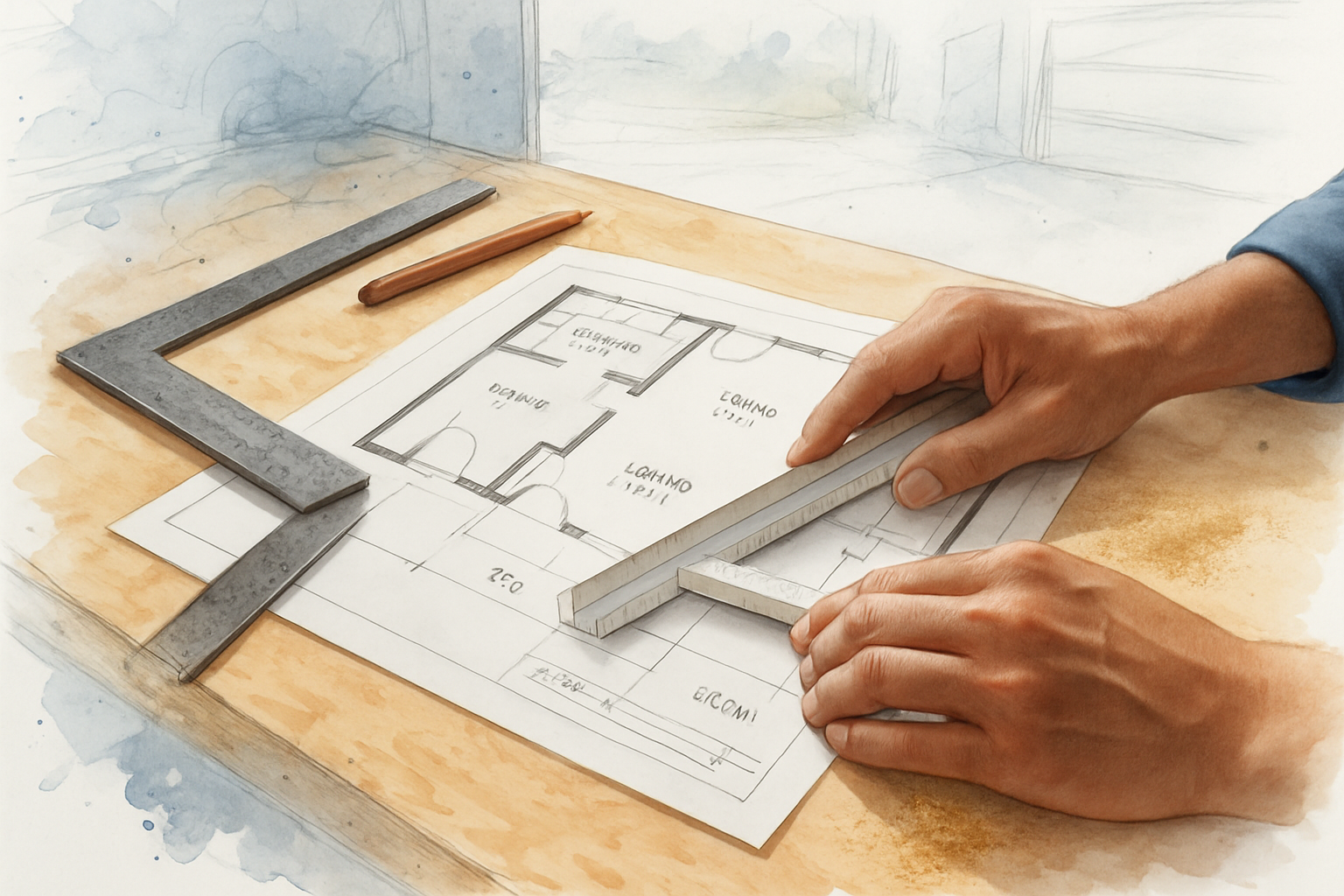
Here is why this matters in real dollars. Impact fees in many California jurisdictions are charged per square foot, covering things like parks, traffic, and public facilities.
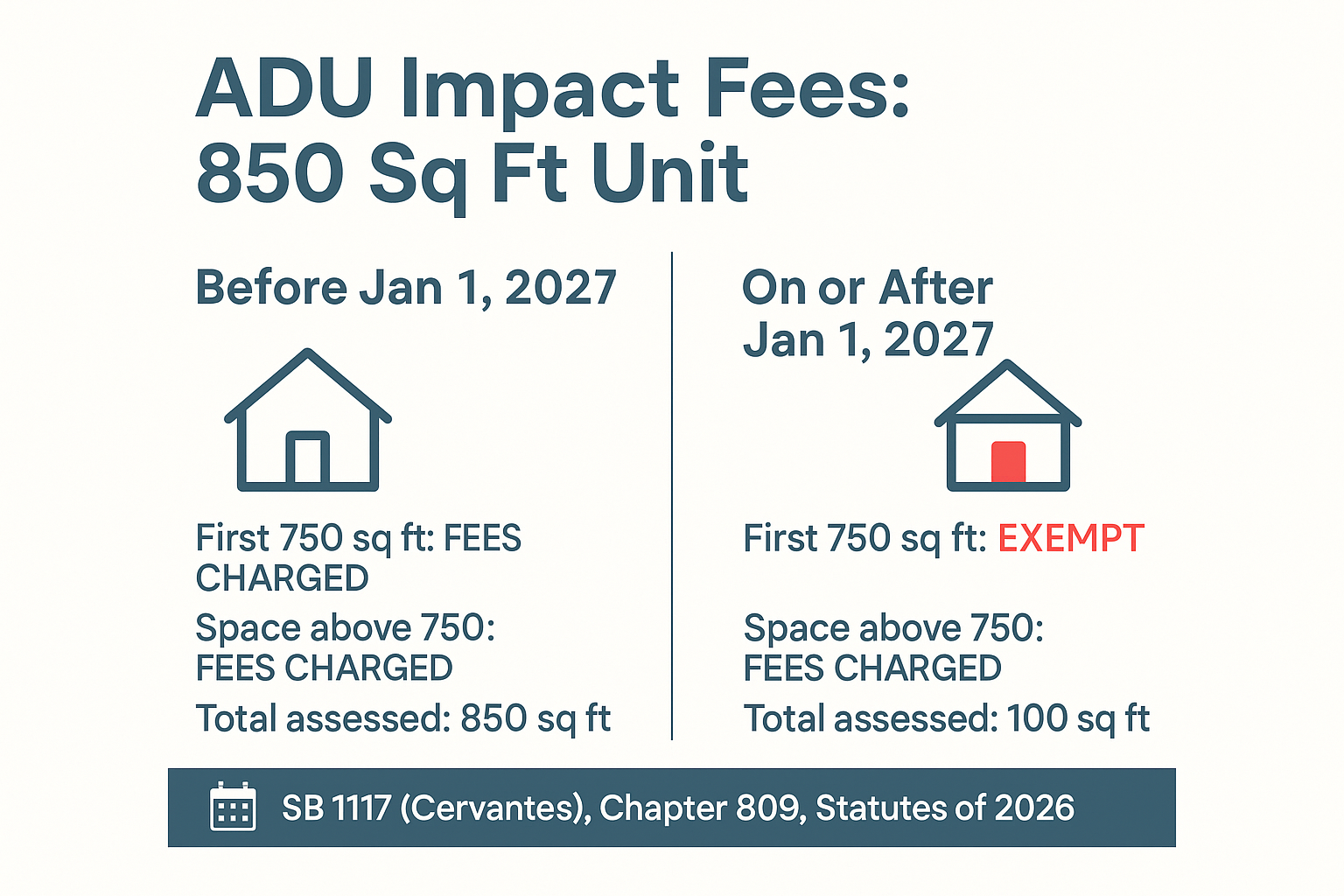
Under the old approach, an 850 square foot ADU could be assessed on all 850 feet. Under SB 1117, the assessment applies to the 100 square feet above 750.
I am not going to quote you a per square foot rate, because it varies by city, by district, and by which agencies have jurisdiction over your parcel. What I can tell you is that the difference between paying on 850 feet and paying on 100 feet is meaningful, and in many cases it runs into the thousands.
A few things that drive your actual number:
- Which agencies levy fees on your parcel. A home in Salinas has a different mix than one in unincorporated Carmel Valley.
- Whether a special district or water corporation is involved. SB 1117 covers those too.
- Interior livable space, which is the measurement that counts, not the roof footprint.
- How many ADUs are on the lot. The relief covers up to two.
Before you assume a number, call the building department that will issue your permit and ask for a current fee schedule. Requirements and fee structures vary by jurisdiction, and the only reliable figure is the one that agency gives you in writing.
How ADU impact fees compare before and after January 1, 2027
This is a simplified look at how the square footage subject to impact fees changes. Actual fees depend entirely on your jurisdiction’s schedule.
| ADU interior livable space | Common treatment before 2027 | Treatment for permits on or after Jan 1, 2027 |
|---|---|---|
| 600 sq ft | Exempt from most local impact fees | Exempt, unchanged |
| 750 sq ft | Exempt from most local impact fees | Exempt, unchanged |
| 850 sq ft | Fees charged on all 850 sq ft in many jurisdictions | Fees charged on 100 sq ft |
| 1,000 sq ft | Fees charged on all 1,000 sq ft in many jurisdictions | Fees charged on 250 sq ft |
| 1,200 sq ft | Fees charged on all 1,200 sq ft in many jurisdictions | Fees charged on 450 sq ft |
The fee cliff versus the new math
A side by side look at how the same 850 square foot ADU is treated before and after the law takes effect.
Why your permit timing matters now
The law was announced on September 29, 2026 and takes effect January 1, 2027. Projects permitted on or after that date get the new math.
If you are planning a unit over 750 square feet, that single date can change your budget more than any finish selection will. I would rather a client hold an application a few weeks than lose the benefit by a day.
But here is the part people underestimate. Getting to a permit takes time, and that time is not evenly distributed:
- Measurements and plan development typically run a few weeks at minimum, longer for anything structural.
- Plan check depends entirely on the jurisdiction’s current queue.
- Corrections and resubmittals are normal, not a sign something went wrong.
One homeowner on a recent project told us the city review stretched much longer than expected, even on a small scope. That is Monterey County reality, and it is why I build review time into the schedule instead of pretending it will not happen.
If you want a realistic picture of the full arc, we laid it out in how long an ADU takes in Monterey County. And for context on the other rule changes that landed recently, see our notes on California’s 2026 ADU law changes.
What this does not change on the Monterey Peninsula
Impact fees are one line on a long list. SB 1117 does not touch the rest of it, and I want to be straight with you about that.
Things that still apply:
- Water permitting. Plumbing related work on the Peninsula runs through the Monterey Peninsula Water Management District, and water credits can be the single hardest part of an ADU here.
- City design review. Carmel-by-the-Sea and Pacific Grove both have their own processes, and a historic listing adds another layer.
- Septic capacity on parcels outside sewer service. Some lots need a system upgrade before a second unit is approved at all.
- Building permit and plan check fees, which are separate from impact fees.
On septic, I have seen this stop projects cold in Carmel Valley and Prunedale. Our piece on when a Monterey County ADU needs a septic upgrade first explains how that gets evaluated.
Verify every one of these with the agency that has jurisdiction over your parcel. Two homes a mile apart can face different requirements.
How I’d think about size now
The fee cliff pushed a lot of people into a size they did not actually want. That pressure is easing, but bigger is not automatically better.
Questions I ask homeowners before we settle on square footage:
- Who lives there, and for how long? A unit for a parent has different needs than a long term rental.
- What does the lot allow after setbacks, access, and usable yard space?
- What does each added foot actually cost to build? Impact fees are a fraction of the total. Framing, roofing, finishes, and utilities scale too.
- Would a Junior ADU do the job? Our junior ADU explainer covers when that makes more sense.
- Is a garage conversion the faster path? Here is what to expect from a garage conversion.
When we price an ADU, we use realistic allowances rather than lowball numbers, and every finish and line item gets explained from day one. Clear budgeting practices are the only way a homeowner can compare one proposal to another and actually understand what they are looking at.
Frequently Asked Questions About the 2027 ADU Impact Fee Change
Does SB 1117 apply to ADUs already under construction?
The new treatment applies to projects permitted on or after January 1, 2027. If your permit was already issued under the old rules, the fees charged at that time stand. Confirm with your issuing agency.
Is the 750 square foot exemption still in place?
Yes. An ADU of 750 square feet or less of interior livable space remains exempt from most local impact fees. SB 1117 did not reduce that exemption, it extended partial relief to larger units.
What if I want to build two ADUs on my lot?
The law applies to up to two ADUs on a lot. Whether your parcel can actually support two units is a separate question that depends on zoning, setbacks, water, and septic or sewer capacity.
Do water district charges count as impact fees under this law?
SB 1117 applies to local agencies, special districts, and water corporations. That said, water permitting on the Monterey Peninsula involves more than fees, and the Monterey Peninsula Water Management District has its own requirements. Ask the district directly about your parcel before you budget.
Should I delay my application to get the new fee treatment?
If your unit will exceed 750 square feet and you are close to the date, it is worth running the numbers both ways. For a unit at or under 750 square feet, nothing changes and there is no reason to wait.
Thinking through ADU size and timing for 2027?
If you own property in Monterey, Pacific Grove, Salinas, Carmel Valley, or anywhere else in Monterey County and you are weighing a unit above 750 square feet, the permit date is now part of the planning conversation. We handle ADU design, permitting, and construction with hands-on project management from the first site visit through final inspection. You can reach us at (831) 220-3334 or at palaciosconstructionca.com when you are ready to talk it through.