Direct Answer: ADU permitting in Monterey County depends entirely on where your property sits. Different cities and unincorporated areas answer to different agencies, and Peninsula homeowners face additional water permit requirements that don’t apply elsewhere.
The most common thing I hear from homeowners early in the ADU planning process is a version of the same question: “I looked it up online — how hard can it be?” And the honest answer is that the state-level rules are actually clearer than they’ve ever been. But Monterey County is not a single permitting environment. It’s a collection of separate jurisdictions, each with its own building department, planning review process, and in some cases, a completely separate water agency that has to sign off before any building permit gets issued.
Where your property sits on the map determines which of those agencies you’re dealing with. A homeowner in Salinas is working with the City of Salinas. A homeowner in unincorporated Carmel Valley answers to Monterey County’s Housing and Community Development department. And a homeowner in Monterey, Pacific Grove, or Pebble Beach is working with their city’s building department and, in most cases, the Monterey Peninsula Water Management District. Mixing up which agency governs your parcel is one of the earliest and most costly mistakes I see in this process.
This article focuses on the three things that actually determine how your ADU permitting experience goes: which jurisdiction you’re in, whether a water permit applies to your project, and what state law now requires local agencies to do — and how long it takes. If you’re still in the early research phase, understanding why ADU projects run into trouble before construction starts is worth reading first.
Which Agency Actually Governs Your ADU Project
This is the question most homeowners don’t think to ask until they’re already partway into the process. The answer depends on whether your property is inside an incorporated city or in an unincorporated part of the county.
Here’s a basic breakdown of how jurisdiction works across the areas we work in:
- City of Monterey — City of Monterey Building Department and Planning Division; MPWMD water permit required for most ADU projects
- Pacific Grove — City of Pacific Grove Building Department; MPWMD service area applies
- Pebble Beach — Monterey County Building Services (Pebble Beach is unincorporated); MPWMD water permit typically required
- Carmel-by-the-Sea — City of Carmel Building Department; MPWMD applies; design review can add time
- Carmel Valley (unincorporated) — Monterey County Housing and Community Development; water availability varies by area
- Salinas — City of Salinas Building and Planning Departments; no MPWMD overlay
- Marina and Seaside — respective city building departments; outside MPWMD service area
I bring this up not to overwhelm anyone, but because the wrong assumption early on can send you down months of prep work under the wrong set of rules. A contractor or designer who has only worked in Salinas will not know the MPWMD process from experience. And that gap shows up when it matters.
For a deeper look at how to evaluate whether a contractor actually has local experience — not just a local address — this article covers the right questions to ask.
The MPWMD Layer That Catches Peninsula Homeowners Off Guard
If your property is on the Monterey Peninsula, adding an ADU almost certainly means dealing with the Monterey Peninsula Water Management District before your building permit can be issued. This surprises a lot of homeowners because most online ADU guides don’t mention it — they’re written for a generic California audience.
The MPWMD regulates water use across the Peninsula because the region draws from the Carmel River and local groundwater basins, both of which have been under allocation limits for years. Any new plumbing fixture — and an ADU with a kitchen or bathroom definitely qualifies — triggers a review for water availability and requires a valid MPWMD water permit as a prerequisite to the building permit.
What makes this more complicated for Monterey specifically: the City of Monterey’s planning division maintains a residential remodel water waiting list that is separate from the new residential water list. This list exists because water allocations are limited, and demand on the Peninsula consistently exceeds what’s immediately available. For ADU projects in Monterey, getting into that queue is a step that needs to happen early — not after plans are drawn and submitted to the building department.
I’ve seen projects stall for months simply because the homeowner (or their contractor) didn’t know the water permit step existed until plan check flagged it. At that point, the clock resets. Starting the MPWMD process in parallel with design, rather than after it, is one of the most practical things you can do to protect your timeline on a Peninsula ADU project.
If you’re weighing whether an ADU pencils out financially before getting into all of this, this article on what determines ADU financial feasibility walks through the cost and income side of that question.
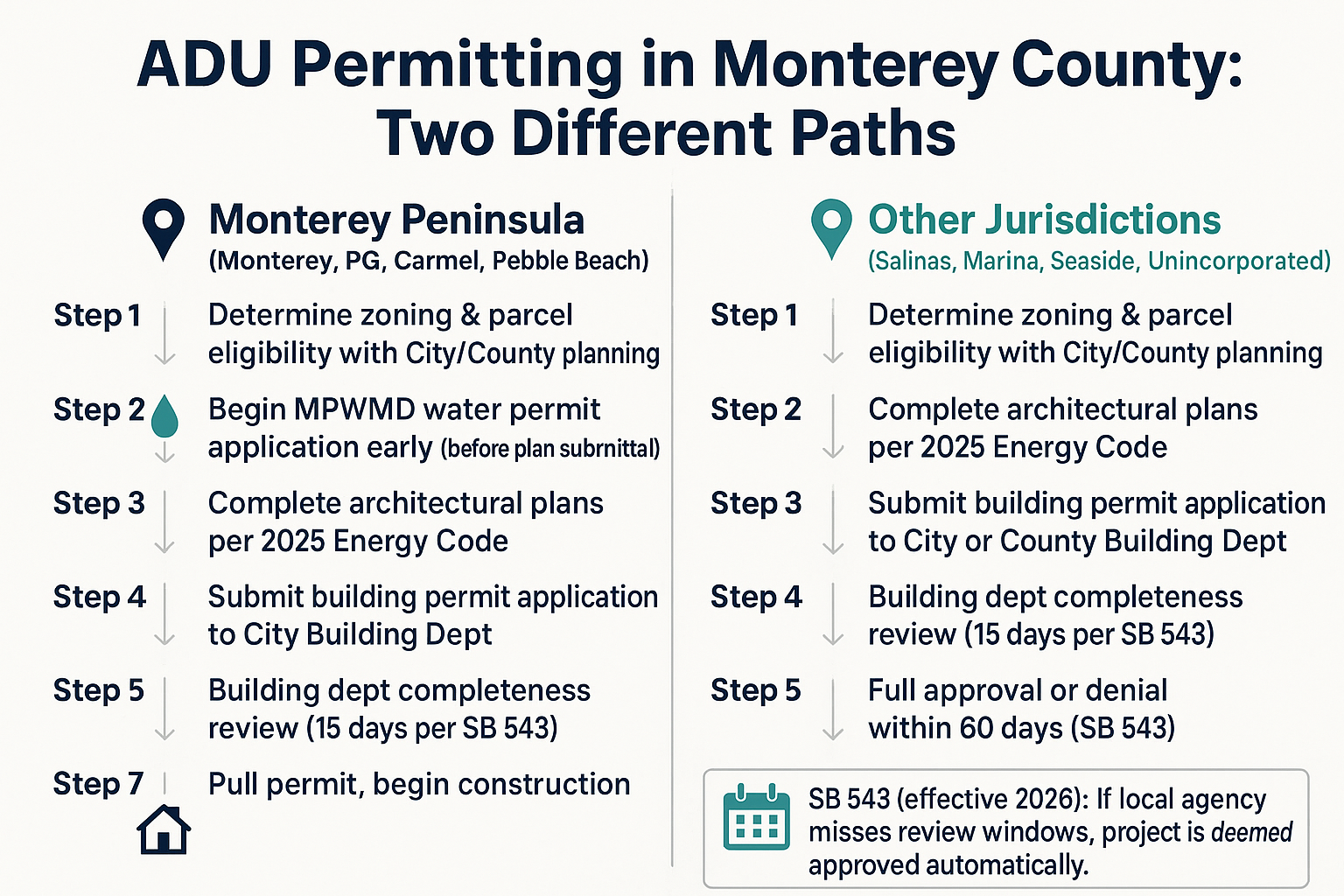
ADU Permitting Path: Monterey Peninsula vs. Other Monterey County Jurisdictions
The steps differ meaningfully depending on where your property is located. This breakdown shows the two most common paths we see in Monterey County.
What SB 543 Changed — and What It Didn’t
State law moved meaningfully in 2026. Under SB 543, local agencies now have 15 days to issue a completeness determination on an ADU application and 60 days to issue a full approval or denial. If they miss those windows, the project is deemed approved by operation of law. That’s a real protection for homeowners, and it’s worth knowing.
But here’s what I tell people when they bring this up: SB 543 sets the clock. It doesn’t start it for you. The 60-day review window doesn’t begin until your application is deemed complete. If your plans are missing information, don’t reflect current code, or haven’t addressed water permit requirements on the Peninsula, you’ll receive a corrections notice — and the timeline resets.
The 2025 California Energy Code is one of the more common sources of corrections right now for detached ADUs. Any detached ADU permitted on or after January 1, 2026 has to meet the full 2025 Energy Code, which means:
- Energy-efficient HVAC systems sized and specified to current standards
- Improved insulation values and window performance ratings
- Electrical readiness requirements — including pre-wiring for EV charging and heat pump compatibility
These requirements apply to the entire unit, not just portions of it. A contractor who is familiar with the 2025 code requirements incorporates them into the plans before submission. One who isn’t discovers them at plan check — which means corrections, redesign time, and a delayed start to that 60-day clock.
Getting the application in right the first time is still the most reliable way to move quickly, even in a streamlined system. This overview of what California’s 2026 ADU law changes mean for Monterey homeowners goes further into the state-level rule changes if you want more detail.
Key Permitting Requirements by Monterey County Jurisdiction
Requirements vary by city and parcel type. This table summarizes the main differences we work with across Monterey County ADU projects.
| Jurisdiction | Governing Agency | MPWMD Water Permit Required? | Notes |
|---|---|---|---|
| City of Monterey | City of Monterey Building & Planning | Yes — water waiting list applies | Separate remodel water list from new residential list |
| Pacific Grove | City of Pacific Grove Building Dept | Yes | Coastal proximity may add design review steps |
| Carmel-by-the-Sea | City of Carmel Building Dept | Yes | Design review process can add timeline |
| Pebble Beach | Monterey County Building Services | Yes | Unincorporated; MPWMD service area still applies |
| Carmel Valley (uninc.) | Monterey County HCD | Varies by area | Check water district coverage for specific parcel |
| Salinas | City of Salinas Building & Planning | No | Standard building permit process; no MPWMD overlay |
| Marina | City of Marina Building Dept | No | Outside MPWMD service area |
| Seaside | City of Seaside Building Dept | No | Outside MPWMD service area |
Who Manages the Permitting Process — and Why It Matters
One question I get from homeowners fairly often is: “Do I need to deal with the building department myself, or does the contractor handle that?”
The short answer is that a licensed general contractor pulls and manages the permits. In California, the CSLB is explicit that the licensed contractor is responsible for the work performed under a permit. That responsibility includes submitting plans, responding to plan check corrections, scheduling inspections at each phase of work, and resolving any issues that come up with the building department.
For an ADU project on the Monterey Peninsula specifically, add the MPWMD process to that list. Knowing how to file that application, when to file it relative to the building permit submission, and how to respond if the water district requests additional information — that’s not theoretical knowledge. It’s procedural experience that comes from having done it before.
A homeowner managing this alone while also working with a design-only firm and separate subcontractors is carrying a significant coordination burden. A general contractor who handles permit management as part of the project removes that burden and reduces the risk of delays caused by incomplete submissions or missed agency requirements.
If you’ve ever wondered who is actually responsible for keeping the permit process on track, this article on contractor permit responsibility explains how California law addresses that question. And if you want to know what to ask any contractor before signing, this homeowner checklist covers the ground-level questions worth asking before any agreement is made.
Frequently Asked Questions About ADU Permitting in Monterey County
Can I find out which jurisdiction my property is in before calling anyone?
Yes. The Monterey County Assessor’s parcel map and your property’s address on the County’s GIS portal will show whether you’re in an incorporated city or unincorporated county land. If you’re in an incorporated city, that city’s building department governs your project. If you’re unincorporated, Monterey County Housing and Community Development is your agency. When in doubt, a quick call to the county building department will point you in the right direction.
How do I know if my project requires an MPWMD water permit?
If your property is in the MPWMD service area — which covers most of the Monterey Peninsula including Monterey, Pacific Grove, Carmel-by-the-Sea, and Pebble Beach — and your ADU will include a kitchen or bathroom, you almost certainly need one. The MPWMD website has a service area map, and their staff can confirm for a specific parcel. The key thing is to check before you finalize plans, not after.
How long does ADU permitting actually take in Monterey County?
Under SB 543, local agencies must issue a completeness determination within 15 days and a full decision within 60 days. But those clocks start only after a complete application is submitted. On the Peninsula, if you need an MPWMD water permit first, that step adds time before you even reach the building permit stage. A well-prepared application submitted to an agency with current availability moves much faster than one that triggers corrections or is waiting on a water allocation. Realistic total timelines vary — a contractor with local experience can give you a more honest range based on current conditions.
Does the 2025 Energy Code apply to my ADU if I already started planning?
If your detached ADU permit is issued on or after January 1, 2026, the 2025 Energy Code applies to the full unit regardless of when you started planning. Attached ADUs and JADUs have slightly different scoping rules. The practical implication is that plans drawn before the code change may need to be updated before submission — something worth confirming with your contractor and the relevant building department.
What’s the difference between an ADU and a JADU for permitting purposes?
A JADU (Junior Accessory Dwelling Unit) is created within the existing walls of a home — often from a bedroom or attached garage — and is capped at 500 square feet. It has its own exterior entrance and must include at least a kitchenette. Because it doesn’t add new square footage to the lot, the permit process is generally simpler than for a detached ADU. MPWMD requirements still apply if new plumbing fixtures are added within the MPWMD service area, but the overall scope and cost of the project tends to be lower.
Can I rent out my ADU once it’s permitted and built?
In most cases, yes — but the rules vary by jurisdiction and unit type. Some cities have short-term rental restrictions that affect ADUs differently than long-term rentals. This article on renting out an ADU in Monterey County covers the rental side of the question in more detail.
Planning an ADU in Monterey County?
If you’re in the early stages of an ADU project — whether you’re in Monterey, Salinas, Pacific Grove, or anywhere else in Monterey County — the jurisdiction question is the right place to start. Palacios Construction works through the full permitting process, including MPWMD coordination on Peninsula projects, as part of well-planned, professionally managed projects from pre-construction through final inspection. Reach out at palaciosconstructionca.com or call (831) 220-3334 to talk through where your project stands.