

Direct Answer: As of January 1, 2026, California home improvement contracts must disclose when subcontractors will be used, provide their license details on request, and include updated cancellation notices with email information.
Most homeowners I sit down with are not nervous about tile or cabinet finishes. They are nervous about signing a multi-page document they do not fully understand for a project that represents a big share of the equity in their house.
That feeling is fair. And as of January 1, 2026, the document itself looks different than it did two years ago. Two bills, SB 517 and AB 1327, were chaptered in October 2025 and amended California Business and Professions Code section 7159, the law that governs residential home improvement contracts.
The changes touch disclosure, cancellation rights, and contact information. I want to walk through what a Monterey County homeowner should now expect to see on paper, because reading it before you sign is a lot easier than sorting it out during demolition.
What Changed in the California Home Improvement Contract Requirements for 2026
The core structure of a California home improvement contract has not been thrown out. What changed is how much a contractor has to tell you, and when.
The short version of the 2026 updates:
- Contractors must disclose when subcontractors will be used on your project
- On request, they must give you the subcontractor’s name, contact information, license number, and license classification
- Those same disclosure rules now apply to change orders, not just the original signed contract
- Every home improvement contract must include a notice telling you that you can ask for that subcontractor information at any time
- Cancellation notice requirements were updated to include email information
A contract signed in 2024 will not have this language in it. If you are comparing an old agreement from a previous project to a new one, that is why they read differently.
None of this replaces the basics. California still requires a written contract for home improvement work over $500, and per the Contractors State License Board, any change to that contract also has to be in writing and easy to understand.
Subcontractor Disclosure Is the Headline Change, and It Matters More Here Than You Think
This is the piece I expect to come up most in conversations this year. A typical Monterey Peninsula remodel is not one crew. It is several.
On a single bathroom reconfiguration in a 1940s Pacific Grove house, you may see a framing crew, an electrician, a plumber, a tile setter, a drywall and texture crew, and a painter. Each one is a separate trade, and some of them require their own license classification to do the work legally.
Under the 2026 rules, you have a written right to know who those people are. That means you can ask for:
- The subcontractor’s business name and contact information
- Their CSLB license number
- Their license classification, meaning what they are actually licensed to perform
Why that matters in practice: an electrical scope should be handled by someone carrying a C-10 classification, and plumbing by a C-36. A general contractor holding a B classification runs the project and can self-perform certain work, but the specialty trades on a permitted remodel are usually subbed out.
One homeowner in Monterey wrote in a public review that every subcontractor brought onto his whole-house renovation, from flooring to electrical to plumbing, was solid. That is the outcome you are checking for. The 2026 rule just gives you a paper trail to verify it before anyone walks through your front door. If you want more on how those roles split up, I covered it in what a general contractor actually does on a remodel.

The Cancellation Window: 3 Days, or 5 If You Are 65 or Older
A lot of my clients on the Peninsula are long-term residents in their sixties and seventies who are renovating instead of moving. This part applies directly to them.
California gives a homeowner a 3-day right to cancel a home improvement contract. That window extends to 5 days when the buyer is 65 or older. The 2026 amendments updated how those cancellation notices have to be presented, including email information.
Here is the part worth flagging. If the cancellation disclosures are missing or do not meet the new requirements, you now have a stated path to file a complaint with the Contractors State License Board.
So read the cancellation language before you sign, not after. A contractor who hands you a current, compliant contract has already told you something about how they run a job. Sloppy paperwork at the start tends to predict sloppy paperwork later.
What to Look For on the Contract Page
This is the quick pass I would make on any residential remodeling agreement in Monterey County before signing it.
| What to check | What it should say | Why it matters |
|---|---|---|
| License number and classification | Contractor’s CSLB number and license class printed on the contract | Lets you verify the license is active and correct for the work |
| Subcontractor notice | A statement that you may request sub names, license numbers, and classifications at any time | Required under the 2026 amendments to B&P 7159 |
| Cancellation notice | 3-day right to cancel, 5 days if the buyer is 65 or older, with updated notice details | Missing or noncompliant language gives you a complaint path with CSLB |
| Scope written by phase | Demolition, rough-in, inspections, finishes, punch list, each described | Vague scope is where disputes usually start |
| Written allowances | A stated dollar allowance per finish category, not a lump placeholder | Tells you whether the budget is realistic or padded low |
| Change order process | How extras get priced, approved, and signed by both parties | Verbal approval during demo is not the standard |
| Down payment terms | No more than $1,000 or 10 percent of the contract price, whichever is less | A CSLB rule on home improvement contracts |
Change Orders: Where Most Remodeling Budget Disputes Actually Start
In my experience, budget arguments almost never start over the original contract. They start over the fourth or fifth thing that got added after work began.
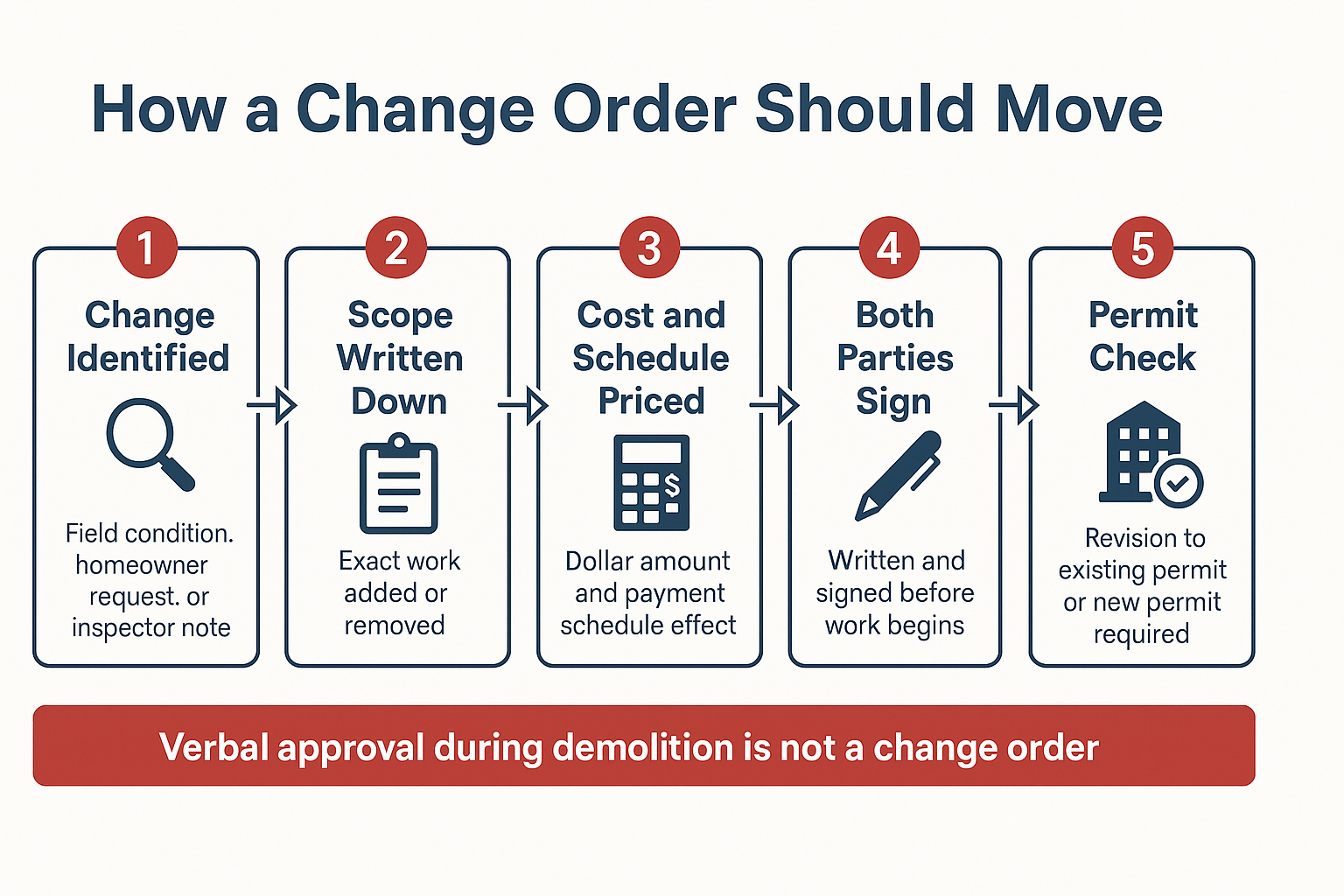
CSLB consumer materials are direct on this. The agreed contract price stands unless a written change order signed by both parties changes it. That written order should describe:
- The scope of the extra or removed work
- The cost added or subtracted
- The effect on the schedule of progress payments
A conversation in the hallway during demolition is not a change order. Neither is a text message saying “go ahead.” Both of those are how a homeowner ends up looking at an invoice they did not expect.
On payments, the rules are also specific. The down payment on a home improvement contract cannot exceed $1,000 or 10 percent of the contract price, whichever is less, and payment for work or materials comes due as the work is performed or the materials are delivered. If someone asks for half up front on a kitchen, that is not how California structures these agreements.
This is separate from the estimate stage. I wrote about that earlier in what a remodeling proposal should actually tell you before you sign. This article is about the signed agreement and the statutory requirements sitting behind it.
How a Change Order Should Actually Move
A change during construction is a paperwork event before it is a construction event. Here is the order it should follow.
In Monterey County, a Paper Change Often Becomes a Building Counter Change
This is the local wrinkle that catches people. A mid-project change on your contract can also be a change to your issued permit.
Monterey County treats a proposed change as major, requiring a new permit, when it:
- Adds 100 square feet or more of space
- Affects structural calculations
- Affects fire and life safety features
Smaller changes can usually be folded into the issued permit as a revision. Moving a non-bearing interior wall or swapping windows and exterior doors typically falls in that category.
County guidance also notes that interior remodels generally do not need a planning permit but do need a building permit. And exterior changes on a parcel carrying a Design Control overlay need Design Approval, which adds review time to the front end.
Plumbing scope has its own layer here. Bathroom and kitchen work on the Peninsula can trigger Monterey Peninsula Water Management District requirements, which I broke down in the water permit step homeowners miss before a bathroom remodel.
Requirements vary by jurisdiction. Monterey, Pacific Grove, Carmel-by-the-Sea, and unincorporated county addresses each run their own process, so verify with the building department that governs your parcel. For how responsibility is usually assigned, see who is responsible for permits on a remodeling project.
Read This Before You Sign
A lot of people reach out to me already mid-process. One homeowner in Salinas wanted a licensed contractor to review and quote a bathroom reconfiguration that was already partly designed. Another had plans in hand and a permit on the way for a partial fire rebuild.
Both situations put a contract in front of someone fast. That is exactly when it pays to slow down for twenty minutes.
Before you sign, confirm you can find all of this on the page:
- License number and classification, printed and verifiable on the CSLB site
- Scope written by phase, not one paragraph summarizing the whole job
- Written allowances for each finish, so you know what tile, fixture, and cabinet budget you are actually working with
- How change orders get priced and approved, in writing, signed by both parties
- The cancellation notice, with the correct window for your age
- Payment schedule tied to work completed, not to calendar dates
If a line item says “allowance TBD,” ask what number is sitting behind it. Placeholder figures are how a proposal comes in low and a final invoice comes in high.
Frequently Asked Questions About California Home Improvement Contract Requirements in 2026
Does the 2026 subcontractor rule mean I get a list of every sub before work starts?
You get a disclosure that subcontractors will be used, plus a notice telling you that you can request their details at any time. When you ask, you should receive the name, contact information, license number, and license classification for each one. That request right also applies to subs added through a change order.
What if my contract does not include the new cancellation language?
Ask the contractor to correct it before you sign. If the disclosures are missing or do not meet the updated requirements, the 2026 amendments give you a stated path to file a complaint with the Contractors State License Board.
Is a written contract required for a small job?
California requires a written contract for home improvement work over $500. That threshold is low enough that most real remodeling work in Monterey County clears it easily, including small bathroom or flooring jobs.
How much can a contractor ask for up front?
On a home improvement contract, CSLB materials state the down payment cannot exceed $1,000 or 10 percent of the contract price, whichever is less. After that, payment comes due as work is performed or materials are delivered.
Will a change order always mean a new permit?
No. Monterey County generally treats a change as major, needing a new permit, when it adds 100 square feet or more or affects structural calculations or fire and life safety features. Smaller items like moving a non-bearing wall are often handled as a revision to the issued permit. Confirm with your local building department, since rules differ across cities on the Peninsula.
Thinking through a remodel in Monterey County?
The legal language is the floor, not the finish. What actually keeps a project predictable is documentation habits: realistic allowances instead of lowball placeholder numbers, every finish and line item explained from day one, and hands-on project management through the whole build rather than just at kickoff. One Monterey homeowner put it plainly in a public review: “The bid process was very transparent, with everything documented online.” Marco S.
Our team is licensed under CA General Contractors License #1071780 B and works throughout Monterey County, from Pacific Grove and Carmel-by-the-Sea out to Salinas and Prunedale. If you are weighing a remodel and want to talk through scope, you can reach us at palaciosconstructionca.com or (831) 998-0046.