
Direct Answer: Usually yes. Pebble Beach ADUs follow California ADU law, but Monterey County planning, Del Monte Forest policies, water district permits, and tree rules decide what a specific lot can actually support.
If you have searched “ADU builder Pebble Beach” or “accessory dwelling unit Monterey CA,” you already know the problem. Almost everything that comes back is a statewide article written for a homeowner with a city building department, a flat lot, and a wide driveway.
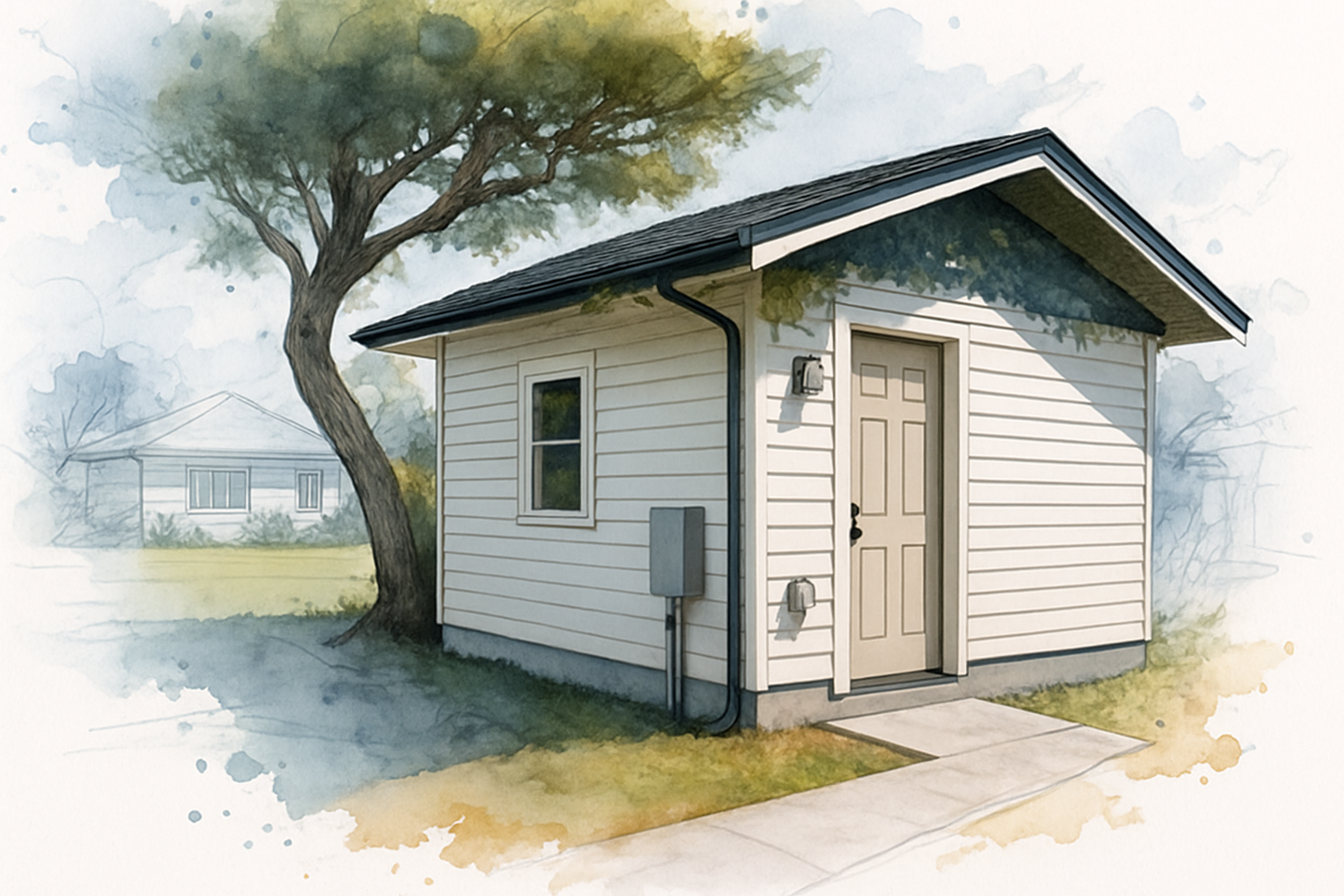
Pebble Beach is none of that. It sits in unincorporated Monterey County, inside the Del Monte Forest area, so county planning plus the Del Monte Forest land use and coastal implementation policies stack on top of the state ADU rules.
The way I explain it to homeowners: California law sets the floor for what is allowed, and the local layer decides whether your particular lot can carry the unit you have in mind. Rules also change and vary by jurisdiction, so confirm anything you read here with Monterey County planning and building before you spend money on drawings.
Why Pebble Beach ADU Requirements Are Not the Same as the State Rules
State ADU law is written to make approval easier. It caps how much a local agency can restrict size, setbacks, and parking, and it puts hard timelines on review.
But state law does not erase the layers that come with a coastal, forested, unincorporated area. In Pebble Beach you are generally dealing with:
- Monterey County planning and building, not a city department
- Del Monte Forest land use and coastal implementation policies, which govern siting and forest resources
- Coastal review, depending on where the parcel sits relative to the coastal zone
- Monterey Peninsula Water Management District requirements when plumbing fixtures are added
- Pebble Beach Community Services District for wastewater
None of those replace state law. They decide how it gets applied to your lot.
I go deeper on the county baseline in this piece on ADU requirements in Monterey County, and on the map question in why location matters for ADU permitting. Read those first if you want the county-wide picture before the Pebble Beach specifics.
Water Capacity Is the First Real Gate
This is the question I want answered before anyone draws a floor plan. Not “what will it cost,” but “does this parcel have water capacity at all?”
The Monterey Peninsula Water Management District serves Pebble Beach as part of unincorporated Monterey County. When a project adds plumbing fixtures, a water permit tied to the parcel’s fixture count generally has to be resolved before the building permit can be issued.
That is a different exercise than the fixture swap math on a bathroom remodel. On a remodel you are often trading one fixture for another. On an ADU you are adding a kitchen, a bath, and sometimes laundry to a parcel that may already be at its limit.
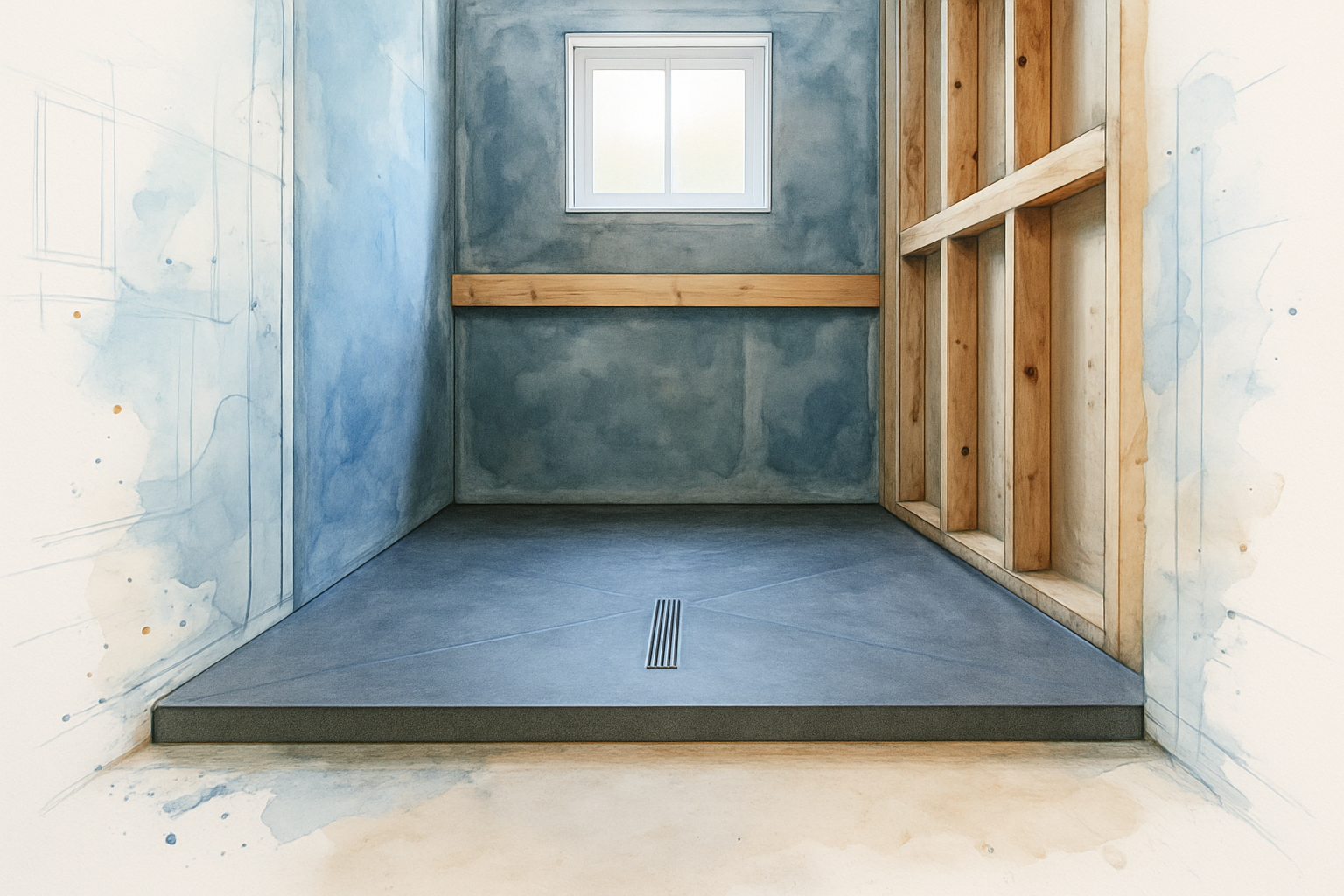
The district also has ADU-specific provisions. It allows permanent submetering of water use into one ADU, and an ADU built inside the existing space of the home or an existing accessory structure is exempt from that submetering requirement. You can read the district’s own explanation of ADU submetering rules directly.
My honest advice: settle the water question early. I have watched homeowners fall in love with a layout that the parcel could not support, and unwinding that is expensive and demoralizing.
Sewer, Not Septic, Changes the Whole Site Work Conversation
Most Monterey County ADU articles spend a lot of time on septic. Inside Pebble Beach, that is usually the wrong conversation.
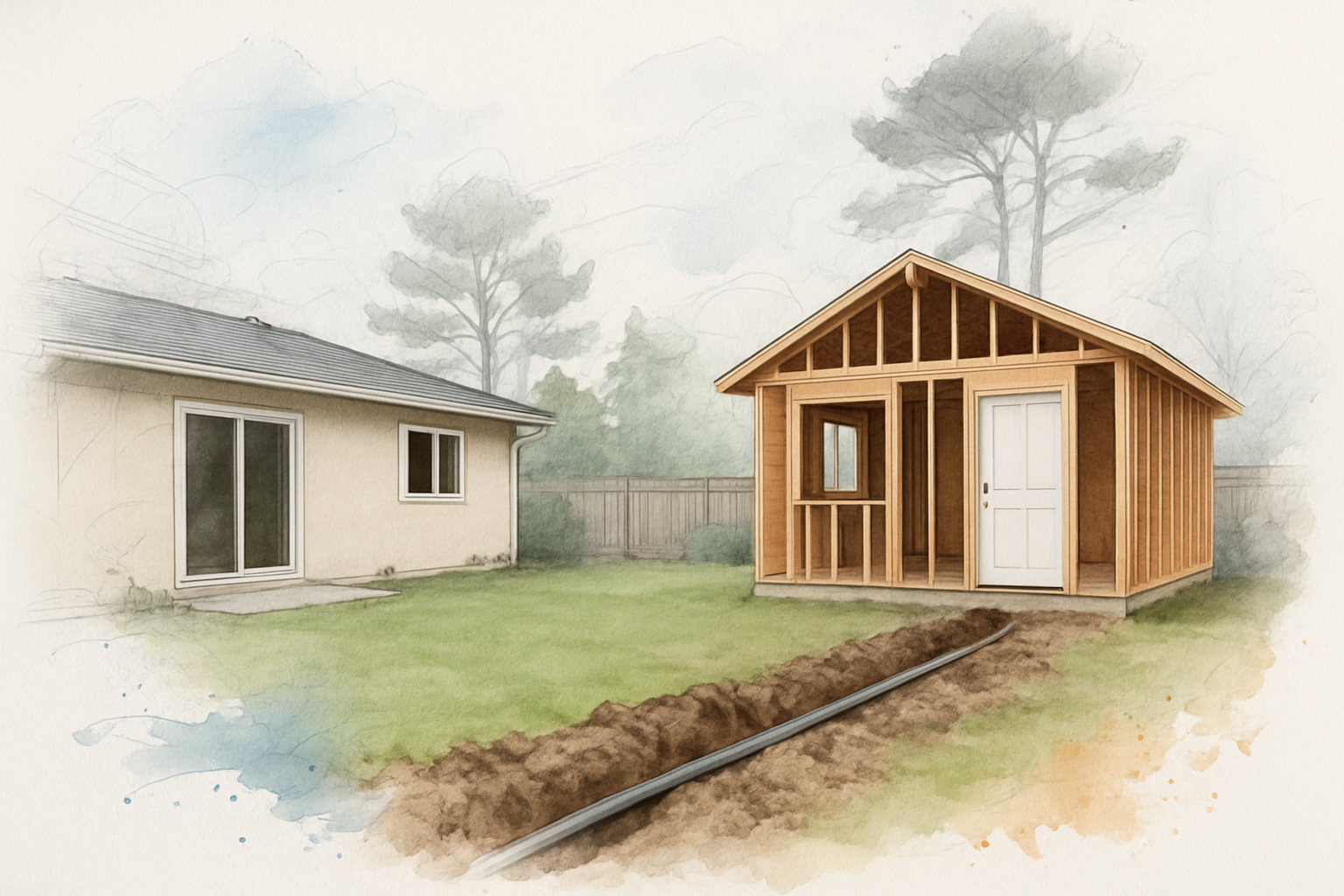
Wastewater collection and treatment in the area is provided by the Pebble Beach Community Services District. So instead of asking whether a septic system needs upgrading, the practical questions become:
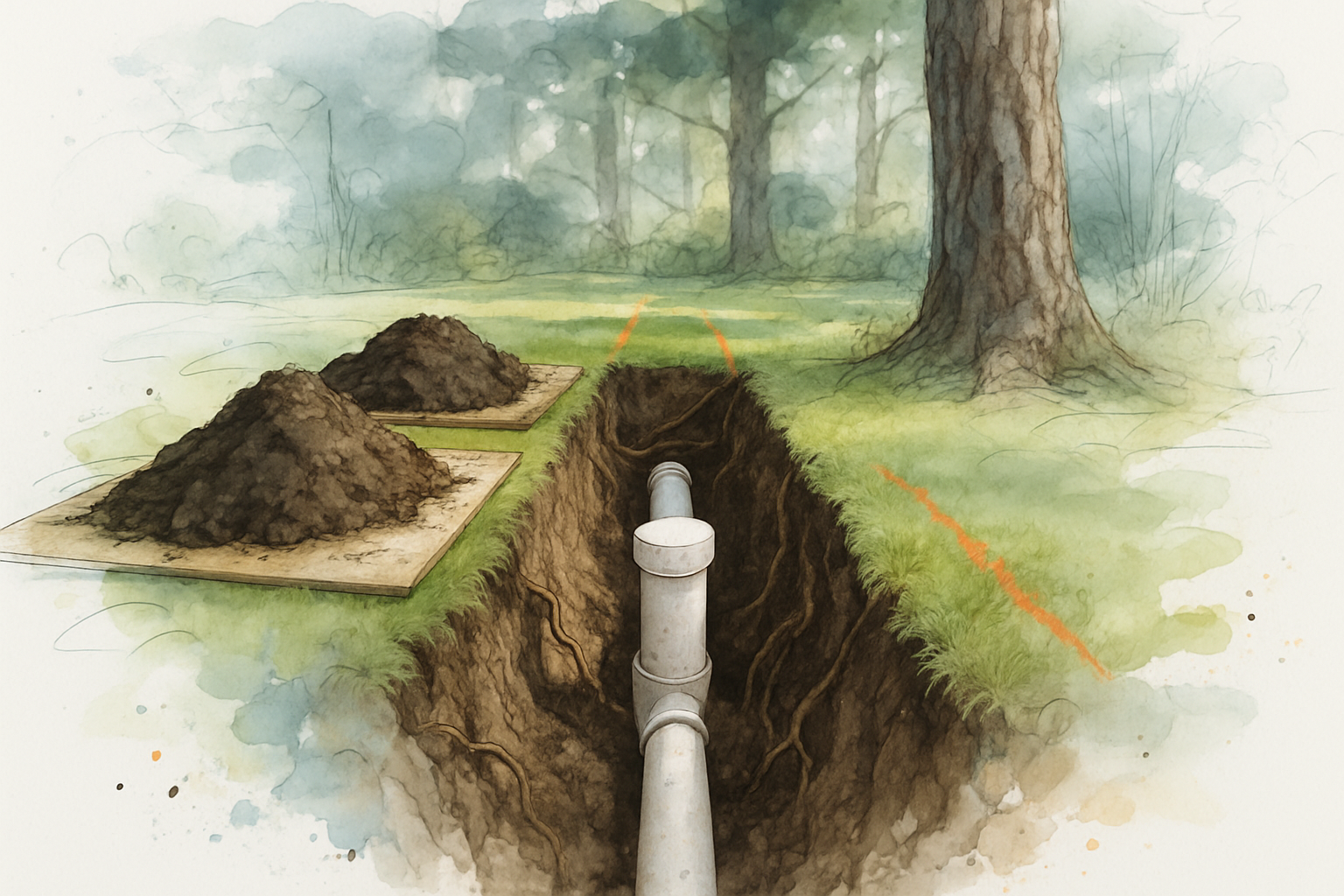
- Where does the existing sewer lateral actually run? Old plans are often wrong.
- Can the ADU gravity feed to it, or does the site need a pump system?
- What connection and capacity charges apply to adding a unit?
- What does the trench route cross? Mature roots, stone hardscape, and established landscaping all add cost and risk.
That last one is the sleeper. A trench that crosses forty feet of lawn is a small line item. The same trench crossing a flagstone patio and the root zone of a protected tree is a different job entirely.
This is exactly why an inland Monterey County ADU brief and a Pebble Beach ADU brief are not the same document. If your property is outside the district and on septic, my article on when a Monterey County ADU needs a septic upgrade first is the one that applies to you.
Inland Monterey County ADU vs. Pebble Beach ADU: What Actually Differs
Here is a side by side of the items that shift the most when the same ADU concept moves from an inland parcel to a Del Monte Forest lot. Details vary by parcel, so treat this as orientation rather than a rule sheet.
| Item | Typical Inland Parcel | Pebble Beach Parcel |
|---|---|---|
| Land use authority | City department or county, single review path | County planning plus Del Monte Forest policies |
| Wastewater | Often septic, capacity study may be needed | Sewer district connection, lateral routing and charges |
| Water | Local supplier, varies by area | Water district permit tied to parcel fixture count |
| Trees | Usually minor or no constraint | Monterey pine and cypress protections shape the envelope |
| Site access | Standard street frontage and driveway | Narrow forest roads, gated entry, limited staging space |
| Front end timeline | Measured in planning steps | More steps, often run in sequence rather than at once |
On a Pebble Beach Lot, Trees and Access Decide Siting More Than Square Footage
Homeowners usually open with a size question. On these lots, size is rarely the binding constraint.
Del Monte Forest is a protected forest setting. Removing or building near Monterey pine and cypress is regulated, which means the buildable envelope is often much smaller than the yard looks when you stand in it.
Then there is getting to the site at all:
- Narrow forest roads limit truck and delivery size
- Gated entry affects sub and delivery scheduling
- Limited staging room means material has to arrive in stages, not all at once
- Fire access requirements influence where a structure can sit and how it is approached
And almost nobody in Pebble Beach is dealing with an empty yard. The inquiries I see from this area routinely involve the rest of the property at the same time: deck rebuilds, fence repair, and corrosion repair on exposed exterior elements that the marine air has been working on for years.
So the ADU footprint has to coexist with what is already standing. That is a design problem, not a paperwork problem, and it is worth solving on paper before permits. If you are weighing configurations, my breakdown of attached versus detached ADUs walks through how lot shape drives that choice.
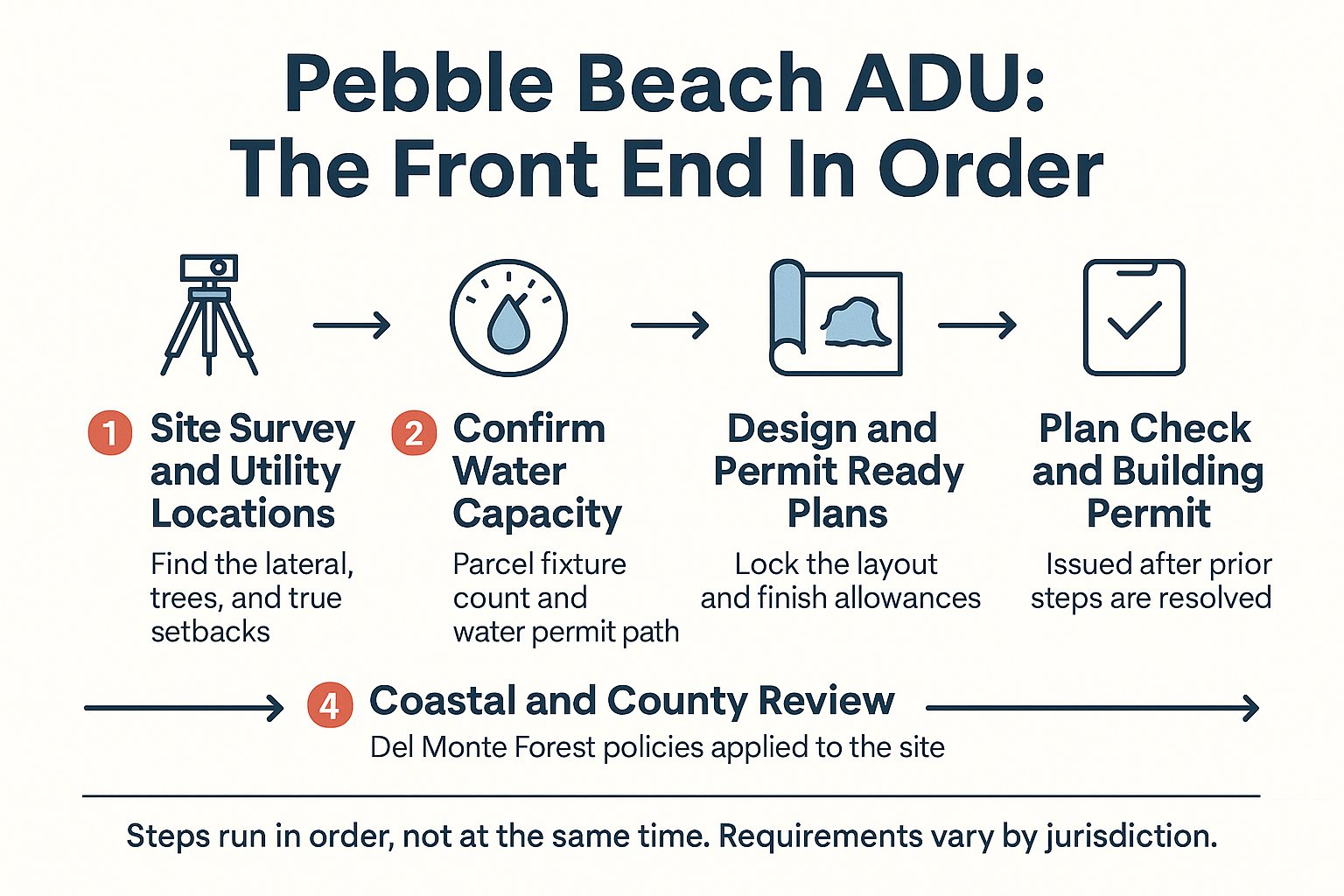
The Front End, In Order
This is the part that surprises people. The approval steps on a Pebble Beach ADU tend to run in sequence rather than side by side, which is why the front end is measured in planning steps rather than framing days.
What You Can Actually Do to Shorten the Timeline
You cannot compress a review agency’s queue. You can stop feeding it incomplete information, which is where most of the lost time comes from.
Three things move the needle:
- Get an accurate site survey and utility locations early. Guessing at where the sewer lateral runs is how a design gets redrawn twice.
- Confirm water availability before you finalize a floor plan. A fixture count that the parcel cannot support turns a finished plan into a redraw.
- Settle finish allowances during design, not mid build. Mid build selections are the single most common cause of budget drift I see.
On cost, I am not going to hand you a number for a lot I have not walked. What I can tell you is what drives the number in Pebble Beach, and it is not raw square footage.
The real drivers here are site access, tree constraints, utility and lateral routing, and design review time. Two identical 700 square foot units on two different Del Monte Forest lots can land in very different places because of those four items alone. A site specific consultation is the only honest way to get a real figure.
If you are still deciding whether the project pencils at all, what determines whether an ADU makes financial sense is a useful reality check before you commit to the permitting road.
Why Documentation Matters More Here Than Almost Anywhere Else
A site with this many approval layers rewards front loaded planning. Every unresolved detail becomes a delay that someone else controls.
That is why our pre-construction work starts with on site measurements, a digital scan, and permit ready plans, and why we work from realistic allowances with every finish and line item explained from day one rather than a lowball number that unravels in month three.
One homeowner in Monterey put it this way in a review: “The bid process was very transparent, with everything documented online.” That is the standard I want on a project where planning steps outnumber framing days.
One more time, because it matters: requirements vary by jurisdiction and change over time. Verify current rules with the Monterey County planning and building department, the water district, and the community services district before you draft anything.
Frequently Asked Questions About Pebble Beach ADU Requirements
Is Pebble Beach part of a city, or is it county jurisdiction?
It is unincorporated Monterey County, inside the Del Monte Forest area. There is no city building department to call. Your review path runs through county planning and building, with Del Monte Forest land use and coastal implementation policies layered on top.
Do I need a water permit before I can pull a building permit?
Generally yes when you are adding plumbing fixtures. The Monterey Peninsula Water Management District ties permits to the parcel’s fixture count, and that typically has to be resolved before a building permit is issued. Confirm the current process with the district for your specific parcel.
Does my ADU need a separate water submeter?
The district allows permanent submetering of water use into one ADU. An ADU built inside the existing space of the home or an existing accessory structure is exempt from that submetering requirement. Which category you fall into depends on how the unit is built.
Will I have to remove trees to fit an ADU?
Maybe, and that is the part to check early. Monterey pine and cypress are regulated in Del Monte Forest, so removing them or building close to them is not automatic. In practice the trees usually shape the footprint rather than the other way around, and the buildable area ends up smaller than the yard appears.
How long does the approval process take?
I will not give you a number I cannot back up. What I can say is that coastal review, county plan check, and the water permit tend to run in order rather than at the same time, so the front end is longer than most homeowners expect. An accurate survey and an early water answer are the two things that shorten it most.
Can I convert my existing garage instead of building new?
Often that is the more practical route on a constrained forest lot, since it avoids new footprint, new trenching, and tree conflicts. The trade off is that you give up the garage. I cover the specifics in the garage conversion article linked below.
Thinking Through an ADU on a Del Monte Forest Lot?
We handle residential projects across the Monterey Peninsula, including Pebble Beach, and the pre-construction side is where a site with this many approval layers gets sorted out. If you want a site specific look at what your parcel can support, you can reach the team at palaciosconstructionca.com or (831) 998-0046. CA General Contractors License #1071780 B, for readers who want to verify it.