

Direct Answer: A change order is a written, signed amendment to your contract that spells out added work, added cost, and schedule impact. In California, it must be in writing before the changed work begins.
The fear I hear most often is not about tile or cabinet doors. It is that the number a homeowner agreed to in the spring turns into a bigger number by summer, and nobody explained how it got there.
That fear keeps good projects from ever starting. So let me walk through what actually happens after demolition begins and something unexpected shows up in the wall.
This is not about reviewing a proposal before you sign or building a budget from scratch. This is about the middle of the job: who decides what happens next, what the paperwork has to say, and how a Monterey County homeowner keeps control of the number.
Why the Number Can Move Once the Walls Are Open
Monterey Peninsula housing stock is old, and it sits in salt air and fog. That combination produces a predictable set of finds.
Every month we get inquiries that describe them plainly. One homeowner in Salinas reached out about an existing family room addition and wrote that they “need to fix the foundation, remove a window, add insulation, and a few other issues.” Others have called about a closet that had to be rebuilt after water damage and mold remediation, a water-damaged section of a front wall at the basement level of a Pacific Grove home, and corrosion repair on a Pebble Beach property.
The common hidden conditions I see behind Peninsula walls and floors:
- Moisture and dry rot in sill plates, bottom plates, and around old window openings
- Undersized or notched framing from a remodel done decades ago without a permit
- Out-of-date wiring, including cloth-insulated conductors and ungrounded circuits
- Failed shower pans and rotted subfloor under a tub that looked fine on the surface
- Galvanized supply piping that turns to rust flakes the moment it gets disturbed
None of this should shock a contractor who works here. A good one plans for the possibility, budgets time to investigate, and tells you early instead of acting surprised on day three. If your home is from the 1950s or 1960s, remodeling a mid-century home in Monterey County comes with its own version of this list.

A Discovery and a Decision Are Two Different Things
Homeowners tend to lump all mid-project cost movement into one pile. Separating it into two piles makes the whole thing easier to manage.
A discovery is something the house did to you. Rot behind a shower pan, a cracked drain line under a slab, knob-and-tube found above a kitchen ceiling. Nobody chose it, and it has to be fixed before the finish work goes back on.
A decision is something you chose. Upgrading from a stock vanity to a custom one, swapping tile after the allowance was set, adding recessed lights that were not on the plan. Those are normal. Homeowners change their minds during construction, and I would rather they say so than live with something they do not like.
The reason the two get confused is allowances. When a proposal uses a lowball allowance for tile or cabinets or plumbing fixtures, a change order is guaranteed the moment you go shopping. That is not a discovery. That is a number that was never real.
We write proposals with realistic allowances and explain every finish and line item from day one. When allowances are honest, most of the money that moves mid-project comes from choices, not surprises, and you can see that clearly on paper. If you want the front end of that process, here is what a remodeling proposal should actually tell you before you sign.
What California Requires a Change Order to Say
Most homeowners do not know they have real protection here, so I will state it plainly.
In California, a home improvement contract has to be in writing and easy to understand, and so does any change to it. If the contract price changes, it takes a written change order that becomes part of the contract. The Contractors State License Board explains the requirements for home improvement contracts and changes to them.
A change order should describe:
- The added or deleted work, in enough detail that a stranger could read it and know what was done
- The added cost, broken out rather than dropped in as one lump number
- How it changes the payment schedule
- The effect on the completion date
And both parties should sign it before the changed work begins. Verbal approvals in a driveway and “we will settle up at the end” arrangements are exactly the situation this rule exists to prevent.
I am describing general requirements, not legal advice for your specific agreement. Confirm the details that apply to your contract with the state licensing board.
What to Look For on a Change Order Before You Sign It
This is the quick read I would do standing in my own kitchen before signing anything mid-project.
| Part of the document | What good looks like | Why it matters |
|---|---|---|
| Scope description | Names the specific work, location, and materials | Protects you if there is a dispute about what was covered |
| Cost breakdown | Labor, materials, and any sub costs shown as line items | A lump sum hides the math and makes it hard to compare |
| Schedule impact | Stated in days added, not ‘minimal delay’ | Delay is a cost too, especially if you are living elsewhere |
| Payment terms | Says when the added amount is due and how it shifts draws | Keeps you from getting surprised by an early invoice |
| Permit impact | Notes whether plans need revision or a new inspection | A revision can add weeks, not days |
| Signatures and date | Both parties, dated before work starts | This is the part California law cares about most |
How a Mid-Project Surprise Should Move Through the Process
Here is the sequence I follow when a crew opens something up and finds a condition nobody planned for.
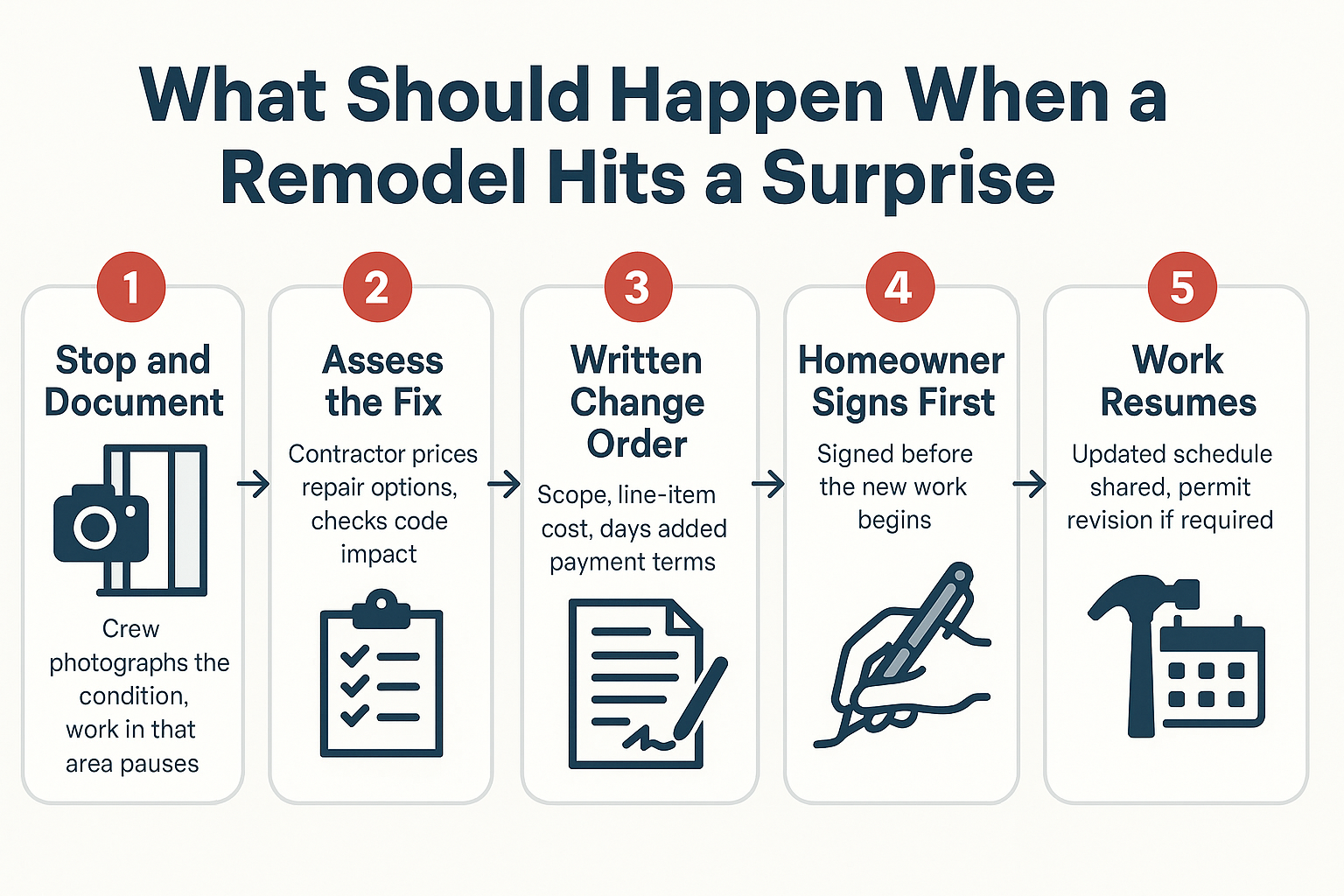
A Scope Change Can Send You Back to the Building Department
This is the part national articles cannot tell you. In Monterey County, a mid-project change is not always just a money conversation.
If the change alters what was approved, it can mean a revision to your permitted plans. In Monterey, Pacific Grove, and Carmel-by-the-Sea, that can also mean another pass through design review or a second look from the building department, depending on what changed and where the house sits.
Changes that commonly trigger a second review:
- Moving a wall that was shown on the approved drawings
- Adding or relocating plumbing fixtures
- Changing a window or door opening size on an exterior elevation
- Structural repairs to foundation, cripple walls, or framing
- Adding electrical load beyond what the panel schedule showed
On the Peninsula, plumbing changes carry an extra layer. Monterey Peninsula Water Management District requirements can come into play on top of the building permit when fixtures are added or relocated, which is the step homeowners most often miss. I wrote about that specifically in the water permit step before a bathroom remodel.
Requirements vary by jurisdiction. Before you assume a change is minor, verify with the building department serving your address. If you are unclear on who owns that task, here is who is responsible for permits on a remodeling project.
How to Keep Control Without Running the Job Yourself
You hired a general contractor so you would not have to manage a job site. You can still hold the line on cost with a few habits.
- Ask for change orders in line-item form. Labor, material, and sub costs separated. A lump sum is harder to question and harder to remember later.
- Ask what it does to the schedule in days. Not “a little delay.” A number.
- Set decision deadlines for long-lead selections. Tile, cabinets, windows, and custom glass all have lead times. A selection that drifts becomes the reason work stops, and stopped work costs money.
- Keep a written running total. Original contract, plus each signed change, equals where you actually are today.
On contingency: many homeowners and designers talk about holding back somewhere in the range of roughly 10 to 20 percent of the project budget, with the higher end for older houses. Treat that as general practice rather than a fixed rule. A 1920s Pacific Grove cottage deserves more cushion than a 2005 house in Marina.
And say this out loud to yourself before the job starts: changes you request are normal and expected, not a failure of planning.
What This Looks Like When It Is Handled Well
The projects that end well are not the ones without surprises. They are the ones where the cost conversation happened before the work proceeded instead of after.
That means documented pricing, a project manager who is on site checking in rather than only showing up at signing, and a written record you can hand to anyone. One homeowner in Pacific Grove put it this way in a review: “Throughout the project, Christian was communicative, transparent with costs, and always available to address any concerns or changes we wanted to make.”
That is the standard worth holding any contractor to, whoever you hire.
Frequently Asked Questions About Remodel Change Orders
Can a contractor charge me for extra work without a signed change order?
In California, a change to a home improvement contract price is supposed to be in writing and part of the contract. Verbal approvals and end-of-job reconciliations are exactly what that rule was written to prevent. If someone asks you to approve a cost by text or a handshake, ask for it on paper first, and confirm your own contract details with the state licensing board.
How much should I set aside for unexpected costs on an older Monterey home?
Many homeowners and designers plan for roughly 10 to 20 percent of the project budget as contingency, with older homes on the higher end. That is general practice, not a rule, and the right number depends on the age of the house, whether prior work was permitted, and how much of the structure gets opened up. A walkthrough of your specific property is the only way to get a real figure.
Does a change order always delay the project?
Not always. Swapping a faucet model may cost nothing in time. Rebuilding a rotted sill plate or adding a plumbing fixture can add days or weeks, especially if the plans need a revision or a new inspection. Ask for the schedule impact in days on every change order so you are never guessing.
What if I disagree with a change order price?
Say so before you sign, because signing is the approval. Ask for the breakdown behind the number, ask whether there is a less expensive way to solve the same condition, and ask what happens if you decline. Some discoveries have to be fixed for the work to pass inspection. Others genuinely have options.
Who pays when the contractor makes a mistake?
A mistake is not a change order. If something was installed wrong, measured wrong, or missed in a scope that clearly included it, that is on the contractor to correct. A change order is for work that was genuinely outside the agreed scope, whether the house revealed it or you requested it.
Thinking through the budget side of a Monterey County remodel?
If you are weighing a project on the Peninsula and want to talk through scope, realistic allowances, and how changes get handled once the walls are open, Palacios Construction is available for those conversations at palaciosconstructionca.com or (831) 220-3334. No pressure and no timeline attached to it.